
In recent years, the automotive industry has witnessed a significant shift towards electric vehicles, particularly electric SUV models, due to their environmental benefits and growing consumer demand. However, the lightweight design requirements for electric SUVs pose unique challenges in ensuring crash safety, especially in low-speed collisions. This study focuses on the crashworthiness of aluminum alloy energy-absorbing boxes in electric SUVs under the Research Council for Automobile Repairs (RCAR) low-speed collision protocols. The energy-absorbing box, located between the front bumper and longitudinal beams, plays a critical role in absorbing impact energy and minimizing damage to key components like the fan and radiator, thereby reducing repair costs. Through finite element simulation and optimization, we aim to enhance the crash performance of these components, ensuring they meet RCAR standards while maintaining the lightweight characteristics essential for electric SUVs.
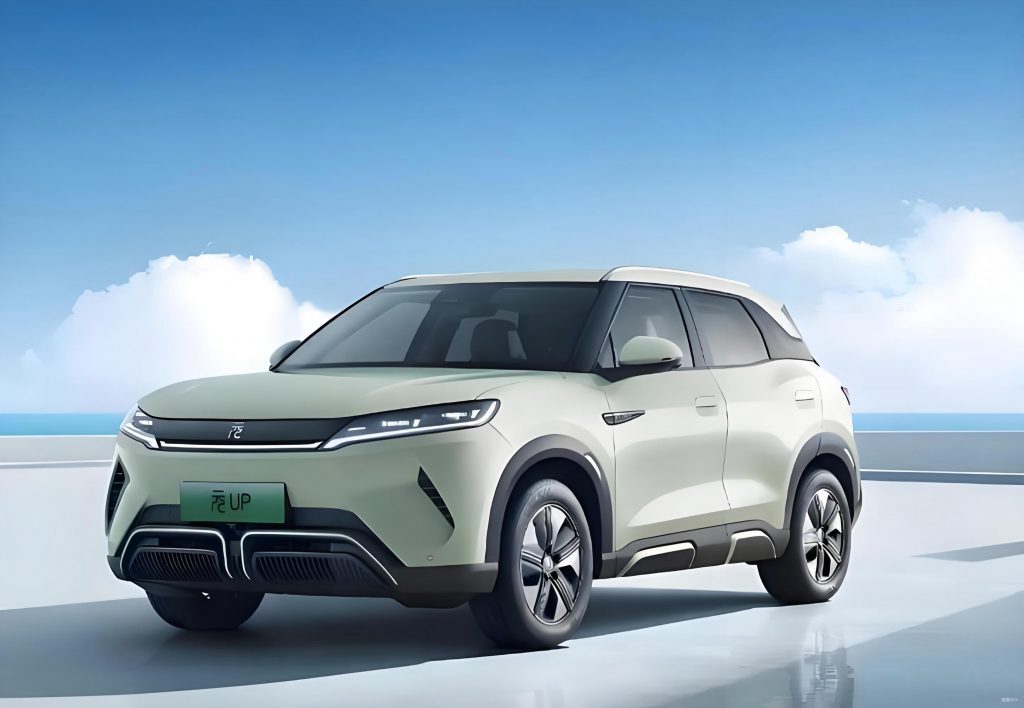
The finite element model of the electric SUV was developed using ANSA software, incorporating detailed geometric and material parameters to simulate a low-speed frontal structural collision. The model consisted of 795 components, 359,921 solid elements, and 2,592,836 shell elements, with a total mass of 1,753 kg and a wheelbase of 2,675 mm, accurately reflecting real-world specifications. According to RCAR test requirements, the collision parameters were set as follows: impact velocity of 16 km/h (4,444.44 mm/s), simulation time of 0.15 s, and gravitational acceleration of 9.81 m/s². LS-DYNA software was employed for the computational analysis. Energy conservation was verified during the simulation, with kinetic energy decreasing and internal energy increasing smoothly, while the hourglass energy ratio remained below 1%, confirming model validity.
To evaluate the crashworthiness of the energy-absorbing box in the electric SUV, we defined several key performance indicators. The total energy absorption, \( E_\alpha \), represents the energy absorbed through deformation and is given by the integral of force over displacement: $$E_\alpha = \int_0^\delta p \, d\delta$$ where \( p \) is the collision force and \( \delta \) is the deformation. The specific energy absorption, \( ESEA \), measures energy absorption per unit mass: $$ESEA = \frac{E_\alpha}{M_S}$$ with \( M_S \) being the mass of the energy-absorbing box. Compression displacement, \( \delta \), indicates the extent of deformation, where smaller values suggest less damage to adjacent components. The peak collision force, \( F_p \), typically occurs during initial buckling, and the average impact force, \( F_m \), is calculated as: $$F_m = \frac{E_\alpha}{\delta}$$ Higher \( F_m \) values, within permissible force limits, denote better energy absorption efficiency. These metrics collectively assess the crashworthiness of the energy-absorbing box in electric SUVs, guiding optimization efforts.
Initial simulation results for the electric SUV revealed poor crashworthiness in the aluminum alloy energy-absorbing box. The deformation pattern showed asymmetric folding, initiating from the root near the longitudinal beam, which is undesirable as it leads to uncontrolled deformation and reduced energy absorption. The compression displacement reached 128.3 mm, exceeding the 110 mm limit that prevents fan damage, indicating a high risk of component failure. Energy absorption analysis showed that the left-side energy-absorbing box absorbed 6.520 kJ, accounting for 44.52% of the total system energy absorption of 14.644 kJ. While this demonstrates significant energy dissipation, the peak collision force was 104,250 N, which is relatively high and could transmit excessive forces to the vehicle structure. These findings highlight the need for design improvements to enhance the crash performance of electric SUVs in low-speed collisions.
Based on the initial analysis, we proposed four optimization schemes for the energy-absorbing box in the electric SUV, adhering to principles such as ensuring the box deforms before the longitudinal beams, achieving stable axial crushing, and minimizing peak forces. Scheme 1 involved changing the material from 6005A aluminum alloy to 6082 aluminum alloy, which has higher yield strength. Scheme 2 increased the wall thickness from 3 mm to 3.2 mm. Scheme 3 added a 2 mm thick horizontal rib at the rear end, 70 mm in length, while Scheme 4 incorporated a 2 mm thick vertical rib of the same length. All schemes included two induction grooves at the front to guide deformation. The material properties for the aluminum alloys are summarized in Table 1.
| Material | Density (t/mm³) | Yield Strength (MPa) | Tensile Strength (MPa) | Poisson’s Ratio |
|---|---|---|---|---|
| 6005A | 2.70E-09 | 215 | 255 | 0.34 |
| 6082 | 2.70E-09 | 280 | 315 | 0.34 |
Simulation of the optimized schemes for the electric SUV provided comparative data on deformation, energy absorption, compression displacement, and force characteristics. In terms of deformation, Scheme 4 exhibited the most desirable symmetric folding pattern, with progressive crushing from the impact end, whereas Schemes 1-3 showed asymmetric folding. Energy absorption curves indicated that Scheme 4 achieved the highest total energy absorption of 7.2931 kJ, compared to 6.1204 kJ for Scheme 1, 6.0890 kJ for Scheme 2, and 4.9559 kJ for Scheme 3. Compression displacements were 106.47 mm, 117.41 mm, 103.06 mm, and 111.80 mm for Schemes 1-4, respectively, with Schemes 1 and 3 staying within the 110 mm limit. Peak collision forces were lowest for Scheme 2 (102,220 N) and Scheme 4 (103,110 N), reducing the risk of structural damage. A quantitative comparison of crashworthiness indicators is presented in Table 2, using the formulas defined earlier.
| Scheme | Total Energy Absorption \( E_\alpha \) (mJ) | Compression Displacement \( \delta \) (mm) | Specific Energy Absorption \( ESEA \) (J/kg) | Peak Collision Force \( F_p \) (N) | Average Impact Force \( F_m \) (N) |
|---|---|---|---|---|---|
| 1 | 6,120,400 | 106.47 | 12,363.63 | 115,690 | 57,484.74 |
| 2 | 6,089,000 | 117.41 | 11,664.75 | 102,220 | 51,860.99 |
| 3 | 4,955,900 | 103.06 | 9,475.91 | 129,130 | 48,087.52 |
| 4 | 7,293,100 | 111.80 | 13,891.62 | 103,110 | 65,656.28 |
Further analysis compared the optimal Scheme 4 with the initial model for the electric SUV. As shown in Table 3, Scheme 4 demonstrated superior crashworthiness, with a 773,300 mJ increase in total energy absorption, a 16.5 mm reduction in compression displacement, a 903.87 J/kg rise in specific energy absorption, a 1,140 N decrease in peak collision force, and a 14,839.45 N increase in average impact force. These improvements highlight the effectiveness of the vertical rib design in enhancing energy dissipation and controlling deformation. The symmetric folding mode in Scheme 4 ensures stable crushing, which better protects the fan and reduces repair costs, aligning with RCAR requirements for electric SUVs.
| Model | Total Energy Absorption \( E_\alpha \) (mJ) | Compression Displacement \( \delta \) (mm) | Specific Energy Absorption \( ESEA \) (J/kg) | Peak Collision Force \( F_p \) (N) | Average Impact Force \( F_m \) (N) |
|---|---|---|---|---|---|
| Initial | 6,519,800 | 128.3 | 12,987.65 | 104,250 | 50,816.83 |
| Optimal (Scheme 4) | 7,293,100 | 111.80 | 13,891.62 | 103,110 | 65,656.28 |
In conclusion, this study underscores the importance of optimizing energy-absorbing boxes for electric SUVs to meet RCAR low-speed collision standards. The initial design exhibited inadequate crashworthiness, with excessive deformation and high peak forces. Among the four optimization schemes, Scheme 4, featuring a vertical rib and induction grooves, proved most effective, achieving symmetric folding deformation, improved energy absorption, and reduced compression displacement. The quantitative analysis confirms that Scheme 4 enhances crashworthiness metrics significantly, making it a viable solution for electric SUVs. Future work could explore additional materials or structural variations to further optimize performance, ensuring that electric SUVs remain safe and cost-effective in low-impact scenarios.