
In recent years, the rapid growth of the electric vehicle (EV) industry has underscored the critical importance of standardizing repair technologies for power batteries, which are core components of EVs. As a researcher in this field, I have observed that the lack of a unified standard system for EV repair, particularly for electric car repair involving power batteries, poses significant challenges to safety, quality, and industry development. This article explores the necessity of reconstructing the standard system for electric vehicle battery repair technology, analyzing existing issues and proposing strategies to enhance EV repair processes. Through this work, I aim to provide a comprehensive framework that addresses the complexities of electric vehicle repair, ensuring higher reliability and efficiency in maintenance operations.
The standardization of EV repair is fundamental to ensuring the safety and longevity of electric vehicles. Power batteries, with their intricate electrical and thermal management systems, require precise repair protocols to prevent hazards such as overheating or short circuits. In my analysis, I have found that a well-defined standard system for electric car repair can streamline operations, reduce costs, and protect consumer interests. For instance, standardized procedures in EV repair help technicians accurately diagnose faults and apply consistent quality controls, thereby minimizing risks. Moreover, as the electric vehicle market expands, a robust standard framework for electric vehicle repair will facilitate regulatory oversight and promote sustainable industry growth. This article delves into the current shortcomings and outlines a reconstructed approach, incorporating tables and formulas to summarize key aspects of EV repair standardization.
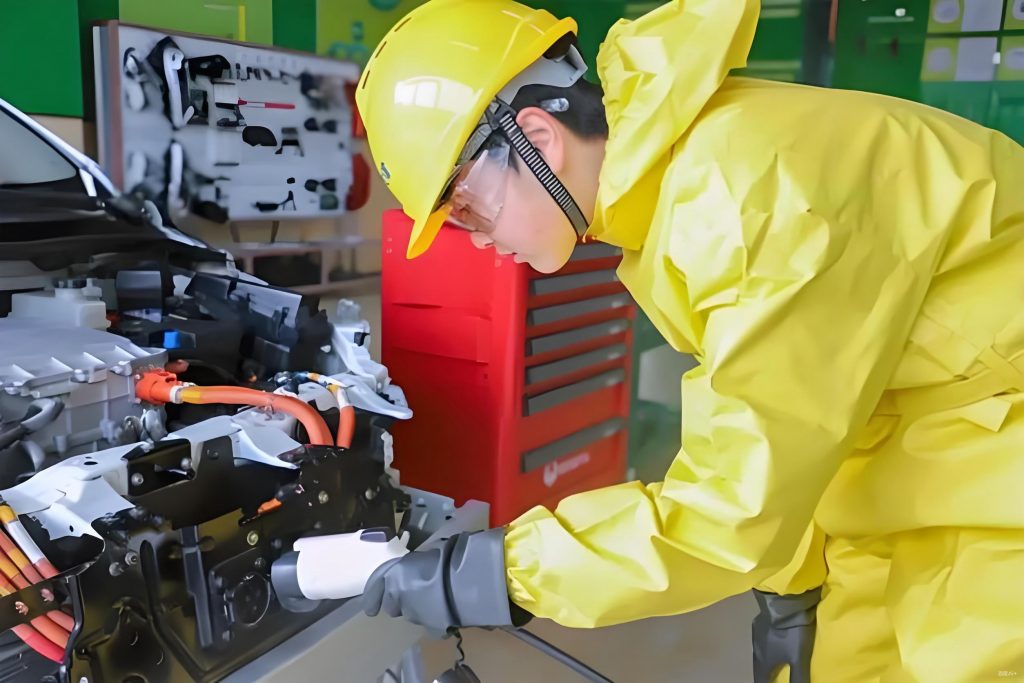
One of the primary reasons for focusing on EV repair standardization is the increasing complexity of power battery technologies. As I have studied various cases, it becomes evident that electric car repair involves multiple disciplines, including electrical engineering, chemistry, and control systems. Without standardized guidelines, EV repair practices can vary widely, leading to inconsistent outcomes. For example, in electric vehicle repair, the diagnosis of battery faults often relies on subjective judgments, which can compromise safety. To address this, I propose that standardizing EV repair processes should include mathematical models to predict battery behavior. Consider a formula for battery degradation: $$ D(t) = D_0 \cdot e^{-\lambda t} $$ where \( D(t) \) represents the degradation level at time \( t \), \( D_0 \) is the initial degradation, and \( \lambda \) is a decay constant specific to the battery type. Such formulas can guide EV repair technicians in assessing battery health and planning maintenance, thereby enhancing the reliability of electric car repair.
However, the current standard system for EV repair faces several critical issues that hinder its effectiveness. In my research, I have identified that the existing frameworks are often outdated and fail to cover emerging technologies. For instance, in electric vehicle repair, new battery materials like solid-state cells lack specific standards, leading to ad-hoc approaches that increase risks. The table below summarizes the key problems in the EV repair standard system based on my findings:
| Issue Category | Description | Impact on EV Repair |
|---|---|---|
| Standard Lag | Slow updates compared to technological advancements in electric car repair. | Inconsistent repair quality and increased safety hazards in EV repair. |
| Incomplete Safety Coverage | Gaps in safety protocols for high-voltage operations in electric vehicle repair. | Higher risk of accidents during EV repair procedures. |
| Lack of Emergency Guidelines | Absence of detailed应急 response steps for battery failures in electric car repair. | Delayed and ineffective handling of incidents in EV repair. |
As illustrated, these issues directly affect the efficiency and safety of electric vehicle repair. For example, in EV repair, the absence of standardized emergency procedures can lead to prolonged downtime and potential harm. To quantify this, I often use a risk assessment formula: $$ R = P \times S $$ where \( R \) is the risk level, \( P \) is the probability of failure, and \( S \) is the severity of consequences. In the context of electric car repair, this highlights the need for comprehensive standards to mitigate risks. Furthermore, my observations indicate that the fragmentation in EV repair standards results in higher costs for training and equipment, underscoring the urgency for reconstruction.
To overcome these challenges, I propose a reconstructed standard system for EV repair that emphasizes a hierarchical framework and enhanced safety measures. This approach is designed to address the multifaceted nature of electric vehicle repair, ensuring that standards are both comprehensive and adaptable. The hierarchical framework consists of three levels: top-level general standards, mid-level specific technical standards, and bottom-level customized standards for particular EV models or repair scenarios. In my view, this structure can streamline electric car repair processes by providing clear guidelines at each stage. For instance, top-level standards for EV repair might include universal safety protocols, such as the use of insulated tools, which can be represented by a formula for electrical safety: $$ V_{max} = I \times R $$ where \( V_{max} \) is the maximum safe voltage, \( I \) is the current, and \( R \) is the resistance. This ensures that during electric vehicle repair, technicians adhere to safe operating limits.
The mid-level standards in this EV repair framework should focus on specific battery types, such as lithium-ion or nickel-metal hydride cells. Based on my analysis, these standards need to incorporate detailed technical specifications to guide electric car repair procedures. For example, a table can summarize the recommended repair parameters for different battery chemistries in EV repair:
| Battery Type | Recommended Voltage Range for EV Repair (V) | Temperature Limits (°C) | Common Faults in Electric Vehicle Repair |
|---|---|---|---|
| Lithium-ion | 3.0 – 4.2 | -20 to 60 | Overheating, capacity loss |
| Nickel-metal hydride | 1.2 – 1.5 | -10 to 50 | Memory effect, leakage |
| Solid-state | 2.5 – 4.0 | -30 to 80 | Interface issues, cracking |
This table aids electric vehicle repair technicians in making informed decisions, thereby improving the accuracy and safety of EV repair operations. Additionally, I suggest using formulas to model battery performance during repair, such as the state of charge (SOC) estimation: $$ SOC = \frac{Q_{remaining}}{Q_{max}} \times 100\% $$ where \( Q_{remaining} \) is the remaining capacity and \( Q_{max} \) is the maximum capacity. In electric car repair, this helps in diagnosing issues and ensuring proper recalibration.
Another crucial aspect of the reconstructed standard system for EV repair is the enhancement of safety protocols. From my experience, electric vehicle repair involves inherent risks, such as thermal runaway or chemical exposure, which require stringent standards. I recommend developing a comprehensive safety framework that covers the entire repair lifecycle, from disassembly to reassembly. For instance, in EV repair, the risk of fire can be mitigated by implementing standards for thermal management, which can be expressed using a heat dissipation formula: $$ Q = h \cdot A \cdot \Delta T $$ where \( Q \) is the heat transfer rate, \( h \) is the heat transfer coefficient, \( A \) is the surface area, and \( \Delta T \) is the temperature difference. This formula guides the design of safe workshops for electric car repair, ensuring adequate ventilation and cooling systems.
Moreover, emergency response standards in EV repair must be detailed and actionable. In my proposed system, I include step-by-step procedures for incidents like battery leaks or short circuits during electric vehicle repair. These can be summarized in a table for quick reference:
| Emergency Scenario in EV Repair | Immediate Actions | Long-term Measures |
|---|---|---|
| Battery Thermal Runaway | Activate cooling systems, evacuate area | Review repair protocols, update training |
| Electrolyte Leakage | Contain spill, use neutralizers | Inspect storage conditions, enhance PPE |
| High-Voltage Shock | Cut power, administer first aid | Audit equipment safety, implement checks |
By integrating such tables into the standard system for electric car repair, we can ensure that EV repair technicians are well-prepared for emergencies, reducing downtime and enhancing overall safety. Furthermore, I advocate for the use of predictive models in EV repair, such as a reliability function: $$ R(t) = e^{-\int_0^t \lambda(\tau) d\tau} $$ where \( R(t) \) is the reliability over time, and \( \lambda(\tau) \) is the failure rate. This helps in scheduling preventive maintenance in electric vehicle repair, thereby prolonging battery life.
In implementing this reconstructed standard system for EV repair, it is essential to consider the dynamic nature of the electric vehicle industry. As I have noted, technologies evolve rapidly, and standards for electric car repair must be regularly updated to remain relevant. For example, the advent of fast-charging technologies requires new guidelines for EV repair to address increased wear and tear. A formula for charging cycle impact can be useful: $$ C_{deg} = k \cdot N^m $$ where \( C_{deg} \) is the capacity degradation, \( N \) is the number of cycles, and \( k \) and \( m \) are constants derived from empirical data. Incorporating such formulas into electric vehicle repair standards ensures that technicians can adapt to new challenges.
Additionally, the economic aspects of EV repair cannot be overlooked. Standardization can lead to cost savings by reducing trial-and-error approaches in electric car repair. I propose a cost-benefit analysis model for implementing EV repair standards: $$ B/C = \frac{\sum Benefits}{\sum Costs} $$ where a ratio greater than 1 indicates that the benefits outweigh the costs. For instance, standardized training programs for electric vehicle repair can lower accident rates and insurance premiums, making EV repair more affordable and accessible.
Looking ahead, the reconstruction of the standard system for EV repair will require collaboration among stakeholders, including manufacturers, regulators, and repair technicians. In my vision, this collaborative approach will foster innovation in electric car repair while maintaining high safety standards. For example, digital tools like augmented reality can be integrated into EV repair training, guided by standardized protocols. A formula for skill acquisition in electric vehicle repair could be: $$ S = S_0 + \alpha \cdot T $$ where \( S \) is the skill level, \( S_0 \) is the initial skill, \( \alpha \) is the learning rate, and \( T \) is training time. This emphasizes the importance of continuous education in EV repair.
In conclusion, the reconstruction of the standard system for electric vehicle battery repair technology is a vital endeavor that I believe will transform the EV repair landscape. By addressing current gaps and incorporating hierarchical frameworks, safety enhancements, and mathematical models, we can elevate electric car repair to new levels of efficiency and reliability. As the electric vehicle market continues to grow, this standardized approach to EV repair will not only safeguard users but also drive sustainable industry progress. Through ongoing refinement and adaptation, the future of electric vehicle repair looks promising, with standards that keep pace with technological advancements.
To further illustrate the proposed hierarchical framework for EV repair, I include a summary table that outlines the key components at each level:
| Level | Focus Areas in EV Repair | Examples of Standards | Application in Electric Vehicle Repair |
|---|---|---|---|
| Top-Level | General safety and operational guidelines | Basic disassembly procedures, universal tool specifications | Ensures consistency across all EV repair operations |
| Mid-Level | Battery-specific technical standards | Voltage thresholds, temperature controls for specific chemistries | Tailors electric car repair to battery types, improving accuracy |
| Bottom-Level | Customized standards for models or brands | Proprietary software interfaces, model-specific fault codes | Enhances precision in EV repair for unique vehicle designs |
This table serves as a practical guide for implementing the reconstructed standard system in electric vehicle repair. Furthermore, I emphasize the role of formulas in optimizing EV repair processes, such as a performance index for repair quality: $$ PI = \frac{Q_{actual}}{Q_{target}} \times 100\% $$ where \( PI \) is the performance index, \( Q_{actual} \) is the achieved quality, and \( Q_{target} \) is the desired quality. By monitoring this index, electric car repair facilities can continuously improve their services.
In summary, my proposed reconstruction of the EV repair standard system aims to create a robust, adaptable framework that addresses the complexities of electric vehicle repair. Through the integration of tables, formulas, and hierarchical structures, we can achieve a higher standard of safety and efficiency in EV repair, ultimately supporting the growth of the electric vehicle industry. As I continue to research and refine these ideas, I am confident that this approach will lead to significant advancements in electric car repair practices worldwide.