
In my extensive experience with EV repair, I have observed that electric vehicles (EVs) have become a dominant force in the automotive market. As a critical component of these vehicles, the brake system is paramount for ensuring driving safety. Unlike traditional internal combustion engine vehicles, EVs not only retain conventional friction braking but also incorporate regenerative braking technology, resulting in a more complex system prone to potential failures. Therefore, gaining a deep understanding of common faults in EV brake systems and effective repair strategies is essential for enhancing vehicle safety and reliability. This article delves into the intricacies of electrical car repair, focusing on brake system diagnostics and maintenance, utilizing data-driven approaches, formulas, and tables to provide a comprehensive guide.
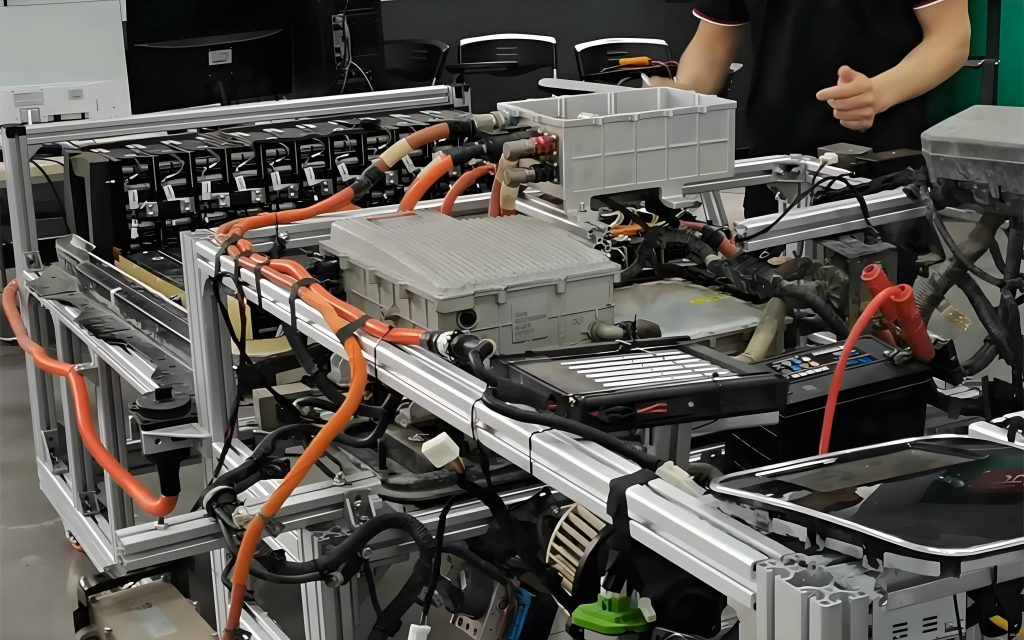
As an expert in EV repair, I have identified several common fault types in electric vehicle brake systems. These can be broadly categorized into electrical system faults, mechanical system faults, hydraulic and pneumatic system faults, and regenerative braking system faults. Each category presents unique challenges that require specialized knowledge in electrical car repair. For instance, electrical system faults often stem from issues with the battery management system (BMS), motor controller, wiring harness connections, and sensor signals. These can lead to severe consequences like brake failure or vehicle deviation, directly threatening safety. In my practice, I have found that using diagnostic tools and formulas helps in accurately pinpointing these issues. For example, the relationship between braking distance and vehicle speed can be expressed using the kinematic equation: $$ s = \frac{v^2}{2a} $$ where \( s \) is the braking distance, \( v \) is the initial velocity, and \( a \) is the deceleration. This formula is crucial in EV repair for assessing braking performance under different conditions.
To better illustrate common electrical system faults, I have compiled a table based on real-world cases in electrical car repair. This table summarizes key symptoms, potential causes, and recommended diagnostic actions.
| Fault Type | Symptoms | Potential Causes | Diagnostic Actions in EV Repair |
|---|---|---|---|
| Battery Management System (BMS) Fault | Reduced regenerative braking efficiency, intermittent power loss | Battery cell imbalance, software glitches | Check voltage and current outputs using multimeters; analyze BMS logs |
| Motor Controller Fault | Unstable brake torque, loss of braking ability | Internal circuit short, software anomalies | Use oscilloscopes to monitor signal waveforms; verify controller firmware |
| Wiring Harness Issues | Brake signal delays, false alerts | Loose connections, aging insulation | Perform continuity tests; inspect for corrosion or damage |
| Sensor Malfunctions (e.g., wheel speed sensors) | ABS or ESP system failures, unstable braking | Sensor precision loss, contamination | Measure output frequency and compare to theoretical values; calibrate as needed |
In electrical car repair, mechanical system faults are equally prevalent and often manifest as brake disc wear, pad aging, caliper sticking, or brake fluid leaks. These issues can cause noise, vibrations, and reduced braking performance, increasing accident risks. From my perspective in EV repair, regular inspections are vital. For instance, brake disc wear beyond 0.7 mm, as per industry standards, necessitates replacement to maintain optimal braking force. The wear rate can be modeled using the formula: $$ w = k \cdot d \cdot t $$ where \( w \) is wear depth, \( k \) is a material constant, \( d \) is distance traveled, and \( t \) is time. This equation helps in predicting maintenance schedules for EVs, a key aspect of proactive electrical car repair.
Hydraulic and pneumatic brake system faults in EVs involve issues like insufficient brake pressure, fluid contamination, or air path blockages. These can lead to uneven tire wear and higher maintenance costs. In my EV repair practice, I emphasize the importance of fluid quality. For example, brake fluid should have a water content below 3% to prevent boiling and vapor lock. The pressure in hydraulic systems can be described by Pascal’s principle: $$ P = \frac{F}{A} $$ where \( P \) is pressure, \( F \) is force applied, and \( A \) is area. This principle is fundamental in diagnosing pressure-related faults during electrical car repair. For pneumatic systems in commercial EVs, faults in compressors or air tanks require specialized tests to ensure proper airflow and pressure buildup.
Regenerative braking system faults are unique to EVs and often involve reduced energy recovery efficiency or instability. As part of EV repair, I have seen that these faults stem from motor controller策略不当 or battery management issues. The energy recovery efficiency \( \eta \) can be calculated as: $$ \eta = \frac{E_{\text{recovered}}}{E_{\text{kinetic}}} \times 100\% $$ where \( E_{\text{recovered}} \) is the energy stored in the battery and \( E_{\text{kinetic}} \) is the kinetic energy of the vehicle. Optimizing this efficiency is a core goal in electrical car repair, as it directly impacts vehicle range and braking smoothness.
Moving on to fault diagnosis steps in EV repair, I follow a structured approach beginning with preliminary diagnosis and symptom collection. For example, if a customer reports increased braking distance, I first assess pedal travel and vehicle response. Based on standards, a pure EV at 60 km/h should have a braking distance of 15–20 m. If deviations occur, I check for issues like hydraulic pressure loss or sensor faults. This initial phase is critical in electrical car repair to narrow down potential causes.
The next step involves in-depth analysis and system testing. In hydraulic systems, I use pressure gauges to measure output from the master cylinder. Under normal conditions, pedal travel of one-third should yield about 40% of the rated pressure. Deviations indicate seal wear or fluid leaks. For electrical systems, I employ tools like oscilloscopes to analyze motor controller signals. A table below summarizes key diagnostic parameters and tolerances used in EV repair.
| System Component | Diagnostic Parameter | Standard Value | Tolerance |
|---|---|---|---|
| Brake Master Cylinder | Pressure Output | Varies by model (e.g., 100 bar) | ±5% |
| Wheel Speed Sensor | Output Frequency | Theoretical frequency based on speed | ±1% for accurate ABS function |
| Motor Controller | Signal Waveform | Stable amplitude and frequency | No significant distortion |
| Brake Fluid | Water Content | < 3% | N/A |
Specialized testing and fault simulation are essential in EV repair for replicating real-world conditions. I conduct tests at various speeds (e.g., 30, 60, 90 km/h) in controlled environments, recording data on braking distance, deceleration, and system parameters. The deceleration \( a \) can be derived from velocity change over time: $$ a = \frac{\Delta v}{\Delta t} $$ This data helps identify anomalies, such as overheating brakes or inconsistent regenerative braking, which are common in electrical car repair scenarios.
For repair strategies in EV repair, component replacement and repair are fundamental. When brake pads wear below 2 mm or discs exceed thickness limits, I replace them with OEM parts to ensure compatibility. In cases of motor controller faults, I follow technical manuals to replace damaged components like power transistors. The reliability of these components can be modeled using the failure rate formula: $$ \lambda(t) = \lambda_0 e^{-\beta t} $$ where \( \lambda(t) \) is the failure rate at time \( t \), \( \lambda_0 \) is the initial rate, and \( \beta \) is a decay constant. This aids in predictive maintenance for electrical car repair.
System adjustment and optimization are crucial in EV repair to enhance coordination between regenerative and friction braking. I often recalibrate sensors to within ±1% error, as per SAE J211 standards, and adjust brake pedal feel by modifying vacuum booster parameters. Additionally, selecting high-boiling-point brake fluid prevents vapor lock. For pneumatic systems in commercial EVs, I recommend regular checks on compressors and dryers to maintain efficiency. A table of optimization measures is provided below.
| Optimization Area | Action | Expected Outcome |
|---|---|---|
| Regenerative Braking Ratio | Increase in urban driving | Energy recovery rate > 30% |
| Sensor Calibration | Adjust wheel speed sensors | Error within ±1% |
| Brake Fluid Upgrade | Use low-hygroscopic fluid | Reduced risk of vapor lock |
| Pneumatic System Maintenance | Clean air paths and check valves | Stable pressure output |
Regular maintenance and inspection are proactive strategies in EV repair to prevent faults. I advise checking electrical systems every 10,000 km or six months, mechanical components during each service, and hydraulic fluids every 40,000 km or two years. The maintenance interval \( I \) can be optimized using: $$ I = \frac{L}{\lambda} $$ where \( L \) is the component lifespan and \( \lambda \) is the average failure rate. This formula helps schedule inspections for electrical car repair, reducing downtime.
Proper use of the brake system by drivers is also a key aspect of EV repair education. I encourage avoiding abrupt stops and blending regenerative with friction braking on descents. For instance, in low-speed scenarios, pedal travel should not exceed one-third of the total to minimize wear. Educating users on these practices extends system life and enhances safety, a core principle in electrical car repair.
In conclusion, through my work in EV repair, I have found that electric vehicle brake systems are susceptible to diverse faults, but with systematic diagnosis and tailored repair strategies, these can be effectively managed. Future advancements should focus on improving system robustness and diagnostic technologies to support the growing EV industry. As the demand for electrical car repair rises, continuous learning and adaptation will be essential for ensuring safe and reliable transportation.