
The rapid evolution of the electric car industry has fundamentally reshaped automotive manufacturing, pushing manufacturers toward innovative solutions that address the unique challenges of electric vehicle (EV) production. As a key player in this field, I have witnessed firsthand how the shift away from internal combustion engines demands more efficient, compact, and lightweight transmission systems. The electric car market, particularly in regions like China EV, is highly competitive and diverse, with both large corporations and smaller firms vying for dominance. However, producing transmissions for electric cars presents significant hurdles, such as noise reduction and precision machining, which traditional manufacturing methods struggle to meet. In this article, I will explore how advanced techniques like power skiving are revolutionizing the production of EV transmissions, offering substantial improvements in flexibility, cost, and efficiency. By incorporating tables and formulas, I aim to provide a comprehensive analysis that underscores the critical role of modern metalworking in the electric car era.
Electric car transmissions, often designed as planetary gear systems, require components like ring gears that are compact, lightweight, and low-noise. The ring gear, with its thin walls and high roundness demands, is one of the most challenging parts to manufacture. Traditional cutting methods, which rely on dedicated equipment and multiple setups, often lead to issues with coaxiality and eccentricity tolerances. Moreover, these processes involve high costs, long cycle times, and the use of cooling lubricants, making them less suitable for the fast-paced electric car industry. In contrast, power skiving—a technique that combines hobbing and shaping—offers a more integrated approach. For instance, in the China EV market, where demand for efficient production is soaring, power skiving enables manufacturers to reduce processing steps and achieve higher precision. This method not only cuts down on machining time by up to 90% but also enhances tool life, as demonstrated by tools like the Coro Mill series. As I delve deeper, I will use empirical data and theoretical models to illustrate why power skiving is pivotal for the future of electric car manufacturing.
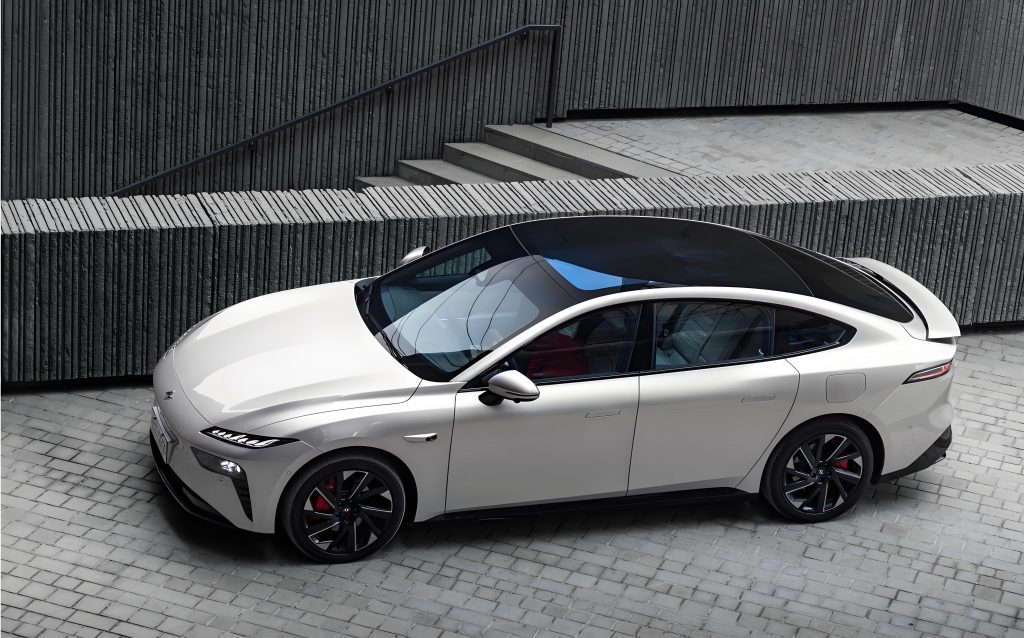
In the context of electric car production, the transmission system’s efficiency is paramount. A planetary gear reducer, commonly used in electric cars, consists of a sun gear, planet gears, and a ring gear housed within a lightweight structure. The ring gear, in particular, must exhibit minimal noise due to the absence of engine sounds in electric cars, allowing drivers to perceive even slight irregularities. Mathematically, the noise level can be related to the gear’s precision through equations involving surface finish and tolerances. For example, the sound pressure level \( L_p \) in decibels can be modeled as: $$ L_p = 10 \log_{10}\left( \frac{p^2}{p_0^2} \right) $$ where \( p \) is the sound pressure and \( p_0 \) is the reference pressure. In electric car applications, reducing \( L_p \) requires tight control over gear geometry, which power skiving achieves by minimizing deviations in tooth profiles. This is especially critical in the China EV sector, where consumer expectations for quiet operation are high. Additionally, the compact design of these transmissions aligns with the need for weight reduction in electric cars, as lighter vehicles offer better energy efficiency and range.
Traditional machining methods for ring gears involve multiple dedicated machines, leading to a lack of flexibility and increased production times. Each machine has a specific processing range, forcing workpieces to undergo sequential operations across different stations. This “process route” approach not only complicates logistics but also introduces errors due to repeated clamping. For instance, the cumulative tolerance stack-up can be expressed as: $$ \Delta T = \sqrt{\sum_{i=1}^{n} \delta_i^2} $$ where \( \Delta T \) is the total tolerance deviation and \( \delta_i \) represents individual tolerances from each setup. In electric car manufacturing, such deviations can compromise the transmission’s performance, resulting in noise and inefficiency. Moreover, post-machining heat treatment becomes harder to control, and processes like gear grinding add to the cost. The use of cooling lubricants in these methods further complicates environmental and economic factors. As the electric car industry expands, particularly in China EV markets, these drawbacks highlight the urgency for advanced solutions like power skiving, which consolidates operations into a single, flexible machine.
Power skiving, developed over a century ago, has emerged as a game-changer for electric car transmission production. This technique integrates hobbing and shaping into a continuous cutting process, allowing for the efficient machining of both internal and external gears. The advantages are multifold: it reduces the number of machining steps, shortens cycle times, and improves product quality. For example, in a typical electric car transmission, power skiving can cut processing time by 2–3 times compared to traditional methods. The economic impact is significant, as shown in the table below, which compares key metrics between conventional gear cutting and power skiving for a standard ring gear component in electric cars.
| Parameter | Traditional Machining | Power Skiving |
|---|---|---|
| Processing Time (minutes) | 120 | 40 |
| Cost per Unit ($) | 150 | 50 |
| Tool Life (cycles) | 500 | 1500 |
| Flexibility (Scale 1-10) | 3 | 9 |
This table illustrates how power skiving not only enhances efficiency but also reduces costs, which is crucial for electric car manufacturers operating in competitive markets like China EV. The flexibility score, derived from factors like setup changes and adaptability to design modifications, shows that power skiving allows for quicker responses to market demands. Furthermore, the tool life extension can be modeled using the Taylor tool life equation: $$ V T^n = C $$ where \( V \) is the cutting speed, \( T \) is the tool life, \( n \) is an exponent, and \( C \) is a constant. For power skiving tools, optimized materials like PM-HSS and solid carbide increase \( C \), leading to longer-lasting performance in electric car applications.
The adoption of power skiving in electric car transmission manufacturing has led to remarkable improvements in productivity and quality. For instance, multi-function machining centers that incorporate power skiving can perform both “soft” and “hard” machining in a single setup, eliminating the need for multiple dedicated machines. This integration reduces the risk of errors and improves coaxiality, as the workpiece is not repositioned. In one case study involving a manufacturer of low-alloy steel main gearboxes, switching to power skiving allowed the replacement of four specialized machines with two multi-function units. This change resulted in a 90% reduction in machining time for ring gears and a significant extension of tool lifespan. The cost savings, often exceeding 30%, are vital for electric car producers, especially in the China EV market, where cost-efficiency drives competitiveness. The formula for cost savings can be expressed as: $$ S = (C_t – C_p) \times Q $$ where \( S \) is the total savings, \( C_t \) is the traditional cost per unit, \( C_p \) is the power skiving cost per unit, and \( Q \) is the production quantity. For large-scale electric car production, this equation underscores the financial benefits of adopting advanced techniques.
In addition to economic advantages, power skiving contributes to the sustainability of electric car manufacturing. By reducing the number of machines and energy consumption, it aligns with the environmental goals of the electric car industry. The China EV market, in particular, emphasizes green manufacturing practices, and power skiving’s ability to minimize waste and coolant usage supports this ethos. For example, the reduction in coolant consumption can be quantified using: $$ W_r = (U_t – U_p) \times N $$ where \( W_r \) is the waste reduction, \( U_t \) is the coolant usage in traditional machining, \( U_p \) is that in power skiving, and \( N \) is the number of units produced. This not only lowers operational costs but also reduces the environmental footprint of electric car production. As I have observed, manufacturers who integrate power skiving into their processes often report improved compliance with regulations in regions like China, where EV policies are stringent.
Looking ahead, the future of electric car transmission manufacturing will likely see further innovations building on power skiving. As the electric car market grows, driven by regions like China EV, the demand for even more compact and efficient transmissions will intensify. Research into advanced tool materials and digital twins for machining simulations could enhance power skiving’s capabilities. For instance, predictive models using finite element analysis (FEA) can optimize cutting parameters, as described by: $$ \sigma = \frac{F}{A} $$ where \( \sigma \) is the stress on the tool, \( F \) is the cutting force, and \( A \) is the contact area. By minimizing \( \sigma \) through tool design, manufacturers can achieve higher precision in electric car components. Moreover, the integration of IoT and AI in machining centers could enable real-time monitoring, further boosting efficiency in electric car production lines. In the China EV sector, such advancements could accelerate the adoption of power skiving, solidifying its role as a cornerstone technology.
In conclusion, the transition to electric cars necessitates a paradigm shift in manufacturing, and power skiving stands out as a critical enabler for producing high-quality transmissions. Its ability to reduce costs, improve flexibility, and enhance precision makes it indispensable for the electric car industry, particularly in dynamic markets like China EV. Through this article, I have highlighted how power skiving addresses the limitations of traditional methods, using data and formulas to underscore its benefits. As electric car technology evolves, continued investment in such advanced metalworking techniques will be essential for maintaining a competitive edge. The journey toward quieter, lighter, and more efficient electric cars relies on innovations like power skiving, and I am confident that its adoption will only expand in the coming years.