
In the context of global energy crises and increasing environmental demands, the electric vehicle (EV) industry has experienced rapid growth. As a core component of EVs, the Battery Management System (BMS) plays a critical role in ensuring battery safety, longevity, and overall vehicle performance. However, the complex technical architecture and working principles of BMS make fault diagnosis and repair particularly challenging. Currently, the maintenance technology system for EVs is not yet fully mature, and in-depth research on BMS repair techniques and optimization of maintenance strategies are of great practical significance for ensuring the safe operation of EVs and reducing usage costs. In this article, I will explore the working principles, functional architecture, and common faults of BMS, and propose effective repair strategies to enhance the reliability of EV repair and electrical car repair processes.
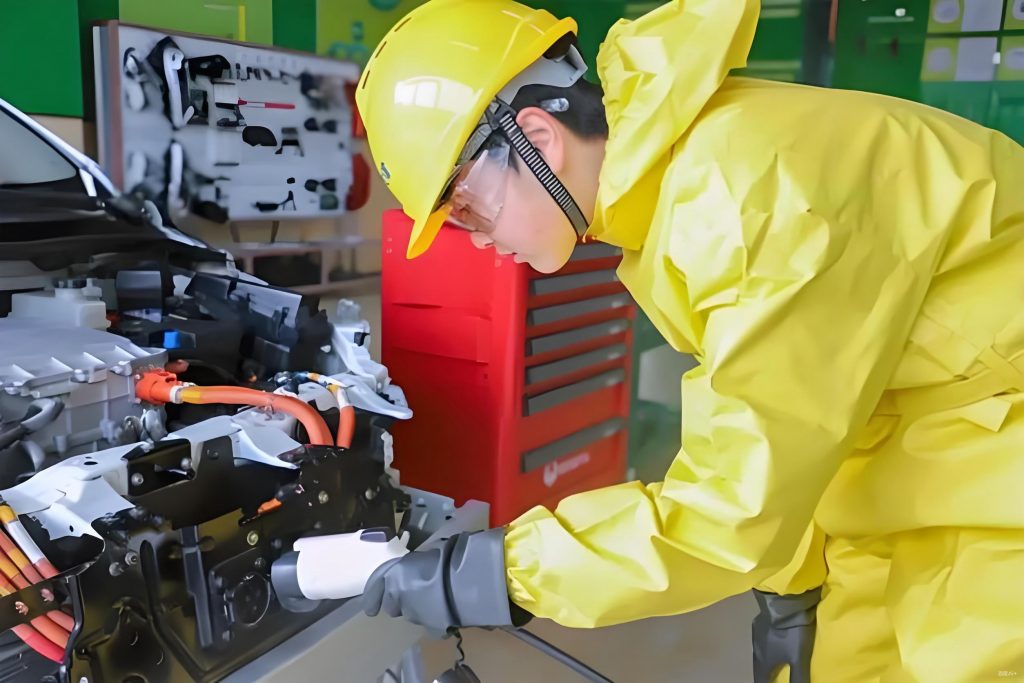
The BMS operates by collecting real-time data such as voltage, current, and temperature from battery sensors, analyzing this data through processing modules, and controlling battery charging, discharging, and balancing based on predefined algorithms. It coordinates the working states of individual battery cells to ensure that the battery operates within safe and efficient ranges. The functional architecture of BMS includes several key modules: data acquisition, state estimation, energy management, safety management, and communication. The data acquisition module is responsible for gathering fundamental battery operation data; the state estimation module uses algorithms to compute critical indicators like State of Charge (SOC) and State of Health (SOH); the energy management module optimizes battery charging and discharging strategies; the safety management module monitors for abnormalities and triggers protection mechanisms; and the communication module facilitates information exchange between the BMS and other vehicle controllers, such as the Vehicle Control Unit (VCU).
To better understand the functional architecture, Table 1 summarizes the key modules and their roles in BMS, which is essential for effective EV repair and electrical car repair.
| Module | Function | Key Parameters |
|---|---|---|
| Data Acquisition | Collects real-time battery data (e.g., voltage, current, temperature) | Sampling rate, accuracy |
| State Estimation | Estimates SOC, SOH, and other states using algorithms | SOC error margin, SOH degradation rate |
| Energy Management | Controls charging/discharging to optimize performance | Charge current limits, discharge profiles |
| Safety Management | Monitors for faults and activates protection mechanisms | Overvoltage/undervoltage thresholds, temperature limits |
| Communication | Enables data exchange with other systems via protocols like CAN | Baud rate, message frequency |
In state estimation, the SOC is a crucial parameter that indicates the remaining battery capacity. It can be estimated using coulomb counting or model-based methods. For instance, the SOC calculation based on coulomb counting is given by:
$$ SOC(t) = SOC_0 – \frac{1}{Q_{\text{max}}} \int_{0}^{t} I(\tau) \, d\tau $$
where \( SOC_0 \) is the initial SOC, \( Q_{\text{max}} \) is the maximum battery capacity, and \( I(\tau) \) is the current at time \( \tau \). Similarly, SOH estimation often involves capacity fade modeling, such as:
$$ SOH = \frac{Q_{\text{current}}}{Q_{\text{original}}} \times 100\% $$
where \( Q_{\text{current}} \) is the current maximum capacity and \( Q_{\text{original}} \) is the original capacity. These formulas are vital for diagnosing battery health in EV repair and electrical car repair scenarios.
Common faults in BMS can be categorized into hardware, software, and communication failures. Hardware faults include sensor malfunctions, circuit board issues, and actuator failures. For example, sensors may suffer from signal distortion or open circuits due to prolonged use or environmental factors, while circuit board components like capacitors or resistors can degrade, leading to system instability. Actuator faults, such as cooling fan failures or relay malfunctions, can disrupt battery operation and pose safety risks. Software faults involve program bugs, parameter misconfigurations, or communication protocol incompatibilities. For instance, incorrect parameter settings might prevent battery preheating in low temperatures, rendering the vehicle inoperable. Communication faults, such as CAN bus interruptions or electromagnetic interference, can cause data loss or signal errors, affecting the BMS’s ability to control the battery. In some cases, electromagnetic interference in complex environments has led to power interruptions in EVs, highlighting the need for robust repair techniques in EV repair and electrical car repair.
Table 2 provides a summary of common BMS faults, their symptoms, and potential impacts, which aids in systematic fault analysis for EV repair and electrical car repair.
| Fault Type | Common Symptoms | Potential Impact |
|---|---|---|
| Hardware Faults | Sensor signal loss, circuit board overheating, actuator failure | Reduced battery efficiency, safety hazards |
| Software Faults | System crashes, parameter errors, communication timeouts | Inaccurate state estimation, vehicle immobilization |
| Communication Faults | CAN bus errors, signal noise, data corruption | Loss of control, intermittent power loss |
To address these faults, I propose several repair technology strategies focused on optimizing fault diagnosis, improving hardware repair methods, enhancing software upgrade processes, and strengthening communication fault handling. These strategies are designed to improve the efficiency and reliability of EV repair and electrical car repair.
First, optimizing the fault diagnosis process is essential for quickly locating BMS faults. Fault Tree Analysis (FTA) provides a graphical logic reasoning approach, where the top event represents the fault phenomenon, and intermediate and basic events are analyzed to form a clear causal chain. Additionally, with the growing number of EVs, big data technology can be leveraged for fault diagnosis. Machine learning algorithms can mine associations between fault patterns and influencing factors, building a dynamically updated fault diagnosis knowledge base. This helps repair personnel make quick judgments, reduce subjective errors, and improve diagnostic accuracy and efficiency. A standardized diagnostic process can be established in stages: initial visual inspection and manual testing to identify physical damage or loose connections; using specialized EV diagnostic tools to read fault codes, real-time data streams, and historical records from the OBD interface; and comparing collected data with standard parameters in an enterprise cloud database. By combining fault tree models and segmentation testing, fault points can be precisely identified. For example, in EV repair, if a BMS shows inconsistent voltage readings, FTA might reveal a sensor fault as the root cause, and data analytics can confirm it through pattern recognition.
Second, improving hardware repair methods involves precise techniques for sensor and circuit board faults. For sensor faults, a three-step method of “signal comparison-threshold detection-environment simulation” can be applied. Initially, use a multimeter to measure the sensor’s supply voltage; if abnormal, the sensor may not output valid signals. Then, employ an oscilloscope to monitor the output signal waveform and compare it with standard values. For instance, if a temperature sensor’s output voltage deviates by ±5% from the standard at 25°C, it should be replaced. Finally, simulate actual conditions, such as heating the sensor to observe signal changes. For circuit board faults, professional equipment like BGA rework stations and hot air guns, combined with microscopes, can locate issues like cold solder joints or short circuits. Techniques such as ball grid array (BGA) reballing can repair solder joints, while fly-wiring can bypass shorted areas. If the main control chip is burned out, replacing the modular circuit board is often the most efficient solution. These methods are critical in EV repair and electrical car repair to restore BMS functionality quickly.
Third, perfecting software upgrade strategies ensures safe and reliable updates. A “three-review, three-proof” upgrade process can be implemented. The first review involves using diagnostic tools to assess battery health, checking parameters like cell voltage balance and SOH, and confirming the current BMS software version for known vulnerabilities. The second review focuses on upgrade package security and integrity; during download from the manufacturer’s cloud server, hash verification (e.g., comparing file hashes with official values) ensures the package is untampered. The third review involves real-time monitoring during upgrade; if abnormalities like voltage drops or temperature spikes are detected, a rollback mechanism reverts to the previous version. For major upgrades, the vehicle should enter an “upgrade mode” that disconnects non-essential loads like entertainment systems, with technicians on standby. This process minimizes risks in EV repair and electrical car repair, as software issues can lead to systemic failures if not handled properly.
Table 3 outlines the software upgrade process, which is a key aspect of EV repair and electrical car repair maintenance.
| Step | Action | Purpose |
|---|---|---|
| 1. Pre-upgrade Review | Check battery health and software version | Ensure compatibility and identify risks |
| 2. Security Verification | Hash校验 and encrypted transmission | Prevent tampering and data breaches |
| 3. Real-time Monitoring | Monitor parameters and trigger rollback if needed | Maintain system stability during upgrade |
Fourth, strengthening communication fault handling employs “segmented detection and waveform analysis” to locate issues. Start by measuring the CAN bus terminal resistance with a multimeter; the standard value is 60 Ω, and deviations indicate problems like open or short circuits that require inspection of terminal resistor modules. Then, use an oscilloscope to analyze the CAN bus waveform; under normal conditions, it should show stable differential signals with CAN-High and CAN-Low lines symmetrical and out of phase. Abnormalities like amplitude attenuation, waveform distortion, or noise suggest issues in specific cable segments, which can be isolated by dividing the harness into test sections. For electromagnetic interference, apply shielding measures such as double-layer shielding nets with proper grounding, and install common-mode chokes at ECU interfaces to filter noise. Regular maintenance, including cleaning oxidized contacts and applying conductive paste, ensures long-term reliability. In EV repair and electrical car repair, this approach prevents communication failures that could cause power loss or control issues.
For example, the CAN bus signal integrity can be assessed using the signal-to-noise ratio (SNR) formula:
$$ \text{SNR} = 10 \log_{10} \left( \frac{P_{\text{signal}}}{P_{\text{noise}}} \right) $$
where \( P_{\text{signal}} \) is the signal power and \( P_{\text{noise}} \) is the noise power. A low SNR indicates poor communication quality, necessitating repairs in EV repair and electrical car repair contexts.
In conclusion, the strategies discussed—optimizing fault diagnosis, improving hardware repairs, enhancing software upgrades, and strengthening communication fault handling—have been validated through practical cases and contribute to the advancement of EV repair and electrical car repair. As EV technology continues to evolve, integrating intelligent and digital tools into BMS maintenance will further elevate repair standards, supporting the healthy development of the EV industry. Future research should focus on adaptive algorithms and predictive maintenance to address emerging challenges in EV repair and electrical car repair.