
As an engineer specializing in powertrain and high-voltage systems, the pursuit of refinement in electric vehicles (EVs) extends beyond range and performance to encompass every facet of the user experience. One often-overlooked yet perceptible aspect is the audible noise generated during vehicle start-up and shut-down. This transient acoustic signature, primarily emanating from the high-voltage DC contactors (often referred to as relays) within the battery pack, can be a source of customer concern, subtly undermining the otherwise silent and refined character of an EV. This article details a systematic investigation into the generation, propagation, and mitigation of this EV battery pack contactor noise, presenting a multi-pronged optimization framework validated through empirical testing.
The core of the issue lies within the Battery Distribution Unit (BDU), the high-voltage switchgear housed inside the EV battery pack. During the “power-on” sequence, the main contactors are energized, causing their internal moving armature and contacts to snap closed against stationary counterparts. Conversely, during “power-off,” these components separate, often with an assisted mechanical break. Each of these mechanical impacts generates a sharp, impulsive force. This impulse is the fundamental noise source, characterized by a broad frequency spectrum. The challenge is that this source is enclosed within the sealed metallic or composite enclosure of the EV battery pack, designed for safety and environmental protection (e.g., IP67).
Noise Propagation Pathways in a Sealed Battery Pack
In acoustics, noise propagates via two primary paths: airborne and structure-borne. Within the constrained environment of an EV battery pack, both paths exist but their significance differs markedly.
- Airborne Path: The impact noise originates at the contactor’s internal components. Sound waves radiate into the limited internal air volume of the EV battery pack, strike the inner walls of the BDU’s plastic cover and the pack’s main enclosure, cause these walls to vibrate, and finally re-radiate from the outer surfaces of the pack into the surrounding environment. The transmission loss through each layer (air, plastic, metal, air again) attenuates the sound. The sound pressure level (SPL) at a point outside the pack can be conceptually modeled by considering transmission losses:
$$ L_{p,out} = L_{p,source} – TL_{BDU} – TL_{pack} – A_{internal} $$
where $L_{p,source}$ is the SPL at the source, $TL_{BDU}$ and $TL_{pack}$ are the transmission losses of the BDU cover and pack wall respectively, and $A_{internal}$ represents absorption within the pack cavity, which is typically minimal. - Structure-Borne Path: This is the dominant and more critical pathway. The impulsive force from the contactor’s action is directly applied to its mounting base. This base is bolted either to the BDU’s internal frame or directly to the EV battery pack‘s structural tray. The force injects vibrational energy directly into these solid structures. The vibration travels efficiently through the bolts, brackets, and sheet metal, causing large areas of the EV battery pack enclosure (especially large, thin panels) to vibrate and act as loudspeakers. The resulting noise is often louder, lower in frequency, and more perceptible than the airborne component. The acceleration of a panel can be related to the input force by its frequency response function (FRF), and the radiated sound power is proportional to the panel’s velocity.
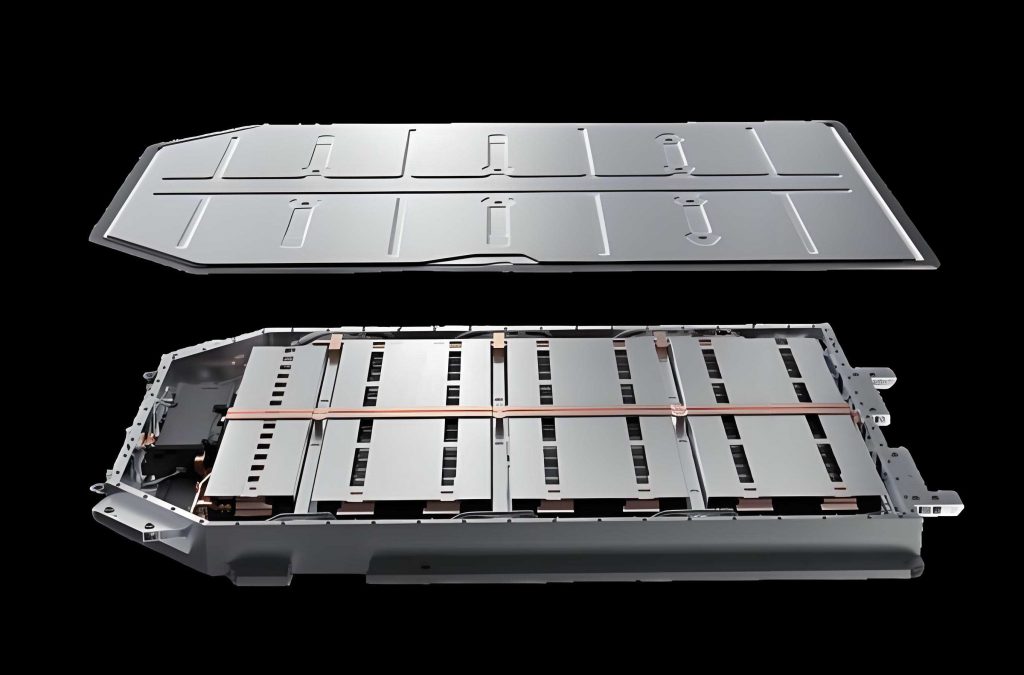
An early experiment starkly demonstrated the supremacy of the structure-borne path. By simply unbolting a BDU from the EV battery pack tray—leaving it resting in place—and repeating the contactor actuation test, the externally measured noise reduced dramatically by approximately 11 dB(A). This confirms that the bolted connections are primary conduits for vibrational energy from the contactor to the radiating surfaces of the EV battery pack.
A Multi-Layer Optimization Strategy
Addressing contactor noise effectively requires a layered approach, targeting the source, the transmission paths, and the receiver (the pack structure).
1. Source-Level Mitigation: Contactor Selection and Design
The most fundamental improvement comes from reducing the mechanical impact energy at its origin. Two key strategies are employed:
- Horizontal-Axis Contactors: Traditional “vertical” contactors have their moving armature axis aligned with gravity. Upon closure, the combined force of the electromagnetic pull and the armature’s weight creates a high-impact energy. “Horizontal” or lateral-action contactors have their armature moving in a plane perpendicular to gravity. The gravitational force does not contribute to the impact velocity, resulting in a lower collision energy. Comparative tests show that horizontal contactors consistently produce 2-7 dB(A) lower noise than their vertical counterparts in the same application within an EV battery pack.
- Internal Damping: Some advanced contactor designs incorporate microscopic visco-elastic damping materials or optimized spring systems within the actuator mechanism to cushion the final stage of closure and opening. The reduction in impact force $F_{impact}$ can be modeled as an impulse with a slightly extended duration $\Delta t$, reducing the peak amplitude of the exciting force spectrum.
2. Path Isolation: Advanced Mounting Solutions
Interrupting the structure-borne path is the single most effective countermeasure after source control. This is achieved through isolation mounts.
- Basic Rubber Grommets: The first iteration involves placing elastomeric grommets (e.g., 70 Shore A hardness) between the BDU’s mounting feet and the EV battery pack tray. A metal sleeve is typically inserted to prevent over-compression during bolt tightening. This provides a basic level of isolation, attenuating higher-frequency vibrations. The isolation effectiveness can be approximated by the transmissibility $T_r$ of a single-degree-of-freedom system:
$$ T_r = \sqrt{ \frac{1 + (2 \zeta r)^2}{(1-r^2)^2 + (2 \zeta r)^2} } $$
where $r = \omega / \omega_n$ is the frequency ratio and $\zeta$ is the damping ratio of the isolator. For effective isolation ($T_r < 1$), the excitation frequency $\omega$ must be greater than $\sqrt{2} \omega_n$, the natural frequency of the mounted system. - Decoupled Stud Mounts: A superior design physically separates the bolt’s load-bearing function from its vibration-transmitting role. This is achieved using a two-part stud connected by a central elastomeric core. The upper stud attaches to the BDU, the lower to the pack, and the rubber element in between carries the weight while providing excellent shear and axial isolation. This design nearly eliminates “bolt short-circuiting,” leading to significantly better noise reduction, particularly in the low-to-mid frequency range critical for perceived loudness.
3. Receiver Modification: Structural and Acoustic Treatments
This layer focuses on making the EV battery pack structure itself a less efficient radiator of sound.
- Structural Reinforcement (Modal Stiffening): The goal is to shift the natural frequencies of key radiating panels (like the pack cover or side walls) away from the dominant frequencies of the contactor excitation and increase their stiffness to reduce vibration amplitudes. Techniques include adding strategic ribbing, increasing local sheet metal thickness, or bonding constrained layer damping patches. The reduction in vibration response can be significant. If a panel’s resonance is shifted from a critical frequency, the resulting noise reduction can exceed 10 dB at that tone.
- Acoustic Barriers and Absorption: While less effective for structure-borne noise, acoustic treatments can help with the airborne component. Applying sound-absorbing foam to the interior of the BDU cover or the inside of the EV battery pack lid can absorb some high-frequency energy. However, due to stringent safety requirements regarding thermal runaway and outgassing, the use of interior foams in an EV battery pack is heavily restricted. External wrapping of the pack with acoustic barrier mats is a possible but often impractical solution due to thermal management and packaging constraints.
- Material Selection: The choice of enclosure material influences damping. Aluminum enclosures generally have higher inherent damping than steel for comparable thicknesses. The sound radiation from an impacted aluminum panel can decay faster than that from steel, leading to a less “ringing” and subjectively quieter noise character.
Experimental Validation and Results Synthesis
The effectiveness of the proposed strategies was quantified through standardized acoustic testing in a semi-anechoic chamber. Multiple production and prototype EV battery pack units were instrumented with an array of microphones. A-weighted Sound Pressure Level (SPL) and psychoacoustic Loudness (in sones) were measured during repeated contactor actuation cycles. The results are synthesized in the table below.
| Optimization Strategy | Implementation Description | Approx. Reduction in A-Weighted SPL | Approx. Reduction in Loudness (Sone) | Key Mechanism | Practical Considerations |
|---|---|---|---|---|---|
| Source: Horizontal Contactor | Replacing vertical-axis with horizontal-axis contactor. | 2 – 6 dB(A) | 1 – 4 sone | Reduces impact energy by eliminating gravitational contribution. | Preferred solution if packaging allows. No performance trade-off. |
| Path: Basic Rubber Grommets | Adding standard elastomeric isolators at BDU mounting points. | 1 – 3 dB(A) | 1 – 3 sone | Provides basic high-frequency vibration isolation. | Simple, low-cost. Limited effectiveness due to bolt short-circuit. |
| Path: Decoupled Stud Mounts | Implementing advanced mounts with elastomer core separating bolt halves. | 3 – 7 dB(A) | 5 – 10 sone | Superior isolation by decoupling the load path; minimizes structure-borne transmission. | Higher cost and complexity. Requires design for durability and crash load management. |
| Receiver: External Acoustic Wrap | Applying sound-absorbing/barrier material to the exterior of the pack. | 1 – 5 dB(A) | 1 – 3 sone | Attenuates airborne noise component and may add damping. | Limited effectiveness for main issue (structure-borne). Conflicts with thermal management and serviceability. |
| Receiver: Structural Reinforcement | Strengthening BDU cover and pack lid (ribs, thicker sections, added aluminum backing plates). | 7 – 12 dB(A) | ~50% reduction (e.g., 15 sone) | Increases panel stiffness and modal frequencies; reduces vibration amplitude and radiation efficiency. | Highly effective. Must be balanced against weight and cost. Integral to pack design. |
| Combined Approach (e.g., Horizontal + Studs + Structure) | Implementing multiple strategies from source to receiver. | >15 dB(A) possible | >70% reduction possible | Synergistic reduction across source energy, transmission, and radiation. | Represents the optimal engineering solution for premium NVH targets. |
The data clearly shows that while each layer contributes, the most substantial improvements come from addressing the structure-borne path with advanced isolation and from stiffening the radiating structure. The combination of a horizontal contactor, decoupled stud mounts, and a structurally optimized BDU/pack lid yielded the most dramatic noise reduction, transforming a sharp, noticeable “clunk” into a muted, acceptable “thud.” It was also confirmed that wrapping the EV battery pack, while providing a measurable benefit, is the least desirable solution from a holistic engineering perspective due to its ancillary drawbacks.
Conclusions and Design Principles
Mitigating high-voltage contactor noise in an EV battery pack is a tractable engineering challenge that requires a systems-level understanding of noise generation and propagation. The impulsive noise is primarily transmitted via structure-borne paths through rigid mountings, making the EV battery pack enclosure an efficient, unwanted loudspeaker.
The following design principles emerge for optimal NVH performance of the EV battery pack:
- Source First: Specify horizontal-axis contactors wherever package space permits to minimize the initial impact energy.
- Break the Path: Design sophisticated vibration isolation mounts (like decoupled studs) for the BDU or individual contactors to drastically reduce the injection of vibrational energy into the pack structure.
- Stiffen the Receiver: Integrate structural NVH considerations early in the EV battery pack enclosure and BDU cover design. Use modal analysis to identify and reinforce critical panels, aiming for higher natural frequencies and greater damping. Consider material selection (aluminum vs. steel) for its damping characteristics.
- Validate Systematically: Use acoustic testing in a controlled environment to quantify the contribution of each component and the efficacy of countermeasures, focusing on both objective SPL and subjective loudness metrics.
By applying this multi-layered optimization strategy, engineers can effectively suppress contactor noise, thereby preserving the serene acoustic character that is a hallmark of electric vehicles and enhancing overall customer satisfaction with the EV battery pack and the vehicle as a whole.