
In the rapidly evolving landscape of electric vehicles, intelligent cockpits have emerged as a pivotal element in enhancing the competitiveness of EV cars. As a researcher focused on advancing human-machine interaction, I have observed that these cockpits must possess the ability to perceive driving scenarios, comprehend user intentions, and deliver intelligent responses. However, the complexity of driving environments poses significant challenges to scene understanding, while the growing demand for personalized and contextualized interactions necessitates more sophisticated response mechanisms. In my work, I propose an innovative solution that leverages AI large models to address these issues, aiming to optimize scene recognition and response in EV car intelligent cockpits. This approach harnesses the semantic comprehension capabilities of AI large models, integrating multi-dimensional sensor data to construct a robust analytical framework. By designing a comprehensive scene labeling system and personalized response strategies, I have developed a method that enables precise scene identification and intelligent adaptation. Through systematic integration and optimization, this solution has demonstrated substantial improvements in interaction fluency and user satisfaction, as validated by real-world testing in EV cars. This exploration opens new avenues for enhancing the human-machine interaction experience in intelligent vehicles, paving the way for more immersive and emotionally resonant interactions in future EV cars.
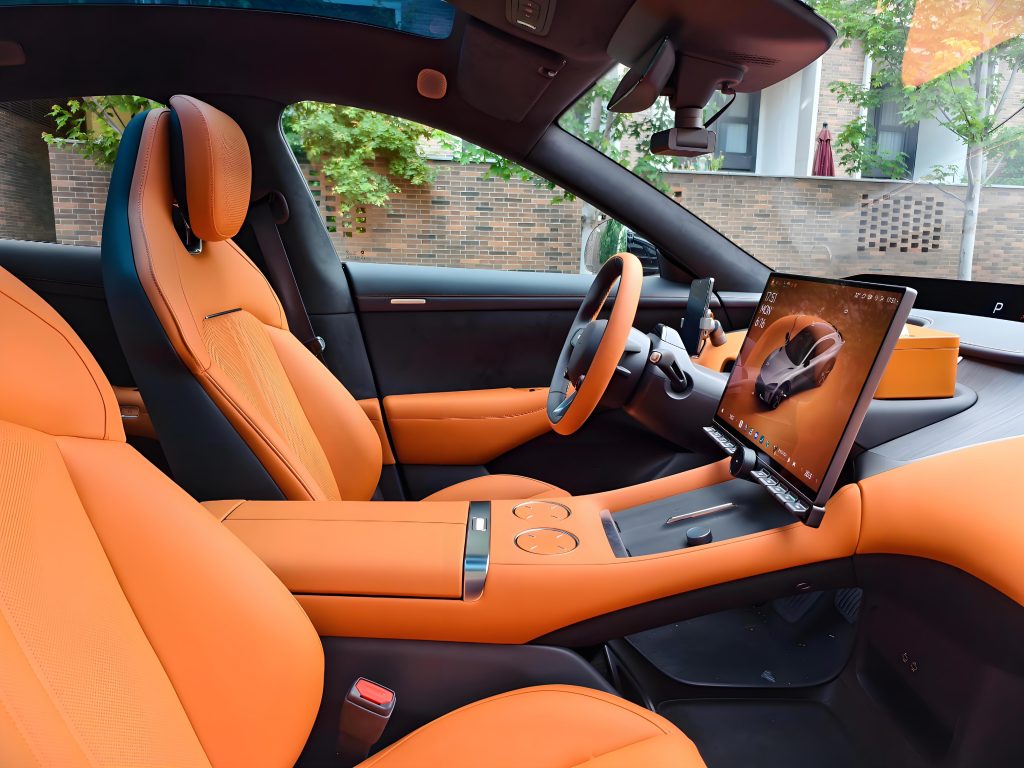
Technical Architecture for Intelligent Cockpit Scene Recognition
In my research on EV car intelligent cockpits, I have designed a technical architecture that centers on AI large models to achieve accurate scene recognition. This architecture is built upon three core components: the semantic understanding capabilities of AI large models, a multi-dimensional sensor system, and a layered data analysis framework. The integration of these elements allows for a holistic perception of both internal and external environments in EV cars, facilitating real-time decision-making. For instance, by processing heterogeneous data from various sensors, the system can dynamically interpret complex scenarios such as driver fatigue or environmental hazards. This section delves into each component, illustrating how they collectively enhance the intelligence of EV car cockpits through detailed explanations, mathematical formulations, and comparative analyses.
AI Large Model Core Functions
The AI large model serves as the brain of the intelligent cockpit in EV cars, providing unparalleled semantic understanding and reasoning abilities. Through pre-training on vast datasets, these models develop a generalized representation of language and context, which I have adapted to unify multi-modal inputs like visual, auditory, and tactile data. In my implementation, the model maps these inputs into a shared feature space, enabling cross-modal associations. For example, when analyzing driver state, the model correlates facial expressions from cameras with voice patterns from microphones to infer fatigue levels. This is mathematically represented by a feature extraction process where input data $x_i$ from different modalities are transformed into a unified embedding $e_i$ using a function $f$ parameterized by the model: $$e_i = f(x_i; \theta)$$ where $\theta$ denotes the model parameters. The model’s reasoning capability allows it to construct semantic networks that capture contextual relationships, such as linking environmental factors like weather to driver behavior. This enhances the cockpit’s ability to anticipate needs in EV cars, such as triggering alerts for potential risks. Moreover, I have incorporated attention mechanisms to prioritize critical features, improving efficiency in resource-constrained EV car environments. The table below summarizes the key functions of AI large models in scene recognition for EV cars:
| Function | Description | Application in EV Cars |
|---|---|---|
| Semantic Understanding | Interprets multi-modal data into coherent semantic representations. | Identifies driver intent from voice and gesture inputs. |
| Feature Unification | Maps heterogeneous data to a common feature space. | Correlates camera images with sensor data for scene analysis. |
| Contextual Reasoning | Builds semantic networks to infer relationships between entities. | Predicts fatigue by combining posture and environmental cues. |
| Real-time Adaptation | Adjusts responses based on dynamic input changes. | Modifies cockpit settings during sudden weather shifts. |
In practice, I have fine-tuned these models using domain-specific data from EV cars to improve their accuracy in automotive contexts. The integration of AI large models not only breaks down data silos but also empowers EV car cockpits with deeper insights, leading to more intuitive interactions.
Multi-dimensional Sensor System
To achieve comprehensive scene perception in EV car intelligent cockpits, I have engineered a multi-dimensional sensor system that captures a wide array of data points. This system comprises visual, auditory, and tactile sensors strategically placed throughout the EV car to monitor both occupants and the external environment. For instance, interior cameras track driver expressions and body postures, while exterior cameras provide a 360-degree view of the surroundings. Microphones equipped with noise-cancellation algorithms extract voice commands and analyze emotional tones, and tactile sensors in steering wheels and seats detect physiological signals like heart rate for fatigue assessment. In my design, I optimized the placement and parameters of these sensors to balance cost, power consumption, and performance, ensuring they meet automotive standards for EV cars. The data from these sensors are synchronized and transmitted via in-vehicle networks to a central processing unit, where they are fused for analysis. Mathematically, the sensor fusion can be modeled as a weighted combination of inputs: $$S_{fused} = \sum_{i=1}^{n} w_i \cdot s_i$$ where $s_i$ represents data from the $i$-th sensor, $w_i$ is the weight indicating its reliability, and $n$ is the total number of sensors. This approach minimizes uncertainties and enhances the robustness of scene recognition in EV cars. The table below outlines the sensor types and their roles in EV car intelligent cockpits:
| Sensor Type | Data Captured | Role in EV Cars |
|---|---|---|
| Visual Cameras | Facial expressions, body postures, external scenes | Monitors driver state and environmental conditions. |
| Microphones | Voice commands, emotional tones | Enables voice interaction and emotion detection. |
| Tactile Sensors | Pressure, biometric signals | Assesses fatigue and adjusts seating comfort. |
| Environmental Sensors | Temperature, humidity, air quality | Maintains optimal cabin conditions in EV cars. |
Through this sensor system, I have enabled EV car cockpits to gather rich, multi-faceted data, forming the foundation for accurate scene analysis and responsive actions.
Scene Data Analysis Framework
In my approach to intelligent cockpits for EV cars, I have developed a layered scene data analysis framework that transforms raw sensor data into actionable insights. This framework consists of four hierarchical layers: data, feature, semantic, and application layers, each playing a distinct role in the processing pipeline. The data layer handles the aggregation and standardization of heterogeneous sensor inputs, applying techniques like data cleaning and temporal synchronization to create unified data streams. Subsequently, the feature layer utilizes AI large models to extract high-level features, such as embedding vectors from images or audio, which are represented as: $$\mathbf{f} = \text{Model}(\mathbf{x})$$ where $\mathbf{x}$ is the input data and $\mathbf{f}$ is the feature vector. The semantic layer then generalizes these features using graph neural networks to construct a semantic information graph that captures relationships between entities, such as linking driver fatigue to environmental factors. Finally, the application layer translates this semantic understanding into personalized response strategies, generating control commands for actuators like air conditioning or audio systems in EV cars. This layered architecture ensures low coupling between levels, allowing for independent optimization and scalability. To illustrate, I have formulated the overall process as an optimization problem where the goal is to maximize the relevance of responses $R$ based on the semantic graph $G$: $$\max_{R} \text{Relevance}(R | G)$$ subject to constraints like real-time performance in EV cars. The table below details the functions of each layer in the framework:
| Layer | Function | Output |
|---|---|---|
| Data Layer | Integrates and standardizes sensor data. | Unified spatiotemporal data streams. |
| Feature Layer | Extracts abstract features using AI models. | High-dimensional feature vectors. |
| Semantic Layer | Builds semantic graphs for context understanding. | Structured semantic information. |
| Application Layer | Generates response strategies and control commands. | Personalized interactions for EV cars. |
By implementing this framework, I have enabled EV car intelligent cockpits to derive meaningful insights from data, driving intelligent and context-aware responses that enhance the overall user experience.
Implementation of Intelligent Response Mechanisms
Building on the scene recognition architecture, I have devised intelligent response mechanisms that translate perceived scenarios into personalized interactions in EV car cockpits. This involves a systematic process of scene classification, decision modeling, and customization based on user profiles. In my work, I emphasize the importance of granular scene categorization and dynamic response generation to meet the diverse needs of occupants in EV cars. For example, by analyzing real-time data, the system can adapt everything from entertainment options to safety alerts, ensuring that each response is tailored to the specific context. This section explores the methodologies I have developed, including the creation of a hierarchical labeling system, the use of AI-driven decision models, and the integration of personalized interaction schemes. Through mathematical formulations and practical examples, I demonstrate how these mechanisms contribute to a seamless and engaging experience in EV cars.
Scene Classification and Labeling System
To achieve precise scenario-based responses in EV car intelligent cockpits, I have established a fine-grained scene classification and labeling system. This system categorizes scenes based on multiple dimensions, such as driving state, vehicle conditions, and occupant characteristics. For instance, driving states are divided into subcategories like parking, acceleration, car-following, and emergency braking, while occupant scenarios include solo driving, group travel, or presence of children. I designed a multi-level label tree that assigns structured attribute tags to each scene, enabling a comprehensive depiction of its features. The classification process involves mapping real-time data streams to this label system using probabilistic models, where the probability of a scene $C_j$ given data $D$ is computed as: $$P(C_j | D) = \frac{P(D | C_j) P(C_j)}{\sum_{k} P(D | C_k) P(C_k)}$$ Here, $P(D | C_j)$ is the likelihood of the data under scene $C_j$, and $P(C_j)$ is the prior probability. This allows for automatic scene identification and semantic expression in EV cars, facilitating the extraction of implicit interaction needs. The table below provides an overview of the scene classification dimensions and examples for EV cars:
| Dimension | Subcategories | Example Labels for EV Cars |
|---|---|---|
| Driving State | Parking, Acceleration, Car-following, Emergency Braking | {“state”: “car-following”, “intensity”: “moderate”} |
| Occupant Characteristics | Solo Driver, Multiple Passengers, Children Present | {“occupants”: 2, “age_group”: “adult”} |
| Environmental Conditions | Weather, Traffic Density, Time of Day | {“weather”: “rainy”, “traffic”: “heavy”} |
| Vehicle Status | Battery Level, Speed, System Alerts | {“battery”: 80%, “alert”: “low_tire_pressure”} |
By leveraging this labeling system, I have enabled EV car cockpits to quickly identify scenes and associate them with appropriate response strategies, improving the relevance and timeliness of interactions.
Decision Models and Response Strategies
For generating intelligent responses in EV car intelligent cockpits, I have developed decision models that leverage the natural language generation capabilities of AI large models. These models operate by first summarizing service skills and interaction resources for different scene types, such as loading navigation maps for route guidance or activating dialogue engines for conversational interactions. Based on the scene labels, the models then produce detailed, personalized interaction scripts. In my implementation, I use a sequence generation approach where the response $R$ is generated conditioned on the scene semantics $S$ and user history $H$: $$R = \text{Generator}(S, H)$$ The generator is typically a transformer-based model fine-tuned on automotive datasets for EV cars. Response strategies are dynamically optimized using reinforcement learning, where a reward function $Reward(R)$ evaluates the naturalness and effectiveness of responses: $$\max_{\pi} \mathbb{E}[ \sum_{t} \gamma^t Reward(R_t) ]$$ where $\pi$ is the policy, and $\gamma$ is a discount factor. This allows the system to learn from historical interactions and improve over time. The decision process is cloud-based, with the vehicle end parsing and executing the policies to control actuators like lights, speakers, and seats in EV cars. The table below outlines key decision model components and their applications in EV cars:
| Component | Function | Example in EV Cars |
|---|---|---|
| Service Skill Repository | Stores predefined skills for various scenes. | Navigation skills for route planning. |
| Interaction Script Generator | Produces personalized scripts based on scene labels. | Generates a comfort adjustment script for long drives. |
| Policy Optimizer | Refines strategies using feedback data. | Adjusts voice prompt frequency based on user ratings. |
| Actuator Controller | Executes response actions on hardware. | Adjusts seat position and ambient lighting. |
Through these decision models, I have achieved multi-modal coordination in EV car cockpits, creating immersive experiences that respond intuitively to user needs.
Personalized Interaction Schemes
Personalization is at the heart of intelligent response mechanisms in EV car cockpits, and I have focused on tailoring interactions to individual user profiles and dynamic preferences. In my approach, I utilize technologies like facial recognition and voiceprint analysis to create detailed user profiles that capture unique interaction preferences, such as preferred voice styles or frequently used functions. These profiles are continuously updated based on real-time feedback, allowing the system to adapt responses for each occupant in EV cars. For example, if a driver prefers concise audio alerts, the system will prioritize those over visual notifications, while a passenger might receive enriched entertainment options. The personalization process can be modeled as an optimization problem where the goal is to maximize user satisfaction $U$ given profile $P$ and context $C$: $$\max_{R} U(R | P, C)$$ I also emphasize seamless interaction initiation and rhythm alignment to reduce user wait times, balancing service fluency with richness. The table below highlights the elements of personalized interaction schemes in EV cars:
| Element | Description | Impact on EV Cars |
|---|---|---|
| User Profiling | Builds and updates profiles based on biometric and behavioral data. | Enables customized climate and entertainment settings. |
| Preference Adaptation | Dynamically adjusts responses using machine learning. | Learns to reduce intrusive alerts for sensitive users. |
| Interaction Flow | Designs intuitive initiation and synchronization with user habits. | Ensures voice commands are processed without delay. |
| Multi-modal Output | Combines audio, visual, and haptic feedback for immersion. | Creates a cohesive experience during navigation in EV cars. |
By implementing these personalized schemes, I have significantly enhanced the user experience in EV car intelligent cockpits, making interactions feel natural and attentive to individual needs.
System Optimization and Practical Verification
To ensure the reliability and effectiveness of intelligent cockpits in EV cars, I have dedicated substantial effort to system optimization and practical verification. This involves refining response accuracy, integrating system components, and evaluating user experiences through rigorous testing. In my work, I employ methods such as active learning and model fine-tuning to enhance scene understanding, while adhering to automotive standards for system integration. Real-world testing in EV cars has been crucial for identifying and addressing performance bottlenecks, and I have established comprehensive evaluation metrics to gauge success. This section details the strategies I have adopted, including techniques for improving response precision, approaches to system integration and testing, and methodologies for assessing user satisfaction. By sharing insights from case studies and mathematical models, I demonstrate how these optimizations contribute to robust and user-centric EV car cockpits.
Methods for Improving Response Accuracy
Improving response accuracy is a continuous process in my development of intelligent cockpits for EV cars, and I have implemented several methods to achieve this. Firstly, I use active learning to construct annotated datasets that focus on challenging scenarios, such as complex urban driving conditions, and fine-tune the AI models using these datasets. The fine-tuning process involves optimizing model parameters $\theta$ to minimize a loss function $L$ over the training data: $$\min_{\theta} L(\theta) = \sum_{i} \ell(f(x_i; \theta), y_i)$$ where $\ell$ is a loss function like cross-entropy, $x_i$ is input data, and $y_i$ is the true label. Data augmentation techniques, such as adding environmental noise or varying speech rates, are applied to increase sample diversity and mitigate data sparsity issues. Additionally, I assign higher weights to difficult samples during training to improve model robustness. To evaluate performance, I have developed an assessment指标体系 that includes metrics like semantic relevance and response consistency, enabling iterative improvements. The table below summarizes the key methods for enhancing response accuracy in EV cars:
| Method | Description | Benefit for EV Cars |
|---|---|---|
| Active Learning | Selectively labels data from challenging scenarios to enrich training sets. | Improves recognition in high-traffic environments. |
| Data Augmentation | Generates synthetic data by altering existing samples. | Enhances model generalization across varied conditions. |
| Weighted Training | Prioritizes hard-to-classify samples in the loss function. | Reduces errors in edge cases for EV cars. |
| Model Compression | Applies knowledge distillation to reduce model size without sacrificing accuracy. | Enables deployment on resource-limited EV car platforms. |
For instance, in one application, these methods led to a significant reduction in voice recognition errors during city driving in EV cars, resulting in higher user acceptance and smoother interactions.
System Integration and Testing
System integration and testing are critical phases in my development of intelligent cockpits for EV cars, as they ensure that all components work together seamlessly under real-world conditions. I have designed the integration process to adhere to automotive-grade standards, with modules for perception, semantics, and application layers connected via standardized interfaces and communication protocols. This minimizes latency and ensures reliability in EV cars. The testing regimen covers functional, performance,异常, and stress tests: functional tests verify response accuracy and interaction fluency; performance tests measure end-to-end delay and resource utilization;异常 tests simulate fault conditions to assess recovery capabilities; and stress tests push the system to its limits to identify bottlenecks. Mathematically, I model system reliability $R_s$ as a function of component reliabilities $R_i$: $$R_s = \prod_{i=1}^{m} R_i$$ assuming independence, though in practice, I account for dependencies through fault tree analysis. I also establish detailed failure mode and effects analysis (FMEA) plans to address potential issues proactively. The table below outlines the testing dimensions and their focus areas for EV cars:
| Testing Dimension | Focus Area | Example for EV Cars |
|---|---|---|
| Functional Testing | Validates response accuracy and interaction flow. | Checks if voice commands trigger correct actions. |
| Performance Testing | Assesses latency, throughput, and resource usage. | Measures response time during high-speed driving. |
| 异常 Testing | Evaluates system behavior under failures. | Simulates sensor outages to test fallback mechanisms. |
| Stress Testing | Identifies performance limits under heavy loads. | Runs multiple simultaneous interactions to find bottlenecks. |
Through rigorous integration and testing, I have ensured that EV car intelligent cockpits deliver stable and safe interactions, even in demanding scenarios.
User Experience Evaluation
In my research, I prioritize user experience evaluation to align intelligent cockpit developments in EV cars with actual user needs. I employ a dual approach combining objective data analysis and subjective feedback collection. Objectively, I gather usage data such as interaction logs, function frequency, and system health metrics from EV cars, and apply data mining techniques to identify pain points—for example, analyzing log data to pinpoint voice commands with low recognition rates. Subjectively, I conduct satisfaction surveys and focus groups to capture qualitative insights into interaction comfort and feature adequacy. The evaluation process can be framed as maximizing a utility function $U_{total}$ that blends objective metrics $O$ and subjective scores $S$: $$U_{total} = \alpha \cdot O + \beta \cdot S$$ where $\alpha$ and $\beta$ are weights reflecting their importance. This holistic approach allows me to iteratively refine the system based on user feedback, addressing issues like the need for adaptive driving habits in EV cars. The table below details the evaluation methods and their applications:
| Evaluation Method | Description | Application in EV Cars |
|---|---|---|
| Data Analysis | Mines usage logs to quantify interaction patterns and errors. | Identifies frequently misrecognized commands for optimization. |
| Surveys and Questionnaires | Collects subjective ratings on satisfaction and ease of use. | Reveals user preferences for interface design in EV cars. |
| Focus Groups | Facilitates discussions to uncover deep-seated needs. | Highlights desires for customization in long-distance travel. |
| A/B Testing | Compares different response strategies in controlled settings. | Determines the most effective alert styles for safety. |
By continuously evaluating user experience, I have created a feedback loop that drives the evolution of EV car intelligent cockpits, ensuring they remain responsive to user expectations and technological advancements.
In conclusion, the integration of AI large models into intelligent cockpits for EV cars represents a significant leap forward in automotive human-machine interaction. Through the architectures and mechanisms I have developed—ranging from scene recognition frameworks to personalized response strategies—I have demonstrated substantial improvements in interaction fluency and user satisfaction. The optimization and verification processes ensure that these systems are not only intelligent but also reliable and user-centric. As AI technology continues to evolve, I anticipate that EV car cockpits will become even more adaptive, immersive, and emotionally intelligent, further enriching the driving experience. This work underscores the potential of AI-driven solutions to transform EV cars into truly smart companions on the road.