
As global environmental awareness grows and technology advances, electric vehicles (EVs) have become a key choice for daily transportation. The power battery, serving as the heart of an electric vehicle, directly influences driving range, performance, and overall user experience. However, power batteries frequently encounter various faults during operation, making the analysis of maintenance strategies essential. In this article, we explore common power battery faults and effective maintenance approaches, providing valuable insights for professionals in EV repair and electrical car repair. We emphasize the importance of proactive measures to ensure safety, longevity, and sustainability in the electric vehicle industry.
The necessity of maintaining electric vehicle power batteries stems from multiple factors, including performance degradation, safety risks, and economic considerations. Over time, batteries experience capacity loss and reduced efficiency due to internal chemical changes and external environmental influences. For instance, prolonged use leads to the depletion of active materials and electrolyte drying, which diminish overall battery performance. From a safety perspective, issues like overheating, short circuits, or leakage can escalate into fires or explosions, posing significant hazards. Economically, regular maintenance reduces long-term costs by preventing major failures and extending battery life. In electrical car repair, addressing these aspects is crucial for sustainable EV adoption. We will delve into specific strategies, incorporating formulas and tables to summarize key points.
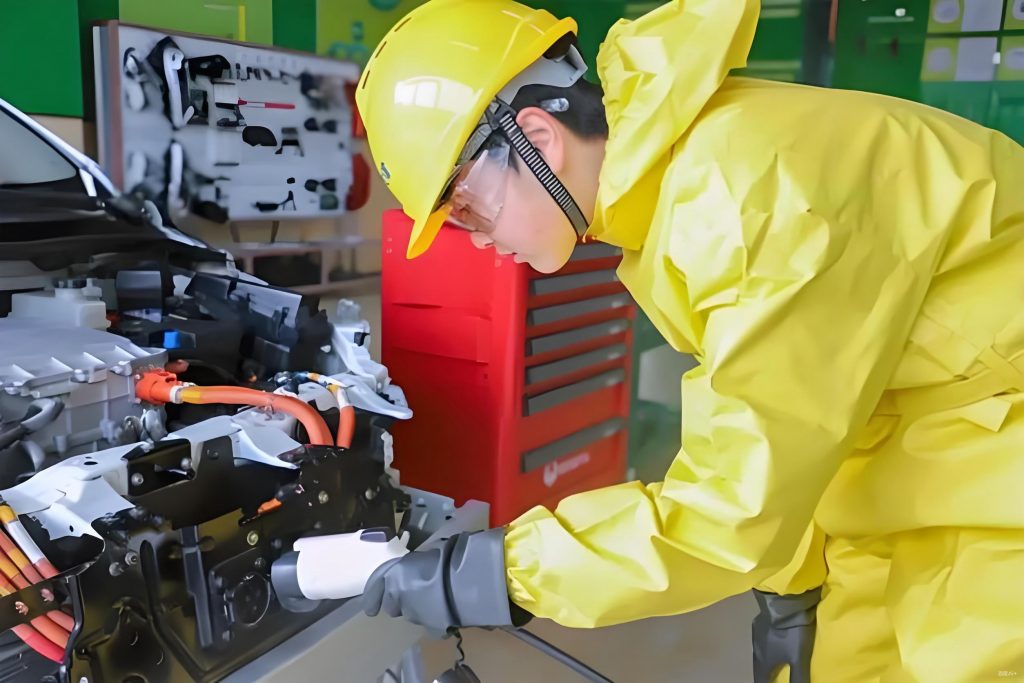
One of the primary concerns in EV repair is performance degradation, which manifests as reduced capacity and shortened cycle life. Capacity fade occurs as batteries undergo repeated charge-discharge cycles, leading to a decline in energy storage capability. This can be modeled using a simplified exponential decay formula: $$ C(t) = C_0 \cdot e^{-\lambda t} $$ where \( C(t) \) is the capacity at time \( t \), \( C_0 \) is the initial capacity, and \( \lambda \) is the degradation rate constant. Factors such as temperature fluctuations, charging habits, and battery chemistry influence \( \lambda \). For example, high temperatures accelerate degradation, while optimal charging practices can mitigate it. In electrical car repair, monitoring these parameters helps in early fault detection. Additionally, cycle life reduction is a common issue, defined as the number of cycles a battery can complete before its capacity drops below a threshold, often 80% of the original. This relates to the cumulative damage model: $$ N = \frac{E_a}{R T} \cdot \ln\left(\frac{C_0}{C_f}\right) $$ where \( N \) is the cycle life, \( E_a \) is the activation energy, \( R \) is the gas constant, \( T \) is temperature, and \( C_f \) is the final capacity. Understanding these equations aids in developing maintenance schedules for EV repair.
| Fault Type | Primary Causes | Symptoms | Impact on EV Performance |
|---|---|---|---|
| Capacity Degradation | Loss of active materials, electrolyte evaporation, structural changes | Reduced driving range, slower charging times | Decreased user satisfaction and efficiency |
| Thermal Runaway | Overheating, cooling system failures, external heat sources | Battery swelling, smoke, or fire risk | Safety hazards and potential vehicle damage |
| Internal Short Circuit | Metal impurities, separator damage, manufacturing defects | Sudden voltage drops, excessive heating | Risk of complete battery failure |
| Shell Damage and Seal Failure | Physical impacts, corrosion, material aging | Electrolyte leakage, gas emission | Compromised safety and environmental contamination |
Thermal management faults are critical in electrical car repair, as they can lead to thermal runaway—a dangerous condition where heat generation exceeds dissipation. The heat balance in a battery can be described by: $$ \frac{dT}{dt} = \frac{P_{\text{gen}} – P_{\text{diss}}}{C_p} $$ where \( T \) is temperature, \( t \) is time, \( P_{\text{gen}} \) is the heat generation rate, \( P_{\text{diss}} \) is the heat dissipation rate, and \( C_p \) is the heat capacity. Inadequate cooling systems or sensor failures disrupt this balance, causing temperatures to rise rapidly. For instance, if a battery’s thermal management system fails, \( P_{\text{diss}} \) decreases, leading to overheating. EV repair technicians must regularly inspect cooling components, such as fans and coolant levels, to prevent such scenarios. Moreover, internal short circuits pose significant risks, often resulting from microscopic metal particles or separator breaches. The current during a short circuit can be approximated by Ohm’s law: $$ I = \frac{V}{R_{\text{internal}}} $$ where \( I \) is the current, \( V \) is the voltage, and \( R_{\text{internal}} \) is the internal resistance. High currents generate excessive heat, escalating into thermal events. In electrical car repair, using insulation tests and visual inspections helps identify potential short circuits early.
Another common issue in EV repair is shell damage and seal failure, which compromise battery integrity. Physical impacts from accidents or environmental stress can crack the battery casing, allowing moisture or contaminants to enter. This accelerates internal corrosion and increases the risk of leakage. The pressure buildup due to gas generation in faulty seals can be modeled as: $$ P = \frac{nRT}{V} $$ where \( P \) is pressure, \( n \) is the number of moles of gas, \( R \) is the ideal gas constant, \( T \) is temperature, and \( V \) is volume. If seals fail, pressure relief mechanisms may not function, leading to explosions. Regular maintenance in electrical car repair includes checking for cracks, ensuring proper sealing materials, and replacing damaged components. Additionally, electrical faults like loose connections or battery management system (BMS) errors can disrupt overall performance. For example, a BMS fault might cause inaccurate state-of-charge readings, affecting vehicle operation. Technicians in EV repair often use diagnostic tools to measure voltage and resistance across connections, ensuring stability.
| Strategy Category | Specific Actions | Tools/Techniques Used | Expected Outcomes |
|---|---|---|---|
| Fault Diagnosis and Preprocessing | Comprehensive inspections, voltage tests, internal resistance measurements | Multimeters, BMS scanners, thermal cameras | Early fault detection, reduced downtime |
| Charge-Discharge Management | Controlled charging currents, voltage limits, cycle optimization | Smart chargers, algorithm-based BMS | Extended battery life, improved efficiency |
| Temperature Control | Monitoring cooling systems, adjusting thermal parameters | Thermal sensors, coolant systems, software updates | Prevention of overheating, enhanced safety |
| Recalibration and Material Repair | Parameter adjustments, additive applications, component replacements | Calibration software, conductive materials, replacement parts | Restored capacity, cost-effective repairs |
| System Optimization and Upgrades | BMS updates, structural enhancements, software patches | Firmware tools, engineering analysis | Better performance, adaptability to new tech |
| Recycling and Reuse | Material extraction, repurposing for energy storage | Disassembly tools, chemical processing | Environmental benefits, resource conservation |
In EV repair, fault diagnosis and preprocessing form the foundation of effective maintenance. This involves a systematic approach to identify issues like capacity fade or internal shorts. For example, technicians might measure the internal resistance \( R_{\text{int}} \) using: $$ R_{\text{int}} = \frac{V_{\text{oc}} – V_{\text{load}}}{I} $$ where \( V_{\text{oc}} \) is the open-circuit voltage, \( V_{\text{load}} \) is the voltage under load, and \( I \) is the current. High \( R_{\text{int}} \) indicates degradation, prompting further inspection. Preprocessing steps include disconnecting the battery, cleaning terminals, and verifying connections to prevent accidental shorts. In electrical car repair, this phase often utilizes advanced diagnostic software integrated with BMS to log data and predict failures. Case studies in EV repair show that preprocessing reduces repair times by up to 30%, emphasizing its value in routine maintenance.
Charge-discharge management is vital in electrical car repair to optimize battery health. Improper charging, such as frequent fast charging, can accelerate degradation. The optimal charging current \( I_{\text{charge}} \) can be derived from the Peukert’s law adaptation: $$ I_{\text{charge}} = k \cdot C^{\alpha} $$ where \( k \) and \( \alpha \) are constants specific to the battery type, and \( C \) is the capacity. By controlling \( I_{\text{charge}} \) and avoiding deep discharges, technicians in EV repair can prolong cycle life. For instance, implementing balanced charging across cells ensures uniform performance, reducing the risk of weak links. Discharge management involves monitoring depth of discharge (DoD), where lower DoD levels correlate with longer lifespan. In electrical car repair, tools like battery analyzers help set appropriate thresholds, aligning with manufacturer guidelines.
Temperature control strategies in EV repair focus on maintaining batteries within safe operating ranges, typically between 15°C and 35°C. The heat transfer equation: $$ Q = h A \Delta T $$ where \( Q \) is heat transfer rate, \( h \) is heat transfer coefficient, \( A \) is surface area, and \( \Delta T \) is temperature difference, guides the design of cooling systems. In electrical car repair, technicians check thermal management components—such as coolant pumps and radiators—for efficiency. For example, if a vehicle operates in cold climates, heating systems may be activated to prevent capacity loss, as low temperatures increase internal resistance. Regular software updates in BMS can improve temperature regulation algorithms, a common practice in modern EV repair. Additionally, thermal imaging during inspections helps spot hotspots before they escalate, ensuring proactive maintenance.
Recalibration and material repair are advanced techniques in electrical car repair to restore battery performance. Recalibration involves adjusting BMS parameters to account for aging, such as resetting the state-of-charge algorithms. This can be modeled using correction factors: $$ C_{\text{adjusted}} = C_{\text{measured}} \cdot f_{\text{cal}} $$ where \( f_{\text{cal}} \) is a calibration factor based on historical data. Material repair includes adding conductive agents like carbon nanotubes to electrodes, enhancing conductivity. The effectiveness can be quantified by the improvement in conductivity \( \sigma \): $$ \sigma = \frac{1}{\rho} $$ where \( \rho \) is resistivity. In EV repair, this approach is cost-effective for mildly degraded batteries, avoiding full replacements. However, it requires specialized knowledge and equipment, highlighting the skill set needed in electrical car repair.
System optimization and upgrades are essential in EV repair to keep pace with technological advancements. This includes updating BMS firmware to improve fault detection accuracy or reinforcing battery structures for better impact resistance. The overall system efficiency \( \eta \) can be expressed as: $$ \eta = \frac{P_{\text{out}}}{P_{\text{in}}} \times 100\% $$ where \( P_{\text{out}} \) is output power and \( P_{\text{in}} \) is input power. Upgrades aim to maximize \( \eta \) by reducing losses. In electrical car repair, technicians might install enhanced cooling systems or integrate AI-based monitoring for predictive maintenance. For example, software upgrades can resolve communication errors between battery modules, a common issue in older EV models. These strategies not only fix immediate faults but also future-proof vehicles, a key aspect of professional EV repair.
Recycling and reuse strategies in electrical car repair address environmental and economic concerns. As batteries end their vehicle life, they can be repurposed for secondary applications, like energy storage systems. The material recovery rate \( R_{\text{mat}} \) can be calculated as: $$ R_{\text{mat}} = \frac{M_{\text{recovered}}}{M_{\text{total}}} \times 100\% $$ where \( M_{\text{recovered}} \) is the mass of reclaimed materials (e.g., lithium, cobalt), and \( M_{\text{total}} \) is the total battery mass. In EV repair, establishing take-back programs and partnerships with recycling facilities ensures proper disposal and resource recovery. Techniques such as hydrometallurgical processing extract valuable metals, reducing the need for raw materials. This aligns with circular economy principles, making electrical car repair a sustainable practice. Moreover, reused batteries in less demanding applications extend their lifecycle, providing cost savings and reducing waste.
In conclusion, maintaining electric vehicle power batteries is integral to the success of EV adoption. Through diligent EV repair and electrical car repair practices—such as fault diagnosis, thermal management, and system upgrades—we can enhance battery longevity, safety, and performance. The integration of mathematical models and systematic strategies, as outlined in this article, provides a framework for technicians to address common faults effectively. As the electric vehicle industry evolves, continuous innovation in maintenance approaches will play a pivotal role in achieving sustainability and reliability. We encourage ongoing education and adoption of these methods to foster a robust EV repair ecosystem.