
With the rapid expansion of electric vehicle (EV) infrastructure, the reliability and maintenance of EV charging stations have become critical. Power modules in DC charging piles are prone to failures due to complex switching devices and operational stresses, hindering efficient recycling and reuse. Traditional fault diagnosis methods often struggle with feature extraction and accurate fault localization in series-parallel switching components. To address these challenges, we propose a novel fault diagnosis approach integrating Variational Mode Decomposition (VMD), Phase Composite Time-Shift Multiscale Fuzzy Entropy (PTSMFE), and a Gray Wolf Optimization-optimized Support Vector Machine (GWO-SVM). This method enhances feature extraction by capturing phase information and optimizes classification for small-sample scenarios common in EV charging station maintenance.
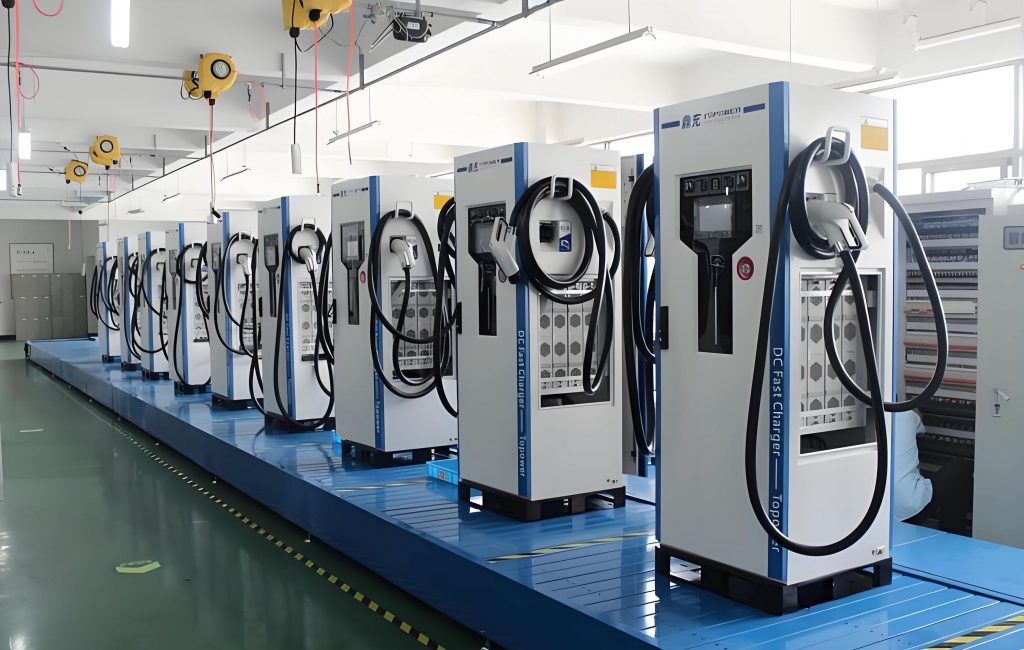
The increasing deployment of EV charging stations worldwide has led to a surge in decommissioned power modules, many of which are still functional but require fault diagnosis for reuse. In EV charging stations, power modules typically consist of a three-phase VIENNA rectifier front-end and an isolated DC-DC converter back-end. Failures often occur in switching devices like MOSFETs and diodes, leading to nonlinear and non-stationary current signals. Existing techniques, such as wavelet analysis and neural networks, face limitations in handling phase variations and small datasets. Our method leverages VMD to decompose signals into intrinsic mode functions (IMFs), PTSMFE to extract entropy-based features with phase weighting, and GWO-SVM for robust classification, achieving high accuracy in fault identification for EV charging station components.
Methodology Overview
The proposed fault diagnosis framework for EV charging station power modules involves three key steps: signal decomposition, feature extraction, and fault classification. First, VMD processes the raw current signals from the resonant cavity of the DC-DC converter to obtain IMFs. Then, PTSMFE computes multiscale entropy values while incorporating phase differences derived from signal symmetries. Finally, GWO-SVM classifies the fault types based on optimized parameters. This approach addresses the unique challenges of EV charging station diagnostics, such as phase shifts in switching faults and limited fault samples.
Variational Mode Decomposition (VMD)
VMD decomposes a signal $f(t)$ into $K$ band-limited IMFs $u_k(t)$ with center frequencies $\nu_k$. The constrained variational problem is formulated as:
$$ \min_{\{u_k\},\{\nu_k\}} \left\{ \sum_{k=1}^K \left\| \partial_t \left[ \left( \delta(t) + \frac{j}{\pi t} \right) * u_k(t) \right] e^{-j\nu_k t} \right\|_2^2 \right\} $$
subject to $\sum_{k=1}^K u_k(t) = f(t)$. The Lagrangian function introduces a penalty factor $\beta$ and multiplier $\lambda(t)$:
$$ \mathcal{L}(\{u_k\},\{\nu_k\},\lambda) = \beta \sum_{k=1}^K \left\| \partial_t \left[ \left( \delta(t) + \frac{j}{\pi t} \right) * u_k(t) \right] e^{-j\nu_k t} \right\|_2^2 + \left\| f(t) – \sum_{k=1}^K u_k(t) \right\|_2^2 + \langle \lambda(t), f(t) – \sum_{k=1}^K u_k(t) \rangle $$
Iterative updates using Fourier transforms yield the IMFs. For EV charging station signals, we set $K=8$ and $\beta=1000$ to capture fault-related frequencies. The decomposition isolates high-frequency components where faults manifest, improving feature extraction for diagnostics.
Phase Composite Time-Shift Multiscale Fuzzy Entropy (PTSMFE)
PTSMFE extends multiscale fuzzy entropy by incorporating phase information from time-series data. Given a signal $X = \{x(i), i=1,2,\dots,N\}$, the steps are:
- Symmetry Construction: Identify local maxima and minima to form upper $U(t)$ and lower $V(t)$ envelopes via cubic spline interpolation. The mean envelope $m_1(t)$ is:
$$ m_1(t) = \frac{U(t) + V(t)}{2} $$
Subtracting $m_1(t)$ from $X$ gives a symmetric series $Y = \{y(i)\}$.
- Phase Weight Calculation: Detect zero-crossings in $Y$ to form a phase sequence $Z = \{z_1, z_2, \dots, z_\tau\}$. The phase weight $T(t)$ is computed as:
$$ T_{\text{mean}}^\tau(t) = S \cdot \frac{\sum_{i=1}^\tau z_i}{\tau} $$
where $S=0.06$ is the phase coefficient optimized for EV charging station signals.
- Coarse-Graining with Phase Shift: For scale factor $\tau$, construct coarse-grained series $y_\beta^k$ with time shift $\beta$:
$$ y_\beta^k = \{x_k, x_{\beta+k}, x_{2\beta+k}, \dots, x_{\Delta(\beta,k)\beta+k}\} $$
where $\Delta(\beta,k) = \lfloor (N – \beta) / k \rfloor$. The distance between vectors $y_\beta^k(i)$ and $y_\beta^k(j)$ incorporates phase weight:
$$ d[y_\beta^k(i), y_\beta^k(j)] = \max_{h=0}^{m-1} |y_\beta^k(i+h) – y_\beta^k(j+h)| + j T(t) $$
- Fuzzy Entropy Computation: Calculate fuzzy entropy for dimensions $m$ and $m+1$ using fuzzy membership function $\mu(d_{ij}^m, n, r) = \exp(-(d_{ij}^m)^n / r)$. The PTSMFE value is:
$$ \text{PTSMFE}(X, S, \tau, m, n, r) = -\ln \frac{\bar{\phi}^{m+1}_{k,\tau}}{\bar{\phi}^m_{k,\tau}} $$
where $\bar{\phi}^m_{k,\tau} = \frac{1}{\tau} \sum_{k=1}^\tau \phi^m_{k,\tau}$. Parameters are set to $m=2$, $r=0.15$, $n=2$, and $\tau=10$ for EV charging station fault analysis. This method effectively captures phase differences in switching faults, enhancing feature discrimination.
GWO-SVM Classification
Support Vector Machine (SVM) is ideal for small-sample fault diagnosis in EV charging stations. We use a radial basis function (RBF) kernel, and GWO optimizes the penalty factor $c$ and kernel parameter $g$. The GWO algorithm mimics wolf hunting behavior with alpha, beta, and delta leaders guiding the search. The objective is to maximize five-fold cross-validation accuracy. The distance and position updates are:
$$ \vec{D} = |\vec{C} \cdot \vec{X}_p(t) – \vec{X}(t)| $$
$$ \vec{X}(t+1) = \vec{X}_p(t) – \vec{A} \cdot \vec{D} $$
where $\vec{A}$ and $\vec{C}$ are coefficient vectors. After optimization, SVM classifies fault states using the PTSMFE feature vectors.
Experimental Setup and Data Collection
We evaluated the method on a DC EV charging station test platform with electrical parameters summarized in Table 1. Faults were simulated in 20 power modules, covering 10 fault types and one normal state (E0). Resonant cavity current signals were sampled at 12 kHz for 0.6–0.7 s post-transient, with 200-point segments used for analysis. Each fault state had 30 samples, totaling 330 datasets.
| Parameter | Value |
|---|---|
| Front-end input voltage range | 323–456 V |
| Front-end input frequency | 50–60 Hz |
| Front-end switching frequency | 50 kHz |
| Front-end output voltage | 675–825 V |
| Back-end switching frequency | 20 kHz |
| Back-end output voltage | 250–750 V |
| Back-end output current | 0–25 A |
| Maximum output power | 15,000 W |
| Load resistance | 30 Ω |
Fault types include open-circuit failures in MOSFETs (e.g., E1–E4) and short-circuit faults in resonant components (e.g., E5–E7). For instance, faults E1 and E4 exhibit phase shifts in current waveforms due to switching mismatches at high loads. Figure 1 shows example current signals for normal and faulty states, highlighting phase variations critical for diagnosis in EV charging stations.
Feature Extraction and Parameter Optimization
VMD decomposed signals into 8 IMFs, with IMF3 and IMF4 selected for PTSMFE analysis due to their sensitivity to faults. The PTSMFE vectors for IMF3 and IMF4 across fault states are summarized in Table 2, showing distinct entropy patterns. For example, E1 (Q1 open) has higher entropy in IMF3 compared to E0, aiding classification.
| State | IMF3 PTSMFE | IMF4 PTSMFE |
|---|---|---|
| E0 | 0.00415, 0.00286, …, 0.00019 | 0.02003, 0.01201, …, 0.00422 |
| E1 | 0.27932, 0.28047, …, 0.24726 | 0.22378, 0.18521, …, 0.17148 |
| E2 | 0.21709, 0.18201, …, 0.16226 | 0.23097, 0.21756, …, 0.19935 |
| … | … | … |
| E10 | 0.03479, 0.03167, …, 0.02923 | 0.06997, 0.05645, …, 0.02437 |
To optimize performance, we tested dataset lengths and phase coefficients. As shown in Table 3, a length of 400 points balanced accuracy and computation time for EV charging station signals. The phase coefficient $S$ was varied, with $S=0.06$ yielding peak accuracy (97.27%) in GWO-SVM classification.
| Length | Accuracy (%) | Time (s) |
|---|---|---|
| 100 | 85.2 | 1.5 |
| 200 | 90.1 | 2.8 |
| 400 | 97.3 | 5.2 |
| 800 | 97.5 | 9.1 |
Fault Diagnosis Results and Comparison
We compared our VMD-PTSMFE-GWO-SVM method against wavelet analysis with BP neural networks. Using 330 samples (10 training, 10 validation, 10 testing per state), our approach achieved 97.27% accuracy, outperforming the baseline (94.54%). The confusion matrix in Table 4 illustrates precise fault localization for EV charging station modules, with minimal misclassification in E1–E4 states.
| Method | Macro-P | Macro-R | Macro-F1 | Accuracy (%) |
|---|---|---|---|---|
| Proposed | 0.9744 | 0.9727 | 0.9735 | 97.27 |
| Wavelet-BP | 0.9500 | 0.9454 | 0.9477 | 94.54 |
The GWO-SVM optimization process converged efficiently, with best parameters $c=12.5$ and $g=0.45$. The PTSMFE feature curves for IMF3 and IMF4 (Figures 2 and 3) show clear separation between fault states, validating the phase-weighted entropy approach for EV charging station diagnostics.
Conclusion
This study presents a robust fault diagnosis method for EV charging station power modules, combining VMD, PTSMFE, and GWO-SVM. The integration of phase information into entropy analysis addresses key challenges in switch fault localization, while GWO-SVM ensures high accuracy with small samples. Experimental results demonstrate superiority over traditional methods, facilitating recycling and reuse of EV charging station components. Future work will explore real-time implementation and adaptation to other power electronics systems in EV infrastructure.