
As an expert in the field of electric vehicle (EV) repair, I have observed that the widespread adoption of new energy vehicles hinges on addressing critical issues like power battery voltage differences. In this article, I will delve into the causes of these faults and propose effective repair techniques, focusing on practical solutions for electrical car repair. The growing emphasis on EVs underscores the need for robust maintenance strategies to ensure reliability and performance. Throughout this discussion, I will incorporate tables and formulas to summarize key points, enhancing clarity for professionals in EV repair.
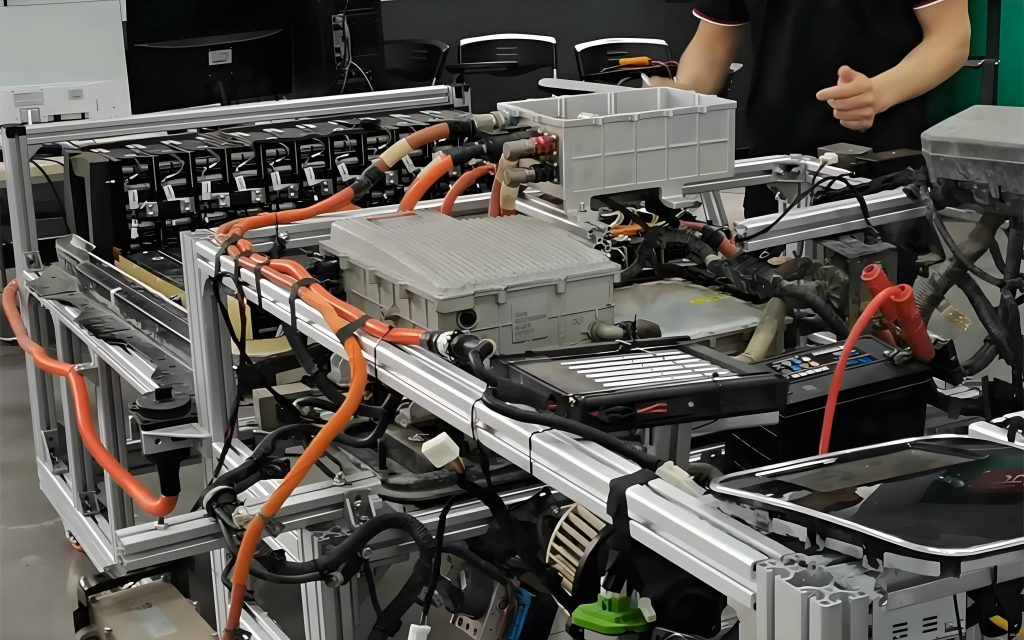
New energy vehicles, including hybrid, pure electric, fuel cell, and other alternative energy cars, represent a shift toward sustainable transportation. Their structure typically comprises components like the HV battery, charger, charging port, drive unit, HV junction box, DC-to-DC converter, PTC coolant heater, A/C compressor, and PTC cabin heater. These elements work in tandem to deliver efficient power, but the heart of the system—the power battery—often faces challenges such as voltage discrepancies. In my experience with electrical car repair, understanding the battery’s architecture is crucial; it consists of series-connected cells, insulation layers, cooling systems, battery modules, and management units. The voltage difference, or ΔV, arises from variations among individual cells and can be expressed mathematically. For instance, if we have n series-connected cells, the total voltage V_total is given by:
$$ V_{\text{total}} = \sum_{i=1}^{n} V_i $$
where V_i represents the voltage of each cell. The voltage difference ΔV is defined as:
$$ \Delta V = \max(V_i) – \min(V_i) $$
When ΔV exceeds a permissible threshold, it indicates a fault that requires immediate attention in EV repair. This can lead to reduced range, performance issues, and even safety hazards. To illustrate the common causes, I have compiled a table based on my observations in electrical car repair scenarios.
| Cause Category | Description | Impact on ΔV |
|---|---|---|
| Individual Cell Issues | Problems like low capacity, leakage, or sulfation in single cells within the series. | Increases ΔV due to uneven voltage distribution. |
| Distribution Copper Bar Faults | Poor contact between copper bars and battery modules, leading to ineffective monitoring. | Prevents accurate ΔV regulation, exacerbating discrepancies. |
| Low-Voltage Harness Problems | Short circuits, breaks, or poor connections in sampling wires for voltage and temperature data. | Disrupts data transmission to controllers, causing unmanaged ΔV. |
In my work with EV repair, I have found that individual cell issues are a primary contributor to voltage differences. Each cell in a series must maintain consistent performance; otherwise, the overall battery efficiency declines. For example, if one cell has a lower capacity, it discharges faster, leading to a voltage drop that increases ΔV. This can be modeled using the capacity formula:
$$ C_{\text{effective}} = \min(C_i) \quad \text{for} \quad i = 1 \text{ to } n $$
where C_i is the capacity of each cell. When C_effective is low, the battery pack cannot deliver optimal power, highlighting the need for regular inspections in electrical car repair. Similarly, distribution copper bars play a critical role in managing module voltages. If these bars are faulty, they fail to balance the voltages, resulting in a cascading effect on ΔV. The resistance R in the copper bar can be described by:
$$ R = \rho \frac{L}{A} $$
where ρ is resistivity, L is length, and A is cross-sectional area. High resistance due to corrosion or poor connections impedes current flow, worsening voltage imbalances. As part of EV repair protocols, I recommend using multimeters to measure these parameters and ensure they are within specifications.
Low-voltage harnesses are another area where faults commonly occur in electrical car repair. These harnesses collect data from cells and transmit it to controllers for real-time adjustments. If a harness has a short circuit, the voltage readings become inaccurate, leading to improper ΔV management. The relationship between voltage V, current I, and resistance R in a harness can be expressed by Ohm’s law:
$$ V = I \times R $$
When R approaches zero in a short circuit, V drops abnormally, causing false ΔV alarms. To address this, I have developed a systematic approach for EV repair, which includes diagnostic steps and corrective actions. The following table summarizes key repair techniques that I employ in my practice.
| Technique | Procedure | Tools Used | Expected Outcome |
|---|---|---|---|
| Individual Cell Inspection | Use voltage testers to measure each cell’s voltage and capacitance; replace faulty cells. | Multimeter, capacitance meter | Restores balanced ΔV within permissible limits. |
| Controller Maintenance | Clean controllers with pure water, check for contact issues, and update firmware. | Soft brushes, diagnostic software | Ensures accurate ΔV monitoring and adjustment. |
| Detector Calibration | Inspect detectors for shorts or poor connections; recalibrate or replace components. | Oscilloscope, continuity tester | Improves data accuracy for ΔV management. |
In my experience with EV repair, individual cell inspection is the first step in resolving voltage difference issues. By testing each cell’s voltage V_i and ensuring it falls within the acceptable range, typically between 3.2V and 4.2V for lithium-ion cells, I can identify outliers. The standard deviation σ of cell voltages can be calculated as:
$$ \sigma = \sqrt{\frac{1}{n} \sum_{i=1}^{n} (V_i – \bar{V})^2} $$
where \bar{V} is the average voltage. If σ exceeds a threshold, it signals the need for cell replacement—a common task in electrical car repair. Additionally, I assess internal resistance R_int using:
$$ R_{\text{int}} = \frac{V_{\text{open}} – V_{\text{load}}}{I} $$
where V_open is the open-circuit voltage, V_load is under load, and I is the current. High R_int indicates degradation, necessitating proactive maintenance in EV repair to prevent ΔV faults.
Controller maintenance is equally vital in electrical car repair, as controllers regulate module voltages and monitor sampling harnesses. I often simulate fault conditions to test controller responses, using equations like the proportional-integral-derivative (PID) control for voltage adjustment:
$$ u(t) = K_p e(t) + K_i \int_0^t e(\tau) d\tau + K_d \frac{de(t)}{dt} $$
where u(t) is the control output, e(t) is the error in ΔV, and K_p, K_i, K_d are tuning parameters. By ensuring controllers are free from dust and have secure connections, I minimize the risk of ΔV-related failures. Similarly, detector calibration involves verifying that sensors accurately transmit temperature and voltage data. In EV repair, I use calibration curves to adjust detector outputs, often represented as:
$$ V_{\text{corrected}} = a \times V_{\text{measured}} + b $$
where a and b are calibration constants. This ensures that ΔV calculations are precise, enabling timely interventions.
To further elaborate on the importance of these techniques in EV repair, I have encountered cases where unaddressed voltage differences led to complete battery failure. For instance, in a series of 100 cells, if ΔV exceeds 0.1V, the effective capacity drops significantly, as per the formula:
$$ C_{\text{loss}} = C_{\text{nominal}} \times \left(1 – \frac{\Delta V}{V_{\text{max}}}\right) $$
where C_nominal is the rated capacity and V_max is the maximum cell voltage. This underscores why regular maintenance is critical in electrical car repair. Moreover, the integration of battery management systems (BMS) plays a key role; the BMS continuously computes ΔV and triggers alarms if thresholds are breached. In my EV repair practice, I recommend using advanced tools like battery analyzers to log data over time, allowing for predictive maintenance.
In conclusion, addressing power battery voltage difference faults is essential for the advancement of new energy vehicles. Through systematic EV repair approaches—such as individual cell checks, controller upkeep, and detector calibration—we can mitigate these issues and enhance vehicle reliability. As the demand for electrical car repair grows, sharing these insights will foster innovation and sustainability in the automotive industry. By applying the formulas and tables discussed, professionals can streamline their workflows and contribute to the broader adoption of EVs.