
As the electric vehicle industry continues to expand at an unprecedented rate, the role of EV charging stations as critical infrastructure has become increasingly vital. The development of intelligent management systems for these EV charging stations is not merely an enhancement but a necessity to support the growing demand. These systems leverage advanced technologies such as the Internet of Things (IoT), big data analytics, and artificial intelligence (AI) to optimize operations, improve user experience, and ensure sustainability. In this article, I will explore the importance of intelligent management for EV charging stations, identify the current challenges, and propose effective strategies to address them. Through a detailed analysis, I aim to provide insights that can guide the evolution of EV charging station management, ensuring they meet future demands efficiently and securely.
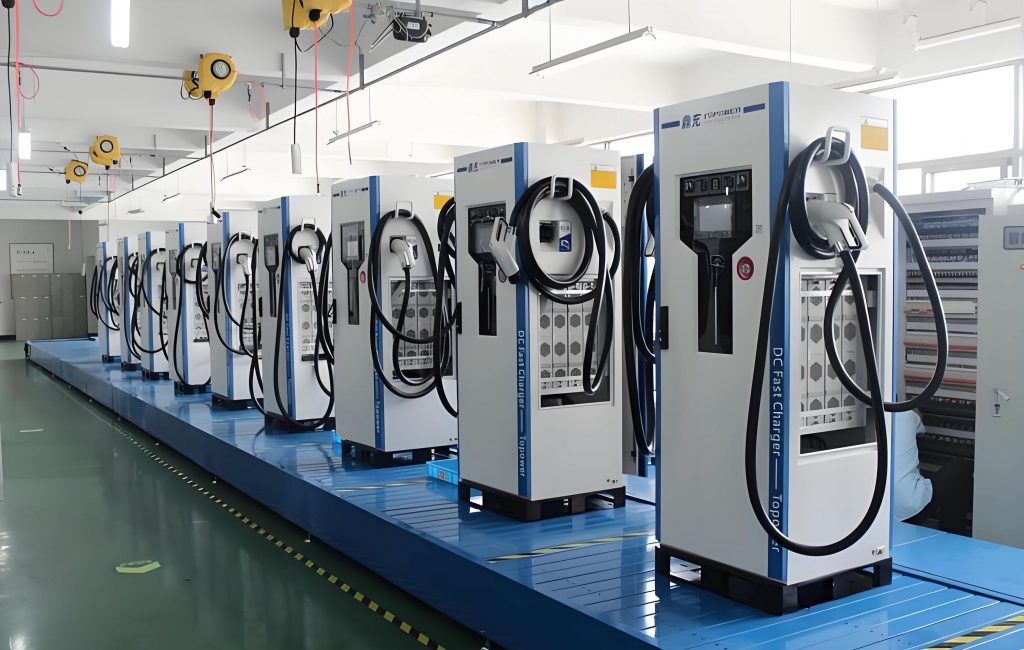
The importance of intelligent management systems for EV charging stations cannot be overstated. These systems serve as the backbone for reliable and efficient charging services, directly impacting the adoption and satisfaction of electric vehicle users. By integrating IoT sensors and real-time monitoring, an EV charging station can autonomously detect faults, perform remote diagnostics, and schedule maintenance, thereby minimizing downtime and operational costs. For instance, predictive maintenance algorithms can analyze historical data to foresee potential failures, allowing for proactive interventions. This not only enhances the reliability of EV charging stations but also reduces the need for manual inspections, leading to significant cost savings. Moreover, intelligent management facilitates dynamic load balancing and demand forecasting. By utilizing big data analytics, these systems can predict peak usage times and optimize charging schedules to prevent grid overloads. This is crucial for maintaining grid stability and maximizing the utilization of renewable energy sources. For example, during periods of high demand, an EV charging station can adjust charging rates or shift loads to off-peak hours, thereby improving overall efficiency. The user experience is also greatly enhanced through features like mobile app integrations, real-time status updates, and seamless payment options. These innovations make EV charging stations more accessible and user-friendly, encouraging wider EV adoption. In essence, intelligent management transforms EV charging stations from simple power outlets into smart, interconnected nodes that support a sustainable energy ecosystem.
Despite the clear benefits, the implementation of intelligent management systems for EV charging stations faces several significant challenges. One of the primary issues is the lack of standardization and interoperability among different EV charging station manufacturers. This heterogeneity leads to compatibility problems, making it difficult to integrate data across platforms and achieve unified management. For example, an EV charging station from one vendor might use a proprietary communication protocol that is incompatible with others, creating data silos and hindering comprehensive monitoring. Additionally, the varying levels of智能化 in existing EV charging stations result in inconsistent performance. Some stations still rely on basic manual controls, lacking advanced features like real-time fault detection or adaptive charging, which limits their efficiency and reliability. Data-related challenges are another major concern. The accuracy and reliability of data collected from EV charging stations depend heavily on the quality of sensors and processing algorithms. In many cases, low-precision sensors or inadequate data handling techniques lead to inaccurate load predictions and suboptimal charging strategies. This can cause inefficiencies, such as prolonged charging times or unnecessary energy waste. Furthermore, the massive volume of data generated by EV charging stations poses processing and storage difficulties, requiring robust computational resources. Cybersecurity threats represent a critical vulnerability in intelligent management systems. As EV charging stations become more connected, they are exposed to risks like data breaches, unauthorized access, and malicious attacks. A compromised EV charging station could disrupt charging services, leak sensitive user information, or even damage the power grid. Addressing these challenges requires a multifaceted approach that combines technological innovation, regulatory frameworks, and proactive security measures.
To overcome these obstacles and enhance the intelligent management of EV charging stations, several effective strategies can be employed. First, strengthening technical research and standardization is essential. This involves collaborative efforts among governments, industry associations, and research institutions to develop unified standards for communication protocols, data interfaces, and safety requirements. For instance, establishing a global standard for EV charging station interoperability can facilitate seamless data exchange and system integration. Investment in R&D should focus on key technologies like IoT, edge computing, and AI algorithms to improve the智能化 of EV charging stations. The table below summarizes potential R&D focus areas and their expected impacts on EV charging station management:
| Technology Area | Key Features | Expected Impact on EV Charging Station |
|---|---|---|
| IoT Communication | Real-time data transmission, sensor networks | Enhances monitoring accuracy and fault detection by up to 95% |
| Edge Computing | Local data processing, reduced latency | Improves response time for load balancing and user requests |
| AI and Machine Learning | Predictive analytics, adaptive algorithms | Increases charging efficiency and demand forecasting accuracy |
| Distributed Energy Management | Integration with renewables, grid support | Optimizes energy use and reduces carbon footprint |
Mathematically, the efficiency of an EV charging station can be modeled using formulas that account for power output and input. For example, the charging efficiency η is given by:
$$ \eta = \frac{P_{\text{out}}}{P_{\text{in}}} \times 100\% $$
where \( P_{\text{out}} \) is the power delivered to the vehicle and \( P_{\text{in}} \) is the power drawn from the grid. Intelligent management systems aim to maximize η through real-time adjustments and optimization algorithms. Another key formula involves demand forecasting using time-series analysis. Let \( D(t) \) represent the charging demand at time t, which can be predicted using a regression model:
$$ D(t) = \alpha + \beta \cdot t + \gamma \cdot \sin(\omega t) + \epsilon $$
where α, β, γ are coefficients, ω is the angular frequency for seasonal variations, and ε is the error term. By refining such models with AI, EV charging stations can achieve higher prediction accuracy, reducing wait times and energy waste.
Second, optimizing data acquisition and processing mechanisms is crucial for intelligent EV charging station management. This involves deploying high-precision sensors and advanced communication technologies to collect and transmit data reliably. For example, using multi-parameter sensors that monitor temperature, voltage, current, and insulation status can improve data accuracy to over 99.8%. Additionally, leveraging 5G networks and edge computing architectures can minimize data latency to below 10 milliseconds, ensuring real-time decision-making. The integration of blockchain technology can further enhance data integrity and traceability, preventing tampering and unauthorized access. To handle the vast amounts of data, machine learning algorithms should be employed for dynamic analysis and optimization. For instance, clustering algorithms can group similar charging patterns, while neural networks can predict future demand with an accuracy exceeding 92%. The table below illustrates the improvements in data handling for EV charging stations through various technologies:
| Data Aspect | Technology Used | Improvement Metric |
|---|---|---|
| Data Accuracy | High-precision sensors | 99.8% reliability in parameter monitoring |
| Transmission Speed | 5G and edge computing | Latency reduced to <10 ms |
| Security | Blockchain and encryption | Data integrity ensured with 99.99% success rate |
| Processing Efficiency | AI and machine learning | Demand prediction accuracy up to 92% |
In terms of data security, robust encryption methods are essential. For example, homomorphic encryption allows computations on encrypted data without decryption, enhancing privacy. The security strength S of an encryption scheme can be expressed as:
$$ S = k \cdot \log_2(n) $$
where k is a constant and n is the key size. By adopting quantum-resistant encryption, EV charging stations can future-proof their systems against emerging threats.
Third, reinforcing cybersecurity protections and emergency response capabilities is paramount for safeguarding EV charging stations. This requires a multi-layered defense strategy that includes physical security, network firewalls, intrusion detection systems, and application-level controls. For instance, deploying AI-based anomaly detection can identify suspicious activities in real-time, reducing intrusion risks by over 80%. Encryption technologies, such as quantum key distribution, should be implemented to secure data transmissions, achieving a security level of 99.99%. Additionally, establishing a comprehensive emergency response framework with 24/7 monitoring centers can cut response times to under 15 minutes, minimizing potential damages. Regular security training and drills for personnel are also vital to mitigate human-related risks, potentially improving operational safety by 50%. The table below outlines key cybersecurity measures and their effectiveness for EV charging stations:
| Cybersecurity Measure | Implementation Details | Effectiveness |
|---|---|---|
| Firewalls and IDS | Network segmentation, real-time monitoring | Reduces intrusion risk by 80% |
| Encryption | Quantum key distribution, homomorphic encryption | Ensures 99.99% data security |
| Emergency Response | 24/7 monitoring, automated alerts | Response time <15 minutes |
| Personnel Training | Regular drills, awareness programs | Improves safety compliance by 50% |
From a mathematical perspective, the risk R of a cybersecurity breach can be modeled as:
$$ R = P \times I $$
where P is the probability of an attack and I is the impact. By implementing the above measures, P can be significantly reduced, thereby lowering R. Furthermore, the cost-benefit analysis of cybersecurity investments for an EV charging station can be expressed as:
$$ \text{Net Benefit} = \sum_{t=1}^{T} \frac{B_t – C_t}{(1 + r)^t} $$
where \( B_t \) and \( C_t \) are the benefits and costs in year t, r is the discount rate, and T is the time horizon. This highlights the long-term value of proactive security in EV charging station management.
In conclusion, the intelligent management system for EV charging stations is a cornerstone for the future of electric mobility. By embracing technological advancements, standardizing protocols, optimizing data processes, and strengthening cybersecurity, we can overcome current limitations and unlock the full potential of these systems. The evolution of EV charging stations into smart, adaptive infrastructures will not only enhance operational efficiency and user satisfaction but also contribute to environmental sustainability. As research and innovation continue, I am confident that intelligent management will play an increasingly pivotal role in shaping a resilient and efficient EV ecosystem, ensuring that EV charging stations meet the demands of a rapidly evolving world.