
In recent years, EV cars have gained widespread adoption, with their market share steadily increasing as they replace traditional internal combustion engine vehicles. The integration of intelligent driving modes in EV cars represents a significant advancement, enabling better adaptation to complex traffic conditions, contributing to environmental protection, promoting low-carbon economic development, and reducing the incidence of traffic accidents. However, intelligent driving technologies still face numerous challenges, necessitating enhanced research into the safety performance and intelligent driving modes of EV cars. In my study, I aim to explore these aspects by focusing on technological innovation, regulatory improvements, international collaboration, and talent development to foster the sustainable growth of the EV car industry. This article delves into the evaluation methods for safety performance, measures to enhance it, and the implementation of intelligent driving modes, all from a first-person perspective as I analyze and propose solutions based on extensive research.
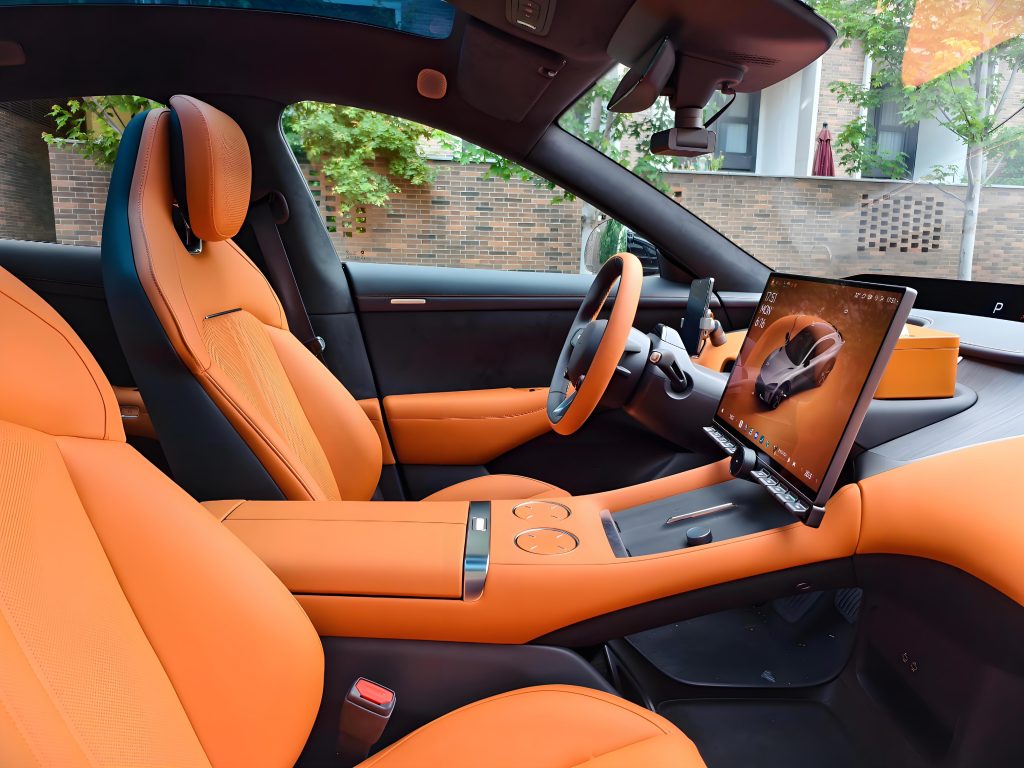
As I investigate the safety performance of EV cars, it becomes evident that a comprehensive assessment is crucial for ensuring reliability and user trust. EV cars, with their complex electrical systems and advanced features, require meticulous evaluation to address potential risks. In my analysis, I employ various methods, including sensor testing, data collection and analysis, simulation testing, and identification of safety risks. These approaches allow me to quantitatively and qualitatively assess the safety of EV cars, leading to targeted improvements. For instance, in sensor testing, I deploy multiple sensors to monitor real-time performance parameters, which helps in evaluating overall safety coefficients. Below, I present a table summarizing the key sensors used in EV cars and their functions, based on my research findings.
| Sensor Type | Primary Function | Application in EV Cars |
|---|---|---|
| Acceleration Sensor | Measures changes in velocity and impact forces | Used in collision tests to assess passive safety by analyzing acceleration patterns during impacts. |
| Temperature Sensor | Monitors thermal conditions of components | Applied in battery and motor thermal stability tests to detect overheating and prevent thermal runaway. |
| Displacement Sensor | Measures movement and deformation | Evaluates structural integrity post-collision by tracking displacement of key parts like the battery pack. |
In my work with sensor testing for EV cars, I ensure that multiple sensors are deployed simultaneously to cross-verify data and minimize errors. For example, acceleration sensors are strategically placed on the vehicle body to conduct collision tests, where I control the EV car to impact objects at specified speeds. The data collected, such as acceleration changes, helps me determine if safety standards are met. Similarly, temperature sensors are crucial for monitoring the battery and motor in EV cars, as overheating can lead to severe failures. I often use mathematical models to interpret sensor data; for instance, the relationship between temperature rise and risk can be expressed using a formula like $$ T_{\text{risk}} = k \cdot \Delta T $$ where \( T_{\text{risk}} \) is the risk level, \( k \) is a constant, and \( \Delta T \) is the temperature change. This quantitative approach allows me to set threshold values for safe operation in EV cars.
Moving to data collection and analysis, I focus on processing the sensor data to evaluate the safety performance of EV cars. In my research, I employ both manual and intelligent analysis methods. Manual analysis, while useful, is subjective and prone to human error, so I prefer intelligent models like Artificial Neural Networks (ANNs) for their ability to handle non-linear data. For EV cars, the input variables include sensor measurements, and the output is a safety assessment score. The ANN model can be represented as: $$ y = f\left( \sum_{i=1}^{n} w_i x_i + b \right) $$ where \( y \) is the output safety score, \( x_i \) are the input sensor data points, \( w_i \) are weights, \( b \) is the bias, and \( f \) is the activation function. This model helps me identify patterns and anomalies in EV cars’ performance, ensuring accurate evaluations. Additionally, I conduct data validation to remove outliers, as erroneous data can skew results. In my experience, this process is vital for maintaining the reliability of EV cars, and I often use correlation analysis to check data consistency.
Simulation testing is another critical aspect of my research on EV cars, as it allows me to replicate extreme conditions in a controlled environment. I utilize advanced simulation equipment, such as high-speed impact testers, environmental chambers, and multi-axis vibration tables, to mimic various road and weather scenarios. For EV cars, these tests include collision simulations, environmental durability tests, and vibration assessments. In collision tests, I analyze the deformation of the vehicle structure to evaluate crashworthiness, while environmental tests expose EV cars to high and low temperatures, strong winds, and heavy rain to assess the stability of electrical systems. Vibration tests help me understand the comfort and structural integrity of EV cars on rough terrains. Below is a table summarizing the key simulation tests I perform for EV cars, along with their parameters and objectives.
| Test Type | Simulated Conditions | Key Parameters | Objective |
|---|---|---|---|
| Collision Test | Impact at different angles and speeds | Collision velocity, acceleration data | Assess passive safety and structural integrity of EV cars. |
| Environmental Test | Extreme temperatures, rain, wind | Temperature, humidity, electrical parameters | Evaluate thermal stability and component reliability in EV cars. |
| Vibration Test | Rough road surfaces | Vibration frequency, amplitude | Test durability and comfort of EV cars under dynamic loads. |
During these simulations, I meticulously record data using sensors and high-speed cameras, and I often apply statistical formulas to analyze the results. For example, the mean value of effective data points is calculated as: $$ \bar{x} = \frac{1}{n} \sum_{i=1}^{n} x_i $$ where \( \bar{x} \) is the average, and \( x_i \) are the individual measurements. This helps me derive reliable conclusions about the safety of EV cars. In my findings, I have identified common safety risks in EV cars, such as battery explosions, control system failures, and structural weaknesses. These issues often arise under extreme conditions, highlighting the need for robust design and management strategies.
To enhance the safety performance of EV cars, I propose several measures based on my research. First, battery management is paramount, as batteries are among the most critical and risk-prone components in EV cars. I recommend implementing state limitation techniques, where protective chips are embedded in the battery pack to monitor and restrict operations during abnormal conditions like overcurrent or overvoltage. The power limitation can be modeled as: $$ P_{\text{limit}} = \min(P_{\text{max}}, P_{\text{actual}}) $$ where \( P_{\text{limit}} \) is the restricted power, \( P_{\text{max}} \) is the safe upper limit, and \( P_{\text{actual}} \) is the current power. Additionally, improving heat dissipation in EV cars is essential; I optimize the thermal management system using materials with high thermal conductivity, reducing the risk of overheating. Controlling the charging and discharging processes is also crucial; I set upper limits for power levels to prevent short circuits and extend battery life in EV cars.
Second, optimizing the electrical control system in EV cars is vital for preventing insulation breakdowns and system failures. In my approach, I enhance insulation by using advanced materials, such as Type II insulated windings with anti-corona layers, and I thicken insulation layers in high-voltage areas. Online monitoring systems are integrated to detect anomalies in real-time, with automated alerts and emergency responses. For fault diagnosis, I employ intelligent algorithms that can quickly identify and isolate issues, ensuring the reliability of EV cars. The fault detection process can be described using a probability model: $$ P(\text{fault}) = 1 – \exp(-\lambda t) $$ where \( P(\text{fault}) \) is the probability of a fault occurring, \( \lambda \) is the failure rate, and \( t \) is time. This helps me prioritize maintenance and improvements for EV cars.
Third, I focus on the structural design of EV cars to improve crash safety and durability. By using high-strength, lightweight materials like aluminum alloys, I reduce the overall weight of EV cars, enhancing energy efficiency and collision resistance. Finite element analysis (FEA) and dynamics simulations are integral to my design process; for instance, I model stress distributions using equations like: $$ \sigma = E \cdot \epsilon $$ where \( \sigma \) is stress, \( E \) is Young’s modulus, and \( \epsilon \) is strain. This allows me to optimize components such as the A-pillar and rear sections, increasing the safety margin for EV cars. Moreover, I improve waterproofing and sealing in critical areas like the battery compartment, conducting water immersion tests to validate performance. The table below summarizes the key measures I advocate for enhancing the safety of EV cars.
| Measure Category | Specific Actions | Impact on EV Cars |
|---|---|---|
| Battery Management | State limitation, improved散热, controlled charging | Reduces risk of thermal runaway and extends battery life in EV cars. |
| Electrical Control System | Enhanced insulation, online monitoring, fault diagnosis | Prevents electrical failures and ensures stable operation of EV cars. |
| Structural Optimization | Use of lightweight materials, FEA, waterproofing | Improves crashworthiness and durability of EV cars in diverse conditions. |
Transitioning to the intelligent driving mode in EV cars, I explore its implementation to achieve autonomous and adaptive driving. In my research, I design an architecture that includes environmental perception, intelligent decision-making, and execution control. For environmental perception, I deploy sensors like CCD industrial cameras, laser radars, and IMUs on EV cars to collect data on the surroundings. This data is processed to map drivable areas and detect obstacles. Intelligent decision-making relies on controllers such as IPC industrial computers or PLCs, which generate driving strategies based on real-time inputs. Execution control involves subsystems for steering, braking, and acceleration, ensuring that EV cars respond appropriately to dynamic conditions. The overall architecture can be represented as a feedback loop: $$ \text{Perception} \rightarrow \text{Decision} \rightarrow \text{Execution} \rightarrow \text{Feedback} $$ This loop enables EV cars to navigate complex environments safely.
One key technology I employ for perception in EV cars is binocular camera image acquisition. By mounting two CCD cameras on the vehicle, I capture stereo images to estimate distances to objects using triangulation. The distance \( d \) can be calculated as: $$ d = \frac{f \cdot B}{x_l – x_r} $$ where \( f \) is the focal length, \( B \) is the baseline distance between cameras, and \( x_l \) and \( x_r \) are the pixel disparities in the left and right images. However, issues like camera distortion and image blur can introduce errors, so I apply calibration and preprocessing techniques. For instance, I use chessboard patterns for camera calibration to determine intrinsic and extrinsic parameters, and I enhance images through grayscale conversion, filtering, and sharpening. This improves the accuracy of environmental perception for EV cars, making intelligent driving more reliable.
Developing a smart central control system is another focal point in my work on EV cars. This system integrates subsystems for steering, braking, and acceleration, and I design control strategies based on predictive models. For example, I build a two-degree-of-freedom vehicle dynamics model to simulate EV car behavior: $$ m \ddot{x} = F_x – F_{\text{drag}} $$ where \( m \) is the mass, \( \ddot{x} \) is acceleration, \( F_x \) is the driving force, and \( F_{\text{drag}} \) is the drag force. Using model predictive control, I forecast the paths of surrounding vehicles and determine optimal steering angles and timings for EV cars. The control commands are generated dynamically, adapting to changes in the environment. This approach enhances the responsiveness and safety of intelligent driving in EV cars.
Furthermore, I implement diverse human-machine interaction methods to make EV cars more user-friendly and intuitive. In my research, I incorporate voice, gesture, and gaze interactions to understand driver intentions and provide customized services. For voice interaction, I use advanced recognition software like百度 AI frameworks, which convert audio inputs into control commands for EV cars. The recognition accuracy can be modeled as: $$ A = \frac{\text{Correct Recognitions}}{\text{Total Commands}} $$ where \( A \) is the accuracy rate. This allows EV cars to execute instructions for media control, navigation, and driving adjustments, improving the overall experience. By integrating these interactions, I aim to make intelligent driving in EV cars more accessible and efficient.
In conclusion, my research on EV cars underscores the importance of advancing safety performance and intelligent driving modes. Through rigorous evaluation methods and targeted improvements, I have identified ways to mitigate risks and enhance reliability in EV cars. The implementation of intelligent driving technologies, supported by robust architectures and interactive systems, promises to transform the EV car industry. As I continue my work, I emphasize the need for ongoing innovation, collaboration, and education to address challenges and drive sustainable development. EV cars represent the future of transportation, and by focusing on safety and intelligence, we can unlock their full potential for society.