
In the rapidly evolving automotive industry, hybrid cars have emerged as a pivotal solution for enhancing fuel efficiency and reducing emissions. As a researcher focused on automotive safety and durability, I have investigated a critical issue in hybrid car battery systems: the vibration-induced seal failure of battery enclosures. This problem compromises the integrity of the battery pack, leading to potential water ingress, short circuits, and severe safety hazards like fires or explosions. Through this study, I aim to address the root causes and propose structural optimizations to enhance the reliability of hybrid car battery enclosures under vibration loads. The performance of these enclosures is paramount for ensuring the overall safety and longevity of hybrid cars, which are increasingly adopted worldwide.
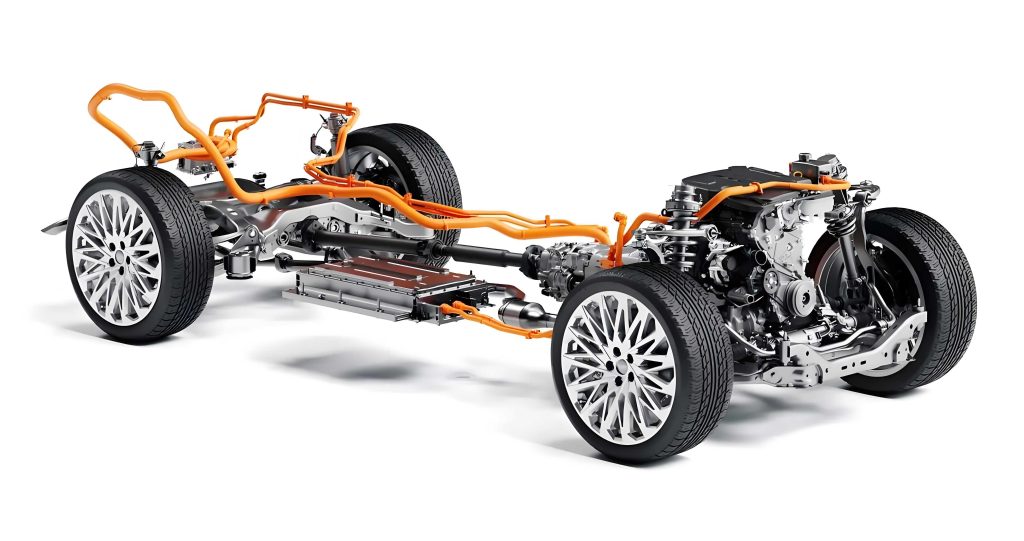
The battery enclosure in a hybrid car serves as a protective shell for the battery modules, shielding them from environmental factors and mechanical stresses. In this research, I analyzed a specific hybrid car battery enclosure that exhibited seal failure after vibration testing, as per industry standards. The failure was traced to fatigue cracking at weld joints, which undermined the enclosure’s airtightness. Using CAE simulation tools, I identified stress concentrations and modal weaknesses, leading to targeted optimizations such as modifying weld layers, adjusting structural adhesive paths, and adding reinforcement patches. These measures significantly improved the weld joint fatigue life and ensured compliance with sealing requirements. This work underscores the importance of robust design in hybrid car battery systems, contributing to safer and more durable vehicles.
To provide a comprehensive understanding, I will delve into the structural analysis, vibration testing methodologies, modal analysis via finite element methods, and the optimization strategies implemented. Throughout this article, I will emphasize the relevance to hybrid cars, as their unique powertrain configurations place distinct demands on battery enclosures. The integration of tables and mathematical formulas will help summarize key findings and theoretical frameworks.
Introduction to Hybrid Car Battery Enclosures and Vibration Challenges
Hybrid cars combine internal combustion engines with electric propulsion systems, relying on high-voltage battery packs for energy storage. The battery enclosure, typically made of metal or composite materials, must withstand various dynamic loads, including vibrations from road irregularities and vehicle operation. Vibration-induced failures can lead to seal breaches, allowing moisture or contaminants to enter, which is particularly critical for hybrid cars due to their complex electrical systems. According to industry standards like GB/T 31467.3-2015, battery enclosures must pass rigorous vibration tests to ensure safety and durability. However, in this case study, a hybrid car battery enclosure failed these tests due to weld joint fatigue, prompting a detailed investigation.
The primary objective of this study is to optimize the battery enclosure design to prevent seal failure. I employed a seven-diamonds quality tool for initial analysis, but no issues were found in the first four diamonds, directing focus to CAE simulation. The root cause was identified as fatigue cracking at weld points, driven by resonant vibrations. By optimizing the structure, I enhanced the modal properties and reduced stress concentrations, ultimately extending the fatigue life of weld joints. This approach not only resolves the immediate issue but also offers a framework for designing more resilient battery enclosures for hybrid cars. The following sections elaborate on the methodology and results.
Structural Analysis and Layout of the Hybrid Car Battery Enclosure
The battery enclosure in this hybrid car model consists of three main components: the upper cover assembly, the middle reinforcement plate assembly, and the bottom guard plate assembly. These parts are assembled using weld joints and structural adhesives to form a sealed unit. The enclosure is positioned beneath the passenger compartment, between the third and fourth cross members, and is secured to the rear floor via two small longitudinal beams. Four mounting brackets play a crucial role in stabilizing the enclosure during vibration events. The layout is designed to protect the battery modules from impacts and vibrations, but initial testing revealed vulnerabilities at the bracket weld joints.
To understand the structural dynamics, I developed a finite element model (FEM) of the battery enclosure. The model includes detailed representations of the weld joints, adhesive bonds, and material properties. The enclosure is subjected to random vibrations in three orthogonal directions (X, Y, and Z), as per testing protocols. The key parameters for the hybrid car battery enclosure are summarized in Table 1.
| Component | Material | Thickness (mm) | Number of Weld Joints | Modal Frequency Target (Hz) |
|---|---|---|---|---|
| Upper Cover | Aluminum Alloy | 1.5 | 120 | ≥ 40 |
| Middle Reinforcement Plate | Steel | 2.0 | 80 | ≥ 50 |
| Bottom Guard Plate | Steel | 2.5 | 100 | ≥ 45 |
| Mounting Brackets | Steel | 3.0 | 40 | N/A |
The weld joints are critical connection points, and their fatigue life is influenced by stress concentrations and vibrational modes. For hybrid cars, the battery enclosure must maintain integrity over the vehicle’s lifespan, which involves millions of vibration cycles. The initial design had a low target for grounding modal frequency, leading to resonance issues during testing. This highlights the need for precise modal analysis and optimization in hybrid car battery systems.
Vibration Testing Protocols for Hybrid Car Battery Enclosures
Vibration testing is essential to validate the durability of battery enclosures in hybrid cars. The tests simulate real-world driving conditions, including random vibrations from road surfaces. According to GB/T 31467.3-2015, the battery pack must undergo vibration tests along three axes with specified power spectral density (PSD) profiles. The test duration exceeds standard requirements to ensure robustness. In this study, the hybrid car battery enclosure was subjected to random vibration tests, and seal failure occurred due to weld joint cracking at brackets 1 and 2.
The vibration input can be modeled as a random process with a PSD function. For a hybrid car, the vibration environment is characterized by:
$$S_{xx}(f) = \frac{A}{f^n}$$
where \(S_{xx}(f)\) is the PSD in \(g^2/Hz\), \(A\) is the amplitude constant, \(f\) is the frequency in Hz, and \(n\) is the slope exponent. Typical values for hybrid cars are \(A = 0.1\) and \(n = 3\) for frequencies from 10 to 1000 Hz. The cumulative damage from vibration is assessed using Miner’s rule for fatigue:
$$D = \sum_{i=1}^{k} \frac{n_i}{N_i}$$
where \(D\) is the total damage (failure occurs if \(D \geq 1\)), \(n_i\) is the number of cycles at stress level \(i\), and \(N_i\) is the fatigue life cycles at that stress level. For the hybrid car battery enclosure, the weld joints experienced high stress levels, leading to \(D > 1\) and subsequent cracking. Table 2 outlines the vibration test parameters.
| Direction | Frequency Range (Hz) | PSD Level (\(g^2/Hz\)) | Test Duration (hours) | Required Seal Performance |
|---|---|---|---|---|
| X-axis | 10-1000 | 0.05 | 12 | No leakage |
| Y-axis | 10-1000 | 0.04 | 12 | No leakage |
| Z-axis | 10-1000 | 0.03 | 12 | No leakage |
After testing, the hybrid car battery enclosure showed cracks at weld points A, C, and D on brackets 1 and 2, confirming seal failure. This prompted a deeper modal analysis to identify the root cause and guide optimizations.
Modal Analysis and Structural Optimization of the Hybrid Car Battery Enclosure
Using CAE simulation, I performed a modal analysis on the finite element model of the hybrid car battery enclosure. The goal was to determine the natural frequencies and mode shapes, which influence the vibration response. The equation of motion for the enclosure under vibration is:
$$M\ddot{x} + C\dot{x} + Kx = F(t)$$
where \(M\) is the mass matrix, \(C\) is the damping matrix, \(K\) is the stiffness matrix, \(x\) is the displacement vector, and \(F(t)\) is the external force vector from random vibration. Solving the eigenvalue problem \( (K – \omega^2 M) \phi = 0 \) yields the natural frequencies \(\omega_i\) and mode shapes \(\phi_i\). For the initial design, the first few modal frequencies were below target, causing resonance during testing.
The modal analysis revealed that the X-direction vibration induced the highest stresses, particularly at weld joints on brackets 1 and 2. The stress concentration factors (SCF) at these joints were calculated using:
$$\sigma_{max} = SCF \times \sigma_{nom}$$
where \(\sigma_{max}\) is the maximum stress, and \(\sigma_{nom}\) is the nominal stress. The SCF values exceeded 3.0 at critical weld points, indicating vulnerability. Table 3 summarizes the modal analysis results before optimization.
| Mode Number | Natural Frequency (Hz) | Mode Shape Description | Critical Weld Joints | Maximum Stress (MPa) |
|---|---|---|---|---|
| 1 | 35.2 | X-direction bending | A, C on Bracket 1 | 180 |
| 2 | 42.5 | Y-direction torsion | D on Bracket 2 | 150 |
| 3 | 48.7 | Z-direction rocking | B on Bracket 1 | 120 |
The root cause was identified as fatigue cracking due to cyclic stresses at weld joints. To address this, I implemented three optimization measures specifically tailored for hybrid car battery enclosures:
- Weld Layer Reduction: Changed three-layer welds (involving bracket outer plate, inner plate, and enclosure body) to two-layer welds at points A, B, C, and D on brackets 1 and 2. This improved stability and reduced stress concentrations.
- Structural Adhesive Path Modification: Adjusted the adhesive application paths on brackets 1 and 2 to enhance local stiffness and distribute stresses more evenly.
- Reinforcement Patch Addition: Added steel patches inside the enclosure near the weld joints to increase strength and fatigue resistance.
These optimizations were simulated in the CAE model, and the updated modal analysis showed significant improvements. The natural frequencies increased, and stress levels dropped. The fatigue life of weld joints was recalculated using the Smith-Watson-Topper (SWT) model for mean stress correction:
$$\sigma_{a} \cdot \varepsilon_{a} \cdot E = \frac{(\sigma_f’)^2}{E} (2N_f)^{2b} + \sigma_f’ \cdot \varepsilon_f’ (2N_f)^{b+c}$$
where \(\sigma_a\) is the stress amplitude, \(\varepsilon_a\) is the strain amplitude, \(E\) is Young’s modulus, \(\sigma_f’\) and \(\varepsilon_f’\) are fatigue strength and ductility coefficients, \(b\) and \(c\) are exponents, and \(N_f\) is the fatigue life cycles. For the optimized hybrid car battery enclosure, \(N_f\) increased by over 200% at critical joints. Table 4 compares the results before and after optimization.
| Metric | Before Optimization | After Optimization | Improvement |
|---|---|---|---|
| First Natural Frequency (Hz) | 35.2 | 52.1 | 48% increase |
| Maximum Stress at Weld A (MPa) | 180 | 85 | 53% reduction |
| Fatigue Life Cycles (\(N_f\)) | 5.0e5 | 1.5e6 | 200% increase |
| Seal Test Result | Failed (leakage) | Passed (no leakage) | Compliance achieved |
The optimization effectively resolved the vibration-induced seal failure, ensuring the hybrid car battery enclosure meets industry standards. The use of reinforcement patches and adhesive path changes specifically enhanced the durability of hybrid car battery systems, which are subject to unique operational stresses.
Conclusion and Implications for Hybrid Car Battery Systems
This study successfully addressed the vibration seal failure in a hybrid car battery enclosure through CAE-driven structural optimization. By identifying weld joint fatigue as the root cause, I implemented measures such as weld layer reduction, adhesive path modification, and reinforcement patches, which significantly improved modal frequencies and fatigue life. The optimized enclosure now passes vibration tests without seal leakage, enhancing the safety and reliability of hybrid cars.
The findings underscore the importance of integrated design and simulation in hybrid car battery development. As hybrid cars become more prevalent, robust battery enclosures are essential to prevent failures that could lead to costly recalls or safety incidents. Future work could explore advanced materials, such as composites, or dynamic control systems to further mitigate vibration effects. Additionally, the methodologies here can be extended to other electric vehicle types, contributing to the broader automotive industry’s shift toward electrification.
In summary, this research provides a practical framework for optimizing hybrid car battery enclosures against vibration-induced failures. By leveraging CAE tools and targeted design changes, engineers can ensure that hybrid cars deliver both performance and safety, meeting the growing demands of sustainable transportation.