
In the era of rapid electric vehicle adoption, the integration of intelligent voice broadcast systems in EV charging stations has become a pivotal innovation. As a researcher focused on enhancing user experience and operational efficiency, I have developed a comprehensive voice broadcast system tailored for EV charging stations. This system leverages advanced speech processing technologies to provide real-time feedback, safety alerts, and personalized interactions, addressing the growing demands of both public and private charging scenarios. The proliferation of EV charging stations necessitates solutions that not only streamline charging processes but also mitigate risks such as overcharging and equipment failures. By incorporating voice recognition and synthesis, this system elevates the functionality of EV charging stations, making them more accessible and user-friendly. In this article, I will delve into the theoretical foundations, design architecture, practical applications, and future directions of this intelligent system, emphasizing its role in advancing sustainable transportation.
The core of the voice broadcast system lies in its sophisticated speech signal processing framework, which begins with image recognition models for detecting light-based triggers in EV charging stations. These models classify images into standard and distorted states, where standard images represent unobstructed light signals and distorted ones indicate potential anomalies. This visual data serves as a precursor to voice signal activation, ensuring timely responses in EV charging station environments. The audio processing pipeline involves several stages: sound acquisition, analog-to-digital conversion (ADC), quantization, and digital signal processing (DSP). For instance, sound is captured via acoustic sensors and converted into electrical signals, which are then sampled and quantized into digital formats. The sampling process can be represented by the equation: $$ x[n] = x(nT) $$ where \( T \) is the sampling interval, and \( n \) denotes discrete time indices. Quantization maps continuous amplitude values to discrete levels, expressed as: $$ y = Q(x) = \Delta \cdot \text{round}\left(\frac{x}{\Delta}\right) $$ where \( \Delta \) is the quantization step size. The DSP then applies algorithms like noise suppression and data compression, encoding the signal for storage in memory chips such as MTP, which allows for updates and customization in EV charging stations.
Voice chips in EV charging stations are categorized into speaker-dependent and speaker-independent types. Speaker-dependent chips require user-specific voice enrollment, where reference samples are stored and matched during operation, enhancing security in restricted EV charging station setups. In contrast, speaker-independent chips utilize deep learning models trained on diverse datasets, enabling broad accent and dialect recognition without prior enrollment, ideal for public EV charging stations. To illustrate the differences, consider the following table comparing these chips:
| Feature | Speaker-Dependent Chip | Speaker-Independent Chip |
|---|---|---|
| Recognition Accuracy | High for enrolled users | Moderate across diverse users |
| Setup Complexity | Requires enrollment process | No enrollment needed |
| Ideal Use Case | Private EV charging stations | Public EV charging stations |
| Security Level | Enhanced against unauthorized access | Standard, with broader accessibility |
Furthermore, EV charging stations are classified into AC (alternating current) and DC (direct current) types, each with distinct characteristics. AC EV charging stations, often termed slow chargers, operate at around 7 kW and rely on the vehicle’s onboard charger to convert AC to DC. They are cost-effective and simple to install but suffer from prolonged charging times. DC EV charging stations, or fast chargers, deliver power directly as DC at rates up to hundreds of kilowatts, enabling rapid charging but at higher costs and complexity. The power delivery in DC EV charging stations can be modeled using: $$ P = V \times I $$ where \( P \) is power, \( V \) is voltage, and \( I \) is current. A comparison table highlights key aspects:
| Aspect | AC EV Charging Station | DC EV Charging Station |
|---|---|---|
| Power Rating | ~7 kW | 50 kW to 350 kW |
| Charging Time | Several hours | 30 minutes to 1 hour |
| Cost | Low | High |
| Grid Impact | Minimal | Significant, requiring stabilization |
| Battery Health | Gentler, prolonging lifespan | Potential for faster degradation |
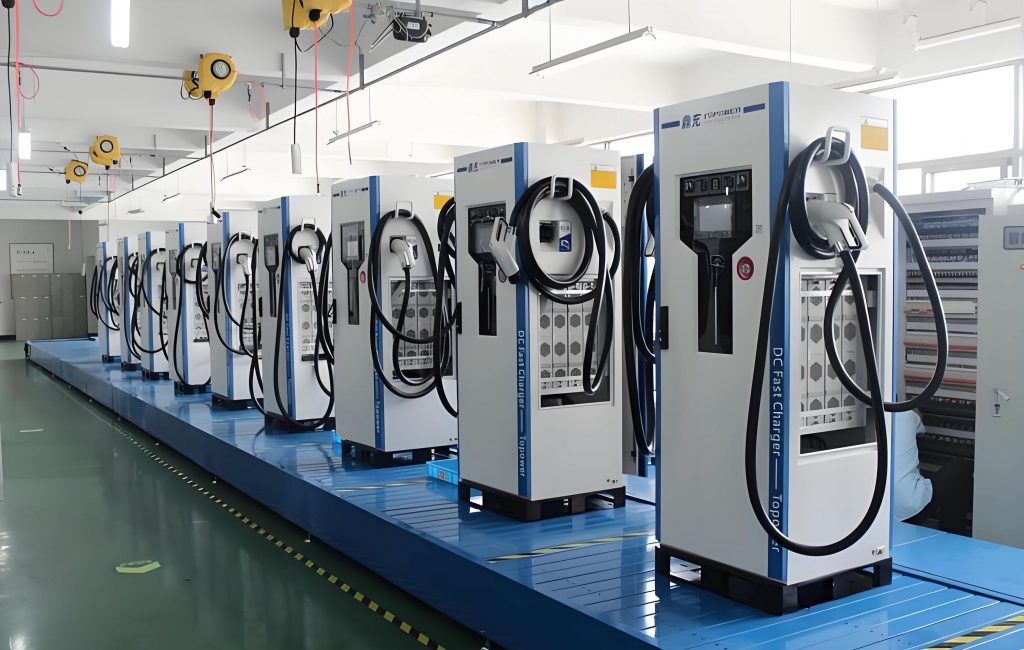
Designing the hardware for the smart voice broadcast system in EV charging stations involves a multi-component architecture centered on a main control chip, such as the STM32 series microcontroller. This chip orchestrates system operations, enhancing data processing through embedded controllers and interfaces like I2S for audio communication. It connects to external memory for audio signal storage and retrieval, enabling functions like playback and display. The voice chip, such as the ISD series, stores pre-recorded messages and executes commands from the main controller, outputting signals to an audio amplifier like the TDA2030. The amplifier’s circuitry includes voltage followers and automatic gain control, boosting signals to drive speakers. The power module ensures stable operation, while communication interfaces like UART or I2C facilitate data exchange with the EV charging station’s control system. The overall system efficiency can be quantified using the signal-to-noise ratio (SNR): $$ \text{SNR} = 10 \log_{10} \left( \frac{P_{\text{signal}}}{P_{\text{noise}}} \right) $$ where \( P \) denotes power, ensuring high-quality audio output in EV charging stations.
On the software front, the system encompasses voice file management, instruction reception and parsing, playback control, fault detection, and logging. Voice files are categorized and stored, with algorithms for recording and retrieval. Instructions from the EV charging station control system are received via serial or network interfaces, parsed to extract key details, and trigger appropriate voice responses. Playback control includes volume adjustment and progress management, such as pausing or skipping. Fault detection mechanisms monitor hardware and communication status, initiating alerts or recovery procedures to maintain reliability in EV charging stations. Logging features record usage patterns, enabling analysis for optimization. For example, the parsing logic can be represented as a finite state machine: $$ S_{n+1} = f(S_n, I) $$ where \( S \) is the system state and \( I \) is the input instruction, ensuring robust operation in diverse EV charging station environments.
In practical applications, the voice broadcast system demonstrates significant benefits. In public parking lots, EV charging stations equipped with this system provide guidance and safety warnings, reducing user search time by approximately 20% and preventing incidents through real-time alerts. For instance, users receive voice prompts on charger location and status, enhancing efficiency. In residential communities, EV charging stations offer convenience by notifying residents of charging completion and preventing overcharging, thus extending battery life. The system’s impact can be summarized using a performance metric: $$ \text{Efficiency Gain} = \frac{T_{\text{without voice}} – T_{\text{with voice}}}{T_{\text{without voice}}} \times 100\% $$ where \( T \) represents time, highlighting improvements in EV charging station utilization.
Looking ahead, the evolution of voice broadcast systems in EV charging stations will focus on heightened intelligence, IoT integration, and multi-scenario adaptability. Enhancements in AI algorithms could enable predictive voice interactions based on user behavior, while IoT connectivity would allow EV charging stations to synchronize with smart grids for dynamic power management. Expanding to diverse environments, such as highways or commercial hubs, will require robust noise cancellation and multi-language support. Voice quality can be optimized using perceptual evaluation metrics like PESQ: $$ \text{PESQ} = \sum_{i} w_i \cdot \text{similarity}(x_i, y_i) $$ where \( x \) and \( y \) are reference and processed signals. Additionally, system stability must be reinforced through redundancy and fault-tolerant designs, ensuring reliable operation in all EV charging stations. Personalized settings, such as custom voice prompts, and regular content updates will further enrich user experiences, driving the adoption of EV charging stations globally.
In conclusion, the smart voice broadcast system represents a transformative advancement for EV charging stations, merging cutting-edge technology with practical usability. By addressing key challenges in safety, efficiency, and user engagement, it paves the way for smarter, more sustainable transportation ecosystems. As EV charging stations become ubiquitous, continuous innovation in voice systems will be crucial to meeting evolving demands and fostering a greener future.