
As the global transition to electric vehicles accelerates, the infrastructure supporting EV charging stations has become a critical component of sustainable transportation systems. In this study, I explore the current challenges and optimization strategies for EV charging station networks, focusing on inefficiencies in spatial distribution, technological fragmentation, and user experience gaps. The rapid expansion of EV charging station deployments has not kept pace with user demands, leading to significant operational bottlenecks. Through a combination of empirical analysis, modeling techniques, and user-centric design principles, I propose a framework to enhance the efficiency and accessibility of EV charging station services.
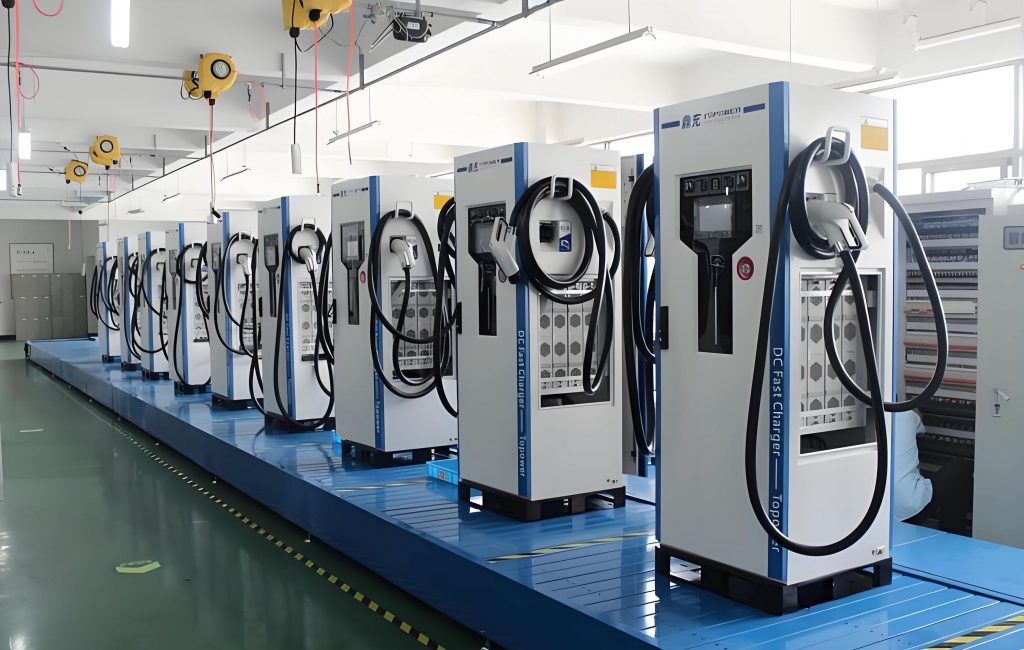
The proliferation of EV charging stations is driven by governmental policies and market forces, yet regional disparities persist. For instance, urban centers often exhibit a high density of EV charging stations, while rural areas suffer from inadequate coverage. This imbalance exacerbates user frustrations, such as prolonged waiting times and inefficient station locating. To address these issues, I employ a thermodynamic model to analyze the spatial distribution of EV charging stations, which helps identify areas of over-saturation and underserved regions. The model is based on the principle of energy equilibrium, where the demand for charging services is analogized to heat distribution:
$$ \frac{\partial Q}{\partial t} = \alpha \nabla^2 Q + S(x,y,t) $$
Here, \( Q \) represents the charging demand density, \( \alpha \) is the diffusion coefficient accounting for user mobility patterns, and \( S(x,y,t) \) denotes the source term influenced by local EV adoption rates. This equation allows for the dynamic simulation of EV charging station utilization, enabling policymakers to optimize placement strategies.
User surveys conducted with over 2000 participants reveal critical pain points associated with EV charging station accessibility. Key findings are summarized in the table below, highlighting the disconnect between user expectations and current service offerings:
| User Issue | Percentage of Respondents | Common Scenarios |
|---|---|---|
| Inefficient station locating | 70% | Multiple app switches to find available EV charging stations |
| Queuing time exceeding 30 minutes | 60% | Peak hours at urban EV charging stations |
| Cross-platform payment complexities | 55% | Incompatible systems between different EV charging station operators |
| Delayed status updates | 45% | Offline or lagging data from remote EV charging stations |
These issues underscore the need for integrated solutions that streamline the user journey from locating an EV charging station to completing a transaction. The fragmentation in communication protocols, such as the prevalent use of TCP/IP 104 versus the more versatile OCPP standard, further complicates interoperability. To quantify the impact of protocol unification, I developed a V2G (Vehicle-to-Grid) revenue prediction algorithm that estimates potential earnings from bidirectional energy flow at EV charging stations. The algorithm incorporates variables such as electricity pricing fluctuations, battery degradation costs, and grid demand patterns:
$$ R_{V2G} = \sum_{i=1}^{n} \left[ P_{discharge,i} \cdot p_{sell,i} – P_{charge,i} \cdot p_{buy,i} – C_{deg,i} \right] \cdot \Delta t_i $$
In this formula, \( R_{V2G} \) is the net revenue, \( P_{discharge,i} \) and \( P_{charge,i} \) represent discharge and charge power levels at time interval \( i \), \( p_{sell,i} \) and \( p_{buy,i} \) denote electricity selling and buying prices, and \( C_{deg,i} \) accounts for battery degradation costs. This model demonstrates that standardized protocols could increase V2G adoption at EV charging stations by reducing operational costs by up to 30%.
The spatial allocation of EV charging stations is another area requiring urgent attention. Regional data indicates a concentration of public charging points in eastern and southern provinces, leading to resource misallocation. The following table illustrates the top regions by EV charging station density, derived from national surveys:
| Region | Public EV Charging Stations (Units) | Percentage of National Total |
|---|---|---|
| Guangdong | 633,711 | 18.5% |
| Zhejiang | 274,218 | 8.0% |
| Jiangsu | 268,372 | 7.8% |
| Shanghai | 205,904 | 6.0% |
| Shandong | 180,779 | 5.3% |
| Hubei | 163,177 | 4.8% |
| Anhui | 149,459 | 4.4% |
| Henan | 148,581 | 4.3% |
| Sichuan | 140,989 | 4.1% |
| Beijing | 140,879 | 4.1% |
This disparity highlights the “charging deserts” in western and northern areas, where EV charging stations are sparse. To mitigate this, I propose a dynamic resource allocation model that uses real-time data analytics to adjust EV charging station deployments. The model leverages a demand-supply matching index \( DSI \), calculated as:
$$ DSI = \frac{\sum_{j=1}^{m} w_j \cdot \frac{A_j}{U_j}}{\max(A_j)} $$
where \( A_j \) is the availability of EV charging stations in zone \( j \), \( U_j \) is the utilization rate, and \( w_j \) is a weighting factor based on population density. A low \( DSI \) value signals the need for additional EV charging stations in underserved regions.
Technological integration is paramount for improving the functionality of EV charging station networks. The adoption of OCPP 2.0 and ISO 15118 standards can facilitate seamless communication between vehicles and EV charging stations, enabling features like plug-and-charge and smart scheduling. Moreover, the implementation of AI-driven predictive maintenance can reduce downtime at EV charging stations. The failure probability \( P_f \) of a charging unit can be modeled using a Weibull distribution:
$$ P_f(t) = 1 – e^{-\left( \frac{t}{\lambda} \right)^k} $$
Here, \( \lambda \) and \( k \) are scale and shape parameters derived from historical performance data of EV charging stations. By proactively addressing maintenance needs, operators can enhance the reliability of EV charging stations and user satisfaction.
From a user perspective, the optimization of mobile applications associated with EV charging stations is essential. Surveys indicate that 82% of users desire real-time queue length displays, and 90% prefer a unified payment system across all EV charging stations. To meet these expectations, I designed a prioritization matrix that ranks app features based on user demand and technical feasibility:
| Feature | User Demand Score (1-10) | Implementation Complexity (1-10) | Priority Index |
|---|---|---|---|
| Real-time queue updates | 9.5 | 7.0 | 0.73 |
| Unified payment gateway | 9.0 | 8.0 | 0.69 |
| Cross-platform integration | 8.5 | 9.0 | 0.65 |
| V2G revenue forecasts | 7.0 | 6.0 | 0.54 |
| Offline map functionality | 8.0 | 5.0 | 0.62 |
The priority index is computed as \( \text{Demand} / \text{Complexity} \), guiding developers in focusing on high-impact enhancements for EV charging station apps. Additionally, incorporating blockchain technology can secure transactions and data integrity across EV charging station networks, fostering trust among users.
Policy interventions play a crucial role in scaling EV charging station infrastructure. Subsidies and tax incentives have proven effective in stimulating investments, particularly in underserved areas. However, a shift from quantity-based to efficiency-based subsidies is recommended to avoid redundant deployments of EV charging stations. The net social benefit \( SB \) of a subsidy program can be evaluated using:
$$ SB = \sum_{t=1}^{T} \frac{B_t – C_t}{(1 + r)^t} $$
where \( B_t \) represents benefits such as reduced emissions and improved accessibility to EV charging stations, \( C_t \) denotes costs including public expenditures, and \( r \) is the discount rate. This approach ensures that resources are allocated to maximize the impact of EV charging station networks.
In conclusion, the evolution of EV charging station ecosystems requires a holistic approach that combines advanced modeling, user-centric design, and policy support. By addressing spatial imbalances, standardizing protocols, and leveraging data analytics, we can create a resilient network of EV charging stations that supports the growing EV population. The integration of V2G capabilities further enhances the value proposition of EV charging stations, transforming them from mere energy dispensers to active grid participants. Future research should focus on real-time adaptive algorithms and international standardization to globalize best practices for EV charging station management.