
In this article, we explore the synergistic operation modes between distribution networks and EV charging stations, focusing on how intelligent coordination can address the challenges posed by the rapid growth of electric vehicles. The increasing adoption of EVs has led to a surge in charging demand, which strains traditional grid infrastructure through load fluctuations, power quality degradation, and expanded peak-to-valley differences. We analyze key strategies such as load balancing, peak shaving, smart dispatch, and distributed energy integration to optimize power resource allocation, enhance grid stability, and support the transition to a green, low-carbon energy system. Throughout this discussion, we emphasize the role of EV charging stations as dynamic components in modern energy networks, capable of interacting bidirectionally with the grid to improve efficiency and reliability.
EV charging stations serve as critical infrastructure for supplying energy to electric vehicles, characterized by diverse charging modes, high intelligence, and strong grid interactivity. These stations can be classified into AC, DC, and wireless types based on power and application scenarios. AC EV charging stations typically offer lower power levels (e.g., 3–22 kW) and are suited for residential or long-term parking settings, whereas DC EV charging stations provide higher power (e.g., 50–350 kW) for fast charging in public areas like highways and urban hubs. Wireless EV charging stations utilize electromagnetic induction or resonance for contactless energy transfer, enhancing user convenience. The power range of EV charging stations varies widely, from 7 kW for slow charging to over 350 kW for ultra-fast options, accommodating different vehicle models and usage patterns. Moreover, modern EV charging stations incorporate advanced features such as remote monitoring, mobile payments, reservation systems, and smart scheduling, enabled by integration with cloud platforms, IoT, and big data analytics. This intelligence allows EV charging stations to participate in grid services, including demand response and peak shaving, where they adjust charging times based on real-time electricity prices or grid conditions. For instance, during low-demand periods, EV charging stations can increase charging activity, while in peak hours, they may reduce load or even feed energy back to the grid via vehicle-to-grid (V2G) technology. These capabilities position EV charging stations not merely as energy endpoints but as integral elements of smart energy systems, fostering sustainable mobility and energy internet development.
| Type | Power Range (kW) | Charging Time | Primary Applications | Grid Interaction Level |
|---|---|---|---|---|
| AC EV Charging Station | 3–22 | 4–8 hours | Home, Workplace | Low to Moderate |
| DC EV Charging Station | 50–350+ | 20–60 minutes | Public Stations, Highways | High |
| Wireless EV Charging Station | 3–11 | Similar to AC | Dynamic Charging, Parking Lots | Moderate |
The operational dynamics of EV charging stations can be modeled mathematically to assess their impact on the grid. For example, the total charging load from multiple EV charging stations at time \( t \) can be expressed as:
$$ P_{\text{total}}(t) = \sum_{i=1}^{N} P_i(t) $$
where \( P_i(t) \) represents the power demand of the \( i \)-th EV charging station, and \( N \) is the total number of stations. This aggregate load must be managed to prevent overloading distribution networks, especially during peak periods.
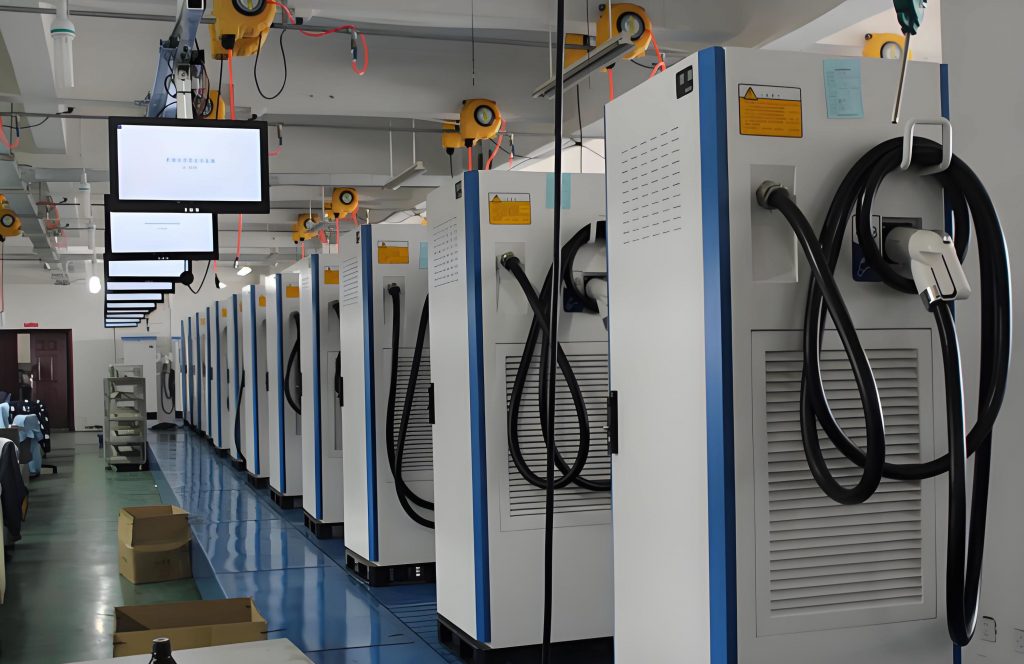
Load balance regulation is a fundamental strategy in the synergistic operation of distribution networks and EV charging stations, aiming to optimize the spatiotemporal distribution of electricity resources and minimize grid stress. As the number of EVs grows, concentrated charging at EV charging stations can cause localized load spikes, jeopardizing grid reliability. We implement load balancing through intelligent charging management systems that leverage data analytics and AI algorithms to forecast charging demand and adjust charging schedules dynamically. For instance, by shifting charging activities to off-peak hours, EV charging stations help flatten the load curve, reducing peak demand and enhancing grid stability. Time-of-use (TOU) pricing mechanisms further incentivize users to charge during low-cost periods, improving overall energy efficiency. Additionally, the integration of distributed energy resources (DERs) like solar PV and wind with EV charging stations enables localized power supply, diminishing reliance on central grids. Energy storage systems complement this by storing excess renewable energy for later use, such as during high-demand charging events. V2G technology amplifies these benefits by allowing EV charging stations to discharge stored energy back to the grid during peaks, creating a balanced load profile. The objective function for load balancing can be formulated as minimizing the variance in grid load:
$$ \min \sum_{t=1}^{T} \left( L_{\text{total}}(t) – \bar{L} \right)^2 $$
where \( L_{\text{total}}(t) \) is the total load at time \( t \), including contributions from EV charging stations, and \( \bar{L} \) is the average load over time horizon \( T \). This approach ensures that EV charging stations contribute to a more resilient and efficient distribution network.
| Time Interval | Base Grid Load (kW) | EV Charging Load (kW) | Total Load (kW) | Load Variance Reduction (%) |
|---|---|---|---|---|
| 00:00–06:00 | 500 | 300 | 800 | 15 |
| 06:00–12:00 | 800 | 400 | 1200 | 10 |
| 12:00–18:00 | 1000 | 500 | 1500 | 12 |
| 18:00–24:00 | 1200 | 400 | 1600 | 18 |
Peak shaving and valley filling optimization is another critical aspect of the synergy between distribution networks and EV charging stations, designed to modulate electricity consumption by reducing loads during peaks and increasing them during valleys. The proliferation of EV charging stations, if unmanaged, can exacerbate peak loads, particularly in evening hours when grid demand is already high. Conversely, overnight or midday periods often see underutilized capacity, leading to inefficiencies. We address this through smart charging systems that dynamically control EV charging stations based on real-time grid data, user preferences, and predictive analytics. For example, algorithms can delay or scale back charging power at EV charging stations during peak times, while incentivizing charging during off-peak hours via dynamic pricing models. A typical pricing function to encourage valley filling might be:
$$ C(t) = C_{\text{base}} + \alpha \left( L(t) – L_{\text{avg}} \right) $$
where \( C(t) \) is the electricity price at time \( t \), \( C_{\text{base}} \) is the base price, \( \alpha \) is a sensitivity coefficient, \( L(t) \) is the current load, and \( L_{\text{avg}} \) is the average load. This economic signal prompts users to utilize EV charging stations when grid stress is low, thereby smoothing demand curves. Furthermore, V2G capabilities enable EV charging stations to inject power into the grid during peaks, effectively acting as distributed storage units. The net effect is a more stable grid, reduced need for peak-generation infrastructure, and enhanced integration of renewables, as EV charging stations can absorb excess solar or wind power during low-demand intervals. We quantify the benefits through metrics like peak load reduction and valley load increase, demonstrating how EV charging stations become active participants in grid optimization.
Intelligent dispatch management forms the backbone of coordinated operations between distribution networks and EV charging stations, utilizing advanced technologies like AI, big data, and cloud computing to align charging demand with grid capacity. The inherent variability and randomness of charging loads from EV charging stations pose significant challenges to distribution network stability. We overcome this through real-time monitoring and predictive control systems that analyze factors such as grid load status, EV charging patterns, weather conditions, and renewable generation forecasts. These systems generate optimized dispatch schedules for EV charging stations, determining when and at what power level each station should operate to avoid congestion and maximize efficiency. For instance, a centralized cloud platform can manage a fleet of EV charging stations, allocating charging slots based on priority, battery state of charge, and grid constraints. The optimization problem for dispatch can be framed as:
$$ \min \sum_{i=1}^{N} \sum_{t=1}^{T} c_i(t) P_i(t) $$
subject to constraints such as:
$$ \sum_{i=1}^{N} P_i(t) \leq P_{\text{max}}(t) $$
where \( c_i(t) \) is the cost associated with charging at EV charging station \( i \) at time \( t \), \( P_i(t) \) is the charging power, and \( P_{\text{max}}(t) \) is the grid’s maximum capacity at time \( t \). This ensures that EV charging stations operate within safe limits while minimizing costs. Demand response (DR) programs further enhance dispatch by allowing grid operators to signal EV charging stations to reduce load during emergencies or high-price events. In practice, smart terminals at EV charging stations execute these commands, enabling seamless adjustments. The integration of V2G adds another dimension, where EV charging stations not only consume but also supply power, creating a bidirectional energy flow that enhances grid flexibility. Through intelligent dispatch, EV charging stations improve their operational efficiency, support higher renewable energy penetration, and contribute to a more agile and sustainable energy ecosystem.
| Parameter | Value Range | Impact on Grid | Optimization Goal |
|---|---|---|---|
| Charging Power per EV Charging Station (kW) | 7–350 | Direct load influence | Minimize peak demand |
| Dispatch Interval (minutes) | 5–30 | Real-time adjustment | Maximize reliability |
| V2G Power Feedback (kW) | Up to 50% of charging power | Grid support | Enhance stability |
| Renewable Integration Rate (%) | 20–80 | Carbon reduction | Increase green energy use |
Distributed energy integration is a pivotal strategy for synergizing distribution networks with EV charging stations, focusing on the local generation and consumption of clean energy to reduce grid dependence and boost efficiency. The expansion of renewables like solar PV and wind power allows EV charging stations to draw from decentralized sources, mitigating congestion on traditional networks. For example, during sunny periods, PV systems can directly power EV charging stations, lowering operational costs and carbon footprints. We achieve this through microgrid configurations that enable self-sufficient energy management, coupled with storage systems that store surplus renewable energy for later charging needs. The energy balance in such a system involving EV charging stations can be described by:
$$ E_{\text{storage}}(t+1) = E_{\text{storage}}(t) + \eta_{\text{charge}} P_{\text{charge}}(t) – \frac{P_{\text{discharge}}(t)}{\eta_{\text{discharge}}} $$
where \( E_{\text{storage}}(t) \) is the energy stored in batteries at time \( t \), \( \eta_{\text{charge}} \) and \( \eta_{\text{discharge}} \) are charging and discharging efficiencies, and \( P_{\text{charge}}(t) \) and \( P_{\text{discharge}}(t) \) are the power flows related to EV charging stations. Smart调度 systems use weather forecasts and demand predictions to optimize this balance, ensuring that EV charging stations receive stable power even when renewables are intermittent. V2G technology further enhances integration by treating EVs connected to EV charging stations as mobile storage units, which can absorb excess solar or wind power and discharge it during shortages. This synergy not only elevates the utilization rate of distributed energy but also reduces transmission losses and emissions. In urban areas, clustering EV charging stations with local PV and storage can create energy-independent hubs, demonstrating how EV charging stations evolve into multifunctional assets within modern energy systems.
In conclusion, the synergistic operation of distribution networks and EV charging stations represents a transformative approach to building intelligent, sustainable energy infrastructures. By leveraging technologies such as smart dispatch, peak shaving, load balancing, and distributed energy integration, we can achieve efficient power resource allocation and enhanced grid stability. EV charging stations play a central role in this paradigm, transitioning from passive loads to active grid participants through V2G and smart management. As AI, big data, and cloud computing advance, the coordination between distribution networks and EV charging stations will become more precise and adaptive, underpinning the development of a green, secure, and resilient energy future. The continued innovation in EV charging station capabilities will be crucial for maximizing renewable energy uptake and minimizing environmental impacts, solidifying their position as cornerstones of the evolving energy landscape.