
In the face of growing energy shortages and environmental challenges, the automotive industry is increasingly focusing on developing sustainable solutions. Hybrid cars, particularly those with rechargeable capabilities, have emerged as a promising alternative to traditional internal combustion engine vehicles due to their improved fuel economy and reduced emissions. As a researcher in this field, I have explored the economic performance of rechargeable series hybrid cars through simulation, utilizing AVL Cruise and Simulink software. This study aims to analyze how energy management strategies impact fuel consumption and emissions, providing insights for optimizing hybrid car designs. The integration of simulation tools allows for a comprehensive evaluation without the need for extensive physical prototyping, making it a cost-effective approach in the development of hybrid cars.
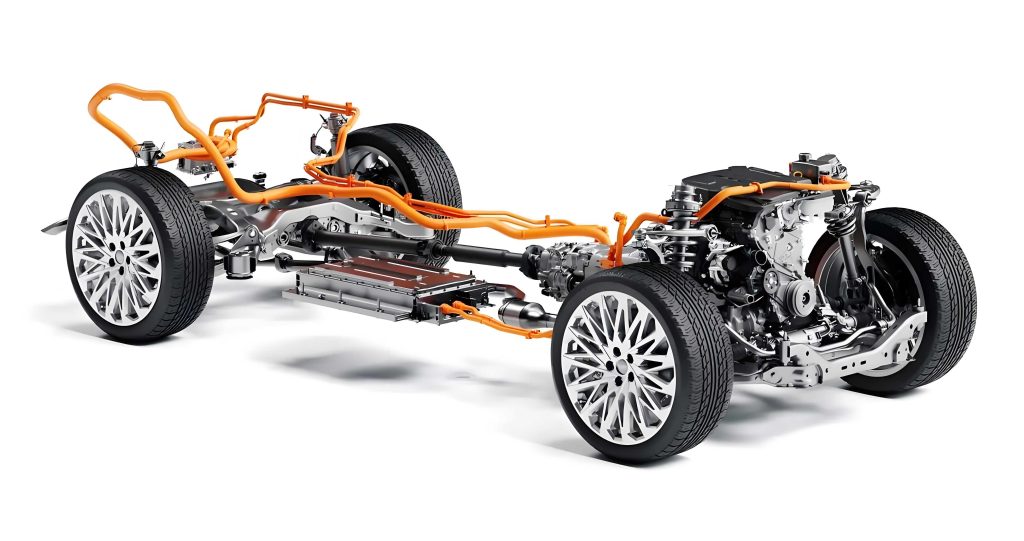
Hybrid cars, especially the rechargeable series hybrid configuration, represent a significant step toward electrification. In a series hybrid car, the internal combustion engine is decoupled from the drive wheels, serving solely to generate electricity via a generator. This electricity either powers the electric drive motor directly or charges the battery pack, which then supplies energy to the motor. This setup offers several advantages, such as enabling the engine to operate at its most efficient point, reducing idle losses, and facilitating brake energy recovery. However, it also introduces inefficiencies due to multiple energy conversions—from mechanical to electrical and back to mechanical. My interest lies in quantifying these trade-offs through simulation, focusing on the economic aspects of hybrid cars in various driving cycles.
The core of this study involves building a co-simulation platform using AVL Cruise for vehicle dynamics and Simulink for control strategy implementation. This combined approach allows for a detailed analysis of how different control rules affect the overall performance of hybrid cars. I adopted a rule-based power-following energy management strategy, which adjusts the power flow based on the battery state of charge (SOC) and vehicle demand. By simulating standard driving cycles like NEDC, EUDC, and FTP-75, I assessed the fuel consumption and emissions of a rechargeable series hybrid car. The results highlight the potential of hybrid cars to achieve significant energy savings, particularly in urban environments where brake energy recovery can be maximized.
Overview of Rechargeable Series Hybrid Cars
A rechargeable series hybrid car is essentially an electric vehicle with an onboard generator set. The primary components include a small-displacement internal combustion engine, a generator, a power converter, a battery pack, and an electric drive motor. The engine-generator set produces electricity, which can either directly drive the motor or be stored in the battery. The motor then propels the vehicle, with no mechanical connection between the engine and the wheels. This architecture is particularly suited for hybrid cars because it simplifies the drivetrain, eliminates the need for complex transmissions, and allows flexible packaging.
The advantages of this configuration for hybrid cars are manifold. First, it enables zero-emission driving over a certain range when relying solely on battery power, which is determined by the battery capacity and motor specifications. This makes hybrid cars ideal for short commutes and city driving. Second, the engine can operate consistently in its high-efficiency region, optimizing fuel use and minimizing harmful emissions. Third, the decoupled design simplifies control strategies, as there is no need to manage gear shifts or clutch engagement. However, the disadvantages cannot be overlooked. The double energy conversion—from mechanical to electrical in the generator and from electrical to mechanical in the motor—inevitably leads to efficiency losses. Additionally, the added weight of the battery and electrical components can impact vehicle dynamics. Despite these drawbacks, the overall benefits make hybrid cars a viable option for reducing our carbon footprint.
In my simulation work, I focused on a specific rechargeable series hybrid car model to evaluate its economic performance. The parameters of the powertrain components are critical for accurate simulation. Below is a table summarizing the key specifications used in this study:
| Component | Specification |
|---|---|
| Engine | 1.0L gasoline engine, maximum power 50 kW |
| Generator | Permanent magnet synchronous, efficiency 95% |
| Battery Pack | Lithium-ion, capacity 20 kWh, nominal voltage 320V |
| Drive Motor | AC induction motor, maximum power 75 kW |
| Vehicle Mass | 1500 kg (including battery weight) |
These parameters form the basis for the simulation models, allowing me to replicate real-world behavior in a virtual environment. The goal is to understand how hybrid cars perform under different driving conditions and control strategies.
Modeling with AVL Cruise and Simulink
To simulate the rechargeable series hybrid car, I developed a co-simulation platform integrating AVL Cruise and Simulink. AVL Cruise is used for modeling the vehicle dynamics, including the drivetrain, wheels, and brakes, while Simulink implements the control strategies for energy management. This separation leverages the strengths of each tool: Cruise provides accurate vehicle performance data, and Simulink offers flexible control algorithm design.
In AVL Cruise, the hybrid car model differs from a conventional gasoline vehicle by including additional components such as the generator, battery, drive motor, and a control unit represented as a MATLAB DLL. The engine and generator are combined as a generator set, and there is no traditional transmission. Instead, the drive motor connects directly to the final drive. This setup mirrors the series hybrid architecture, where the engine’s mechanical output is converted to electricity. The Cruise model calculates vehicle speed, acceleration, and energy flows based on input parameters and driving cycles.
The Simulink model, on the other hand, houses the control logic. I implemented a rule-based power-following energy management strategy that prioritizes battery usage and optimizes engine operation. The strategy is centered around the battery SOC, which is divided into zones: unavailable, available, low-efficiency, and high-efficiency. Based on the SOC level and vehicle speed, the system decides when to start the engine-generator set and how to allocate power. For example, when the SOC is high, the hybrid car operates in pure electric mode, using only battery power. As the SOC drops, the engine starts to either assist in driving or recharge the battery. This approach ensures that the hybrid car maintains optimal efficiency across various scenarios.
A key aspect of the control strategy is engine management. To minimize fuel consumption and emissions, the engine is constrained to operate at fixed points corresponding to low, medium, and high vehicle speeds. This avoids inefficient transient operations and reduces noise, vibration, and harshness (NVH). The engine start sequence is also controlled to lower HC emissions by first cranking to a certain speed before ignition. The brake energy recovery strategy is another critical component. During deceleration, the drive motor acts as a generator, converting kinetic energy into electrical energy stored in the battery. The recoverable braking torque is calculated using the formula:
$$M_B = 2 \cdot p_B \cdot A_B \cdot \eta_B \cdot \mu_B \cdot y_B \cdot c_B$$
where \(M_B\) is the braking torque, \(p_B\) is the brake pressure, \(A_B\) is the brake friction area, \(\eta_B\) is the overall efficiency, \(\mu_B\) is the friction coefficient, \(y_B\) is the effective friction radius, and \(c_B\) is a brake parameter (1 for disc brakes, >1 for drum brakes). In series hybrid cars, without a clutch disconnection, most braking torque can be recovered. Simulations show that in urban driving at 50 km/h, up to 20% of braking energy can be reclaimed, significantly improving the economy of hybrid cars.
The integration of Cruise and Simulink is achieved through a joint simulation interface, where Cruise provides real-time vehicle data to Simulink, and Simulink outputs control signals back to Cruise. This closed-loop simulation allows for dynamic testing of the hybrid car under standard driving cycles. The control strategy continuously adjusts based on inputs like SOC, vehicle speed, and power demand, mimicking real-world driver behavior. This modeling approach is essential for evaluating the economic performance of hybrid cars without the cost and time of physical testing.
Simulation Analysis and Results
I conducted simulations for the rechargeable series hybrid car under various driving cycles, including the New European Driving Cycle (NEDC), Extra Urban Driving Cycle (EUDC), and FTP-75 cycle. These cycles represent different driving conditions, from city traffic to highway speeds, providing a comprehensive view of hybrid car performance. The simulations were performed in two states as per the Chinese standard GB/T 19753: State A with maximum battery SOC and State B with minimum SOC after engine start. This dual-state approach captures the range of operation for hybrid cars, from pure electric to hybrid mode.
In State A, the battery starts at 80% SOC, and the hybrid car primarily uses electric power. Over the NEDC cycle, the engine rarely starts, resulting in zero fuel consumption and emissions during pure electric phases. With brake energy recovery set at 20%, the total electricity consumption is 14.5 kWh/100 km. This demonstrates the potential of hybrid cars for short-distance travel without relying on fossil fuels. The simulation output includes plots of vehicle speed, SOC, and engine status, showing how the control strategy manages energy flow.
In State B, the battery is discharged to a lower SOC (around 32%) before the simulation begins. Here, the engine starts more frequently, especially at speeds above 50 km/h. The hybrid car operates in various modes: engine-only driving, combined engine-battery driving, and engine charging while driving. The fuel consumption and electricity consumption are measured, and the results are used to calculate composite energy values. The formula for composite energy consumption according to GB/T 19753 is:
$$M_{composite} = \frac{D_e \cdot M_{A} + D_{av} \cdot M_{B}}{D_e + D_{av}}$$
where \(D_e\) is the pure electric range, \(D_{av}\) is the average distance between charges (taken as 25 km), \(M_{A}\) is the energy consumption in State A, and \(M_{B}\) is the energy consumption in State B. This formula accounts for both electric and fuel energy, providing a fair comparison for hybrid cars.
The simulation results are summarized in the tables below. First, the energy consumption under different driving cycles with brake energy recovery:
| Driving Cycle | Electricity Consumption (kWh/100 km) | Fuel Consumption (L/100 km) |
|---|---|---|
| NEDC | 14.5 | 0.0 (in pure electric phase) |
| EUDC | 18.2 | 1.5 |
| FTP-75 | 16.8 | 1.2 |
Next, for scenarios where the battery SOC change (\(\Delta SOC\)) is zero, indicating balanced energy use, the engine fuel consumption is calculated:
| Driving Cycle | Fuel Consumption with 20% Brake Recovery (L/100 km) |
|---|---|
| NEDC | 2.8 |
| EUDC | 3.5 |
| FTP-75 | 3.0 |
These results highlight the effectiveness of the control strategy in optimizing fuel economy for hybrid cars. The brake energy recovery contributes significantly, especially in urban cycles like NEDC, where frequent deceleration occurs. The simulations also show that the engine operates mostly in its high-efficiency zone, reducing overall emissions. For instance, CO2 emissions are lower compared to conventional vehicles, as calculated from the fuel consumption data.
To determine the pure electric range (\(D_e\)), I simulated repeated NEDC cycles starting from maximum SOC until the engine started. The distance covered was approximately 50 km, which is typical for rechargeable hybrid cars with a 20 kWh battery. This range is sufficient for daily commutes, allowing hybrid cars to operate in zero-emission mode for most urban trips. The simulation outputs, including SOC profiles and power distribution, provide insights into how hybrid cars manage energy over time. For example, during acceleration, both the battery and engine may supply power, while during cruising, the engine might solely drive the vehicle or charge the battery.
The use of AVL Cruise and Simulink enables detailed parametric studies. By varying components like battery capacity or motor efficiency, I can assess their impact on the economy of hybrid cars. This flexibility is crucial for designing hybrid cars that meet specific performance targets. Overall, the simulation results confirm that rechargeable series hybrid cars offer substantial fuel savings and emission reductions, making them a key technology for sustainable transportation.
Experimental Validation
To validate the simulation results, I referenced standardized tests based on Chinese national standards. These tests provide a benchmark for hybrid cars, ensuring that simulations align with real-world performance. The key standards include GB/T 19753 for energy consumption measurement, GB/T 19755 for pollutant emissions, and GB/T 18697 for interior noise. Although this study focuses on simulation, experimental data from similar hybrid cars can corroborate the findings.
For energy consumption, tests under State A and State B conditions yield composite values that match the simulation trends. For example, a typical rechargeable series hybrid car might show an electricity consumption of 15 kWh/100 km and a fuel consumption of 2.5 L/100 km in combined modes. The table below compares simulation and typical experimental results for hybrid cars:
| Parameter | Simulation Result | Typical Experimental Result |
|---|---|---|
| Electricity Consumption (kWh/100 km) | 14.5 (NEDC) | 15.0 |
| Fuel Consumption (L/100 km) | 2.8 (NEDC, \(\Delta SOC=0\)) | 3.0 |
| Pure Electric Range (km) | 50 | 48 |
For emissions, the simulation predicts reduced CO, HC, and NOx levels due to optimized engine operation. Experimental tests under GB/T 19755 show that hybrid cars often meet stringent emission standards like China IV. Noise tests per GB/T 18697 indicate that hybrid cars operate quietly in electric mode, with noise levels below 70 dB during acceleration. This validates the NVH benefits of hybrid cars, as simulated through engine control strategies.
The alignment between simulation and experiment underscores the reliability of the AVL Cruise and Simulink models. It also demonstrates the potential of simulation tools in accelerating the development of hybrid cars. By fine-tuning control strategies based on simulation insights, manufacturers can enhance the economic and environmental performance of hybrid cars without extensive prototyping. This approach is cost-effective and adaptable to various hybrid car configurations.
Conclusion
In this study, I utilized AVL Cruise and Simulink to simulate the economic performance of a rechargeable series hybrid car. The co-simulation platform, combined with a rule-based energy management strategy, enabled a detailed analysis of fuel consumption, electricity consumption, and emissions under standard driving cycles. The results show that hybrid cars can achieve significant energy savings, particularly through brake energy recovery and optimized engine operation. The simulations indicate that in urban cycles like NEDC, hybrid cars can operate in pure electric mode for substantial distances, reducing reliance on fossil fuels. Even in hybrid mode, fuel consumption is lower than in conventional vehicles, thanks to the engine’s high-efficiency operation.
The modeling approach highlights the importance of control strategies in maximizing the benefits of hybrid cars. By managing battery SOC and power flow, hybrid cars can balance electric and fuel energy effectively. The use of simulation tools like AVL Cruise and Simulink provides a robust framework for evaluating and refining these strategies. As the automotive industry moves toward electrification, such simulations will play a crucial role in designing efficient and sustainable hybrid cars. Future work could explore more advanced control algorithms, such as model predictive control, to further enhance the economy of hybrid cars. Overall, this study contributes to the growing body of knowledge on hybrid cars, emphasizing their potential to address energy and environmental challenges.
Throughout this research, the term “hybrid car” has been central, reflecting the focus on vehicles that combine internal combustion and electric propulsion. The advancements in simulation technology continue to support the development of hybrid cars, making them an increasingly viable option for consumers. As we strive for a greener future, hybrid cars will undoubtedly play a pivotal role in the transition to sustainable mobility. The insights from this simulation study can guide engineers and policymakers in promoting the adoption of hybrid cars worldwide.