
As the critical interface between new power electronic devices and the grid, the metering accuracy of EV charging stations directly impacts the credibility of user billing and the effectiveness of grid power quality monitoring. Currently, both academia and industry predominantly focus on improving static metering accuracy, often neglecting the metering deviations caused by multi-physical field coupling effects under dynamic operating conditions. When the current rise time shortens to the 1 ms level, synchronization errors on the order of microseconds can induce instantaneous power deviations of up to 0.7%. This nonlinear error accumulation phenomenon is particularly pronounced in fast-charging scenarios. More critically, the combined effects of harmonic distortion and temperature drift form time-varying composite error sources. Preliminary experiments by our research group revealed that at an ambient temperature of 40°C, the cumulative error over 8 hours of continuous testing could reach 0.07%. This hidden error propagation mechanism severely threatens the long-term stability of metering equipment. This study further investigates the energy measurement characteristics of EV charging station calibrators.
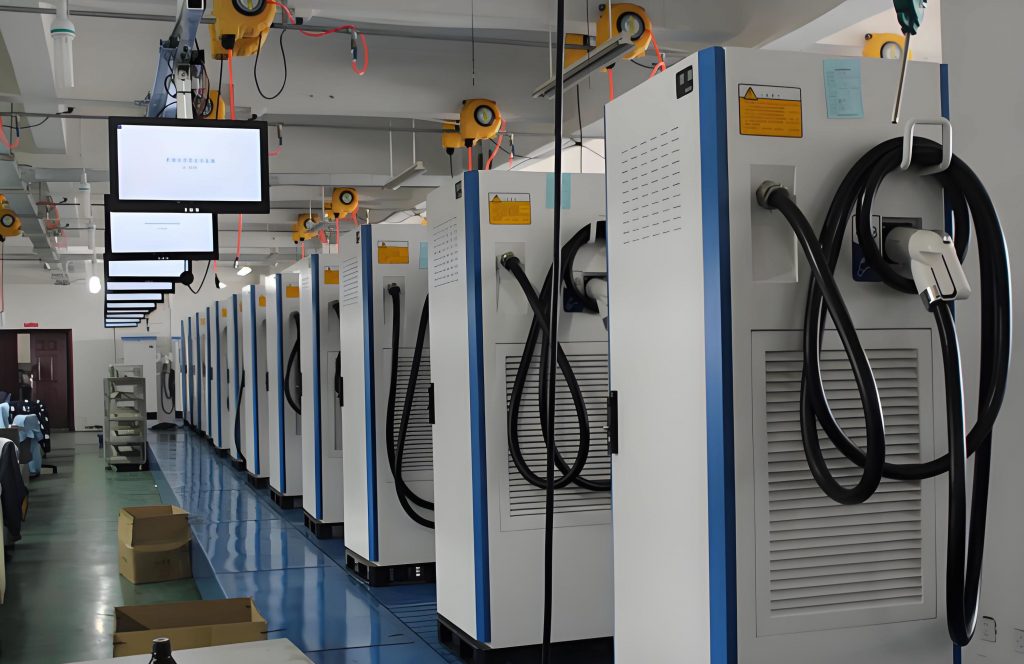
The core functionality of an EV charging station calibrator, as the essential device for assessing energy measurement accuracy, relies on the synergistic operation of three main modules: signal acquisition, data processing, and error analysis. The signal acquisition module synchronously captures the instantaneous voltage $U(t)$ and current $I(t)$ at the output of the EV charging station using high-precision voltage transformers and current sensors. The dynamic response characteristics of these sensors directly influence the metering accuracy. The data processing module employs high-speed analog-to-digital converters (ADCs) to discretize the raw signals and utilizes digital filtering techniques to suppress high-frequency noise interference. The error analysis module calculates the accumulated energy value based on a practical power integration algorithm. The core metering model can be expressed as:
$$E = \int_{t_1}^{t_2} U(t) I(t) dt$$
where $E$ is the measured energy value in kW·h, $U(t)$ and $I(t)$ are the voltage (V) and current (A) at time $t$, respectively, and $t_1$ to $t_2$ is the integration time interval. It is crucial to note that the accuracy of this model depends on the synchronous sampling precision of the voltage and current signals; any phase deviation will lead to power factor calculation errors.
EV charging stations often face conditions of severe load fluctuations during actual operation, such as transient current surges during the initial phase of electric vehicle charging, harmonic distortion introduced by nonlinear loads (typically like 5th and 7th harmonics), and pulsed power changes. If such dynamic characteristics are not effectively captured, traditional steady-state metering methods will exhibit significant deviations. Taking harmonic interference as an example, when the current signal is superimposed with a 5th harmonic at 20% amplitude, the power calculation error can exceed 1.2%. To address these challenges, dynamic testing must meet three core parameter requirements: First, the sampling rate for voltage and current signals needs to reach 100 kHz or higher to fully capture microsecond-level transient features. Second, data processing latency must be controlled within 5 ms to ensure the effectiveness of real-time error compensation. Third, the error compensation mechanism needs to incorporate both nonlinear correction and phase compensation functions. Experiments indicate that when the sampling rate is below 50 kHz, the metering error for a 10 A-level current step response exceeds 0.5%, whereas employing an adaptive Kalman filter algorithm can suppress the dynamic error to below 0.1%. This result highlights the necessity of high sampling rates and intelligent algorithms in dynamic testing for EV charging station calibrators.
The hardware architecture design of a high-precision dynamic testing system must balance signal fidelity and real-time performance requirements. Its core components consist of precision sensing units and a high-speed acquisition system. In the voltage measurement stage, sensors designed based on the zero-flux Hall principle demonstrate superior performance, with their nonlinear error strictly controlled within 0.05% over the ±600 V range. Addressing the dynamic measurement requirements for current parameters, comparative analysis of different sensor characteristics reveals that composite current sensors combining Hall effect and fluxgate technology effectively accommodate both AC and DC measurement capabilities. Across a wide range of 0–100 A, they achieve 0.1-class accuracy, and when paired with an adaptive temperature compensation algorithm, the operating bandwidth can be extended to DC–100 kHz.
The data acquisition unit selects a 16-bit high-resolution ADC chip as the core processing unit. Its 1 MHz synchronous sampling capability allows for precise capture of transient characteristics in the output signals of EV charging stations. Experimental verification shows that the system’s capture error for 10 μs-level current transients is less than 0.2%, significantly outperforming conventional test equipment. For dynamic signal generation, synergistic control between a programmable electronic load and a DSP chip enables rapid switching of 0–80 A step currents (response time < 50 μs) and precise superposition of 2nd to 50th harmonics. In typical test conditions, when the system injects a 5th harmonic component, the voltage waveform distortion rate remains stable below 0.3%, and the deviation of the current total harmonic distortion (THD) analysis result based on the Fast Fourier Transform (FFT) from the theoretical calculation value does not exceed 0.15%.
Due to inherent nonlinearities and phase delays in the hardware system, power integration errors exhibit time-varying characteristics under dynamic conditions. A compensation model based on the least squares method iteratively approximates the deviation between measured and theoretical values. Its mathematical expression is:
$$\Delta E = \sum_{k=1}^{N} \alpha_k \left( U_k I_k – \hat{U}_k \hat{I}_k \right) \Delta t$$
where $\Delta E$ is the cumulative error correction in W·h, $\alpha_k$ is the weight coefficient for the $k$-th sampling point, $U_k$ and $I_k$ are the measured voltage and current values, and $\hat{U}_k$, $\hat{I}_k$ are the theoretical values corrected by the transfer function. The core of this algorithm lies in the adaptive adjustment of the weight coefficients—when the sampling point is during a transient process (e.g., 20 ms before and after a current step), the value of $\alpha_k$ is increased to three times that of the steady-state condition, thereby strengthening the error correction capability in the突变 interval. Simulations indicate that this algorithm can reduce the metering error for a 200 A pulse current from 0.8% to 0.12%.
To quantify the overall system performance, key modules were calibrated and tested in a constant temperature environment of (23±1)°C. The results are summarized in the table below.
| Module | Accuracy Indicator | Test Condition |
|---|---|---|
| Voltage Sensor | ±0.05% FS | 50 Hz–5 kHz Sine Wave |
| Current Sensor | ±0.06% RD | 10–200 A Step Load |
| Data Acquisition Card | 16 bit @ 1 MS/s | Full Scale Input Signal |
| System Total Error | ≤ 0.12% | Dynamic Load Conditions |
Note: FS denotes Full Scale, RD denotes Reading Percentage.
The voltage sensor exhibited a phase deviation of less than 0.02° within the 50 Hz–5 kHz frequency band. The current sensor demonstrated a linearity error of merely ±0.03% across the 10%–120% rated current range. The channel-to-channel synchronization error of the data acquisition card was controlled within ±200 ns using a GPS-disciplined clock source, meeting the requirement for synchronous acquisition of μs-level transient signals.
The assessment of the system’s total error encompassed both steady-state and dynamic composite conditions: Under a 100 A load containing 15% third harmonic, the standard deviation of the error over 24 hours of continuous testing was 0.07%; whereas in scenarios involving 10 ms-level current pulses, the peak error was 0.15%. These results validate the synergistic optimization effect of the hardware and algorithm developed for testing EV charging station calibrators.
The experimental system was set up in an electromagnetic shielding laboratory environment [temperature (23±1)°C, relative humidity ≤ 60%], where the environmental control accuracy met secondary metrology standard requirements, effectively suppressing the impact of electromagnetic interference and temperature drift on the test results. The test subject was a 60 kW rated power DC EV charging station (model ZJQC-60D), paired with an EA Elektro-Automatik ELR 9000–80 programmable DC electronic load system capable of a wide voltage range of 0–1000 V and pulse current output capability of 0–150 A.
The experimental design constructed a test matrix for three typical operating conditions: constant current mode maintaining an 80 A continuous output to examine steady-state characteristics; pulse mode employing 0–150 A step changes (rise time ≤ 1 ms) to evaluate dynamic response performance; and harmonic interference mode injecting characteristic 5th and 7th harmonics at 20% amplitude to simulate grid disturbances. Notably, the DSP controller integrated into the ELR 9000–80 load system enables precise adjustment of duty cycles from 10% to 90%. Combined with the harmonic synthesis module, it can generate independent or composite waveforms of integer harmonics from the 2nd to the 50th order. This multi-dimensional excitation method effectively reveals the metering error characteristics of the calibrator used for EV charging stations.
The assessment of dynamic error quantifies the deviation between the calibrator’s measured value and the standard meter’s value. Its calculation model is defined as:
$$\delta = \frac{E_{\text{calibrator}} – E_{\text{standard}}}{E_{\text{standard}}} \times 100\%$$
where $\delta$ is the relative error percentage, and $E_{\text{calibrator}}$ and $E_{\text{standard}}$ are the energy values in kW·h measured by the calibrator and the standard meter, respectively. The data presented in the following table indicate a nonlinear growth trend in error as the load characteristic transitions from steady-state to dynamic: under the 80 A constant current condition, the error remained stable within 0.05%; the 150 A pulse load caused the error to rise to 0.18%, with a strong correlation observed between the peak error and the current rise time; in the harmonic interference condition, the 20% amplitude 5th harmonic resulted in an error of 0.32%, while the influence of the 7th harmonic was lower at 0.21%.
| Load Type | Average Error /% | Maximum Peak Error /% |
|---|---|---|
| Constant Current (80 A) | 0.03 | 0.05 |
| Pulse (150 A) | 0.15 | 0.41 |
| Harmonic (5th) | 0.28 | 0.56 |
Note: Test data are averages of 10 experiments; pulse load duty cycle is 50%.
Error tracing analysis revealed that the error in pulse conditions primarily originates from phase deviation caused by the frequency response delay of the current sensor during current transients. When the current jumps from 0 to 150 A within 1 ms, the synchronization error between the calibrator’s voltage and current channels reached 8 μs, leading to an instantaneous power calculation deviation of 0.7%. Harmonic error is closely related to spectral leakage effects—although the calibrator’s digital filter with an 80 dB/dec roll-off characteristic can suppress high-frequency noise, it introduces amplitude attenuation for harmonics near the fundamental frequency. For instance, the actual attenuation of the 5th harmonic reached 1.8 times the theoretical value.
The constraining effect of sampling rate on dynamic error was verified through comparative experiments: as the sampling rate was gradually reduced from 1 MHz to 10 kHz, the metering error for the 150 A pulse load increased linearly from 0.12% to 0.89%. The error growth rate accelerated significantly when the sampling rate fell below 100 kHz, with the error increase in the 100–50 kHz interval accounting for 60% of the total increase. This phenomenon can be attributed to the critical effect of the Shannon-Nyquist theorem—when the sampling rate approaches twice the highest signal frequency, the discretization process loses key waveform details. FFT analysis confirmed that a 1 MHz sampling rate can fully capture harmonic components within 30 kHz of the current signal, whereas with a 50 kHz sampling rate, the amplitude of components above 15 kHz attenuated by over 40%.
The experiments also revealed the potential impact of temperature drift: at an ambient temperature of 23°C, the sensitivity change rate of the current sensor reached 0.002%/°C, resulting in an error drift of 0.07% over 8 hours of continuous testing. This finding emphasizes the necessity of a temperature compensation circuit in the dynamic testing system for EV charging stations and provides direction for subsequent algorithm optimization—after embedding temperature sensor data into the error correction model, the drift could be reduced to within 0.01%.
In conclusion, the proposed hardware-algorithm co-optimization scheme effectively addresses the challenges of transient capture and error compensation in dynamic testing, providing reliable technical support for the development and performance evaluation of metering devices for EV charging stations. Measured data verified the system’s engineering applicability in maintaining a total error of 0.12% under complex operating conditions. However, several issues exposed during the research require further investigation: although the hardware system achieved a channel synchronization accuracy of ±200 ns, the nonlinear deviation of the current sensor caused by hysteresis effects still accounts for 45% of the total error during hundred-ampere current transients. Furthermore, the balance between the phase delay and harmonic attenuation characteristics of the digital filter has not been fully decoupled, resulting in a residual error of 0.32% under 5th harmonic conditions. These findings point the way for future research—optimizing sensor dynamic characteristics through multi-physics field co-simulation and developing new filter architectures with adaptive roll-off characteristics will be key to improving metering accuracy under extreme conditions for EV charging station calibrators.
The energy measurement process for EV charging stations can be further refined by considering the instantaneous power calculation, which integrates voltage and current samples over time. The fundamental relationship is given by the power integral, but for discrete systems, it is implemented as a sum. Let $N$ be the total number of samples in the interval $[t_1, t_2]$, and $\Delta t$ be the sampling period. Then the discrete energy calculation becomes:
$$E_{\text{discrete}} = \sum_{k=1}^{N} U[k] I[k] \Delta t$$
where $U[k]$ and $I[k]$ are the $k$-th sampled voltage and current values. The accuracy of this summation depends heavily on the synchronization of the voltage and current channels, as any time skew $\Delta \tau$ between them introduces a phase error $\phi = 2\pi f \Delta \tau$ for a fundamental frequency $f$, leading to a power error proportional to $\sin(\phi)$. For typical grid frequencies ($f=50$ Hz or 60 Hz), even small skews can be significant. For instance, a 10 μs skew at 50 Hz corresponds to $\phi = 0.0018$ radians, causing a power error of approximately 0.18% for a purely sinusoidal signal at unity power factor. This underscores the critical need for high-precision synchronization in the metrology of EV charging stations.
Another important aspect is the characterization of dynamic loads. The current waveform $I(t)$ during the charging process of an electric vehicle connected to an EV charging station is often non-sinusoidal and can be modeled as a superposition of a fundamental component and harmonics:
$$I(t) = I_0 + \sum_{h=1}^{H} I_h \sin(2\pi h f t + \theta_h)$$
where $I_0$ is the DC offset (if present), $I_h$ and $\theta_h$ are the amplitude and phase of the $h$-th harmonic, and $H$ is the highest harmonic order considered. The presence of these harmonics complicates the power and energy calculation. The active power $P$ for such a non-sinusoidal waveform is given by:
$$P = U_0 I_0 + \sum_{h=1}^{H} U_h I_h \cos(\phi_h – \theta_h)$$
where $U_h$ and $\phi_h$ are the amplitude and phase of the $h$-th harmonic voltage. Most energy meters, including those in EV charging station calibrators, are designed to accurately measure active power under sinusoidal conditions. Under distorted waveforms, errors arise if the meter’s frequency response does not adequately capture all significant harmonic components. This is why the dynamic testing system must have a wide bandwidth, as previously discussed.
The performance of the current sensor is paramount. The relationship between the primary current $I_p(t)$ and the sensor’s output voltage $V_{\text{out}}(t)$ can be modeled using a transfer function $H(s)$ in the Laplace domain, or its impulse response $h(t)$ in the time domain:
$$V_{\text{out}}(t) = (h * I_p)(t) = \int_{-\infty}^{\infty} h(\tau) I_p(t-\tau) d\tau$$
In an ideal current sensor, $h(t)$ would be a Dirac delta function, implying instantaneous response. In reality, sensors have a finite bandwidth and introduce phase shift. For the composite current sensor mentioned, the bandwidth extends to 100 kHz. The step response can be characterized by a rise time $t_r$, which is related to the bandwidth $BW$ by the approximate relation $t_r \approx \frac{0.35}{BW}$. For a 100 kHz bandwidth, $t_r \approx 3.5$ μs. This fast response is essential for capturing the rapid current transitions common in EV charging station operation.
The dynamic error compensation algorithm based on least squares can be formulated as an optimization problem. We define a vector of parameters $\mathbf{p}$ that characterize the systematic errors (e.g., gain, offset, phase shift). The goal is to find $\mathbf{p}$ that minimizes the sum of weighted squared differences between the measured energy $E_m$ and a reference energy $E_{\text{ref}}$ over $M$ different test cycles or conditions:
$$\min_{\mathbf{p}} \sum_{j=1}^{M} w_j \left( E_m^{(j)}(\mathbf{p}) – E_{\text{ref}}^{(j)} \right)^2$$
Here, $w_j$ are the weight coefficients. In the adaptive version described, $w_j$ is increased for test cycles involving transients. This formulation allows for the calibration of the entire measurement chain of the EV charging station calibrator.
Temperature drift compensation is another critical area. The sensitivity $S$ of a sensor often varies with temperature $T$. A common model is a polynomial relationship:
$$S(T) = S_0 \left( 1 + \alpha (T – T_0) + \beta (T – T_0)^2 + \cdots \right)$$
where $S_0$ is the sensitivity at reference temperature $T_0$, and $\alpha$, $\beta$ are temperature coefficients. The compensation algorithm uses temperature readings $T[k]$ at each sample time to adjust the measured values. For the current sensor, the compensated current $I_c[k]$ would be:
$$I_c[k] = \frac{I_m[k]}{1 + \alpha (T[k] – T_0)}$$
where $I_m[k]$ is the raw measured current. More sophisticated models might include higher-order terms or different coefficients for different operating ranges. Implementing this compensation digitally within the data processing module is essential for maintaining accuracy during long-term operation of EV charging station test equipment.
Finally, the uncertainty analysis for the overall system is crucial for validation. The combined standard uncertainty $u_c(E)$ of the energy measurement $E$ can be estimated by combining the uncertainties from various sources, such as voltage measurement $u(U)$, current measurement $u(I)$, synchronization $u(\Delta \tau)$, sampling rate $u(f_s)$, and temperature $u(T)$. Assuming independent sources, a simplified model might be:
$$u_c(E) = \sqrt{ \left(\frac{\partial E}{\partial U}\right)^2 u^2(U) + \left(\frac{\partial E}{\partial I}\right)^2 u^2(I) + \left(\frac{\partial E}{\partial \Delta \tau}\right)^2 u^2(\Delta \tau) + \cdots }$$
For the system described, achieving a total error of 0.12% implies that the combined standard uncertainty must be significantly smaller, typically by a factor of 2 or 3, to provide a high level of confidence. This rigorous approach to uncertainty budgeting is necessary for certifying the performance of calibrators used for EV charging stations against national and international standards.
In summary, this comprehensive investigation into high-precision dynamic testing methodologies for EV charging station calibrators has demonstrated the effectiveness of a synergistic hardware and software approach. By addressing key challenges such as wideband signal acquisition, transient response, harmonic distortion, and environmental drift, the developed system provides a robust platform for accurate energy measurement characterization. The insights gained from the detailed error analysis and compensation techniques contribute significantly to the advancement of metrology for electric vehicle charging infrastructure, ensuring fair and reliable energy transaction.