
With the rapid adoption of electric vehicles, the number of EV charging stations has surged, necessitating efficient and accurate metrological verification to ensure fair trade and industry development. Traditional verification methods for EV charging stations face challenges such as low efficiency, high costs, and reliability issues. To address these, we have developed a cloud platform-based verification system that integrates remote data transmission, automated processes, and advanced hardware design. This system enhances verification efficiency, reduces human error, and supports future remote verification modes. In this article, we describe the system’s architecture, workflow, hardware and software components, security measures, and experimental validation. The system leverages cloud computing, mobile applications, and encryption technologies to streamline the verification of EV charging stations, ensuring compliance with national standards.
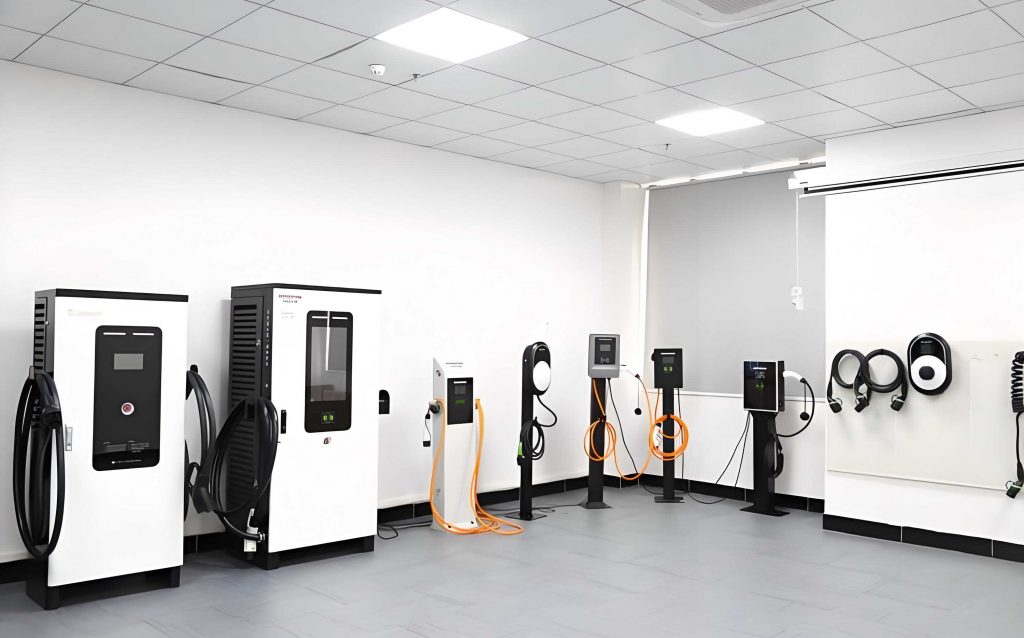
The core of our system revolves around a cloud platform that facilitates remote data exchange between verification instruments and user interfaces, such as WeChat mini-programs. This enables automatic data collection, upload, and processing, while allowing operators to input necessary information on-site. The backend supports data review and supervision, with automated generation of verification certificates. A hierarchical management model assigns different permissions to verifiers and assistants, improving workflow flexibility. For security, we employ hybrid encryption combining symmetric and asymmetric keys, along with GPS location verification to ensure data integrity and trustworthiness. The verification instrument incorporates a dual-ADC sampling scheme and low-temperature drift components to achieve high accuracy, meeting the 0.05-class standard. Experimental results demonstrate that the system’s uncertainty evaluations comply with verification requirements, and stability tests confirm long-term reliability. By integrating these features, our system significantly improves the efficiency and credibility of EV charging station verification, offering substantial value in metrological supervision.
System Architecture and Uncertainty Model
The cloud platform serves as the central hub for data transmission, storage, and processing, connecting various components like verification instruments, mobile apps, and web interfaces. It uses customized APIs to handle requests, a MySQL database for storing device information and verification data, and technologies like hash algorithms and uWSGI to enhance performance. The platform automates the entire verification process, from data acquisition to certificate generation, reducing manual intervention. For uncertainty modeling, we identify key sources: instrument accuracy, measurement rounding, repeatability, and resolution. Assuming independence among these components, we combine them using the root-sum-square method to compute the overall uncertainty. This approach ensures that the verification results for EV charging stations are reliable and meet regulatory standards.
The uncertainty model is critical for assessing the performance of EV charging station verification. Let the combined standard uncertainty \( u_c \) be derived from individual components \( u_1, u_2, \ldots, u_n \) as follows:
$$ u_c = \sqrt{u_1^2 + u_2^2 + \cdots + u_n^2} $$
For EV charging stations, typical uncertainty sources include the verification instrument’s accuracy (e.g., 0.05% for a class 0.05 device), rounding errors, and repeatability. In our experiments, we evaluate these for a 2-class EV charging station, ensuring that the expanded uncertainty remains within one-third of the station’s accuracy class. This rigorous modeling supports the system’s application in diverse scenarios, enhancing the trustworthiness of EV charging station metrology.
Verification Process Design
The verification process is divided into three stages: preparation, execution, and data processing. During preparation, operators use a WeChat mini-program to select the verification instrument and input essential details, such as the EV charging station’s model and environmental conditions. Two verification schemes are available, allowing flexibility based on the station’s specifications. The execution stage involves three key tests: appearance and function check, operational error measurement, and clock error assessment. For appearance checks, operators upload photos of the display, nameplate, and connector, while the system records GPS coordinates for traceability. Operational error is measured by comparing the station’s displayed energy with the instrument’s reading, automatically calculating the error. Clock error is evaluated by comparing the station’s time with a standard reference, using video or photo evidence. Finally, in the data processing stage, the cloud platform automates the generation of verification records and certificates, which are reviewed via a web interface. This streamlined process minimizes human error and increases efficiency for EV charging station verification.
To illustrate the operational error calculation, consider the relative error \( E \) given by:
$$ E = \frac{W_d – W_r}{W_r} \times 100\% $$
where \( W_d \) is the energy displayed by the EV charging station, and \( W_r \) is the reference value from the verification instrument. This formula is applied automatically in the system, with results uploaded to the cloud for further analysis. The integration of mobile apps and cloud services ensures that all data for EV charging station verification are handled securely and efficiently.
Hardware Design of the Verification Instrument
The verification instrument is a compact, integrated device that includes a front-end board for signal conditioning, a control module for communication, and built-in load components. It supports both AC and DC EV charging stations, with the ability to connect external load boxes for higher power requirements. A key innovation is the dual-ADC sampling scheme, which uses two analog-to-digital converters with different sampling frequencies. One ADC captures low-frequency signals for fundamental measurements, while the other handles high-frequency components like harmonics or ripple. This design improves accuracy and reduces noise interference, crucial for precise verification of EV charging stations. Additionally, low-temperature drift components are used to minimize errors caused by environmental variations, ensuring the instrument maintains 0.05-class accuracy over time.
The hardware framework consists of a mobile smartphone for interface, the verification instrument, load boxes, and charging connectors. The instrument’s front-end board converts input signals to voltage levels suitable for ADC sampling, and the control module implements protocols like GB/T 27930—2023 for compatibility with various EV charging station manufacturers. The dual-ADC process is summarized in the following table, highlighting its advantages for EV charging station verification:
| ADC Type | Sampling Frequency | Application |
|---|---|---|
| Low-Frequency ADC | Base rate | Measures fundamental waves in AC charging or DC components |
| High-Frequency ADC | Higher rate | Captures harmonics in AC charging or ripple in DC charging |
This hardware design enables high-precision measurements, making it suitable for the rigorous demands of EV charging station verification. By incorporating these features, the instrument supports both on-site and potential remote verification scenarios, enhancing the scalability of our system.
Software Components and Encryption
The software system comprises three parts: the WeChat mini-program, the cloud platform, and the web interface. The mini-program, developed with JavaScript and WXML/WXSS, allows operators to input data, monitor the verification process, and upload evidence. The cloud platform, built with C++ on Windows, uses TCP for communication with verification instruments, managing data storage, and automating calculations. It handles tasks such as sending start/stop commands, storing verification data, and generating certificates. The web interface, based on Vue and TypeScript, provides tools for data review, device management, and user role assignment. This modular design ensures that the system can be adapted for various EV charging station verification needs, with real-time data synchronization across all components.
Security is paramount in our system, especially for remote data transmission. We implement a hybrid encryption scheme combining AES (symmetric) and RSA (asymmetric) algorithms. Initially, the server generates an AES key and encrypts it with its RSA private key. The encrypted key and RSA public key are sent to the verification instrument, which decrypts the AES key using the RSA public key. All subsequent commands and data are encrypted with AES, ensuring secure communication. The process is outlined as follows:
- Server encrypts AES key with RSA private key: \( \text{Encrypted Key} = E_{\text{RSA-private}}(\text{AES Key}) \).
- Instrument decrypts AES key with RSA public key: \( \text{AES Key} = D_{\text{RSA-public}}(\text{Encrypted Key}) \).
- Data and commands are encrypted/decrypted using AES: \( \text{Ciphertext} = E_{\text{AES}}(\text{Plaintext}) \), \( \text{Plaintext} = D_{\text{AES}}(\text{Ciphertext}) \).
This approach protects against unauthorized access and ensures the integrity of EV charging station verification data. Additionally, GPS integration verifies the instrument’s location, adding an extra layer of trustworthiness.
Experimental Results and Analysis
We conducted experiments to evaluate the system’s performance, focusing on uncertainty assessment and stability testing. For uncertainty, we verified a 2-class DC EV charging station at a load point of 500 V and 60 A, with an energy output of 2.5 kWh per test. The uncertainty components included instrument accuracy (0.05%), rounding error (0.1%), repeatability, and resolution. Ten repeated measurements were taken, and the standard deviation was calculated. The results are summarized in the table below:
| Uncertainty Source | Value (%) | Distribution | Standard Uncertainty (%) |
|---|---|---|---|
| Instrument Accuracy | 0.05 | Uniform | 0.03 |
| Rounding Error | 0.1 | Uniform | 0.06 |
| Repeatability | 0.156 (single) | Normal | 0.11 (for two measurements) |
| Resolution | 0.005 kWh | Uniform | 0.08 (included in repeatability) |
The combined standard uncertainty \( u_c \) is computed as:
$$ u_c = \sqrt{(0.03)^2 + (0.06)^2 + (0.11)^2} = 0.129\% $$
With a coverage factor \( k = 2 \), the expanded uncertainty \( U \) is:
$$ U = k \times u_c = 2 \times 0.129\% = 0.26\% $$
This is less than one-third of the 2% accuracy class, satisfying verification requirements for EV charging stations.
For stability, we tested the verification instrument over six months at a typical load of 750 V and 50 A, using a 0.02-class reference device. Four sets of measurements were taken, each with 10 repetitions. The maximum variation in average values was 0.006%, which is below the 0.05% limit, confirming the instrument’s stability. The data is presented in the following table:
| Measurement Set | Average Error (%) |
|---|---|
| 1 | 0.003 |
| 2 | 0.002 |
| 3 | 0.008 |
| 4 | 0.004 |
The stability metric is the difference between the maximum and minimum averages: 0.008% – 0.002% = 0.006%. Since this is within the allowed 0.05%, the instrument meets the stability criteria for EV charging station verification.
Conclusion
Our cloud platform-based verification system for EV charging stations effectively addresses the inefficiencies and reliability issues of traditional methods. By integrating remote data transmission, automated processes, and robust hardware, it streamlines the entire verification workflow, from on-site operations to certificate generation. The use of hybrid encryption and GPS verification ensures data security and trustworthiness, while the dual-ADC design and low-drift components enhance measurement accuracy. Experimental results demonstrate that the system’s uncertainty and stability meet rigorous standards, making it suitable for widespread application in the metrological supervision of EV charging stations. This system not only improves efficiency but also paves the way for future remote verification modes, contributing to the sustainable development of the electric vehicle industry.