
With the rapid advancement of the global economy, there is an increasing focus on energy development worldwide, particularly in the realm of new energy exploitation and utilization, which serves as a critical pathway toward sustainable economic growth. In this context, the new energy vehicle industry has garnered significant attention, supported by governmental policies and financial investments that accelerate technological progress and the development of supporting infrastructure. According to data released by relevant industry alliances, as of the end of the first quarter of 2025, the cumulative number of charging infrastructure units nationwide has reached millions, including both public and private facilities. This expansion underscores the growing demand for high-performance EV charging stations. However, traditional EV charging stations often suffer from inefficiencies, such as low charging speeds and inadequate safety mechanisms, which can lead to operational risks and user dissatisfaction. To address these challenges, we integrate intelligent control technologies with conventional charging equipment to design an advanced EV charging station. This approach aims to enhance the overall performance, safety, and user experience of EV charging stations, providing a robust reference for future developments in the field.
The design of the intelligent EV charging station is structured into two primary layers: the hardware layer and the software application layer. This division ensures a modular and scalable architecture, facilitating efficient management and operation. The hardware layer comprises five key modules: control, charging, interaction, protection, and communication. Each module is meticulously engineered to perform specific functions, working in harmony to achieve reliable and intelligent charging. The control module acts as the central nervous system, utilizing a high-performance microcontroller to coordinate data flow and execute core functionalities. The charging module is responsible for converting alternating current (AC) to direct current (DC), employing advanced circuits like rectification, filtering, and inversion to ensure stable power delivery. The interaction module provides a user-friendly interface, enabling users to monitor charging status, view real-time data, and perform authentication through touchscreens and card readers. The protection module incorporates high-precision sensors to continuously monitor parameters such as voltage, current, and temperature, triggering alarms and safety measures in case of anomalies. Lastly, the communication module facilitates seamless data exchange between the EV charging station, vehicle battery management systems (BMS), and backend management platforms, supporting remote diagnostics and updates. On the software side, the application layer is organized into functional units, including the main control unit, communication unit, charging unit, safety unit, and display unit. These units work collaboratively to manage the entire charging process, from user authentication to charging termination, while ensuring safety and efficiency through real-time monitoring and adaptive algorithms.
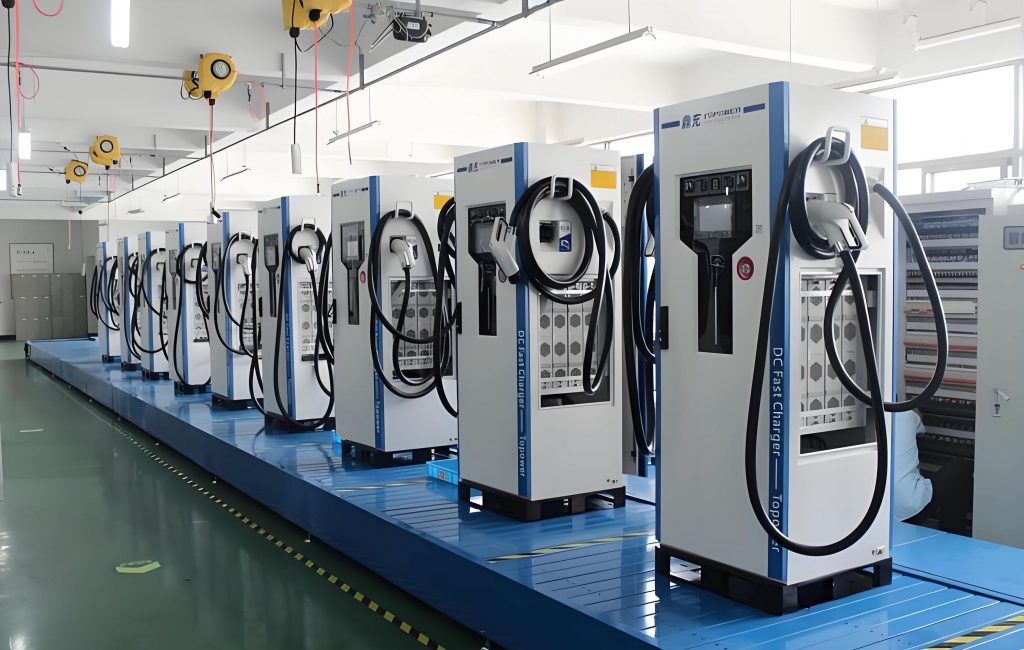
In the hardware design of the EV charging station, the control module is centered around the GD32F103ZGT6 microcontroller, which is based on the ARM Cortex-M3 core. This microcontroller operates at a maximum frequency of 108 MHz and integrates dual CAN interfaces, USB, and an external memory controller, making it ideal for control and communication applications in EV charging stations. To power the microcontroller, we employ the TMI3253T voltage conversion chip, which provides a stable 3.3 V supply from a wide input voltage range of 4.5 V to 18 V. This chip utilizes a constant-on-time (COT) control mode and can deliver up to 3 A of output current, meeting the demanding performance requirements of the control system. For communication with the vehicle’s BMS, the control module incorporates a CAN bus interface, leveraging the TJA1044GT/3 CAN transceiver from NXP. This transceiver supports high-speed communication up to 5 Mbps and features low-power standby characteristics. The TXD and RXD pins of the transceiver are connected to the microcontroller’s corresponding ports, with 120 Ω termination resistors at both ends of the CAN bus to match impedance and transient voltage suppression diodes to mitigate surge voltages. Additionally, the LM25011AQ1 DC-DC converter is used to supply 5 V to the CAN transceiver, with an adjustable potentiometer connected between the output and ground to fine-tune the feedback voltage and regulate the output.
The interaction module is designed to provide an intuitive user experience, displaying critical information such as current, voltage, and charging costs. We utilize the XG070YVW touchscreen display, which offers smart UI components and can be updated via an SD card for images and fonts. Communication with the control module is achieved through an RS485 serial interface, ensuring robust data exchange. For user authentication and payment, we integrate the Mifare S50 IC card, operating at 13.56 MHz with 1 KB of memory divided into 16 sectors, each with independent keys and access controls for enhanced security.
The communication module is essential for transmitting data related to charging status, energy consumption, and operational commands. We adopt the EC200S wireless communication module, which supports maximum downlink and uplink rates of 10 Mbps and 5 Mbps, respectively. This module is equipped with various industrial standard interfaces and built-in network protocols, making it suitable for remote data transmission and intelligent maintenance of the EV charging station.
The charging module consists of a rectifier-filter circuit, an active power factor correction (PFC) circuit, and a DC-DC converter. AC input is first filtered to remove high-frequency noise, then shaped by the PFC circuit, and finally converted to DC by the DC-DC converter before being output to the vehicle’s battery. A relay, specifically the G7EB-E model with a current-carrying capacity of 120 A and impulse withstand voltage of 10 kV, controls the high-power circuit. Since the microcontroller cannot directly drive the relay, we use the XL2803AG Darlington transistor array for this purpose.
The protection module is critical for ensuring the safe operation of the EV charging station. It employs Hall effect current sensors to accurately measure current in the charging loop, with signals filtered and amplified by the OPA2376 operational amplifier before being fed to the controller. If the current exceeds a predefined threshold, the system rapidly cuts off power to prevent hazards. For overvoltage protection, a precision resistor network divides the input voltage, which is then isolated and sent to a dual-limit comparator built with the OPA4192 operational amplifier. The OPA4192 offers a high DC gain of 120 dB and operates over a wide voltage range of ±2.25 V to 18 V. Adjustable potentiometers set the threshold limits, and if voltage fluctuations exceed these limits, an alarm signal is generated to initiate protective actions. Temperature protection is implemented using a PT100 thermistor, a constant current source, and the LM393 comparator. As temperature rises, the resistance of the thermistor increases, and when it surpasses the set threshold, the comparator triggers actions such as stopping charging or activating cooling systems.
The software system of the EV charging station is designed with a modular architecture to handle data communication, charging control, and information management efficiently. The control program begins with system initialization and self-diagnostics. If any faults are detected during self-test, charging services are halted. Users then authenticate themselves via card swipe or QR code scanning to gain access. After physically connecting the charging gun to the vehicle, the system checks for a confirmation signal. Once connected, users select a charging mode, and the system verifies account balance; insufficient balance results in termination and a prompt for recharge, while sufficient balance initiates charging. Throughout the process, real-time monitoring of voltage, current, and temperature is conducted. Charging stops either when termination conditions are met, followed by payment settlement, or prematurely in case of anomalies.
A core function of the software is the efficient and reliable charging of the vehicle battery. The off-board charger and BMS communicate based on a standardized protocol, exchanging messages for state synchronization and command confirmation. The protocol involves four stages: handshake connection, configuration of charging parameters, charging execution, and charging termination. If communication is interrupted, the system re-establishes the physical connection to reinitialize the charging process.
According to Massey’s Law, the battery charging acceptance rate is related to the discharge rate and depth of discharge. By incorporating discharge pulses during the charging cycle, the ion concentration gradient at the electrode interface can be neutralized, effectively breaking polarization phenomena and enhancing the acceptance of subsequent charging currents, thereby reducing charging time. Therefore, we implement a three-stage charging algorithm that monitors and analyzes battery parameters to adjust the charging current based on the state of charge (SOC). This algorithm controls the IGBT to regulate the entire charging process. The stages are defined as follows: Stage 1, when SOC is below 10%, involves low-current pre-charging to protect the battery; Stage 2, for SOC between 10% and 80%, uses constant current charging to minimize polarization and achieve efficient charging; and Stage 3, when SOC exceeds 80%, employs alternating positive and negative pulse charging, where a negative pulse is applied after each positive pulse, with duration determined by the degree of polarization. The charging current \( I_{\text{charge}} \) can be expressed as a function of SOC:
$$ I_{\text{charge}}(SOC) = \begin{cases}
I_{\text{pre}} & \text{if } SOC < 0.1 \\
I_{\text{const}} & \text{if } 0.1 \leq SOC \leq 0.8 \\
I_{\text{pulse}}(SOC) & \text{if } SOC > 0.8
\end{cases} $$
where \( I_{\text{pre}} \) is the pre-charging current, \( I_{\text{const}} \) is the constant current, and \( I_{\text{pulse}}(SOC) \) is the pulse current that varies with SOC. The pulse charging in Stage 3 can be modeled using a duty cycle \( D \) and frequency \( f \), with the average current given by:
$$ I_{\text{avg}} = D \cdot I_{\text{peak}} $$
where \( I_{\text{peak}} \) is the peak current during the pulse. This approach optimizes charging efficiency and battery health.
To validate the performance of the designed EV charging station, we conducted functional tests using three sets of new lithium iron phosphate batteries. The tests were performed at an ambient temperature of 25°C, with batteries cycled through charge and discharge until reaching the termination voltage. We compared our three-stage charging strategy with two reference methods: constant voltage charging and pulse charging. After five cycles of charge and discharge, the data were collected and analyzed. The results, summarized in the table below, demonstrate the time efficiency of our approach in raising the battery voltage to near 3.4 V.
| Charging Method | Time (s) | Average Voltage (V) | Time (s) | Average Voltage (V) | Time (s) | Average Voltage (V) |
|---|---|---|---|---|---|---|
| Three-Stage | 500 | 2.711 | 1500 | 2.852 | 3500 | 3.395 |
| Pulse | 500 | 2.706 | 1500 | 2.811 | 3500 | 3.325 |
| Constant Voltage | 500 | 2.653 | 1500 | 2.770 | 3500 | 3.287 |
Additionally, under resistive load conditions, we simulated output currents exceeding 110% of the EV charging station’s maximum output current and voltages exceeding 115% of the maximum output voltage. The relay responded by cutting off power within 200 ms for overcurrent and 90 ms for overvoltage, complying with the GB/T 18487.1—2023 standard for electric vehicle conductive charging systems. These results confirm that the intelligent EV charging station provides reliable charging保障 for new energy vehicles.
In summary, the规模化 development of the new energy vehicle industry imposes higher technical requirements on supporting infrastructure. Through this research, we have explored the design of an intelligent EV charging station based on the GD32F103ZGT6 main control chip. The integration of control, charging, interaction, protection, and communication modules, combined with a three-stage charging algorithm, enables efficient and reliable charging of power batteries. Experimental tests validate the station’s robustness and ease of management, highlighting its promising application prospects. Looking ahead, future designs could incorporate machine learning-based models for predicting battery health states, further optimizing charging algorithms and advancing the intelligence of EV charging stations. This evolution will contribute to the sustainable growth of the new energy vehicle ecosystem, ensuring that EV charging stations meet the demands of modern transportation.
The hardware components of the EV charging station are summarized in the following table for clarity:
| Module | Component | Specification | Function |
|---|---|---|---|
| Control | GD32F103ZGT6 Microcontroller | 108 MHz, ARM Cortex-M3 | Central processing and coordination |
| Control | TMI3253T Voltage Converter | 4.5-18 V input, 3.3 V output | Power supply for microcontroller |
| Communication | TJA1044GT/3 CAN Transceiver | 5 Mbps, low-power standby | High-speed data exchange with BMS |
| Interaction | XG070YVW Touchscreen | RS485 interface, SD card update | User interface and display |
| Charging | G7EB-E Relay | 120 A capacity, 10 kV withstand | Control of high-power circuit |
| Protection | Hall Current Sensor | High precision, low error | Current monitoring and protection |
Furthermore, the software algorithms can be enhanced with mathematical models for battery behavior. For instance, the charging efficiency \( \eta \) can be expressed as a function of current and voltage:
$$ \eta = \frac{P_{\text{out}}}{P_{\text{in}}} = \frac{V_{\text{battery}} \cdot I_{\text{charge}}}{V_{\text{input}} \cdot I_{\text{input}}} $$
where \( P_{\text{out}} \) is the output power delivered to the battery, and \( P_{\text{in}} \) is the input power from the grid. Optimization of this efficiency is crucial for reducing energy losses in EV charging stations.
In conclusion, the intelligent EV charging station represents a significant step forward in charging technology, addressing key issues of efficiency and safety. By leveraging advanced hardware and software design, we have created a system that not only meets current demands but also paves the way for future innovations. As the adoption of electric vehicles continues to grow, the role of EV charging stations will become increasingly vital, and ongoing research will focus on integrating artificial intelligence and IoT technologies to further enhance their capabilities.