
As an engineer deeply immersed in the evolution of hybrid electric vehicle technology, I find the Intelligent Multi-Mode Drive (i-MMD) system to be a fascinating case study in efficiency and integration. The 2016 Accord Hybrid serves as a perfect platform to explore this advanced hybrid electric vehicle architecture. In this comprehensive analysis, I will dissect its core components, operational logic, and control strategies, leveraging tables and mathematical models to clarify complex interactions. The fundamental goal of any modern hybrid electric vehicle like this is to seamlessly marry an internal combustion engine with electric propulsion to minimize energy waste.
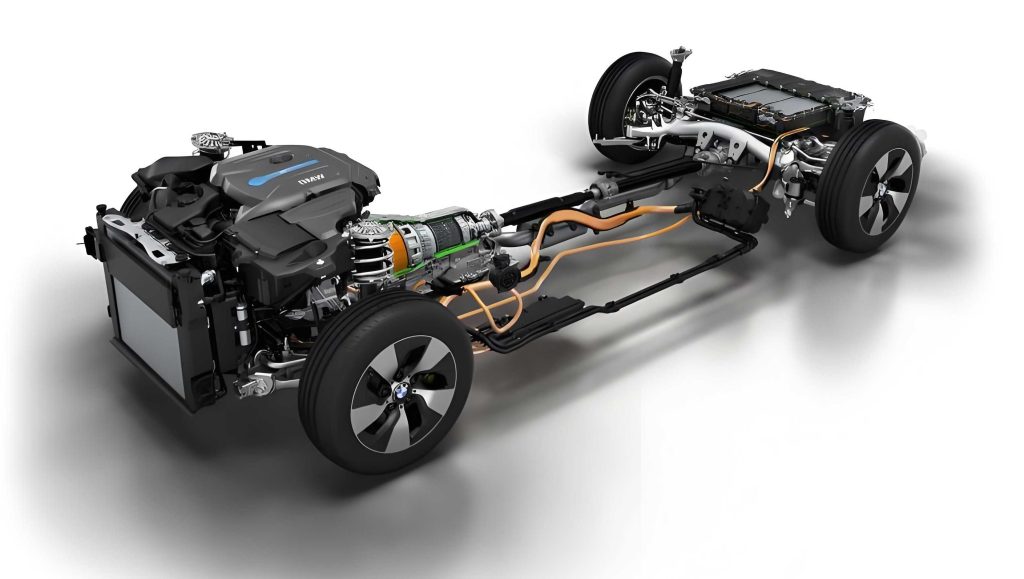
The heart of any hybrid electric vehicle is its power management system. In the i-MMD hybrid electric vehicle, this role is masterfully executed by the Power Control Unit (PCU). I will begin by examining this unit in detail. Located above the E-CVT in the engine bay, the PCU’s aluminum alloy housing contains the motor control unit, inverter, and phase current sensors. The motor control unit is the brain here, performing vector control for both the traction motor and the generator. Its functions include DC/AC conversion, frequency modulation, and critical protection protocols. The inverter is equally crucial, handling voltage transformation. It boosts the high-voltage lithium-ion battery’s nominal 259.2 V to approximately 700 V for the traction motor. Conversely, it steps down voltage from the generator or motor during regeneration to match the battery’s charging requirements. This voltage relationship can be expressed as:
$$ V_{motor} = \eta_{boost} \cdot V_{battery} $$
$$ V_{charge} = \eta_{buck} \cdot V_{gen} $$
where $\eta_{boost}$ and $\eta_{buck}$ represent the efficiency of the boost and buck conversion processes, respectively. The thermal management of the PCU is vital for a reliable hybrid electric vehicle. A dedicated cooling loop with a 12V brushless DC pump ensures optimal operating temperature, which directly impacts the efficiency of power electronics. The heat dissipation can be modeled by the formula:
$$ Q = h \cdot A \cdot \Delta T $$
where $Q$ is the heat transfer rate, $h$ is the heat transfer coefficient, $A$ is the surface area of the water jacket, and $\Delta T$ is the temperature difference between the coolant and the PCU components.
| PCU Sub-component | Primary Function | Key Parameter |
|---|---|---|
| Motor Control Unit (MCU) | Vector Control, DC/AC Conversion, Communication with PCM | PWM Frequency, Communication Rate |
| Inverter | Voltage Step-up/Step-down, Current Regulation | Max Output Voltage (~700 V), Efficiency Curve |
| Phase Current Sensor | Real-time Motor Phase Current Feedback | Measurement Accuracy, Bandwidth |
| Cooling System | Heat Extraction from Power Semiconductors | Coolant Flow Rate, Pump Power (12V DC) |
Moving to driver interaction, this hybrid electric vehicle employs a shift-by-wire system. The traditional mechanical lever is replaced with electronic push-buttons for P, N, D, and a toggle for R. This design reduces complexity and allows for innovative features like the automatic P-control based on door and seatbelt status. The logic can be represented as a Boolean function:
$$ AutoP = (VehicleSpeed \approx 0) \land (Gear \neq P) \land (DriverDoor = Open) \land (Seatbelt = Unlatched) $$
If $AutoP$ is true, the system commands a shift to Park. The SPORT mode alters the throttle map and power delivery strategy, emphasizing performance at the cost of fuel economy, a common trade-off in a performance-tuned hybrid electric vehicle.
The instrument cluster in this hybrid electric vehicle is reimagined to inform the driver about the hybrid system’s state. It replaces the tachometer with gauges for electric power output, battery charge flow, and state-of-charge (SOC). The SOC is a critical parameter in hybrid electric vehicle energy management, often estimated using ampere-hour counting or Kalman filters:
$$ SOC(t) = SOC_0 – \frac{1}{C_{nom}} \int_0^t \eta I(\tau) d\tau $$
where $SOC_0$ is the initial charge, $C_{nom}$ is the battery’s nominal capacity, $I$ is the current (positive for discharge), and $\eta$ is the coulombic efficiency.
| Instrument Display | Information Conveyed | Typical Range/Units |
|---|---|---|
| POWER Meter | Instantaneous Traction Motor Power Output | 0 – 135 kW |
| CHARGE Meter | Instantaneous Battery Charging/Regen Power | -50 kW (charge) to 0 kW |
| SOC Gauge | Remaining Battery Energy (8 segments) | 0% to 100% (≈ 1.3 kWh total) |
| EV Indicator | Signifies Pure Electric Drive Mode | On/Off |
Network communication forms the nervous system of this sophisticated hybrid electric vehicle. Four distinct CAN buses orchestrate data flow. The IMA-CAN is dedicated to high-speed communication between hybrid control units, the BAT-CAN manages the battery sensors and management system, while F-CAN and B-CAN handle body and chassis functions. This segregation ensures real-time performance for critical powertrain functions. The network latency for torque request messages on IMA-CAN must be minimal, often below 10 ms, to ensure smooth mode transitions.
The climate control system in a hybrid electric vehicle must function independently of the engine. This vehicle uses an electric compressor driven by a high-voltage motor. The compressor’s power draw, $P_{comp}$, impacts the battery’s load and can be calculated as:
$$ P_{comp} = \frac{\dot{Q}_{cool}}{COP} $$
where $\dot{Q}_{cool}$ is the cooling capacity and $COP$ is the coefficient of performance of the refrigeration cycle. The system intelligently manages battery SOC, initiating the engine to drive the generator for recharge when SOC drops to a low threshold (e.g., 2 segments), ensuring cabin comfort even during extended idle periods.
Pedestrian safety is paramount for a quiet hybrid electric vehicle. The Acoustic Vehicle Alerting System (AVAS) generates an artificial sound during low-speed EV operation. The sound pressure level $L_p$ is often programmed to increase with vehicle speed $v$ until a cutoff point (e.g., 25 km/h):
$$ L_p(v) =
\begin{cases}
k \cdot v + L_0 & \text{for } 0.5 \leq v < 25 \text{ km/h} \\
0 & \text{for } v \geq 25 \text{ km/h}
\end{cases} $$
where $k$ is a gain constant and $L_0$ is the base sound level. The driver can manually deactivate this system, a feature sometimes used on highways where engine noise is present.
The true genius of this hybrid electric vehicle lies in its multi-mode driving strategy. The i-MMD system dynamically switches between three primary driving modes and two energy recovery modes based on demand, battery SOC, and vehicle speed. I will now analyze each in depth, presenting the power flow equations.
1. Pure Electric Drive (EV Mode): In this mode, the hybrid electric vehicle operates solely on the traction motor powered by the battery. The engine is off. This mode is used for launch, low-speed cruising, and reverse. The tractive force $F_t$ is provided entirely by the motor:
$$ F_t = \frac{T_m \cdot G_r \cdot \eta_{drivetrain}}{r_{wheel}} $$
where $T_m$ is motor torque, $G_r$ is the final drive ratio, $\eta_{drivetrain}$ is efficiency, and $r_{wheel}$ is the wheel radius. The limited battery energy (1.3 kWh) constrains the pure EV range, which can be estimated as:
$$ Range_{EV} \approx \frac{E_{battery} \cdot \eta_{total}}{P_{avg}} $$
where $E_{battery}$ is usable energy, $\eta_{total}$ is overall powertrain efficiency, and $P_{avg}$ is average power demand.
2. Hybrid Drive (HV Mode – Series/Extended-Range): When power demand exceeds a threshold or SOC is low, the engine starts (via the generator acting as a starter motor) and operates in an efficient region to drive the generator. The generator supplies electricity to the traction motor. The battery assists if needed or stores excess energy. This is a series hybrid configuration. The system power balance is:
$$ P_{demand} = P_{motor} = \eta_{gen} \cdot P_{engine} + P_{battery} $$
where $P_{demand}$ is wheel power demand, $P_{engine}$ is engine output power, $\eta_{gen}$ is generator efficiency, and $P_{battery}$ is battery power (positive for discharge, negative for charge).
3. Engine-Only Drive (Direct Drive): At steady highway speeds, the system engages a mechanical clutch (overrun clutch) to directly couple the engine to the wheels for optimal highway efficiency. The motor is idle. The engine torque path bypasses the electrical conversion, reducing losses. The direct drive efficiency $\eta_{direct}$ is higher than the series path for this operating point:
$$ \eta_{direct} > \eta_{engine} \cdot \eta_{gen} \cdot \eta_{motor} \cdot \eta_{inverter} $$
4. Regenerative Braking & Coasting: During deceleration, the traction motor acts as a generator, converting kinetic energy into electrical energy. The regenerative braking torque $T_{regen}$ is a function of motor capability and battery acceptance:
$$ T_{regen} = min\left( \frac{P_{battery, max}}{\omega_m}, T_{motor, max} \right) $$
where $\omega_m$ is motor speed and $P_{battery, max}$ is the maximum battery charge power. The recovered energy $E_{regen}$ over a deceleration event is:
$$ E_{regen} = \int_{t_1}^{t_2} \eta_{regen} \cdot T_{regen}(\tau) \cdot \omega_m(\tau) d\tau $$
5. Standstill Charging: If the hybrid electric vehicle’s battery is deeply depleted, a forced charging mode can be initiated. The engine runs solely to drive the generator for charging, with no traction load.
| Operational Mode | Primary Power Source | Engine State | Motor State | Generator State | Typical Use Case | System Efficiency Estimate |
|---|---|---|---|---|---|---|
| EV Drive | Battery | OFF | MOTORING | OFF | Launch, Low-speed | ~85% (Battery to Wheel) |
| Hybrid Drive (Series) | Engine via Generator | ON (Optimal) | MOTORING | GENERATING | City Driving, Acceleration | ~35-40% (Fuel to Wheel) |
| Engine-Only Drive | Engine | ON (Direct) | FREE | FREE | Highway Cruise | ~40-45% (Fuel to Wheel) |
| Regeneration | Kinetic Energy | OFF/ON | GENERATING | Varies | Braking, Coasting | ~65-70% (Wheel to Battery) |
The mode selection algorithm is a cornerstone of this hybrid electric vehicle’s efficiency. It continuously solves an optimization problem, minimizing an equivalent cost function $J$ that incorporates fuel consumption, electrical losses, and battery depreciation:
$$ J = \int (\dot{m}_f(t) \cdot c_f + P_{loss}(t) \cdot c_e + f(SOC, I_{batt}) \cdot c_{batt}) dt $$
where $\dot{m}_f$ is fuel mass flow rate, $c_f$ is fuel cost coefficient, $P_{loss}$ is system electrical loss, $c_e$ is electricity cost coefficient, and $f(SOC, I_{batt})$ is a battery stress function weighted by a cost factor $c_{batt}$.
To further elucidate the energy management, let’s consider the power split during a typical urban cycle for this hybrid electric vehicle. The battery acts as a buffer, smoothing the engine’s load. The instantaneous electrical power balance at the DC link (within the PCU) is:
$$ P_{batt} + P_{gen} = P_{motor} + P_{aux} + P_{loss, inv} $$
where $P_{aux}$ includes loads like the electric A/C compressor and $P_{loss, inv}$ is inverter loss, often modeled as a quadratic function of current:
$$ P_{loss, inv} = R_{eq} \cdot I_{dc}^2 + V_{drop} \cdot I_{dc} $$
The high-voltage battery itself is a complex subsystem. Its internal resistance $R_{int}$ increases with age and affects performance. The terminal voltage $V_t$ under load is:
$$ V_t = V_{oc}(SOC) – I_{batt} \cdot R_{int}(SOC, T) $$
where $V_{oc}$ is the open-circuit voltage, a function of SOC, and $T$ is temperature. The Battery Management System (BMS) on the BAT-CAN bus meticulously monitors cell voltages and temperatures to ensure the longevity and safety of this hybrid electric vehicle’s energy store.
The electric motor’s performance is characterized by its efficiency map, $\eta_m(T_m, \omega_m)$. The motor control unit uses vector control to operate the motor at its highest efficiency region for a given torque and speed demand. The motor’s d-q axis voltage equations are fundamental to this control:
$$ V_d = R_s I_d + L_d \frac{dI_d}{dt} – \omega_e L_q I_q $$
$$ V_q = R_s I_q + L_q \frac{dI_q}{dt} + \omega_e (L_d I_d + \lambda_f) $$
where $V_d, V_q$ are d-q axis voltages, $I_d, I_q$ are currents, $R_s$ is stator resistance, $L_d, L_q$ are inductances, $\omega_e$ is electrical frequency, and $\lambda_f$ is permanent magnet flux linkage.
The thermal dynamics of the entire hybrid electric vehicle powertrain are coupled. The engine coolant loop, PCU cooling loop, and battery cooling (if present) must be managed. A simplified lumped-parameter model for a component temperature $T_c$ is:
$$ C_{th} \frac{dT_c}{dt} = P_{loss} – \frac{T_c – T_{amb}}{R_{th}} $$
where $C_{th}$ is thermal capacitance, $R_{th}$ is thermal resistance to ambient, and $T_{amb}$ is ambient temperature.
In conclusion, the 2016 Accord’s i-MMD system represents a highly optimized implementation of a hybrid electric vehicle. By intelligently toggling between series-hybrid, parallel-hybrid (direct drive), and pure-electric modes, it extracts maximum efficiency from both the internal combustion engine and the electric drivetrain across a wide spectrum of driving conditions. The extensive use of dedicated control networks, sophisticated power electronics, and driver-centric interfaces underscores the complexity behind the seamless experience offered by a modern hybrid electric vehicle. The mathematical principles and control strategies discussed here form the bedrock upon which current and future generations of hybrid electric vehicles will continue to evolve, pushing the boundaries of fuel efficiency and reducing emissions without compromising performance.