
The modern electric vehicle (EV) battery pack is a complex integration of mechanical, electrical, and thermal components. This inherent complexity presents significant challenges in accurately analyzing its mechanical performance and subsequently validating models against physical tests. Therefore, establishing a reasonable and effective modeling methodology is paramount for virtual development, offering substantial advantages in improving design quality, reducing prototyping costs, and shortening development cycles.
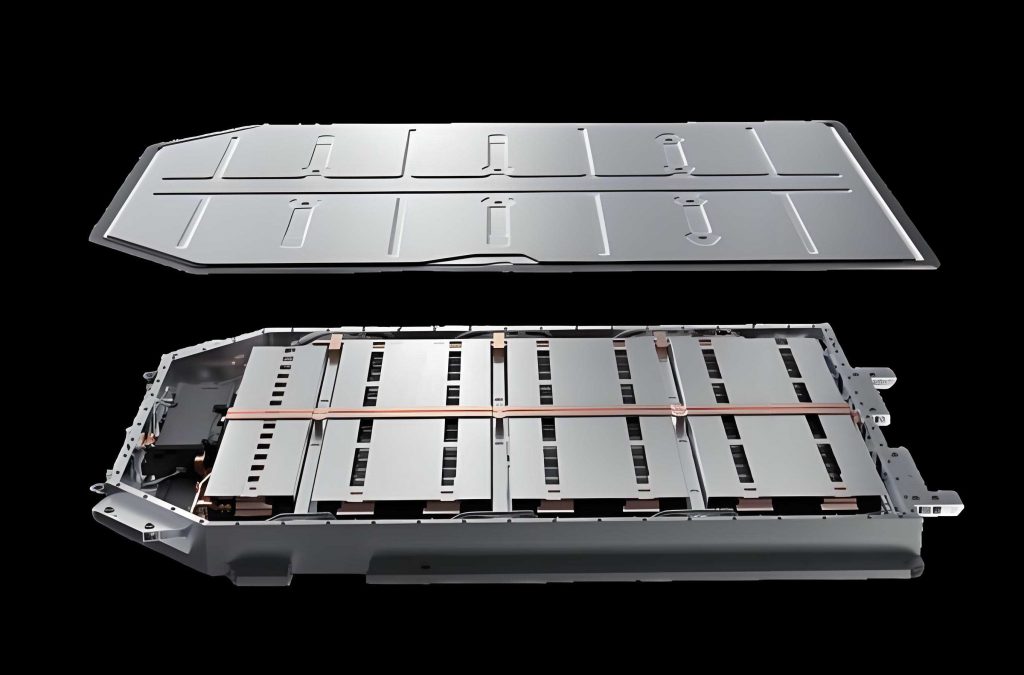
This article details a systematic approach for the dynamic modeling of EV battery packs, focusing on homogenization techniques, material characterization, and the significant influence of ancillary components like the cover and support foam on overall system stiffness.
1. Core Modeling Philosophy and Theoretical Foundation
The primary challenge in modeling an EV battery pack lies in its multi-scale, multi-material nature. A practical engineering approach involves simplifying complex structures into equivalent models. The battery cell, a composite and highly non-linear structure, is effectively simulated using a homogenization method, representing it as a continuum with isotropic material properties derived from compression tests.
In the assembly of an EV battery pack, numerous bolts create preloads, inducing a pre-stress field. While this field can influence the natural frequency of the assembly, research indicates the frequency shift is within acceptable margins for linear dynamic analysis. Therefore, fasteners are commonly modeled using rigid beam elements (RBE2) connecting washers at bolt holes, neglecting the non-linear preload effects for modal and frequency response analysis.
Contact interfaces between components introduce boundary non-linearity. However, once the contact state stabilizes under preload (e.g., clamped interfaces), the structural stiffness matrix becomes approximately constant, allowing the system to be treated as linear for modal analysis. The fundamental equation for undamped or proportionally damped linear vibration of an n-degree-of-freedom system is:
$$ \mathbf{M}\ddot{\mathbf{X}} + \mathbf{K}\mathbf{X} = 0 $$
Where $\mathbf{M}$ is the mass matrix, $\mathbf{K}$ is the stiffness matrix, $\mathbf{X}$ is the displacement vector, and $\ddot{\mathbf{X}}$ is the acceleration vector.
Assuming a harmonic solution of the form $\mathbf{X} = \mathbf{\Phi} \sin(\omega t + \phi)$, where $\mathbf{\Phi}$ is the mode shape vector, leads to the eigenvalue problem:
$$ (\mathbf{K} – \omega^2 \mathbf{M})\mathbf{\Phi} = 0 $$
The condition for a non-trivial solution yields the characteristic equation:
$$ |\mathbf{K} – \omega^2 \mathbf{M}| = 0 $$
Solving this equation yields the system’s natural frequencies $\omega_i$ and corresponding mode shapes $\mathbf{\Phi}_i$.
From Equation (3), it is evident that the natural frequency is governed by both system stiffness ($\mathbf{K}$) and mass ($\mathbf{M}$). Stiffness itself comprises material stiffness (Young’s modulus) and geometric stiffness (moment of inertia). Consequently, enhancing the natural frequency of an EV battery pack can be achieved by using materials with a higher modulus, increasing the cross-sectional inertia of components, or reducing the overall system mass.
2. Finite Element Model Development and Material Characterization
A complete EV battery pack finite element (FE) model includes the lower tray (housing), upper cover, support foam, cell modules, busbars, mounting brackets, cooling plates, adhesives, and numerous electrical components. An effective modeling strategy involves retaining core structural members while simplifying non-critical features. General guidelines for FE model development include:
- Accurately representing component geometry and kinematic relationships.
- Ensuring the FE model’s total mass and center of gravity match the CAD model.
- Simplifying local features like small holes and fillets while preserving global contours and critical mounting points.
Components with a high length-to-thickness ratio (e.g., sheet metal covers, trays) are meshed with shell elements, while bulky parts are meshed with solid elements. Welded joints are modeled using a layer of solid hexahedral elements connected to parent parts via RBE3 elements.
A critical aspect of modeling the EV battery pack is representing the interaction between the cover and the internal components. The cover often has relatively low stiffness and requires support to prevent excessive vibration or noise. In practice, support foam is attached either to the inner surface of the cover or the top of the cell modules. In the FE model, this foam is typically represented as a continuous layer of solid elements with a defined compression gap, and the cover is bolted to the tray flange using RBE2 connections at bolt holes.
Material Data Acquisition: The accuracy of the model hinges on correct material properties. For isotropic materials like metals, standard handbook values suffice. However, characterizing non-linear components like the battery cell and support foam is essential. Uniaxial compression tests are performed to obtain stress-strain curves. The initial linear slope of this curve provides the equivalent elastic modulus ($E$) used in the linear homogenized model.
For the specific EV battery packs (referred to as Pack A and Pack B) analyzed in this study, compression testing yielded the following equivalent material properties:
| Component | Material Type | Equivalent Elastic Modulus (E) | Source |
|---|---|---|---|
| Lithium-Iron-Phosphate Cell (with plastic endplates) | Homogenized Isotropic Solid | 75 MPa | Compression Test |
| Support Foam | Hyperelastic / Isotropic Solid | 0.35 MPa | Compression Test |
| Cover (Pack A & B) | Steel DC06 | 210 GPa | Standard |
| Tray (Pack A) | Aluminum Extrusion | 70 GPa | Standard |
| Tray (Pack B) | Steel Sheet | 210 GPa | Standard |
3. Simulation and Experimental Correlation: Influence of Cover and Foam
To investigate the influence of the cover and support foam on the dynamic response of the EV battery pack, a series of simulation and experimental studies were designed. The primary variable was the presence/absence of the cover and the support foam. Sweep frequency tests were conducted on physical packs in different configurations, and the results were correlated with modal analysis from the FE models.
3.1 Study on EV Battery Pack A (Aluminum Tray)
Three configurations were analyzed for Pack A:
- Configuration A1: Full pack with cover and support foam.
- Configuration A2: Pack without cover and without foam (bare tray with modules).
- Configuration A3: Pack with cover but without support foam.
The modal analysis for the cover alone predicted a first natural frequency of 23.57 Hz in a free-free boundary condition. The system-level modal analysis results for the three configurations are summarized below.
| Configuration | Description | Simulated 1st System Frequency (Hz) | Simulated Cover Frequency (Hz) |
|---|---|---|---|
| A1 | With Cover, With Foam | 37.17 | 23.57 |
| A2 | Without Cover, Without Foam | 35.75 | N/A |
| A3 | With Cover, Without Foam | 38.13 | 23.57 |
The corresponding sine sweep tests were performed from 5-200 Hz with an input acceleration of 0.5g. Accelerometers were placed on the tray (sensor 4) and on the cover at center (sensor 7) and edge (sensor 8) locations. Key experimental results are tabulated below.
| Config. | Test Description | 1st Freq. at Tray (Sensor 4) (Hz) | 1st Freq. at Cover Center (Sensor 7) (Hz) | 1st Freq. at Cover Edge (Sensor 8) (Hz) | Identified Cover Freq. (Hz) |
|---|---|---|---|---|---|
| A1 | With Cover, With Foam | 37.53 | 38.12 | 37.53 | 27.06 |
| A2 | Without Cover, Without Foam | 37.04 | N/A | N/A | N/A |
| A3 | With Cover, Without Foam | 37.64 | 37.64 | 39.38 | 27.13 |
Analysis of Pack A Results:
- The simulation results show good correlation with test data, with errors within an acceptable 5% margin, validating the modeling methodology and material data for the EV battery pack.
- Support foam locally increases system stiffness: In Config. A1, the area under the foam (Sensor 7, 38.12 Hz) showed a higher response frequency than areas without direct foam support (Sensor 8, 37.53 Hz).
- The cover’s inherent stiffness is lowest at its center. This is evidenced in Config. A3, where the cover center frequency (37.64 Hz) is lower than the edge frequency (39.38 Hz) in the absence of foam.
- Adding the cover alone increases system stiffness: Config. A2 (no cover) has the lowest frequency (37.04 Hz). Adding the cover (Config. A3) raises the system frequency to 37.64 Hz, as the bolted connection between the cover and tray flange stiffens the entire assembly.
- The identified cover frequency in tests (~27 Hz) was higher than the simulated free-free frequency (23.57 Hz). This is because during the system test, the cover is boundary-conditioned by its bolted connection to the tray, increasing its effective natural frequency.
3.2 Study on EV Battery Pack B (Steel Tray)
This study focused on the specific impact of support foam on an EV battery pack with a stiffer, steel tray. Two configurations were compared:
- Configuration B1: Pack with cover but without support foam.
- Configuration B2: Pack with cover and with support foam.
The modal analysis and corresponding sweep test results are consolidated in the table below.
| Configuration | Description | Simulated 1st System Frequency (Hz) | Experimental 1st System Frequency (Hz) | Frequency Increase |
|---|---|---|---|---|
| B1 | With Cover, Without Foam | 37.3 | 38.24 | — |
| B2 | With Cover, With Foam | 39.7 | 39.86 | ~1.6 Hz |
Analysis of Pack B Results:
- The correlation between simulation and test is again within 5%, reinforcing the robustness of the modeling approach for different EV battery pack architectures.
- The addition of support foam (Config. B2) increased the system’s first natural frequency by approximately 1.6 Hz compared to the configuration without foam (Config. B1). This demonstrates that even with a stiffer tray, the foam plays a crucial role in enhancing the overall dynamic stiffness of the EV battery pack by providing distributed support to the cover, effectively coupling it more rigidly to the internal module structure.
4. Discussion on Damping and Response Behavior
The experimental data reveals an insightful phenomenon related to damping. In Pack A’s Config. A1 (with foam), the cover’s accelerometer showed a clear resonant peak. In Config. A3 (without foam), the acceleration response on the cover was significantly lower than the input excitation level at low frequencies. This can be explained by structural damping.
When the foam is present, it provides elastic support, creating a more deterministic load path with relatively lower structural damping. This allows resonant build-up. When the foam is absent, the poorly supported cover exhibits higher structural damping (due to micro-slip, friction, etc.). According to vibration theory, when the excitation frequency is much lower than the natural frequency of a highly damped subsystem, its response can be less than the excitation input. This explains the attenuated signal on the cover in the no-foam configuration during the low-frequency sweep.
The general effect of key components on an EV battery pack’s first natural frequency ($f_1$) can be summarized by a conceptual equation highlighting the influencing factors:
$$ f_1 \propto \sqrt{\frac{K_{tray} + \Delta K_{cover} + \Delta K_{foam} + \Delta K_{joints}}{M_{total}}} $$
Where:
$K_{tray}$ is the baseline stiffness of the tray/module assembly.
$\Delta K_{cover}$ is the stiffness contribution from bolting the cover to the tray flanges.
$\Delta K_{foam}$ is the additional stiffness from the foam supporting the cover against the modules.
$\Delta K_{joints}$ represents the stiffness from all welded and bolted connections.
$M_{total}$ is the total mass of the EV battery pack.
5. Conclusions
This comprehensive study on EV battery pack dynamics leads to the following key conclusions:
- A homogenized modeling approach for battery cells and foam, combined with material properties derived from compression tests and careful finite element pre-processing, yields highly accurate dynamic models. The correlation between simulation and experimental sweep frequency tests was consistently within 5%, validating the methodology.
- The upper cover and support foam are not merely sealing or cushioning elements but play a significant role in defining the overall system stiffness of an EV battery pack. Adding a cover increases stiffness by creating a closed structural section with the tray. Adding support foam further increases stiffness by providing distributed support to the cover, reducing its unsupported span.
- The effectiveness of support foam in raising the system frequency is more pronounced when the cover’s inherent natural frequency is relatively high or close to the system’s frequency. It mitigates local compliance.
- The dynamic response of the EV battery pack is governed by a complex interaction of mass, stiffness from multiple components (tray, cover, foam, joints), and damping. The absence of foam can lead to increased structural damping in the cover subsystem, manifesting as attenuated response at low frequencies despite the lower local stiffness.
- This validated modeling framework enables the virtual assessment and optimization of EV battery pack designs for dynamic performance, directly contributing to improved NVH characteristics and structural reliability in electric vehicles.