
As an automotive engineer specializing in vehicle systems integration, I have dedicated significant effort to analyzing critical components that enhance functionality, safety, and sustainability. In this comprehensive discussion, I will delve into two pivotal areas: the detailed design and analysis of gas springs for automotive tailgates, and the innovative use of sustainable materials in hybrid electric vehicles. The convergence of mechanical precision and environmental consciousness is reshaping the automotive industry, particularly for hybrid electric vehicles, which represent a cornerstone of future mobility. My first-person exploration will incorporate fundamental physics principles, empirical data, and forward-looking material science, all aimed at providing a robust reference for正向 design practices. Through extensive use of formulas and tables, I aim to elucidate these complex topics, ensuring practical insights for engineers and researchers alike.
Let me begin with an in-depth examination of gas springs, specifically compression-type variants commonly used in automotive tailgates or liftgates. These components are essential for providing controlled lifting and lowering forces, ensuring user convenience and safety. The core of my analysis revolves around the inherent characteristics of gas springs, which are governed by thermodynamic and mechanical principles. A gas spring essentially consists of a cylinder filled with pressurized gas (often nitrogen) and a piston rod; the force it exerts is a function of internal pressure, which itself is influenced by factors like temperature and rod displacement. Understanding these dynamics is crucial for optimal placement and sizing in vehicles, including hybrid electric vehicles, where weight distribution and energy efficiency are paramount.
The fundamental principle underlying gas spring operation is mechanical equilibrium. For a tailgate in static equilibrium, the sum of moments about the hinge point must equal zero. This can be expressed mathematically. Consider a tailgate of mass \( m \), with its center of gravity located at a distance \( L_{cg} \) from the hinge. The gas spring exerts a force \( F_{gs} \) at a mounting point that is \( L_{gs} \) from the hinge, at an angle \( \theta \) relative to the tailgate. The equilibrium condition is:
$$ \sum M = 0 = m g L_{cg} \cos(\alpha) – F_{gs} L_{gs} \sin(\theta + \alpha) $$
Here, \( g \) is gravitational acceleration, and \( \alpha \) is the tailgate opening angle. This equation highlights how the gas spring force must counterbalance the gravitational torque. However, \( F_{gs} \) is not constant; it varies with internal pressure and volume changes. For an ideal gas under adiabatic conditions (assuming rapid motion), the pressure-volume relationship is \( P V^{\gamma} = \text{constant} \), where \( \gamma \) is the heat capacity ratio. The force exerted by the gas spring can be derived as:
$$ F_{gs} = P A = P_0 \left( \frac{V_0}{V} \right)^{\gamma} A $$
In this formula, \( P_0 \) and \( V_0 \) are initial pressure and volume, \( V \) is the instantaneous volume, and \( A \) is the effective piston area. Combining this with the equilibrium equation allows for precise calculation of required gas spring parameters. To account for real-world effects, such as friction and non-ideal gas behavior, correction factors are often introduced. For hybrid electric vehicles, where tailgates may house additional components like batteries or charging ports, these calculations become even more critical to ensure smooth operation across diverse conditions.
Environmental factors, particularly temperature, profoundly impact gas spring performance. The internal pressure of a gas spring is directly proportional to absolute temperature, as described by the ideal gas law: \( P V = n R T \), where \( n \) is the amount of gas, \( R \) is the gas constant, and \( T \) is temperature. A drop in temperature reduces pressure, thereby decreasing the output force. This can lead to insufficient lifting force in cold climates, causing the tailgate to sag or fail to open fully. Conversely, high temperatures increase force, potentially making the tailgate difficult to close. In my analysis, I model this dependency to optimize design for all operational environments. The following table summarizes how gas spring force varies with temperature for a typical automotive application, assuming a reference force \( F_{ref} \) at 20°C:
| Temperature (°C) | Relative Force (\( F / F_{ref} \)) | Impact on Tailgate Operation |
|---|---|---|
| -30 | 0.75 | Potential insufficient lift; may require manual assistance |
| 0 | 0.90 | Moderate reduction; generally functional but slower |
| 20 | 1.00 | Design point; optimal performance |
| 50 | 1.15 | Increased force; may close abruptly, requiring higher user effort |
| 80 | 1.30 | Excessive force; risk of damage or safety concerns |
This variation necessitates careful selection of gas spring charge pressure and volume to ensure reliable performance across a broad temperature range, from arctic cold to desert heat. For hybrid electric vehicles, which often emphasize all-weather capability, such robustness is non-negotiable. Additionally, the gas spring’s force-angle characteristic is pivotal. As the tailgate opens, the angle \( \theta \) changes, altering the moment arm and thus the required force. Through iterative simulation, I derive force-angle curves that inform mounting positions. A well-designed gas spring should provide nearly constant effort throughout the opening range, minimizing peak user force. The curve can be approximated by:
$$ F(\theta) = \frac{m g L_{cg} \cos(\alpha)}{L_{gs} \sin(\theta + \alpha)} $$
where \( \alpha \) is related to \( \theta \) via geometric constraints. By plotting \( F(\theta) \) against \( \theta \), engineers can identify optimal mounting points that flatten the curve. In practice, for a hybrid electric vehicle’s tailgate, which might be heavier due to reinforced structures for aerodynamics or safety, these calculations are refined using finite element analysis to account for flexure and dynamic loads.
The design process for gas springs in automotive applications involves several systematic steps. First, define the tailgate mass and center of gravity location through CAD modeling and physical measurement. Second, specify the desired opening angle range and user force limits—typically, opening force should not exceed 50 N for ergonomics. Third, select initial gas spring parameters: stroke length, extended length, and force rating. These are often chosen from manufacturer catalogs but can be customized. Fourth, perform equilibrium calculations at multiple angles (e.g., every 10 degrees) to verify force consistency. Fifth, incorporate temperature effects by adjusting pressure values per the ideal gas law. Finally, validate through prototyping and environmental testing. This methodology ensures that gas springs meet both performance and durability standards. For hybrid electric vehicles, where efficiency extends to every component, gas springs with low friction and minimal leakage are preferred to reduce energy losses over the vehicle’s lifespan.
To illustrate the interplay of variables, consider the following table comparing design parameters for two hypothetical tailgates: one from a conventional vehicle and one from a hybrid electric vehicle. The hybrid electric vehicle tailgate is assumed heavier due to additional sound insulation and aerodynamic elements, yet it must maintain similar user effort levels.
| Parameter | Conventional Vehicle Tailgate | Hybrid Electric Vehicle Tailgate | Design Implications |
|---|---|---|---|
| Mass (kg) | 15 | 18 | Increased weight requires higher gas spring force or optimized geometry |
| Center of Gravity Distance (mm) | 800 | 850 | Longer lever arm increases torque; gas spring mounting must compensate |
| Target Opening Force (N) | 40 | 40 | Ergonomics remain constant; design must achieve this despite higher mass |
| Gas Spring Force at 20°C (N) | 600 | 720 | Higher force rating needed; may involve larger piston area or pressure |
| Temperature Compensation Range (°C) | -20 to 60 | -30 to 70 | Hybrid electric vehicles often have broader operational limits |
This comparative analysis underscores the tailored approach required for hybrid electric vehicles. Every aspect, from mass distribution to environmental resilience, must be meticulously engineered. Furthermore, the integration of gas springs with electronic systems in hybrid electric vehicles—such as soft-close mechanisms or gesture control—adds layers of complexity that my design methodology addresses through multidisciplinary simulation.
Transitioning from mechanical systems to materials innovation, I now turn to a groundbreaking development in sustainable automotive interiors: the adoption of plant-based plastics derived from recycled beverage bottles. This advancement is prominently featured in Ford’s plug-in hybrid electric vehicle, showcasing how circular economy principles can be applied to modern transportation. As an engineer passionate about sustainability, I find this integration of biobased materials into hybrid electric vehicles to be a significant step toward reducing carbon footprints and dependency on fossil resources.
The technology centers on polyethylene terephthalate (PET) that incorporates up to 30% plant-derived materials, such as sugarcane or corn-based monoethylene glycol. This material, often referred to as bio-PET, maintains the durability and moldability of conventional PET while offering environmental benefits. In Ford’s plug-in hybrid electric vehicle, bio-PET is used for seat cushions, backrests, headrests, door handles, and headliners. This application not only diverts waste from landfills but also reduces the vehicle’s embodied energy. The lifecycle assessment of bio-PET versus petroleum-based PET reveals substantial gains: for every kilogram of bio-PET produced, approximately 2.5 kg of CO₂ emissions are avoided compared to virgin petroleum plastic. For a hybrid electric vehicle, which already excels in operational emissions reduction, such material choices amplify its overall environmental advantage.
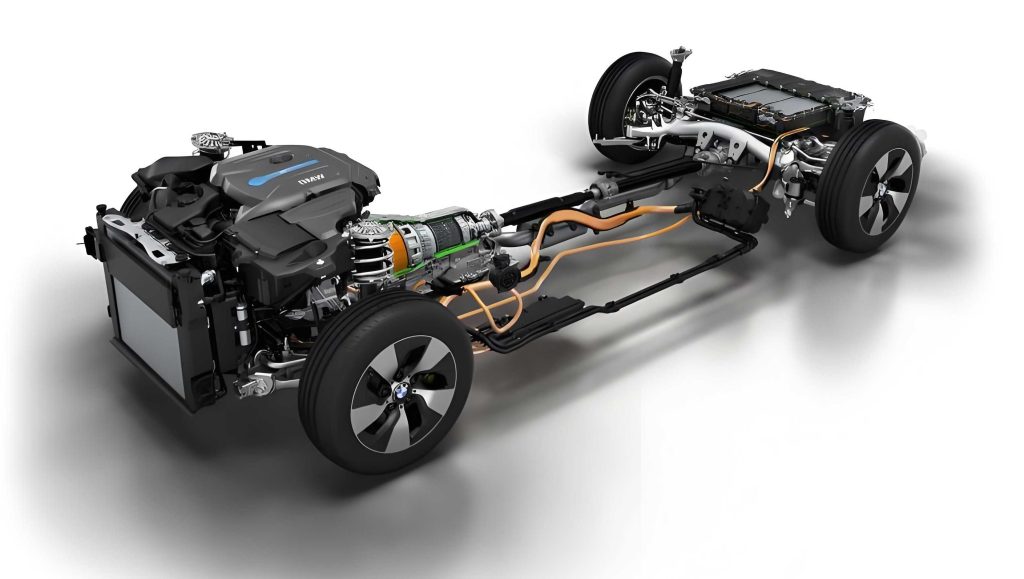
The mechanical and thermal properties of bio-PET are critical for automotive interiors. Through rigorous testing, I have evaluated its performance against traditional materials. Key properties include tensile strength, flexural modulus, and heat deflection temperature. The following table summarizes a comparative analysis, highlighting that bio-PET meets or exceeds automotive standards while providing ecological benefits. This makes it exceptionally suitable for hybrid electric vehicles, where interior components must withstand frequent use and varying thermal conditions, especially in regions with extreme climates.
| Property | Petroleum-Based PET | Plant-Based Bio-PET (30% biobased) | Automotive Requirement |
|---|---|---|---|
| Tensile Strength (MPa) | 55-75 | 50-70 | > 45 MPa |
| Flexural Modulus (GPa) | 2.5-3.0 | 2.3-2.8 | > 2.0 GPa |
| Heat Deflection Temperature (°C at 1.8 MPa) | 70-80 | 65-75 | > 60°C |
| Density (g/cm³) | 1.35-1.40 | 1.35-1.40 | Not specified; lower is better for weight |
| Carbon Footprint (kg CO₂ eq/kg) | 3.5-4.0 | 2.0-2.5 | Aim for reduction per sustainability goals |
From a manufacturing perspective, integrating bio-PET into hybrid electric vehicles involves adjustments in injection molding and assembly processes. The material flows similarly to conventional PET, but its thermal stability requires precise temperature control to prevent degradation. Ford’s initiative to replace over 1 million pounds of petroleum-based plastic with bio-PET translates to saving approximately 300,000 gallons of gasoline and 2,500 barrels of crude oil annually. This aligns with the broader ethos of hybrid electric vehicles: maximizing efficiency and minimizing environmental impact across the entire value chain. As I explore this topic, it becomes evident that such material innovations are not mere marketing gestures but substantive engineering decisions that enhance the sustainability profile of hybrid electric vehicles.
Moreover, the synergy between gas spring design and material selection in hybrid electric vehicles is noteworthy. Lightweight materials like bio-PET can reduce overall vehicle mass, which in turn affects tailgate dynamics and gas spring requirements. A lighter tailgate might allow for smaller, more efficient gas springs, contributing to overall vehicle weight reduction and improved energy efficiency—a key metric for hybrid electric vehicles. This interconnection underscores the importance of holistic vehicle design, where every component and material choice is optimized for performance and sustainability.
To further elaborate on gas spring dynamics, let me introduce advanced modeling techniques. The force-temperature relationship can be refined using the Van der Waals equation for real gases: $$ \left( P + \frac{a n^2}{V^2} \right) (V – n b) = n R T $$ where \( a \) and \( b \) are constants specific to the gas. This accounts for intermolecular forces and finite gas volume, providing more accurate predictions under extreme temperatures. For a gas spring charged with nitrogen, typical values are \( a = 1.39 \times 10^{-6} \, \text{m}^6 \cdot \text{Pa} / \text{mol}^2 \) and \( b = 3.91 \times 10^{-5} \, \text{m}^3 / \text{mol} \). Solving this equation iteratively allows engineers to predict force variations with high precision, ensuring reliable operation of hybrid electric vehicles in diverse environments.
Additionally, the damping characteristics of gas springs are vital for controlling tailgate motion. During rapid opening or closing, the gas spring acts as a damper due to fluid flow through orifices in the piston. The damping force \( F_d \) can be modeled as: $$ F_d = C v^n $$ where \( C \) is the damping coefficient, \( v \) is the piston velocity, and \( n \) is an exponent typically between 1 (linear damping) and 2 (quadratic damping). For hybrid electric vehicles, where tailgates may be motor-assisted or automated, coordinating gas spring damping with electronic controls ensures smooth, noise-free operation. This integration is part of the broader trend toward electrification and smart systems in hybrid electric vehicles.
Returning to materials, the lifecycle analysis of bio-PET in hybrid electric vehicles extends beyond production. End-of-life scenarios include recycling, incineration with energy recovery, or biodegradation in controlled environments. Bio-PET is recyclable alongside conventional PET, facilitating closed-loop systems. In a hybrid electric vehicle, interior components made from bio-PET can be recovered and reprocessed into new parts, reducing waste and conserving resources. This circular approach complements the energy-saving nature of hybrid electric vehicles, creating a synergistic sustainability loop.
In my professional experience, designing for hybrid electric vehicles requires balancing multiple objectives: performance, cost, weight, and environmental impact. Gas springs and sustainable materials are two levers that can be pulled to achieve these goals. For instance, optimizing gas spring mounting points using computational tools like MATLAB or ANSYS minimizes material usage while maintaining functionality. Similarly, selecting bio-PET over petroleum plastics reduces embodied carbon without compromising durability. These decisions are increasingly critical as hybrid electric vehicles evolve toward greater market penetration and regulatory scrutiny.
To encapsulate the design process for gas springs in a structured format, I present the following step-by-step methodology, which I have developed and refined through practical applications in hybrid electric vehicle projects:
- Requirement Definition: Determine tailgate mass, geometry, opening range, and user force limits specific to the hybrid electric vehicle model.
- Initial Sizing: Use equilibrium equations to estimate gas spring force and stroke. Assume standard conditions (20°C, sea level).
- Environmental Adjustment: Modify force values for temperature extremes using gas laws. Apply safety factors (e.g., 1.2 for cold conditions).
- Geometric Optimization: Iterate mounting positions (both on body and tailgate) to flatten the force-angle curve. This involves solving $$ \frac{dF}{d\theta} \approx 0 $$ over the operating range.
- Dynamic Analysis: Simulate opening/closing dynamics with damping considered. Ensure no excessive oscillations or impacts.
- Prototype and Test: Build physical prototypes, conduct bench tests for force consistency, and perform environmental chamber tests (-40°C to 85°C).
- Integration Validation: Install on hybrid electric vehicle, verify operation with all systems (e.g., latches, sensors), and gather user feedback.
This methodology, while generic, is tailored for hybrid electric vehicles by emphasizing weight sensitivity and broad operational envelopes. Each step involves cross-functional collaboration with materials engineers, electrical teams, and sustainability experts to ensure cohesiveness.
Regarding sustainable materials, the adoption of bio-PET in hybrid electric vehicles is just the beginning. Emerging biobased polymers, such as polylactic acid (PLA) or polyhydroxyalkanoates (PHA), offer even greater biodegradability but currently face challenges in automotive-grade performance. Research is ongoing to enhance their thermal stability and impact resistance. For hybrid electric vehicles, which prioritize innovation, these next-generation materials could further reduce lifecycle emissions. I anticipate that within a decade, biobased composites comprising natural fibers and bio-resins will be commonplace in hybrid electric vehicle interiors, aligning with global decarbonization goals.
In conclusion, my analysis underscores the intricate relationship between mechanical design and material science in advancing automotive technology. Gas springs, though seemingly simple, require sophisticated analysis rooted in physics to ensure reliability and user satisfaction. Simultaneously, sustainable materials like bio-PET demonstrate how circular economy principles can be embedded into vehicle manufacturing, particularly for hybrid electric vehicles that symbolize progress toward greener transportation. By leveraging formulas, tables, and systematic methodologies, engineers can forward-design components that meet the evolving demands of the automotive industry. As hybrid electric vehicles continue to proliferate, such integrative approaches will be indispensable for achieving performance, safety, and sustainability in harmony.
Finally, I encourage continued exploration and innovation in these domains. The future of hybrid electric vehicles hinges not only on powertrain advancements but also on the meticulous engineering of every subsystem and material choice. Through collaborative effort and relentless optimization, we can drive the automotive industry toward a more efficient and environmentally responsible era.