
As a specialist in EV repair, I have dedicated years to understanding the intricacies of electrical car repair, particularly as the automotive industry shifts toward sustainable energy solutions. Electric vehicles (EVs) offer significant environmental benefits by reducing air pollution, but their complex systems—distinct from traditional internal combustion engines—present unique challenges in fault diagnosis and maintenance. This article delves into common faults across mechanical, battery, communication control, and air conditioning systems in EVs, and explores efficient repair techniques that enhance service quality and vehicle reliability. Through detailed analysis, including tables and mathematical models, I aim to provide a comprehensive guide for professionals engaged in EV repair, ensuring that electrical car repair practices evolve to meet the demands of modern transportation.
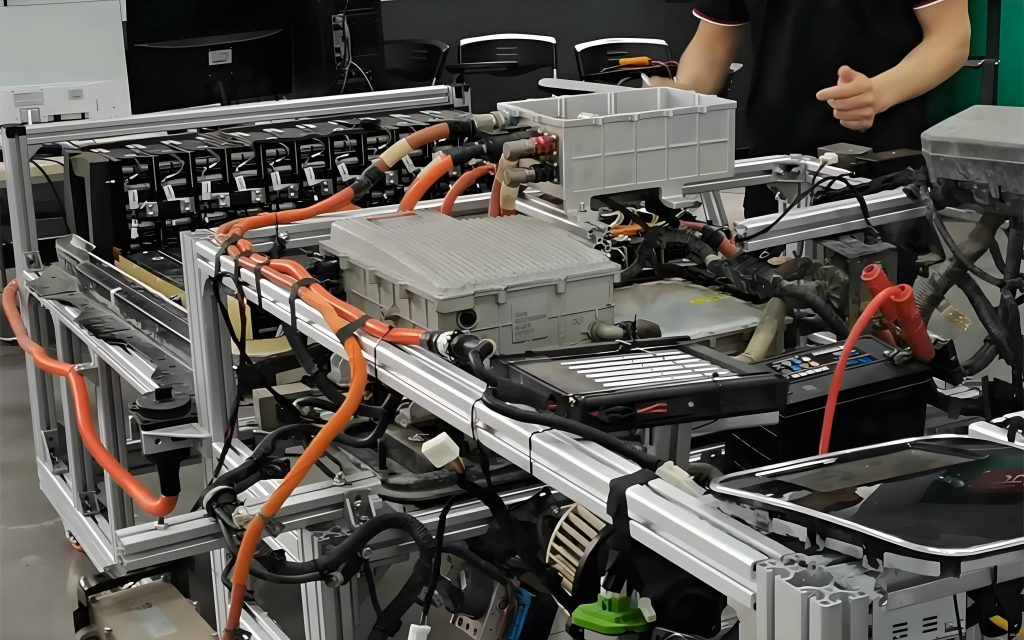
In my work, I have observed that EVs rely on advanced electrical and electronic components, which, while efficient, are prone to specific failures due to factors like vibration, thermal stress, and software glitches. Efficient EV repair requires a blend of traditional mechanical knowledge and expertise in high-voltage systems, diagnostics, and software troubleshooting. For instance, electrical car repair often involves using specialized tools to read fault codes and perform insulation tests, ensuring safety and accuracy. Below, I outline key areas of concern, supported by empirical data and practical insights, to help technicians streamline their electrical car repair processes and improve outcomes in EV repair scenarios.
Mechanical System Faults and Efficient Repair in Electric Vehicles
The mechanical systems in EVs, including the motor, transmission, and braking components, are critical for vehicle performance. Common faults often stem from the unique design of electric drivetrains, which replace conventional engines with electric motors and complex gear systems. In my experience with EV repair, I have frequently encountered issues such as power transmission failures, where the vehicle fails to accelerate or start despite a charged battery. This is typically due to problems in the motor drive system, where electrical faults disrupt the conversion of electrical energy to mechanical energy. For example, circuit interruptions or magnetic field inconsistencies can lead to insufficient torque output. Another prevalent issue in electrical car repair is abnormal noise from reduction gears, caused by wear or inadequate lubrication over time. This not only produces irritating sounds but can also result in power loss if left unaddressed. Steering system faults, such as heavy operation or poor return-to-center, are also common and often linked to tire pressure issues or mechanical wear in linkages. Additionally, brake energy recovery failures pose a significant challenge in EV repair, as this system relies on the battery to store regenerated energy during deceleration; faults here can arise from temperature constraints or control unit malfunctions.
To address these mechanical faults efficiently, I recommend a systematic approach in electrical car repair. For motor-related issues, diagnostic tools are indispensable. Using a professional scanner to retrieve fault codes can quickly pinpoint problems like overloading or voltage anomalies. For instance, if the motor exhibits power loss, the repair process might involve checking the母线 voltage and current using multimeters, followed by local repairs to windings or connectors. In cases of transmission faults, such as difficulty in speed increase, inspecting battery connections for oxidation and ensuring proper charging are essential steps. A key aspect of EV repair is the use of mathematical models to predict and diagnose issues. For example, the power output of an electric motor can be represented as: $$P = \tau \cdot \omega$$ where \(P\) is the mechanical power, \(\tau\) is the torque, and \(\omega\) is the angular velocity. This equation helps in assessing whether the motor is operating within specified parameters during electrical car repair. Similarly, for brake systems, the force required for braking can be analyzed using: $$F = m \cdot a$$ where \(F\) is the force, \(m\) is the mass, and \(a\) is the deceleration. This aids in troubleshooting issues like excessive pedal effort due to vacuum pump failures.
| Fault Type | Common Causes | Efficient Repair Techniques |
|---|---|---|
| Power Transmission Failure | Motor drive circuit issues, voltage instability | Use diagnostic tools to read codes; inspect and repair motor windings; check power supply stability |
| Reduction Gear Noise | Gear wear, inadequate lubrication | Replace lubricant; inspect and replace damaged gears; perform vibration analysis |
| Steering System Issues | Low tire pressure, mechanical wear | Adjust tire pressure; replace worn linkages; calibrate alignment parameters |
| Brake Energy Recovery Failure | Battery temperature limits, control unit errors | Check battery management system; upgrade software; inspect sensors and actuators |
In practice, EV repair for mechanical systems often involves preventive maintenance. For example, regular cleaning and visual inspections of the motor can prevent minor issues from escalating. When dealing with transmission problems, I have found that verifying the battery state of charge and tightening connections can resolve many cases without extensive disassembly. Moreover, for brake systems, replacing components like vacuum pumps or brake pads according to manufacturer standards is crucial in electrical car repair to avoid compatibility issues. Overall, integrating these techniques into daily EV repair routines enhances efficiency and reduces downtime, making electrical car repair more reliable and cost-effective.
Battery System Faults and Efficient Repair in Electric Vehicles
The battery system is the heart of an EV, providing the necessary energy for propulsion and ancillary functions. In my extensive work in EV repair, I have identified several recurrent faults in battery packs, such as voltage imbalance among cells, temperature anomalies, and insulation failures. Voltage imbalance, for instance, occurs when individual cells in a series-connected pack exhibit varying voltage levels due to defects like electrolyte leakage or manufacturing inconsistencies. This can lead to reduced overall performance and even safety hazards if not addressed promptly in electrical car repair. Temperature abnormalities often stem from sensor malfunctions or issues in the battery management system (BMS), where faulty wiring or probe failures prevent accurate temperature monitoring. Insulation faults, on the other hand, are critical in EV repair as they involve high-voltage risks; these can result from water ingress, cable damage, or component degradation, leading to potential short circuits or leakage currents.
Efficient repair techniques for battery systems in EV repair emphasize diagnostics and balancing. For voltage imbalance, I typically start by accessing the BMS to retrieve fault codes and then use testing instruments to measure parameters like internal resistance, capacity, and voltage of each cell. Battery均衡 technology is a cornerstone of electrical car repair here; it involves using均衡 devices to adjust the charge and discharge states of cells, ensuring uniformity. Mathematically, the voltage difference can be modeled as: $$\Delta V = V_{\text{max}} – V_{\text{min}}$$ where \(\Delta V\) represents the voltage spread among cells. In advanced EV repair,智能均衡 systems apply algorithms to minimize this difference, though they may respond slower due to computational overhead. For temperature faults, I employ multimeters to check sensor resistances and calibrate or replace them as needed. The relationship between temperature and battery performance can be expressed using Arrhenius equation approximations: $$k = A e^{-E_a / (RT)}$$ where \(k\) is the rate constant, \(A\) is the pre-exponential factor, \(E_a\) is the activation energy, \(R\) is the gas constant, and \(T\) is the temperature. This helps in understanding how temperature variations affect battery life during electrical car repair.
| Fault Type | Common Causes | Efficient Repair Techniques |
|---|---|---|
| Voltage Imbalance | Cell defects, loose connections | Use BMS data; apply均衡 circuits; replace faulty cells; monitor with voltage tests |
| Temperature Anomalies | Sensor failures, BMS issues | Check sensor resistance; recalibrate or replace sensors; inspect wiring and communication lines |
| Insulation Failures | Cable damage, water ingress | Perform insulation resistance tests with megohmmeters; seal leaks; replace damaged cables; use绝缘 tape for minor repairs |
In electrical car repair, addressing insulation faults requires careful handling of high-voltage components. I often use兆欧表 to measure insulation resistance, ensuring values meet safety standards. For example, if a test reveals resistance below thresholds, I systematically inspect connectors and enclosures for damage. Additionally, in EV repair, proactive measures like updating BMS firmware and conducting regular均衡 cycles can prevent many battery issues. Through these methods, electrical car repair becomes not only about fixing problems but also about optimizing battery health for longer lifespan and better performance.
Communication Control System Faults and Efficient Repair in Electric Vehicles
Communication and control systems in EVs facilitate interactions between components like charging interfaces, motor controllers, and sensors. In my practice of EV repair, I frequently deal with faults such as communication protocol incompatibility and control signal abnormalities. Protocol mismatches often occur during charging, where the vehicle and charging station use different standards or software versions, leading to failed initiation or interrupted sessions. This is a common issue in electrical car repair, as EVs rely on protocols like IEC 61851 for data exchange; discrepancies in frequency settings or encryption methods can cause communication breakdowns. Control signal faults, on the other hand, may arise from hardware damage—such as burnt circuit boards—or software errors like bugs in control algorithms. Environmental factors like electromagnetic interference can also distort signals, resulting in erratic vehicle behavior or charging inefficiencies.
Efficient repair techniques for these systems in EV repair involve a combination of hardware inspection and software debugging. For protocol issues, I use tools like protocol analyzers to monitor data packets between the vehicle and charger, checking for errors in timing or structure. If inconsistencies are found, I update the firmware on both ends to ensure compatibility. The data transmission can be modeled using communication theory formulas, such as the signal-to-noise ratio: $$\text{SNR} = \frac{P_{\text{signal}}}{P_{\text{noise}}}$$ where a low SNR indicates potential interference in electrical car repair scenarios. For control signal faults, I disassemble components to inspect for physical damage, using oscilloscopes to measure waveform integrity. In cases of software glitches, reprogramming the control units is essential. For instance, the power management in charging can be represented as: $$P = V \cdot I$$ where \(P\) is power, \(V\) is voltage, and \(I\) is current; calibrating these parameters ensures stable operation during EV repair.
| Fault Type | Common Causes | Efficient Repair Techniques |
|---|---|---|
| Protocol Incompatibility | Software version mismatches, configuration errors | Use analyzers to debug communication; update firmware; verify physical connections and cables |
| Control Signal Abnormalities | Hardware damage, electromagnetic interference | Inspect circuit boards with multimeters; replace damaged components; recalibrate software and algorithms |
In electrical car repair, testing under various conditions is vital to ensure system reliability. After repairs, I conduct comprehensive checks by simulating different charging scenarios to validate communication stability. This proactive approach in EV repair not only resolves immediate issues but also prevents recurrences, highlighting the importance of integrating advanced diagnostics into routine electrical car repair practices.
Air Conditioning System Faults and Efficient Repair in Electric Vehicles
The air conditioning (AC) system in EVs is crucial for passenger comfort and battery thermal management, but it is prone to faults like pressure irregularities and electronic control failures. In my EV repair experiences, pressure faults often result from refrigerant leaks or overcharging, leading to inadequate cooling or compressor damage. For example, low refrigerant levels cause reduced pressure in the蒸发器, impairing heat exchange, while overcharging elevates pressure, risking component failure. Electronic control issues are equally common in electrical car repair, stemming from aged sensors, faulty wiring, or software errors in the AC control unit. These can manifest as unresponsive controls or inconsistent temperature output, affecting overall vehicle usability.
Efficient repair techniques for AC systems in EV repair focus on precise measurements and component replacements. I typically use pressure gauges and leak detectors to identify refrigerant issues, followed by sealing leaks and replenishing refrigerant to specified levels. The refrigeration cycle can be described using thermodynamic principles, such as the coefficient of performance (COP): $$\text{COP} = \frac{Q_{\text{cooling}}}{W_{\text{input}}}$$ where \(Q_{\text{cooling}}\) is the cooling capacity and \(W_{\text{input}}\) is the work input; this formula helps in assessing efficiency during electrical car repair. For electronic faults, I employ diagnostic tools to read error codes and inspect control boards for damage. Replacing worn-out parts like compressors or sensors, and updating software, are standard practices in EV repair. Additionally, with the advent of eco-friendly refrigerants in modern EVs, I ensure that repairs align with environmental standards, often incorporating heat recovery features to enhance energy efficiency.
| Fault Type | Common Causes | Efficient Repair Techniques |
|---|---|---|
| Pressure Faults | Refrigerant leaks, overcharging, valve blockages | Use pressure gauges; seal leaks; recharge refrigerant; inspect and clean expansion valves |
| Electronic Control Failures | Sensor aging, wiring issues, software bugs | Diagnose with code readers; replace faulty components; update control software; test system reset procedures |
In electrical car repair, preventive maintenance for AC systems includes regular checks of electrical connections and refrigerant levels. By adhering to these methods, EV repair technicians can ensure reliable performance and extend the system’s lifespan, ultimately contributing to safer and more efficient vehicles.
Conclusion
In summary, EV repair demands a holistic understanding of multiple systems, from mechanical components to advanced electronics. Through my experiences in electrical car repair, I have learned that efficient diagnosis and repair rely on specialized tools, mathematical models, and proactive maintenance. By addressing common faults with techniques like battery均衡, protocol debugging, and pressure management, technicians can enhance the quality and speed of EV repair services. Furthermore, standardizing these practices into repair protocols will drive the evolution of electrical car repair, supporting the growing adoption of electric vehicles. As the industry advances, continuous learning and adaptation will be key to mastering EV repair and ensuring long-term vehicle reliability and safety.