
As a professional deeply involved in the field of electrical car repair, I have witnessed the transformative impact of battery detection and maintenance technologies on the repair and maintenance of electric vehicles (EVs). The rapid evolution of EV battery systems, characterized by high-voltage configurations, modular designs, and integrated components, has introduced significant challenges in repair processes. These systems are prone to issues such as voltage deviations, capacity degradation, and thermal instability, which, if not addressed through precise technical means, can lead to delayed fault identification, increased operational risks, and higher maintenance costs. In this article, I will explore the fundamentals of battery detection and maintenance, highlight their application value in EV repair, and detail a comprehensive application path that encompasses state recognition, fault judgment path planning, and repair operation implementation. The integration of these technologies is essential for building a standardized, closed-loop, and intelligent support system in the EV aftermarket, ultimately enhancing repair responsiveness and system reliability.
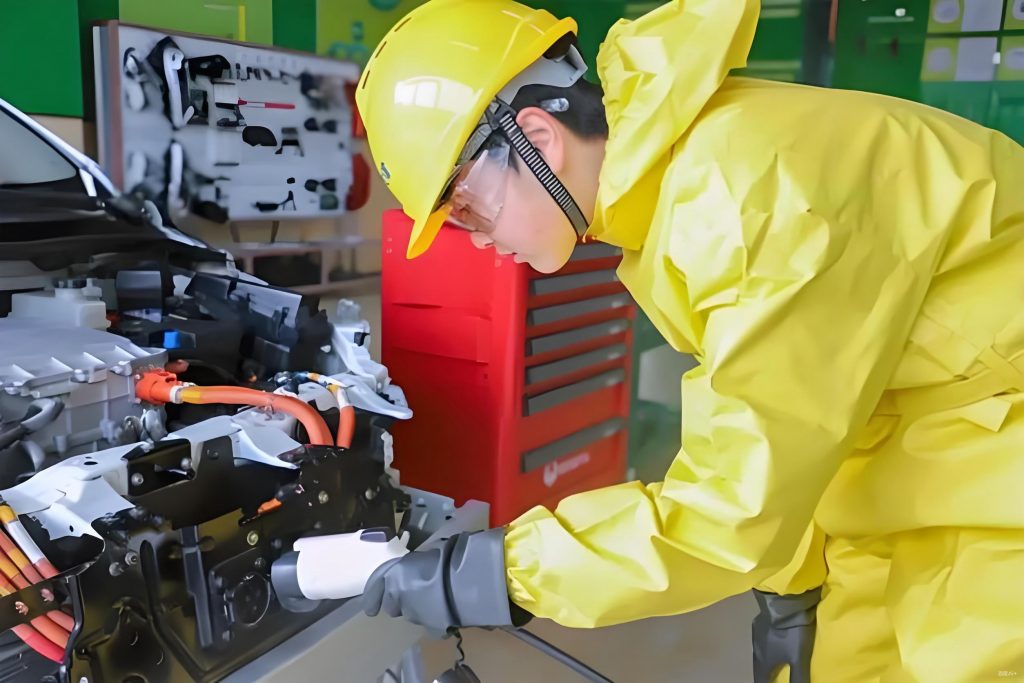
Battery detection and maintenance technology serves as the backbone of efficient EV repair systems, enabling accurate identification of power battery system states, qualitative fault unit judgment, and effective execution of target processes. The detection phase relies on a multi-dimensional monitoring system that captures parameters like voltage, current, temperature, insulation resistance, and internal resistance. For instance, in standard operations, individual cell voltage accuracy must be controlled within ±5 mV, and insulation resistance should not fall below 500 kΩ to provide a quantitative basis for fault identification. The Battery Management System (BMS) collects real-time data, which is processed by diagnostic modules to compute the State of Charge (SOC) and State of Health (SOH). These metrics are critical for assessing capacity decay trends and predicting lifespan, as illustrated by the SOC estimation formula: $$SOC(t) = SOC_0 – \frac{1}{C_n} \int_0^t i(\tau) d\tau$$ where $SOC_0$ is the initial state of charge, $C_n$ is the nominal capacity, and $i(t)$ represents the current at time t. Maintenance operations, including cell replacement, module repair, balanced charging, and thermal management system reconstruction, must align with detection data to ensure工况适配 and safety. For example, when replacing faulty modules, it is essential to verify that new cells match the original ones in parameters like capacity, impedance, and temperature rise, often requiring impedance calculations: $$Z = R + j\omega L + \frac{1}{j\omega C}$$ where $Z$ is the impedance, $R$ is resistance, $L$ is inductance, $C$ is capacitance, and $\omega$ is the angular frequency. This closed-loop approach, linking fault criteria,联动逻辑, and control thresholds, facilitates a shift from经验操作 to data-driven processes in electrical car repair.
| Parameter | Standard Threshold | Unit | Application in EV Repair |
|---|---|---|---|
| Cell Voltage Accuracy | ±5 | mV | Ensures precise fault identification in high-voltage systems |
| Insulation Resistance | ≥500 | kΩ | Prevents electrical hazards during repair operations |
| Internal Resistance Increase | 1.5 times initial | – | Indicates cell aging and guides replacement in electrical car repair |
| Voltage Drift | 15 | mV | Triggers alerts for cell imbalance in EV battery packs |
| Temperature Gradient | ≤5°C per module | °C | Monitors thermal risks in integrated systems |
The application value of battery detection and maintenance technology in EV repair is multifaceted, significantly enhancing fault identification efficiency. In my work, I have seen how data-driven paths replace traditional目测 and经验式诊断, reducing errors and shortening response times. During detection, the system gathers data from the BMS, such as individual cell voltages and module temperatures, and constructs state evolution curves over specific time windows. The state recognition module employs voltage deviation thresholds to identify anomalies, while internal resistance trends help assess aging levels. For example, a cell is considered degraded if its internal resistance rises to 1.5 times the initial value, and a voltage drift of 15 mV signals an imbalance warning. This multi-parameter evaluation, incorporating indices like the capacity decay rate: $$SOH = \frac{C_{actual}}{C_{nominal}} \times 100\%$$ where $C_{actual}$ is the actual capacity and $C_{nominal}$ is the nominal capacity, improves judgment accuracy under nonlinear衰减 conditions. By integrating distributed data comparison mechanisms, this approach accelerates fault localization and boosts repair response rates in electrical car repair scenarios.
Moreover, these technologies play a crucial role in controlling作业安全风险 during EV repair. The detection phase includes electrical isolation checks to identify residual voltage, grounding faults, and insulation weaknesses. Before any operation, technicians use insulation resistance testers and residual voltage detection modules to confirm system de-energization, with operational clearance granted only when voltages drop below 60 V, adhering to safety standards for动力电池作业. Thermal runaway risks are assessed via thermal imaging and BMS data cross-referencing, highlighting hotspots to guide safe work areas. Operational controls involve data alarms and授权逻辑, such as step-by-step unlocking procedures, to prevent mishaps like arc flashes or short circuits. For instance, bolt torque values and contact resistance limits (e.g., <2 mΩ for connectors) are enforced to ensure proper reassembly. Post-repair system-level retests validate electrical integrity and encapsulation, forming a closed loop of risk identification, operational control, and parameter feedback that safeguards high-voltage and high-temperature environments in EV repair.
Additionally, battery detection and maintenance technology supports the智能化发展 of运维体系 in electrical car repair. By integrating real-time vehicle data, historical maintenance records, and environmental factors, these systems create multi-dimensional data structures that enable dynamic perception of cell lifespan and module degradation. Predictive modeling, combined with big data algorithms, extrapolates capacity decline curves: $$C(t) = C_0 e^{-\lambda t}$$ where $C(t)$ is capacity at time t, $C_0$ is initial capacity, and $\lambda$ is the decay constant, helping define maintenance cycles and strategies. Diagnostic knowledge bases compile fault labels and triggers, enhancing the识别能力 for edge cases and sporadic issues. Intelligent maintenance调度 systems automatically generate repair orders and allocate parts based on detection results, while cloud platforms facilitate remote BMS interfacing and OTA updates, reducing on-site labor. This ecosystem, supported by embedded sensors, edge computing, and remote data exchange, enables full-scale perception, smart analysis, and dynamic intervention, laying the groundwork for advanced EV repair systems.
| Fault Category | Key Parameters | Path Decision | Intervention in Electrical Car Repair |
|---|---|---|---|
| Electrical Performance Anomalies | Voltage difference, internal resistance rise rate, current response delay | Prioritize cell replacement or均衡处理 | Use恒流补能 to balance voltages within 5 mV |
| Thermal Risks | Module temperature slope, thermal coupling lag time, surface temperature non-uniformity coefficient | Inspect cooling systems and adjust分区阀 | Apply thermal interface materials and verify flow rates |
| Structural Degradation | Encapsulation offset, connector contact resistance, acoustic diagnosis results | Plan module-level repairs or replacements | Ensure contact resistance <2 mΩ and reassemble with specified torque |
The application path of battery detection and maintenance technology in EV repair begins with state recognition, which involves distributed data acquisition, hierarchical parameter analysis, and on-site condition verification. Initially, technicians connect to the BMS port to read data on cell voltages, loop currents, temperatures, insulation resistance, and system alarms, forming a structured data table for recognition. Detection modules compare these values against benchmarks to identify deviations, such as voltage differences or internal resistance increases. High-precision voltage detection units with sampling accuracy不低于 1 mV are essential for early signal detection, often using filtering algorithms like the三阶滤波 to minimize false triggers: $$V_{filtered} = \frac{1}{N} \sum_{i=1}^{N} V_i e^{-\alpha i}$$ where $V_i$ is the voltage sample, $N$ is the window size, and $\alpha$ is the damping factor. Temperature recognition combines infrared thermal imaging with BMS data, employing image processing algorithms to locate hot zones and distinguish between operational heat accumulation and cooling failures. Insulation resistance tests in static conditions identify leakage paths, while dynamic state recognition under controlled discharge captures load response curves, including voltage fluctuations and internal resistance变化率. Parameters like the R-T characteristic model: $$R(T) = R_0 e^{\beta (T – T_0)}$$ where $R_0$ is resistance at reference temperature $T_0$, and $\beta$ is the temperature coefficient, help mark structural degradation if growth rates exceed thresholds. The output is a standardized diagnostic result that feeds into fault judgment path planning.
Fault judgment path planning builds on state recognition results, incorporating spatial distribution features and fault model mappings to guide decisions. For cell failure judgment, historical degradation models are referenced, and risk index matrices based on cell identifiers are constructed alongside module layouts. SOC deviations from averages are analyzed using残差 calculations: $$\Delta SOC = SOC_{actual} – SOC_{average}$$ with comparisons to极限判据 generating anomaly labels. In cases of module inconsistency, thermal distribution analysis determines if structural imbalances exist, using热源—流阻 diagrams and coolant temperature rises. Faults are categorized into three primary paths: electrical performance anomalies, thermal risks, and structural degradation, each defined by specific parameter sets. Path planning incorporates risk levels and intervention mechanisms; for example, cells with超标 internal resistance in critical current paths necessitate battery pack disassembly, while mild voltage drifts in peripheral areas may allow for local balancing. Continuous minor anomalies trigger dynamic observation zones with delayed processing. This path is linked to operation templates, enabling automated recommendations for tools and sequences, thus streamlining the transition to repair operations in EV repair.
Repair operation implementation follows the judgment path, structured into five technical phases: high-voltage safety isolation, structural disassembly and定位, electrical function restoration, thermal management system recovery, and control logic reconstruction. Operations start with high-voltage system shutdown procedures, disconnecting relays and verifying voltage decay to safe levels (<60 V) via residual voltage detection. During disassembly, specialized tools are used to open battery pack casings and locate marked components, with resistance measurements ensuring connector integrity (contact resistance <2 mΩ). Module-level replacements involve full模组 swaps to maintain system consistency, followed by capacity and internal resistance retests. Electrical restoration includes module substitution, cell compensation balancing, and conduction tests;均衡处理 employs constant current charging or bypass discharging to reduce voltage deviations below 5 mV, while insulation testers validate overall pack integrity. Thermal management recovery involves coolant injection, bubble removal, and pump speed adjustments, with温差 and flow checks confirming system functionality. Thermal sensors are repositioned near high-heat channels, and control logic is updated via BMS interfaces, recalibrating parameters like pack serial numbers and nominal resistances. Post-repair, cold-start simulations test charge-discharge limits, and all steps are logged for performance tracking, completing the闭环 in electrical car repair.
In summary, battery detection and maintenance technology provides end-to-end support in EV repair, covering state recognition, fault diagnosis, path planning, and process execution. Its core relies on high-precision monitoring, intelligent modeling, and standardized operations, which enhance identification efficiency, mitigate risks, and enable remote diagnostics. Future advancements could focus on intelligent self-healing for high-density packs, online condition prediction, and module-level rapid replacement, pushing EV repair from reactive数字响应 to proactive预测主动. As I continue to explore this field, I am confident that these innovations will redefine the landscape of electrical car repair, ensuring safer and more sustainable EV ecosystems.