
As a researcher deeply involved in the energy storage sector, I have witnessed the rapid evolution of battery technologies, with solid state batteries emerging as a pivotal innovation. Solid state batteries represent a transformative shift from conventional liquid lithium-ion batteries, offering enhanced safety, higher energy density, and longer cycle life. In this article, I will explore the current landscape, challenges, and future prospects of solid state batteries, drawing on global trends and technological advancements. The term “solid state battery” refers to a battery system where the electrolyte is solid, eliminating flammable liquid components and enabling more compact designs. Throughout this discussion, I will emphasize the importance of solid state batteries in addressing the growing demands of electric vehicles, renewable energy storage, and emerging applications like aerial mobility and robotics.
The fundamental advantage of solid state batteries lies in their ability to overcome the limitations of liquid electrolytes, which are prone to leakage, thermal runaway, and degradation. A solid state battery typically employs solid electrolytes such as polymers, oxides, sulfides, or halides, each with distinct properties. For instance, the ionic conductivity of a solid electrolyte can be modeled using the Arrhenius equation: $$ \sigma = \sigma_0 \exp\left(-\frac{E_a}{kT}\right) $$ where $\sigma$ is the ionic conductivity, $\sigma_0$ is a pre-exponential factor, $E_a$ is the activation energy, $k$ is Boltzmann’s constant, and $T$ is the temperature. This equation highlights how temperature influences conductivity, a critical factor in solid state battery performance. Moreover, the energy density of a solid state battery can be expressed as: $$ E_d = \frac{C \times V}{m} $$ where $E_d$ is the energy density, $C$ is the capacity, $V$ is the voltage, and $m$ is the mass. Solid state batteries often achieve values exceeding 300 Wh/kg, significantly higher than the 250-300 Wh/kg typical of liquid lithium-ion batteries.
Globally, the development of solid state batteries is accelerating, with countries and companies investing heavily in research and commercialization. The transition from semi-solid to all-solid state batteries is a key focus, as semi-solid variants serve as an intermediate step, maintaining compatibility with existing manufacturing processes. However, all-solid state batteries require entirely new materials and production techniques, posing both opportunities and risks. Below is a table summarizing the major solid electrolyte types and their characteristics, which are central to solid state battery innovation:
| Electrolyte Type | Ionic Conductivity (S/cm) | Stability | Mechanical Strength | Potential Applications |
|---|---|---|---|---|
| Polymer | 10^{-5} – 10^{-4} | Moderate | Flexible | Consumer electronics |
| Oxide | 10^{-4} – 10^{-3} | High | Rigid | Electric vehicles |
| Sulfide | 10^{-3} – 10^{-2} | Low (air-sensitive) | Brittle | High-energy systems |
| Halide | 10^{-4} – 10^{-3} | Moderate | Variable | Specialized devices |
In recent years, the solid state battery market has seen significant activity, with startups and established players racing to achieve milestones. For example, semi-solid state batteries have already been integrated into electric vehicles, demonstrating energy densities of 300-380 Wh/kg. All-solid state batteries, however, remain in the pilot phase, with projections for mass production around 2030. The global competition is intense; regions like North America, Europe, and East Asia are leveraging partnerships and research consortia to advance solid state battery technologies. A notable trend is the focus on sulfide-based electrolytes, which offer high ionic conductivity but require controlled environments due to their sensitivity to moisture. Composite electrolytes, combining organic and inorganic materials, are also gaining traction to balance performance and practicality in solid state batteries.
From a technical perspective, the development of solid state batteries involves addressing multiple challenges. The interface between solid electrodes and electrolytes is a critical area, as poor contact can lead to high impedance and reduced efficiency. The interfacial resistance $R_i$ can be described by: $$ R_i = \frac{\delta}{\sigma_i} $$ where $\delta$ is the interfacial thickness and $\sigma_i$ is the interfacial conductivity. Minimizing $R_i$ is essential for optimizing solid state battery performance. Additionally, material compatibility issues arise when pairing high-capacity anodes like silicon-carbon or lithium metal with solid electrolytes, as volume changes during cycling can cause mechanical stress and failure. To illustrate the progress in solid state battery energy densities, consider the following table based on industry data:
| Battery Type | Energy Density (Wh/kg) | Stage of Development | Key Challenges |
|---|---|---|---|
| Liquid Lithium-ion | 250-300 | Mature | Safety, cycle life |
| Semi-Solid State Battery | 300-380 | Early Commercialization | Cost, manufacturing yield |
| All-Solid State Battery | 400-500+ | R&D and Pilot | Interface stability, scalability |
Manufacturing solid state batteries presents another layer of complexity. Processes like dry electrode fabrication and isostatic pressing require specialized equipment, which is still under development. The cost of producing solid state batteries remains high, with current estimates above $2/Wh, compared to under $0.1/Wh for advanced liquid lithium-ion batteries. This cost disparity is partly due to expensive raw materials, such as sulfide precursors priced around $2000/kg. Furthermore, the supply chain for solid state battery components is immature, necessitating investments in upstream materials and production facilities. Despite these hurdles, the potential applications of solid state batteries extend beyond electric vehicles to sectors like low-altitude aviation, humanoid robotics, and grid storage, where safety and energy density are paramount.
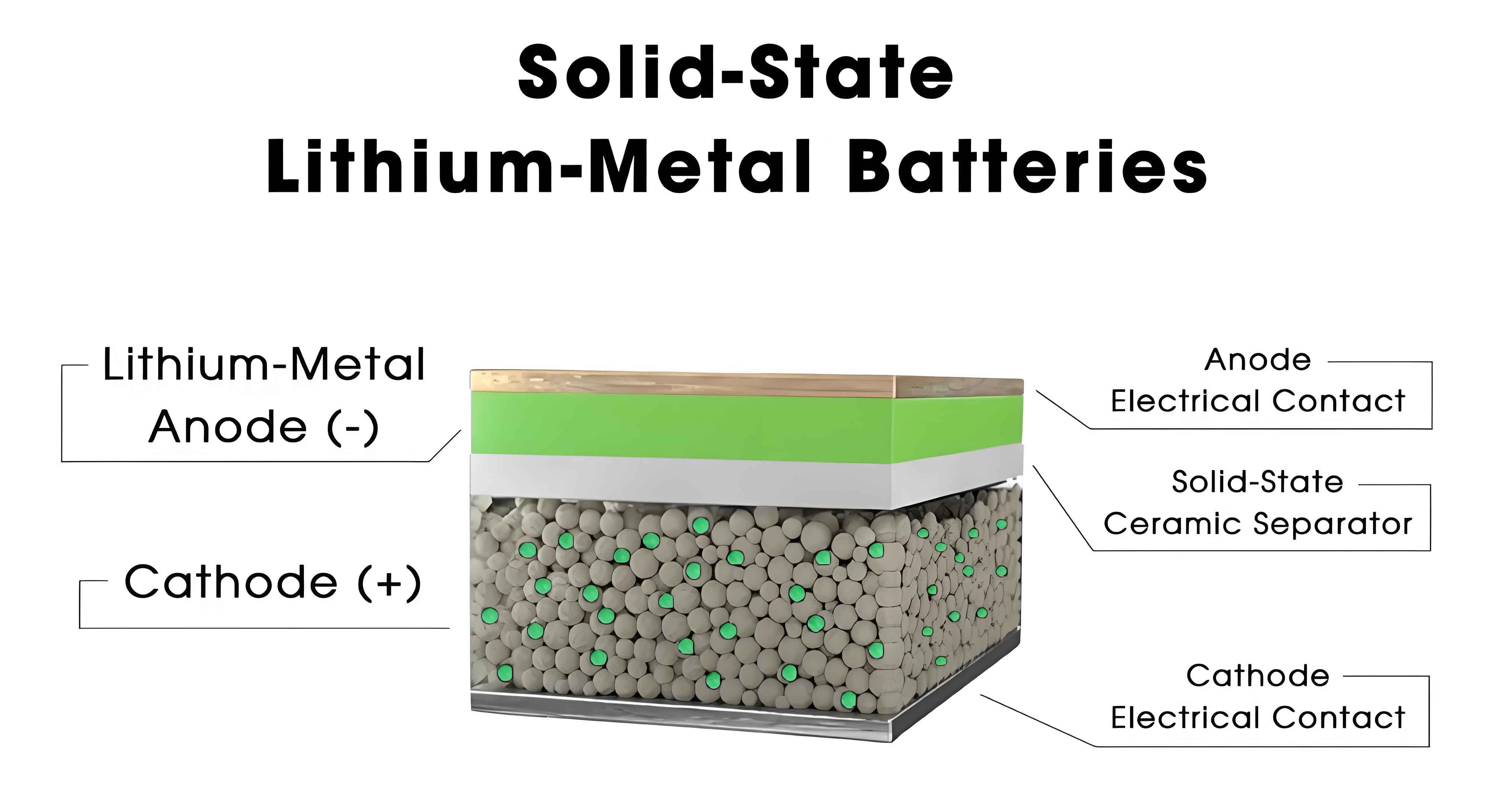
In my view, strategic support is crucial for accelerating the adoption of solid state batteries. Governments and industry stakeholders must collaborate to establish clear roadmaps and funding mechanisms. For instance, policies that incentivize research into solid electrolyte materials and manufacturing processes can drive innovation. I recommend fostering public-private partnerships to build pilot lines and testing facilities, which would help de-risk investments in solid state battery production. Additionally, standardization efforts are needed to ensure interoperability and safety across different solid state battery designs. The equation for total cost of ownership $C_t$ for a solid state battery system can be approximated as: $$ C_t = C_m + C_p + C_o $$ where $C_m$ is material cost, $C_p$ is production cost, and $C_o$ is operational cost. Reducing $C_m$ through material innovations and economies of scale is key to making solid state batteries commercially viable.
Technological breakthroughs in solid state batteries often hinge on interdisciplinary research. For example, computational modeling can predict the behavior of solid electrolytes under various conditions, guiding experimental work. The diffusion coefficient $D$ of ions in a solid electrolyte can be calculated using: $$ D = D_0 \exp\left(-\frac{\Delta G}{kT}\right) $$ where $D_0$ is a constant and $\Delta G$ is the Gibbs free energy of activation. Such models aid in designing electrolytes with higher ionic conductivity for solid state batteries. Moreover, advances in nanotechnology enable the synthesis of composite materials that enhance interface compatibility in solid state batteries. Below is a table outlining potential research priorities for solid state battery development:
| Research Focus | Description | Expected Impact |
|---|---|---|
| Interface Engineering | Improving contact between electrodes and solid electrolytes | Reduced impedance, longer cycle life |
| Material Synthesis | Developing high-conductivity solid electrolytes | Higher energy density, faster charging |
| Manufacturing Processes | Scaling up dry electrode and film production | Lower costs, higher yield |
| System Integration | Designing battery packs for diverse applications | Broader adoption in EVs and storage |
Looking ahead, the commercialization of solid state batteries will depend on a concerted effort to address both technical and economic barriers. I believe that demonstration projects and early adoption in niche markets can create a feedback loop, driving down costs through iterative improvements. For instance, deploying solid state batteries in electric aviation or premium consumer electronics could validate their performance and stimulate demand. The lifecycle of a solid state battery can be modeled using: $$ L = \frac{N_c \times E_d}{C_t} $$ where $L$ is the lifecycle efficiency, $N_c$ is the number of cycles, $E_d$ is energy density, and $C_t$ is total cost. Optimizing this equation requires balancing material choices and manufacturing techniques for solid state batteries.
In conclusion, solid state batteries hold immense promise as the next generation of energy storage, with the potential to revolutionize multiple industries. However, realizing this potential demands sustained investment in research, infrastructure, and policy support. As we navigate the complexities of material science and production scalability, collaboration across borders and sectors will be essential. I am optimistic that with strategic focus, solid state batteries will overcome current challenges and become a cornerstone of the global energy transition, enabling safer, more efficient, and sustainable power solutions for the future.