
In our pursuit of sustainable transportation, electric vehicles (EVs) have emerged as a pivotal solution to global energy and environmental challenges. Among them, electric two-wheelers constitute a significant and growing segment. The heart of these vehicles is the lithium-ion EV battery pack. While celebrated for their high energy density and long cycle life, lithium-ion batteries are intrinsically temperature-sensitive. The performance, safety, and longevity of an EV battery pack are profoundly influenced by its internal thermal environment. Non-uniform temperature fields, characterized by localized hot spots and significant temperature differences ($\Delta T$) between cells, can accelerate degradation, induce state-of-charge (SOC) imbalances, and ultimately compromise the entire pack’s reliability. Therefore, a comprehensive understanding of the thermal behavior of an EV battery pack under diverse, real-world operating conditions is not merely academic but essential for optimal design and usage.
This study systematically investigates the temperature field within a commercially representative 48 V, 20 Ah EV battery pack designed for electric two-wheelers. We employ a symmetric thermocouple network to monitor temperatures at key locations during charge and discharge cycles. Our analysis spans various critical scenarios: different ambient temperatures, varying charge/discharge rates (C-rates), low-temperature operations, and continuous cyclic duties. By quantifying temperature rise ($\Delta T_{rise}$) and internal $\Delta T$, we identify patterns and root causes of thermal non-uniformity. The insights gained aim to inform better thermal management strategies and usage practices, ultimately enhancing the performance and lifespan of the EV battery pack.
Experimental Methodology
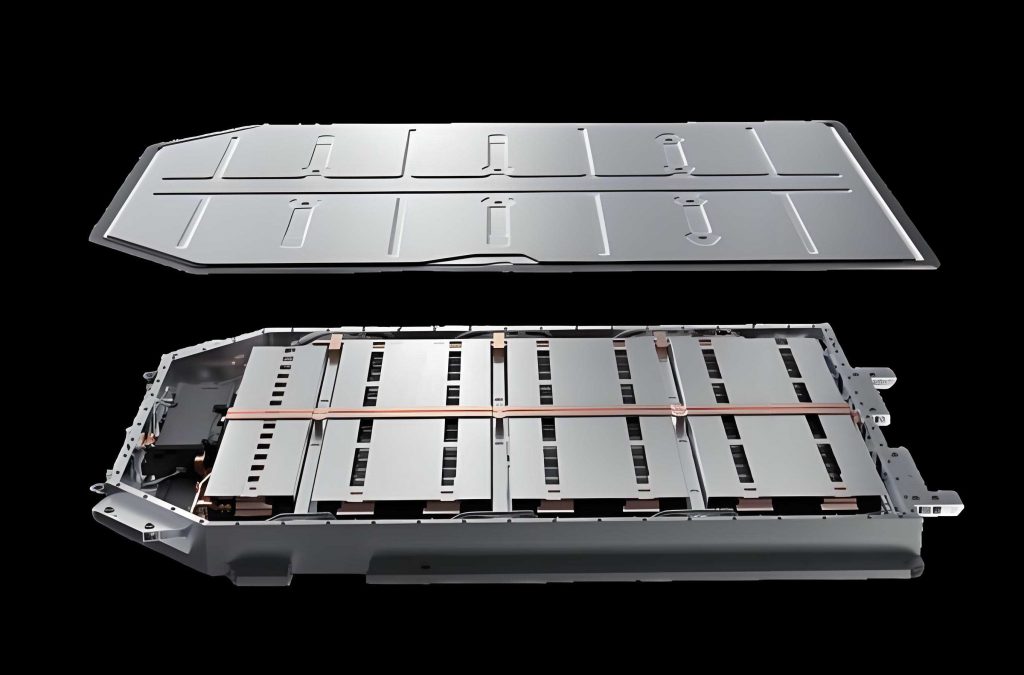
The core of our experiment is a standard EV battery pack with a nominal voltage of 48 V and a capacity of 20 Ah. The pack’s core module consists of 15 soft-pack lithium iron phosphate (LFP) cells connected in series. To map the internal temperature field with high fidelity, we instrumented the pack with a network of K-type thermocouples. The strategic placement allows us to capture gradients both within the cell stack and across different pack components.
The thermocouples were positioned as follows: on the surface of a central cell at the top (T1), middle (T2), and bottom (T3) along its vertical axis; on consecutive cells from the outer edge towards the center of the stack (T7, T6, T5, T4, T2—note T2 is shared); on the module’s busbar (T8); and on a cell tab (T9). An ambient sensor (TA) was suspended inside the pack enclosure. This configuration enables us to dissect thermal behavior along the primary axis of heat accumulation (the stack) and assess uniformity at the cell level.
We defined a matrix of test conditions to simulate real-world application scenarios for the EV battery pack:
- Standard Temperature & Variable C-rate: The pack was conditioned and tested at 25°C and 45°C. At each temperature, it underwent single charge-discharge cycles at 0.2C, 0.5C, and 1.0C rates (where 1.0C = 20A), with appropriate rest periods between steps.
- Low-Temperature Operation: The pack was discharged to cutoff at room temperature, then equilibrated in a low-temperature chamber at 0°C or -10°C for 16 hours. It was then charged at a low rate (0.2C) and subsequently discharged at a moderate rate (0.5D). An additional extreme test involved a 1.0D discharge from -10°C.
- Continuous Cycling at Room Temperature: To simulate intensive use, the EV battery pack was subjected to repeated charge-discharge cycles with only short (10-minute) rests. Two regimes were tested: a mild regime (0.2C charge / 0.5D discharge) and a more strenuous regime (0.5C charge / 0.5D discharge), each for five consecutive cycles.
Data from all thermocouples and the pack’s voltage/current were recorded simultaneously using a high-precision data acquisition system.
Results and Discussion
1. Thermal Field Under Standard Conditions: The Role of C-rate and Ambient Temperature
The baseline tests reveal fundamental characteristics of the EV battery pack’s thermal behavior. A consistent thermal gradient is observed along the cell stacking direction. During both charge and discharge, the innermost cell (monitored by T4/T2) consistently exhibits the highest temperature rise, while the outermost cell (T7) remains coolest. The temperature profile from T7 (edge) to T4 (center) shows a stair-step increase. This is a direct consequence of thermal accumulation: heat generated in the core cells is impeded from dissipating to the environment by the surrounding cells, which act as thermal insulation. In contrast, temperatures along the vertical axis of a single cell (T1-top, T2-middle, T3-bottom) show minimal variation, indicating good internal thermal conductivity within the cell pouch.
The data underscores that the primary source of temperature non-uniformity within this EV battery pack is the physical stack configuration and the resultant disparity in heat dissipation rates, not intrinsic cell variations. The busbar (T8) temperature slightly exceeds that of the outer cell casing (T7), likely due to rising warm air, while the cell tab (T9) temperature closely follows the cell body temperature (T2).
The impact of C-rate is pronounced and systematic. As the charge or discharge current increases, the total heat generation rises. This heat ($Q_{gen}$) can be approximated as the sum of irreversible Joule heating ($Q_{joule}$) and reversible/irreversible polarization heating ($Q_{polar}$):
$$ Q_{gen} = Q_{joule} + Q_{polar} = I^2R_{ohmic}t + I|V – OCV|t $$
where $I$ is current, $R_{ohmic}$ is the internal ohmic resistance, $t$ is time, $V$ is terminal voltage, and $OCV$ is the open-circuit voltage. Higher currents exponentially increase the $I^2R$ Joule heating component. Consequently, both the overall $\Delta T_{rise}$ and the maximum internal $\Delta T$ within the EV battery pack escalate with C-rate.
| Ambient Temp. | 0.2C Charge | 0.2D Discharge | 0.5C Charge | 0.5D Discharge | 1.0C Charge | 1.0D Discharge |
|---|---|---|---|---|---|---|
| 25°C | 1.4°C | 1.5°C | 2.5°C | 2.8°C | 5.3°C | 4.8°C |
| 45°C | 1.2°C | 1.3°C | 2.6°C | 2.4°C | 4.9°C | 5.4°C |
Interestingly, Table 1 shows that the internal $\Delta T_{max}$ is largely independent of the ambient temperature (25°C vs. 45°C) for a given C-rate. The thermal gradients are dictated by internal heat generation and dissipation geometry, which are similar at both ambient temperatures. However, the net $\Delta T_{rise}$ from the starting ambient point is generally lower at 45°C. For example, the central cell’s $\Delta T_{rise}$ during a 0.5C charge was 12.9°C at 25°C but only 8.7°C at 45°C. This can be attributed to the temperature dependence of cell overpotential and resistance; at higher temperatures, kinetic and transport properties improve, reducing the polarization ($V-OCV$) and thus $Q_{polar}$ for the same current.
2. Low-Temperature Challenges: Amplified Heating and Gradient
Operating an EV battery pack in cold environments presents a distinct thermal challenge. Our tests at 0°C and -10°C reveal a counterintuitive yet critical trend: for the same applied C-rate, the $\Delta T_{rise}$ and internal $\Delta T$ are significantly higher than at room temperature.
| Ambient Temp. | 0.2C Charge | 0.5D Discharge | 1.0D Discharge |
|---|---|---|---|
| 0°C | 2.7°C | 5.1°C | — |
| -10°C | 3.6°C | 6.1°C | 9.0°C |
At -10°C, a 0.2C charge resulted in a $\Delta T_{rise}$ of 9.8-13.4°C and a $\Delta T_{max}$ of 3.6°C, compared to much lower values at 25°C. This exacerbation is due to the severe increase in cell impedance at low temperatures. The electrolyte viscosity rises, and lithium-ion diffusion and charge transfer kinetics slow dramatically. This leads to a substantial increase in both ohmic ($R_{ohmic}$) and polarization resistances. According to the heat generation formula, for a fixed current $I$, a larger resistance $R$ and overpotential $|V-OCV|$ directly result in greater $Q_{gen}$. Furthermore, the heat accumulation effect in the core of the EV battery pack becomes more severe, as the same physical stack now contains cells generating more heat, leading to the observed increase in both absolute temperatures and internal gradients.
The extreme case of a 1.0D discharge from -10°C vividly illustrates the risk. The pack’s internal temperature spanned from 21.3°C to 30.3°C, creating a dangerous $\Delta T_{max}$ of 9.0°C. Such a large thermal gradient can induce significant disparities in internal resistance and capacity utilization among series-connected cells. Warmer cells will have lower impedance and may deliver more capacity than colder peers, leading to accelerated SOC divergence. Moreover, the rate of deleterious side reactions (like solid electrolyte interphase growth) is highly temperature-dependent, meaning cells at different temperatures will age at different rates, causing State-of-Health (SOH) mismatch. This phenomenon underscores the importance of thermal management and cautious power draw (avoiding high-rate discharges) for an EV battery pack in cold climates.
3. Continuous Cycling: Thermal Accumulation and Its Implications
Real-world usage often involves consecutive charge-discharge cycles with limited rest, making continuous cycling a critical scenario to study for an EV battery pack. Our experiments contrasted two cycling protocols.
Mild Cycling (0.2C/0.5D): In this regime, thermal accumulation was minimal. The 0.2C charge produced a modest $\Delta T_{rise}$ (~6-7.5°C). The subsequent 0.5D discharge, starting from this elevated temperature, ended at a temperature similar to that of a single 0.5D discharge starting from 25°C. Crucially, the internal $\Delta T$ remained around 3°C throughout the cycles. The 0.2C charging rate generates heat at a low average power. More importantly, its long duration (~5 hours) allows sufficient time for heat exchange between the pack’s core and its environment, largely dissipating the heat from the previous discharge. Therefore, the thermal state effectively resets each cycle, preventing runaway temperature increases.
Strenuous Cycling (0.5C/0.5D): This regime revealed clear thermal accumulation. While the first cycle’s temperatures mirrored single-cycle tests, subsequent cycles saw a steady climb in both the maximum temperature and the internal $\Delta T$.
| Cycle Number | Charge End Temp. | Discharge End Temp. | Estimated $\Delta T_{max}$ in Pack |
|---|---|---|---|
| 1 | ~38.9°C | ~35.1°C | ~3.5°C |
| 5 (Steady State) | ~44.5°C | ~45.8°C | ~4.0°C |
As shown in Table 3, by the fifth cycle, the system reached a quasi-steady state where the heat generated during one half-cycle was not fully dissipated during the short rest and the subsequent opposite half-cycle. The 0.5C charge rate generates heat faster than it can be shed to the environment, leading to a progressive temperature increase. This accumulating heat load exacerbates the core-to-edge thermal gradient. The final steady-state $\Delta T_{max}$ of ~4.0°C is notably higher than the ~2.5°C observed in a single 0.5C charge. This has direct implications for the longevity of the EV battery pack. Persistent elevated temperatures and gradients accelerate heterogeneous aging. The warmer central cells will experience faster capacity fade and impedance growth compared to the cooler outer cells, leading to progressive pack imbalance and reduced usable energy over time.
Conclusion
Our multi-faceted investigation into the thermal behavior of a commercial EV battery pack under varied operational scenarios yields several key conclusions with practical significance:
- The internal temperature field of a passively-cooled EV battery pack is inherently non-uniform, primarily due to heat accumulation in the core of the cell stack. This structural thermal gradient is a fundamental design challenge.
- Increasing the charge or discharge C-rate linearly increases heat generation but can have a supra-linear effect on the maximum internal temperature difference ($\Delta T_{max}$), significantly stressing pack homogeneity. Ambient temperature in the standard range (25-45°C) affects the absolute temperature rise but not the magnitude of these internal gradients for a given C-rate.
- Low-temperature operation is particularly taxing. Due to sharply increased cell impedance, both the overall temperature rise and internal $\Delta T_{max}$ are amplified for the same applied current. High-rate discharge in the cold can create dangerously large thermal gradients (>9°C), promoting rapid pack imbalance and degradation.
- During continuous cycling, the choice of charge rate is pivotal. A low charge rate (e.g., 0.2C) allows for thermal recovery, preventing heat accumulation. A moderate charge rate (e.g., 0.5C), however, leads to progressive heat buildup and an increase in both average temperature and internal $\Delta T$, creating conditions that accelerate heterogeneous aging of the cells within the EV battery pack.
These findings point toward clear operational and design guidelines. To maintain temperature uniformity and extend the life of an EV battery pack: (1) preferential use of lower charge rates where possible, (2) avoidance of high-current discharges in cold environments, and (3) allowing for adequate cooling intervals between intensive cycling sessions. From a design perspective, the data quantitatively highlights the need for effective thermal management strategies—such as integrating thermal interface materials, designing better airflow pathways, or implementing active cooling—to mitigate the core heating and gradient issues inherent in stacked cell configurations. This work provides a valuable experimental framework and dataset for validating thermal models and guiding the development of more robust and durable EV battery packs.