
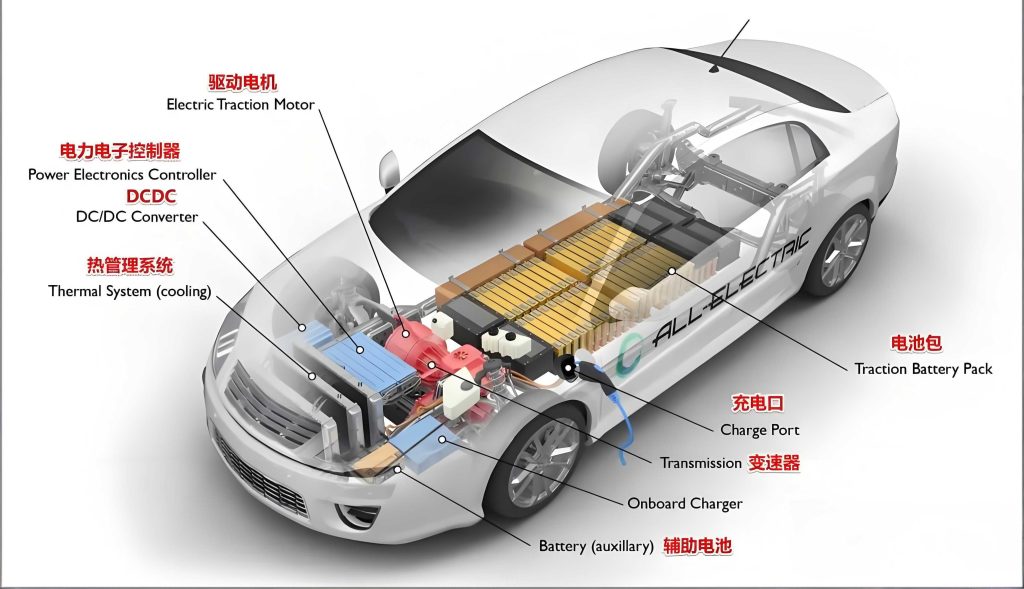
The rapid evolution of the battery electric car represents a pivotal shift towards sustainable transportation. However, its performance ceiling is often constrained by a fundamental architectural limitation: the separate management of the high-voltage traction battery pack and the vehicle’s electrical system. This division creates information silos and sub-optimal control, leading to systemic bottlenecks in efficiency, safety, and longevity. Our research is dedicated to overcoming this challenge by establishing a comprehensive theory for the co-management of these core systems. We believe that unlocking the full potential of a battery electric car necessitates a paradigm shift from isolated control domains to a deeply integrated, synergistic management framework.
This study begins by dissecting the inherent conflicts within the traditional segregated architecture. We then delve into the underlying electro-thermal-physical coupling mechanisms that bind the battery and electrical systems. Following this analysis, we construct a multi-layered co-management strategy, supported by formal models and scheduling algorithms. The ultimate goal is to provide a foundational theory that enables the next leap in the comprehensive performance of the battery electric car.
Current State and Challenges of Decoupled Management
The prevailing architecture in most battery electric cars treats the Battery Management System (BMS) and the Vehicle Electrical System Controller as independent entities. This decoupled approach is the root cause of several persistent performance limitations.
1. Battery System Limitations: The BMS operates under significant uncertainty. State-of-Charge (SOC) estimation suffers from cumulative errors due to the complex, non-linear electrochemistry. State-of-Health (SOH) assessment is hampered by the coupled aging mechanisms of the cells. This imperfect state awareness cascades into other critical functions:
- Thermal Management: Localized hot spots accelerate material degradation. Low temperatures reduce power capability and increase lithium plating risk during charging. High-temperature thermal runaway prevention is reactive and model-limited.
- Power Management: Defining safe, real-time power (State-of-Power, SOP) limits requires reconciling multi-physics constraints (electrochemical, thermal, mechanical). Fast-charging protocols often trade-off against battery longevity. Regenerative braking is curtailed due to a lack of precise knowledge of the battery’s instantaneous energy acceptance capability.
2. Electrical System Limitations: The vehicle’s electrical control systems operate with an incomplete picture of the energy source’s true state.
- Drive cycle power matching is suboptimal due to lagging response to battery state changes.
- High-voltage load transients (e.g., compressor startup) cause voltage oscillations that stress power electronics.
- Low-voltage network efficiency is limited by the fixed operational points of the DC/DC converter, which does not adapt dynamically to the high-voltage bus state or low-voltage load profiles.
3. The Systemic Information Gap: The deepest flaw is the informational disconnect. The BMS cannot anticipate dynamic load demands, while the electrical controllers lack precise awareness of the battery’s real-time safety and performance boundaries. This leads to conservative and inefficient operation: the battery may be kept in suboptimal SOC windows, regenerative braking potential is underutilized, and thermal management is often overly aggressive, wasting energy. While domain-centralized architectures have enabled basic signal sharing, true synergistic decision-making that balances competing objectives—like range versus battery life, or performance versus safety—remains an unresolved theoretical and practical challenge. The following table summarizes the key conflicts arising from decoupled management in a battery electric car.
| System | Primary Objective | Conflict With | Consequence |
|---|---|---|---|
| Battery (BMS) | Maximize Battery Life & Safety | Vehicle Demand for High Power/Performance | Conservative power limits, reduced acceleration, limited regen. |
| Battery (Thermal) | Maintain Optimal Cell Temperature | Cabin HVAC Demand & Motor Cooling Needs | Competition for coolant flow/pump power, reduced HVAC efficiency. |
| Electrical System (Drivetrain) | Deliver Instant Torque & Smooth Response | Battery’s Dynamic Voltage/SOP Limitations | Potential for voltage sag, unexpected torque limiting (“limp mode”). |
| Electrical System (Energy) | Maximize Driving Range | Battery Heating/Cooling & Ancillary Load Energy Use | Reduced usable range in extreme temperatures. |
Fundamental Interaction Mechanisms for Co-Management
Effective co-management must be grounded in a deep understanding of how the battery and electrical systems interact. We identify four core interaction mechanisms.
2.1 Dynamic Coupling of Electro-Thermal Fields
The primary coupling occurs through shared energy and thermal pathways. The high-voltage bus is the electrical nexus. The instantaneous current $I_{bus}(t)$ drawn by the combined loads (traction motor, PTC heater, compressor, etc.) directly determines the battery’s output current $I_{bat}(t)$. This current influences the battery’s internal state profoundly:
$$V_{terminal}(t) = OCV(SOC(t)) – I_{bat}(t) \cdot R_{internal}(SOC, T, SOH) – V_{polarization}(t)$$
where $R_{internal}$ is a function of SOC, temperature (T), and SOH. The Joule heating $Q_{Joule}$ generated within the battery is:
$$Q_{Joule, bat}(t) = I_{bat}^2(t) \cdot R_{internal}(t)$$
Simultaneously, the electrical loads generate their own heat (e.g., motor copper losses $I^2R$, inverter switching losses). This heat $Q_{loads}$ dissipates into the vehicle’s thermal environment. In a tightly packaged battery electric car, these thermal fields interact. The battery’s thermal management system (TMS) competes for cooling capacity with the cabin HVAC system and the drive unit cooler. A truly co-managed system requires a coupled electro-thermal model for the entire powertrain compartment.
2.2 Theory of Multi-Objective Conflict Balancing
Co-management is inherently a multi-objective optimization problem. The core conflict for a battery electric car arises from the finite nature of onboard energy and power, which must be allocated among competing goals. We can formulate this as a constrained optimization problem at any time instant \( t \):
$$
\begin{aligned}
& \underset{u(t)}{\text{minimize}}
& & J = \alpha_1 \cdot J_{range} + \alpha_2 \cdot J_{aging} + \alpha_3 \cdot J_{thermal} + \alpha_4 \cdot J_{performance} \\
& \text{subject to}
& & SOC_{min} \leq SOC(t) \leq SOC_{max} \\
& & & T_{cell,min} \leq T_{cell}(t) \leq T_{cell,max} \\
& & & P_{bat}(t) \leq SOP(SOC, T, SOH) \\
& & & V_{bus,min} \leq V_{bus}(t) \leq V_{bus,max}
\end{aligned}
$$
Here, \( u(t) \) represents the control vector (motor torque, HVAC setpoint, DC/DC power, etc.). The weighting factors \( \alpha_i(t) \) are not fixed; they must be dynamically adjusted based on the driving context, user preference, and system state. For example, in a high-performance driving mode, \( \alpha_4 \) (performance) increases. During a long-distance highway cruise, \( \alpha_1 \) (range) dominates. In extreme ambient temperatures, \( \alpha_3 \) (thermal safety) receives the highest priority. This dynamic weighting is the cornerstone of intelligent co-management in a battery electric car.
2.3 Information Fusion as the Decision-Making Bedrock
Reliable co-management decisions require a unified, high-fidelity view of the entire system. This is achieved through deep information fusion, which involves the temporal and spatial alignment of data from all subsystems.
Battery Data Stream: The BMS must provide not just instantaneous values but predictive trends:
- SOC with uncertainty bounds.
- SOH and its trajectory (e.g., resistance growth rate).
- State-of-Safety (SOS) flags (e.g., cell voltage deviation, temperature gradient).
- 3D thermal map of the pack.
Vehicle Electrical System Data Stream: The electrical controllers must provide intent and demand:
- Predictive torque/power demand profile for the next several seconds.
- HVAC operational plan and its thermal impact.
- Status and forecast of all major auxiliary loads.
A central co-management controller fuses these streams to create a “system state pool.” This enables predictive actions: pre-conditioning the battery based on navigation data, pre-adjusting the DC/DC converter’s operating point before a high-load event, or smoothing power demand to reduce battery stress. The quality and latency of this fused information directly determine the co-management strategy’s efficacy.
2.4 Systemic Failure Propagation Paths
Co-management must also account for fault conditions. In a tightly integrated battery electric car, a fault in one subsystem can propagate to another, leading to cascading failures. Understanding these paths is essential for designing robust joint safety protocols.
| Origin Fault | Propagation Path | Potential Cascading Effect |
|---|---|---|
| Inverter Short-Circuit | Electrical → Thermal DC bus short causes massive battery discharge. |
Battery cell overheating, potential thermal runaway. |
| Cell Internal Short | Electrical → Electrical Module voltage collapse induces back-flow current. |
Damage to BMS sensing circuits or other connected units. |
| Battery Thermal Runaway | Thermal → Physical/Safety Ejecta and flames heat adjacent components/wiring. |
Fire propagation to cabin or other vehicle areas. |
| Co-Management Controller Delay | Cyber-Physical Mismatched timing between torque command and battery limit. |
Sudden loss of propulsion or unintended vehicle behavior. |
Effective co-management involves establishing “firewalls” at these propagation nodes through hardware redundancy, cross-domain sensor validation, and coordinated, hierarchical fault response strategies.
Constructing a Multi-Layer Co-Management Strategy Framework
Based on the above mechanisms, we propose a structured, multi-layer co-management framework for the battery electric car.
3.1 Joint Dynamic Safety Boundary Protection
This strategy replaces static, independent safety limits with a unified, adaptive safety envelope. The co-management controller continuously calculates a joint safe operating area (JSOA) by integrating real-time constraints from both systems:
$$ JSOA(t) = \{ (P, V, T) \, | \, P \leq \min(SOP_{bat}(t), P_{inv,max}(t)), \, V_{min}(T) \leq V \leq V_{max}(T), \, T \leq \min(T_{cell,max}, T_{inv,max}) \} $$
When operating parameters approach the JSOA boundary, a tiered, cross-system response is triggered:
| Tier | Condition | Coordinated Action |
|---|---|---|
| Tier 1: Advisory/Soft Limit | Parameter within 10% of boundary. | Gradual torque ramp-down, pre-cooling activation, non-essential load shed (e.g., seat heaters). |
| Tier 2: Active Intervention | Parameter within 5% of boundary or fast approach. | Hard torque limit, HVAC switched to economy mode, DC/DC output current limited. |
| Tier 3: Emergency Protection | Boundary breached or fault detected. | Command HV contactor open, activate full cooling pumps/fans, illuminate driver warnings. |
3.2 State-Synergistic Optimization Control
This layer focuses on optimizing the operational states of both systems for mutual benefit. Key strategies include:
Thermal Energy Synergy: Treat waste heat as a transferable resource.
- Cold Weather: Direct battery charging/discharging waste heat to assist cabin heating, reducing the load on the energy-intensive PTC heater. The heat transfer benefit \( \Delta Q_{synergy} \) can be modeled as a function of battery power \(P_{bat}\) and efficiency \( \eta \):
$$ \Delta Q_{synergy, cold} = k \cdot P_{bat} \cdot (1 – \eta(T)) $$ where \( k \) is a coupling efficiency factor.
- Hot Weather: Integrate the battery liquid cooling loop with the cabin’s chiller circuit in series or parallel under optimal control, improving overall cooling system efficiency.
Health-Aware Power Management: Adjust electrical system demands based on battery SOH. For example, the maximum regen power limit \(P_{regen,max}\) can be made a function of the battery’s internal resistance rise \( \Delta R \):
$$ P_{regen,max}(SOH) = P_{regen,0} \cdot \left(1 – \beta \cdot \frac{\Delta R}{R_0}\right) $$ where \( \beta \) is a derating factor and \(P_{regen,0}\) is the limit for a new battery. This proactively protects an aging battery.
3.3 Global Energy Efficiency Scheduling Mechanism
This mechanism acts as the “energy dispatcher” for the entire battery electric car. It views all energy sinks and sources holistically and schedules their operation across time. The total vehicle power demand \(P_{total}(t)\) is decomposed and prioritized:
$$ P_{total}(t) = P_{traction}(t) + P_{HVAC}(t) + P_{auxiliary}(t) + P_{batt\_TMS}(t) $$
The scheduler uses predictive information (route, weather) to pre-allocate energy. For instance, it may precondition the battery and cabin while still connected to the grid, or it may slightly reduce cabin cooling on a route with anticipated high regen events to preserve battery temperature headroom. A critical function is the optimization of regenerative braking. The optimal regen torque \(T_{regen}^*\) is solved by considering the battery’s instantaneous acceptance capability \(C_{accept}(SOC,T)\) and the braking demand \(D_{brake}\):
$$ T_{regen}^* = \arg \max_{T_{regen}} \left( \eta_{regen} \cdot \int T_{regen} \cdot \omega \, dt \right) $$
$$ \text{s.t. } P_{regen}(t) \leq C_{accept}(SOC(t), T(t)), \quad T_{regen} \leq D_{brake} $$
Furthermore, it manages the bidirectional DC/DC converter to allow energy exchange between the high-voltage and low-voltage networks, using the HV battery to support high LV loads or using solar panels on the roof to trickle-charge the HV battery.
3.4 Hierarchical and Tiered Architectural Design
To manage the complexity and different time scales of the tasks, a hierarchical control architecture is essential for an advanced battery electric car. This structure ensures stability, responsiveness, and long-term optimization.
| Layer | Time Scale | Primary Function & Algorithms | Input/Output |
|---|---|---|---|
| Strategic (Top) | Minutes to Hours | Long-term optimization. Trip planning, health-aware mode selection (Range, Performance, Eco), SOH model update. | Input: Navigation, Calendar, User Profile. Output: Mode parameters, SOH adjustment factors. |
| Tactical (Middle) | Seconds to Minutes | Coordinated control. Executes JSOA protection, energy scheduling, thermal synergy control. Contains the core co-management algorithms. | Input: Fused system state pool. Output: Setpoints for torque, HVAC, DC/DC, TMS. |
| Execution (Bottom) | Milliseconds | Physical actuation. Standardized signal processing, fast closed-loop control of local devices (inverter, compressor, pump). | Input: Setpoints from Tactical layer. Output: PWM signals, valve commands, contactor states. |
The communication between layers is critical. The tactical layer acts as the central coordinator, receiving high-level goals from the strategic layer and translating them into real-time commands for the execution layer, all while enforcing the dynamic safety envelope.
Conclusion and Future Perspectives
In this work, we have systematically developed a theoretical framework for the integrated co-management of the powertrain battery and the vehicle electrical system in a battery electric car. By moving beyond the paradigm of segregated control, this framework addresses the fundamental electro-thermal couplings and multi-objective conflicts that limit current vehicle performance. The proposed strategies—dynamic joint safety boundaries, state-synergistic optimization, global energy scheduling, and a hierarchical architecture—provide a cohesive blueprint for achieving simultaneous improvements in safety, efficiency, longevity, and drivability.
The practical implementation of this co-management framework promises significant benefits for the battery electric car: a measurable extension of battery service life through reduced stress, an increase in real-world driving range via optimal energy dispatch, and enhanced safety through predictive, cross-domain hazard mitigation. Future research will focus on integrating this framework with emerging technologies. This includes leveraging connectivity (V2X) for cloud-enhanced predictive management, adapting the strategies to next-generation battery chemistries (e.g., solid-state), and developing even more robust algorithms for extreme and unforeseen operating scenarios. The journey towards the truly intelligent and optimally performing battery electric car is underpinned by the deep synergy of its core energy and power systems, as outlined in this co-management theory.