
The rapid adoption of electric vehicles (EVs) has heightened the importance of reliable and efficient EV charging station infrastructure. As a critical component of the EV ecosystem, the operational maintenance of these stations directly impacts user experience and the broader transition to sustainable transportation. However, traditional maintenance approaches often fall short due to delayed fault detection, high costs, and inefficient data utilization. In this context, the integration of Internet of Things (IoT) technology offers a transformative solution for real-time fault diagnosis in EV charging stations. By leveraging advanced data acquisition, processing, and intelligent algorithms, IoT-enabled systems can rapidly identify and address faults, ensuring minimal downtime and enhanced service quality. This article explores the current challenges, advantages, methodologies, and future directions of IoT-based fault diagnosis, emphasizing multi-source data fusion and self-healing mechanisms to support the evolution of smart EV charging station networks.
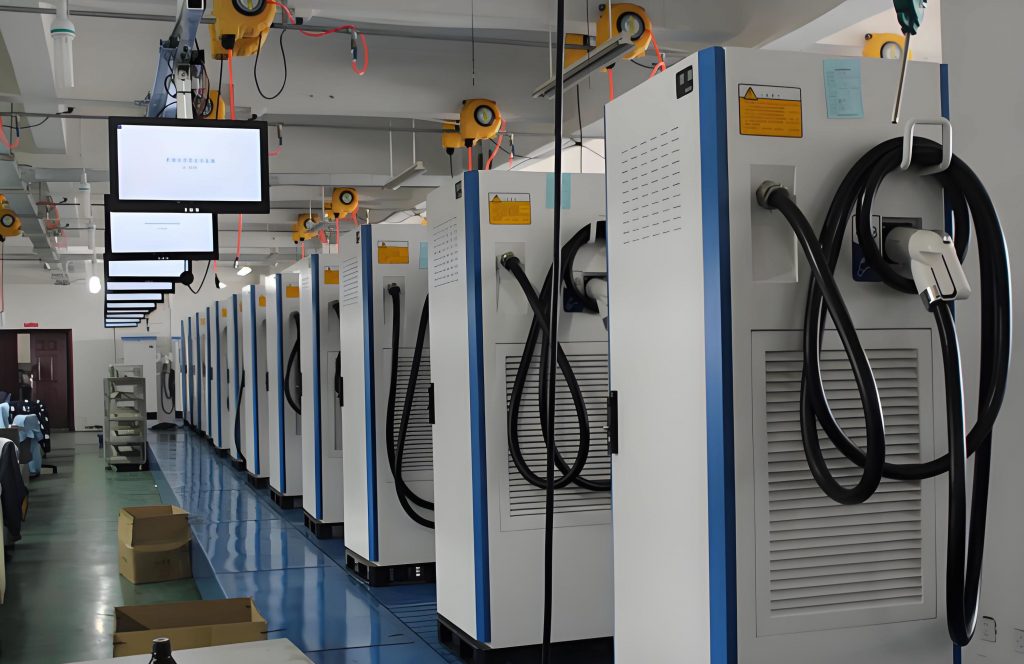
The proliferation of EV charging stations has exposed significant vulnerabilities in maintenance protocols, particularly in fault diagnosis. Conventional methods rely heavily on manual inspections and predefined rules, which are inadequate for handling complex, dynamic failures. For instance, sporadic issues like voltage spikes or communication breakdowns often go undetected until they escalate, leading to prolonged outages. IoT technology addresses these gaps by enabling continuous monitoring through embedded sensors and cloud-based analytics. Sensors in an EV charging station—such as those measuring voltage, current, and temperature—stream real-time data to centralized platforms. This data is then processed using machine learning (ML) and deep learning (DL) models to detect anomalies and predict failures. The result is a proactive maintenance framework that not only diagnoses faults accurately but also facilitates automated responses, such as remote system resets or parameter adjustments. As the demand for EV charging stations grows, the scalability and adaptability of IoT-driven solutions become paramount for sustaining infrastructure resilience.
Current maintenance of EV charging stations involves a multifaceted approach, encompassing hardware integrity, software updates, and power management. However, the heterogeneity of EV charging station designs—varying in communication protocols, encryption standards, and charging controls—complicates unified management. For example, one EV charging station model might use proprietary encryption for data transmission, while another employs open standards, creating interoperability issues. This diversity increases operational costs and delays fault resolution. Traditional diagnostic techniques, such as periodic manual checks, are inherently reactive and subjective. Technicians may overlook subtle signs of impending failure, such as gradual component degradation or intermittent network errors. Moreover, the lack of standardized data formats across different EV charging station manufacturers hinders the aggregation and analysis of operational data. These limitations underscore the need for an integrated, IoT-based system that can harmonize data from disparate sources and apply intelligent diagnostics to preempt failures.
The application of IoT technology in EV charging station fault diagnosis offers several distinct advantages, primarily through real-time data acquisition and advanced analytics. Sensors embedded in an EV charging station continuously capture parameters like voltage ($V$), current ($I$), and temperature ($T$). These readings are transmitted via high-speed networks (e.g., 4G/5G or Wi-Fi) to cloud platforms, where they are processed to identify deviations from normal operating conditions. For instance, if the current sensor detects an anomaly, such as a sudden surge beyond safe thresholds, the system can trigger an alert. The data processing pipeline involves noise reduction and normalization to enhance model accuracy. A common filtering technique is the moving average, expressed as:
$$ y_t = \frac{1}{n} \sum_{i=0}^{n-1} x_{t-i} $$
where $x_t$ represents the raw sensor data at time $t$, $n$ is the window size, and $y_t$ is the smoothed output. This preprocessing step reduces high-frequency noise, enabling clearer fault signatures. Additionally, normalization scales data to a common range, such as [0, 1], using the formula:
$$ x_{\text{norm}} = \frac{x – \min(X)}{\max(X) – \min(X)} $$
where $X$ is the dataset. By cleaning and standardizing data, IoT systems ensure that subsequent diagnostic models operate on reliable inputs, improving the overall robustness of EV charging station monitoring.
| Aspect | Traditional Method | IoT-Based Method |
|---|---|---|
| Data Collection | Manual, periodic inspections | Automated, continuous sensor streaming |
| Diagnosis Speed | Hours to days | Real-time (seconds to minutes) |
| Accuracy | Moderate, based on human expertise | High, driven by ML/DL algorithms |
| Cost Efficiency | High due to labor-intensive processes | Lower through automation and predictive maintenance |
| Scalability | Limited to localized deployments | Highly scalable across distributed EV charging station networks |
Building an effective fault diagnosis model for EV charging stations involves combining ML and DL algorithms to classify and locate faults. Support Vector Machines (SVM) are widely used for their ability to handle high-dimensional data. The objective of SVM is to find an optimal hyperplane that separates fault classes, formulated as:
$$ \min_{w,b} \frac{1}{2} \|w\|^2 \quad \text{subject to} \quad y_i (w \cdot x_i + b) \geq 1 $$
where $w$ is the weight vector, $b$ is the bias, $x_i$ are the feature vectors (e.g., voltage and current readings), and $y_i$ are the class labels (e.g., normal or fault). For time-series data from EV charging stations, recurrent neural networks (RNNs) and long short-term memory (LSTM) networks are employed to capture temporal dependencies. The LSTM update equations include:
$$ f_t = \sigma(W_f \cdot [h_{t-1}, x_t] + b_f) $$
$$ i_t = \sigma(W_i \cdot [h_{t-1}, x_t] + b_i) $$
$$ \tilde{C}_t = \tanh(W_C \cdot [h_{t-1}, x_t] + b_C) $$
$$ C_t = f_t \odot C_{t-1} + i_t \odot \tilde{C}_t $$
$$ o_t = \sigma(W_o \cdot [h_{t-1}, x_t] + b_o) $$
$$ h_t = o_t \odot \tanh(C_t) $$
where $f_t$, $i_t$, and $o_t$ are the forget, input, and output gates, respectively; $C_t$ is the cell state; $h_t$ is the hidden state; and $\sigma$ denotes the sigmoid function. These models learn from historical EV charging station data to recognize patterns associated with common faults, such as overcurrent or insulation failure. By training on diverse datasets, the diagnosis model achieves high accuracy, often exceeding 95% in detecting specific fault types in EV charging stations.
The output of fault diagnosis must be actionable for maintenance teams. Visualization interfaces display critical information—such as fault type, severity, and location—using charts and color codes. For example, a dashboard might use red to indicate critical faults in an EV charging station, prompting immediate intervention. Additionally, diagnostic results are fed back to the EV charging station control system to initiate automated responses. If an overvoltage condition is detected, the system can autonomously disconnect power to prevent damage. This closed-loop feedback reduces the need for on-site visits, cutting downtime and operational costs. The integration of IoT platforms also enables remote updates and configuration changes, ensuring that EV charging stations remain compliant with evolving standards and user requirements.
| Fault Type | Description | Typical Sensors Used | Diagnostic Accuracy (%) |
|---|---|---|---|
| Overcurrent | Excessive current flow beyond rated limits | Current sensors | 97.5 |
| Overvoltage | Voltage spikes damaging components | Voltage sensors | 96.8 |
| Thermal Overload | Overheating of power electronics | Temperature sensors | 95.2 |
| Communication Failure | Loss of network connectivity | Network modules | 98.1 |
| Ground Fault | Insulation breakdown leading to leakage | Insulation monitoring devices | 94.7 |
Despite its benefits, IoT-based fault diagnosis for EV charging stations faces challenges, particularly in cybersecurity and device compatibility. Cyber threats, such as data breaches or malicious attacks, can compromise the integrity of EV charging station operations. To mitigate these risks, encryption protocols like Transport Layer Security (TLS) are implemented to secure data transmission. The encryption process can be represented as:
$$ C = E(K, P) $$
where $P$ is the plaintext data, $K$ is the encryption key, and $C$ is the ciphertext. Additionally, multi-factor authentication and role-based access control restrict system access to authorized personnel only. For device compatibility, standardization efforts—such as adherence to IEC 61851 and GB/T standards—promote interoperability among different EV charging station models. Middleware solutions translate proprietary protocols into unified formats, enabling seamless integration. For instance, a gateway device might convert data from a legacy EV charging station to MQTT, a lightweight IoT protocol. These measures ensure that heterogeneous EV charging stations can coexist within a centralized management framework, facilitating comprehensive fault monitoring.
Optimizing fault diagnosis in EV charging stations involves advancing multi-source data fusion and intelligent self-healing technologies. By incorporating environmental data (e.g., ambient temperature, humidity) and user behavior patterns, the diagnostic model gains a holistic view of operational contexts. For example, high ambient temperatures might correlate with increased cooling system failures in an EV charging station. Data fusion techniques, such as Kalman filtering, combine sensor readings to improve estimation accuracy. The Kalman filter equations include:
$$ \hat{x}_{k|k-1} = F_k \hat{x}_{k-1|k-1} + B_k u_k $$
$$ P_{k|k-1} = F_k P_{k-1|k-1} F_k^T + Q_k $$
$$ K_k = P_{k|k-1} H_k^T (H_k P_{k|k-1} H_k^T + R_k)^{-1} $$
$$ \hat{x}_{k|k} = \hat{x}_{k|k-1} + K_k (z_k – H_k \hat{x}_{k|k-1}) $$
$$ P_{k|k} = (I – K_k H_k) P_{k|k-1} $$
where $\hat{x}$ is the state estimate, $P$ is the error covariance, $K$ is the Kalman gain, $z$ is the measurement, and $F$, $B$, $H$, $Q$, $R$ are matrices defining the system dynamics. This approach enhances the reliability of fault detection in EV charging stations by accounting for uncertainties in sensor data. Furthermore, reinforcement learning (RL) algorithms enable the diagnosis model to adapt dynamically to new fault scenarios. In RL, an agent learns optimal actions through trial and error, maximizing a reward function. For an EV charging station, the reward might be based on the speed and accuracy of fault resolution. Transfer learning allows knowledge from related domains (e.g., power grid fault diagnosis) to be applied to EV charging stations, accelerating model training. Self-healing mechanisms, such as automatic circuit reconfiguration or software reboots, further reduce dependency on human intervention, ensuring continuous operation of EV charging stations.
| Data Source | Parameters Monitored | Contribution to Fault Diagnosis |
|---|---|---|
| Internal Sensors | Voltage, current, temperature | Detects electrical and thermal anomalies in EV charging stations |
| Environmental Sensors | Ambient temperature, humidity, rainfall | Correlates external conditions with component wear in EV charging stations |
| User Interaction Data | Charging frequency, duration, error logs | Identifies usage patterns leading to faults in EV charging stations |
| Network Metrics | Latency, packet loss, bandwidth | Monitors communication health of EV charging stations |
| Historical Maintenance Records | Past failures, repair actions, component replacements | Provides context for predictive analytics in EV charging stations |
In conclusion, IoT technology revolutionizes fault diagnosis for EV charging stations by enabling real-time monitoring, intelligent analysis, and automated responses. The integration of ML and DL models, coupled with multi-source data fusion, significantly improves diagnostic accuracy and reliability. While challenges like cybersecurity and standardization persist, proactive measures—such as encryption and protocol harmonization—mitigate these issues. Future advancements in self-healing and adaptive learning will further enhance the resilience of EV charging station networks, supporting the global shift toward electric mobility. As EV adoption accelerates, the role of IoT in maintaining robust charging infrastructure becomes indispensable, ensuring that EV charging stations operate efficiently and reliably under diverse conditions.