
In recent years, the transportation sector has faced increasing pressure to reduce greenhouse gas emissions and air pollutants. As a significant contributor, heavy-duty vehicles account for a substantial portion of energy consumption and emissions globally. The advent of hybrid electric vehicle technology offers a promising pathway to address these challenges by combining internal combustion engines with electric propulsion systems. In this study, I investigate the effects of different operating modes—specifically, hybrid mode and pure engine mode—on pollutant emissions (CO, NOx, and particulate number, PN) and carbon emissions in a heavy-duty diesel hybrid electric vehicle. Through laboratory experiments on a chassis dynamometer, I aim to provide insights into how hybrid electric vehicle strategies influence environmental performance, with a focus on real-world driving cycles.
The hybrid electric vehicle represents a critical transition technology in the journey toward fully electric mobility. By integrating an electric motor and battery pack with a conventional engine, the hybrid electric vehicle can optimize energy usage, reduce fuel consumption, and lower tailpipe emissions under certain conditions. However, the intermittent operation of the engine in a hybrid electric vehicle, characterized by frequent starts and stops, may lead to unique emission profiles that differ from those of traditional vehicles operating solely on engine power. Understanding these dynamics is essential for refining hybrid electric vehicle designs and informing regulatory frameworks.
Previous research has primarily focused on light-duty hybrid electric vehicles, with limited studies addressing heavy-duty applications. For instance, studies have shown that engine start-stop events in hybrid electric vehicles can increase PN emissions due to cold-start conditions, while NOx emissions may be affected by exhaust temperature fluctuations impacting aftertreatment efficiency. Nonetheless, gaps remain in comprehensively assessing the trade-offs between pollutant reduction and carbon mitigation in heavy-duty hybrid electric vehicles across diverse operating modes. This study seeks to fill that gap by conducting controlled experiments under standardized test cycles.
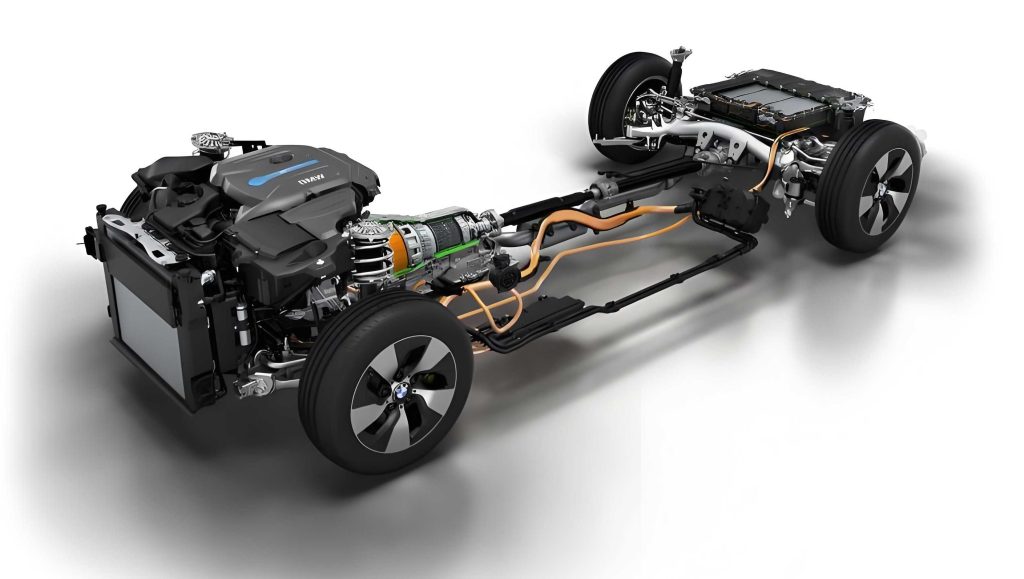
My experimental approach involved testing a heavy-duty diesel hybrid electric vehicle on a heavy-duty four-wheel-drive chassis dynamometer. The vehicle was a parallel hybrid electric vehicle with a non-plug-in configuration, featuring a diesel engine, an electric motor, and a battery system. Key specifications included a maximum gross vehicle weight of 31,000 kg, an engine rated power of 257 kW, a motor power of 100 kW, and a battery capacity of 50.45 kWh. The hybrid electric vehicle control strategy was based on speed thresholds: below 20 km/h, the vehicle primarily operated on electric drive, while above 20 km/h or during high-load conditions, the engine engaged to work synergistically with the motor. This strategy aims to keep the engine within its high-efficiency zone, thereby optimizing performance and emissions.
For emissions measurement, I used a portable emissions measurement system (PEMS) equipped with analyzers for gaseous pollutants and particulate matter. The system included a chemiluminescence detector for NOx, a non-dispersive infrared analyzer for CO, and a particle counter for PN. The testing protocol followed the Chinese Heavy-duty Commercial Vehicle Test Cycle (CHTC-D), which simulates urban and highway driving conditions. To ensure consistency, the same experienced driver operated the vehicle in all tests, and the dynamometer settings were adjusted to simulate real-world road loads using a coast-down method.
I conducted two distinct test runs: one in hybrid mode, where the hybrid electric vehicle utilized both engine and electric drive according to its control strategy, and another in pure engine mode, where the hybrid electric vehicle was forced to operate solely on the diesel engine without electric assistance. Prior to testing, the hybrid electric vehicle underwent a pre-conditioning phase to achieve battery state-of-charge balance. Data collection began once the engine coolant temperature reached 70°C, ensuring stable operating conditions. Instantaneous emissions, exhaust temperatures, and vehicle parameters were recorded throughout the cycles for subsequent analysis.
The analysis of instantaneous emissions revealed significant differences between the two operating modes. In hybrid mode, the exhaust temperature exhibited pronounced fluctuations due to frequent engine start-stop events, particularly during low-speed segments where the engine remained off for extended periods. This led to step-like changes in temperature, as illustrated in the data. In contrast, pure engine mode showed more stable exhaust temperatures, with variations primarily driven by acceleration events. These temperature dynamics directly influenced pollutant formation and aftertreatment efficiency.
For CO emissions, the hybrid electric vehicle in hybrid mode demonstrated lower average emission rates compared to pure engine mode. The instantaneous CO peaks in hybrid mode occurred mainly during engine restart moments, when combustion was incomplete due to lower cylinder temperatures. In pure engine mode, CO spikes were associated with rapid acceleration, where rich fuel-air mixtures led to incomplete combustion. Quantitatively, the average CO emission rate in hybrid mode was 61.9% lower than in pure engine mode. The reduction was more pronounced in low-speed segments, where CO emissions decreased by 83.9%, while in high-speed segments, the decrease was 47.8%.
To summarize the cumulative emissions, I compiled data from the low-speed and high-speed phases of the CHTC-D cycle. The table below presents the total emissions for CO, NOx, and PN under both operating modes:
| Pollutant | Low-Speed Segment (Hybrid Mode) / g or count | Low-Speed Segment (Pure Engine Mode) / g or count | High-Speed Segment (Hybrid Mode) / g or count | High-Speed Segment (Pure Engine Mode) / g or count | Total Emissions (Hybrid Mode) / g or count | Total Emissions (Pure Engine Mode) / g or count |
|---|---|---|---|---|---|---|
| NOx | 2.07 g | 1.93 g | 9.30 g | 5.09 g | 11.36 g | 7.02 g |
| CO | 1.56 g | 9.67 g | 9.39 g | 17.26 g | 10.96 g | 26.94 g |
| PN | 4.79 × 10¹¹ | 0.53 × 10¹¹ | 5.50 × 10¹¹ | 2.01 × 10¹¹ | 10.3 × 10¹¹ | 2.54 × 10¹¹ |
From the table, it is evident that hybrid mode reduced CO emissions but increased NOx and PN emissions compared to pure engine mode. This trade-off highlights the complex interplay between hybrid electric vehicle operation and emission control systems.
To further quantify the emission intensity, I calculated the specific emissions (i.e., emissions per unit of work done by the engine) using the formula:
$$ e = \frac{m}{W} $$
where \( e \) is the specific emission (g/kWh or counts/kWh), \( m \) is the mass or number of pollutants emitted, and \( W \) is the engine work over the cycle. For hybrid mode, the total engine work was 14.4 kWh, while for pure engine mode, it was 17.7 kWh. The results for specific emissions are shown in the following table:
| Pollutant | Low-Speed Specific Emission (Hybrid Mode) | Low-Speed Specific Emission (Pure Engine Mode) | High-Speed Specific Emission (Hybrid Mode) | High-Speed Specific Emission (Pure Engine Mode) | Overall Specific Emission (Hybrid Mode) | Overall Specific Emission (Pure Engine Mode) |
|---|---|---|---|---|---|---|
| CO (g/kWh) | 0.108 | 0.546 | 0.652 | 0.975 | 0.761 | 1.522 |
| NOx (g/kWh) | 0.144 | 0.109 | 0.646 | 0.288 | 0.789 | 0.397 |
| PN (counts/kWh) | 3.33 × 10¹⁰ | 2.99 × 10⁹ | 3.82 × 10¹⁰ | 1.14 × 10¹⁰ | 7.15 × 10¹⁰ | 1.43 × 10¹⁰ |
The data indicate that in hybrid mode, the overall specific CO emission decreased by approximately 50.9% compared to pure engine mode, with a more substantial reduction of 78.0% in low-speed segments. However, NOx specific emissions increased by about 2.0 times overall, with a notable rise of 2.2 times in high-speed segments. PN specific emissions saw an even greater increase of 4.4 times overall, particularly in low-speed segments where it surged by 12.4 times. These findings underscore the emission trade-offs inherent in hybrid electric vehicle operation.
The impact on carbon emissions was assessed using the fuel consumption data and a carbon emission factor. The carbon emissions were calculated as:
$$ C = \frac{Q \times k_{CO_2}}{3600} $$
where \( C \) is the carbon emission (kg), \( Q \) is the fuel consumption rate (L/h), and \( k_{CO_2} \) is the carbon emission factor for diesel, taken as 26.7 kg/L. The instantaneous carbon emissions showed that hybrid mode consistently produced lower peaks and cumulative amounts than pure engine mode. In low-speed segments, the hybrid electric vehicle predominantly operated on electric power, resulting in minimal carbon emissions. In high-speed segments, the synergistic engine-motor operation helped maintain efficient combustion, even during accelerations, thereby curbing carbon output.
The total carbon emissions for the entire cycle were computed as follows: in hybrid mode, the carbon emissions totaled approximately 1.23 kg, while in pure engine mode, they reached 4.11 kg. This represents a reduction of about 70.1% in hybrid mode, with reductions of 79.5% in low-speed segments and 68.2% in high-speed segments. The significant carbon savings highlight the environmental benefit of hybrid electric vehicle technology, aligning with global decarbonization goals.
To delve deeper into the mechanisms behind these results, I analyzed the role of exhaust temperature and aftertreatment systems. In hybrid mode, the frequent engine starts led to lower average exhaust temperatures, which adversely affected the selective catalytic reduction (SCR) system’s efficiency in converting NOx. This explains the higher NOx emissions despite the hybrid electric vehicle’s efficiency gains. For PN emissions, the cold-start conditions during engine restarts promoted particle formation due to poor fuel atomization and rich mixtures. Conversely, in pure engine mode, the more stable exhaust temperatures allowed the SCR system to function better, but the absence of electric assistance led to higher fuel consumption and CO emissions during transient events.
The hybrid electric vehicle’s control strategy played a pivotal role in these outcomes. By decoupling the engine from direct driver demand, the hybrid electric vehicle could operate the engine in its optimal efficiency region, reducing CO and carbon emissions. However, this came at the cost of increased NOx and PN emissions due to thermal management challenges. This trade-off suggests that future hybrid electric vehicle designs need to integrate advanced aftertreatment systems, such as electrically heated catalysts or optimized thermal management, to mitigate pollutant spikes during start-stop events.
Comparing these findings with prior research on light-duty hybrid electric vehicles, I observed similarities in the increase in PN emissions during engine starts, but the magnitude was more pronounced in heavy-duty applications due to larger engine displacements and higher loads. Additionally, the carbon reduction potential of heavy-duty hybrid electric vehicles appears greater, given their higher baseline fuel consumption. This underscores the importance of tailoring hybrid electric vehicle technologies to vehicle class and duty cycle.
From a policy perspective, these results imply that emissions regulations for hybrid electric vehicles should account for operating mode variability. Current testing protocols often focus on single modes, but as shown, the hybrid electric vehicle’s environmental performance can differ significantly between hybrid and pure engine modes. Incorporating multi-mode testing into certification processes could provide a more holistic assessment of hybrid electric vehicle emissions.
In terms of limitations, this study was conducted in a controlled laboratory environment using a single heavy-duty hybrid electric vehicle model. Real-world conditions, such as traffic variability, weather, and driver behavior, may alter emission profiles. Future work should expand to on-road testing with a fleet of hybrid electric vehicles to validate these findings. Moreover, investigating alternative hybrid architectures, such as series or plug-in hybrid electric vehicles, could offer additional insights.
To summarize, the hybrid electric vehicle operating mode profoundly influences pollutant and carbon emissions. Hybrid mode reduces CO and carbon emissions significantly but increases NOx and PN emissions due to engine start-stop events and thermal management issues. The specific emission calculations quantify these trade-offs, providing a basis for optimizing hybrid electric vehicle designs. As the adoption of hybrid electric vehicles accelerates in the heavy-duty sector, balancing these emissions trade-offs will be crucial for achieving sustainable transportation.
In conclusion, this study demonstrates that hybrid electric vehicles offer a viable path for reducing carbon emissions in heavy-duty transport, but attention must be paid to pollutant control. By refining hybrid electric vehicle control strategies and enhancing aftertreatment systems, the environmental benefits of hybrid electric vehicles can be maximized. I recommend further research into integrated emission management for hybrid electric vehicles, considering both local air quality and global climate goals.