
As an industry observer deeply immersed in the evolution of electric vehicle infrastructure, I have witnessed the rapid expansion of the EV charging station sector, driven by robust policy support and surging market demand. The question of when this industry will reach its profitability turning point is central to understanding its future trajectory. In this analysis, I will explore the current state, technological advancements, competitive dynamics, and financial challenges facing EV charging stations, using data, tables, and formulas to provide a comprehensive perspective. The proliferation of EV charging stations has been phenomenal, with cumulative infrastructure numbers soaring, yet profitability remains elusive for many operators. Through this first-person examination, I aim to shed light on the factors that could accelerate the arrival of this critical milestone.
The growth of EV charging stations in recent years has been nothing short of explosive. By the end of 2024, the total number of charging points had reached staggering figures, reflecting a year-on-year increase of nearly 50%. This surge is largely attributed to the synergistic effects of government policies and the booming electric vehicle market. For instance, in the first 11 months of 2024, over 3.7 million new charging points were added, with private installations accounting for a significant portion due to rising consumer adoption. The table below summarizes the key growth metrics for EV charging stations, highlighting the rapid expansion and shifting trends between public and private segments.
| Category | Number of Units (in millions) | Growth Rate (%) |
|---|---|---|
| Total Cumulative Charging Infrastructure | 12.352 | 49.5 |
| New Additions (Jan-Nov 2024) | 3.756 | – |
| Private Charging Points | 3.022 | 35.7 |
| Public Charging Points | 0.734 | -11.3 |
This growth is not merely a numbers game; it represents a fundamental shift in energy infrastructure. The ratio of electric vehicles to charging points has improved significantly, with current estimates suggesting a vehicle-to-charger ratio of approximately 2.46:1. This indicates that while the network is expanding, there is still room for optimization to meet the escalating demand for EV charging stations. The expansion has been particularly notable in regions like East and South China, where policy initiatives and consumer adoption have converged to create hotspots for EV charging station deployment. As I analyze this data, it becomes clear that the foundation for profitability is being laid, but several hurdles remain.
Policy drivers have been instrumental in this expansion. Multi-departmental efforts have focused on extending the coverage of EV charging stations to residential areas, highways, and rural regions, fostering a more comprehensive network. Concurrently, the electric vehicle market has experienced explosive growth, with annual production and sales surpassing 10 million units in 2024. This dual impetus—policy and market demand—has created a virtuous cycle, propelling the construction of EV charging stations forward. The relationship between policy support and market growth can be modeled using a simple formula: $$ \text{Growth Rate} = \alpha \cdot \text{Policy Incentives} + \beta \cdot \text{Market Demand} $$ where $\alpha$ and $\beta$ are coefficients representing the effectiveness of each factor. In the case of EV charging stations, both $\alpha$ and $\beta$ have been high, leading to the observed rapid expansion.
Technological innovation is another critical dimension that I have closely monitored. The development of mobile charging, wireless charging, and megawatt-level high-power charging has marked significant breakthroughs. For example, advancements in cooling technologies, such as isolated air-cooling systems, have enhanced the durability and efficiency of EV charging stations. These innovations not only improve performance but also reduce lifecycle costs. Consider the cost savings from extended product lifespans; if a standard EV charging station requires maintenance every few years, a technologically advanced version might operate for a decade without intervention. The cost-benefit analysis can be expressed as: $$ \text{Lifecycle Cost Saving} = \sum_{t=1}^{n} \frac{C_{\text{maintenance}, t} – C_{\text{innovation}, t}}{(1 + r)^t} $$ where $C_{\text{maintenance}, t$ is the maintenance cost in year $t$ for a conventional station, $C_{\text{innovation}, t$ is the cost for an advanced EV charging station, $r$ is the discount rate, and $n$ is the lifespan. In practice, such innovations have reported savings ranging from $100,000 to $400,000 over the lifecycle of an EV charging station.
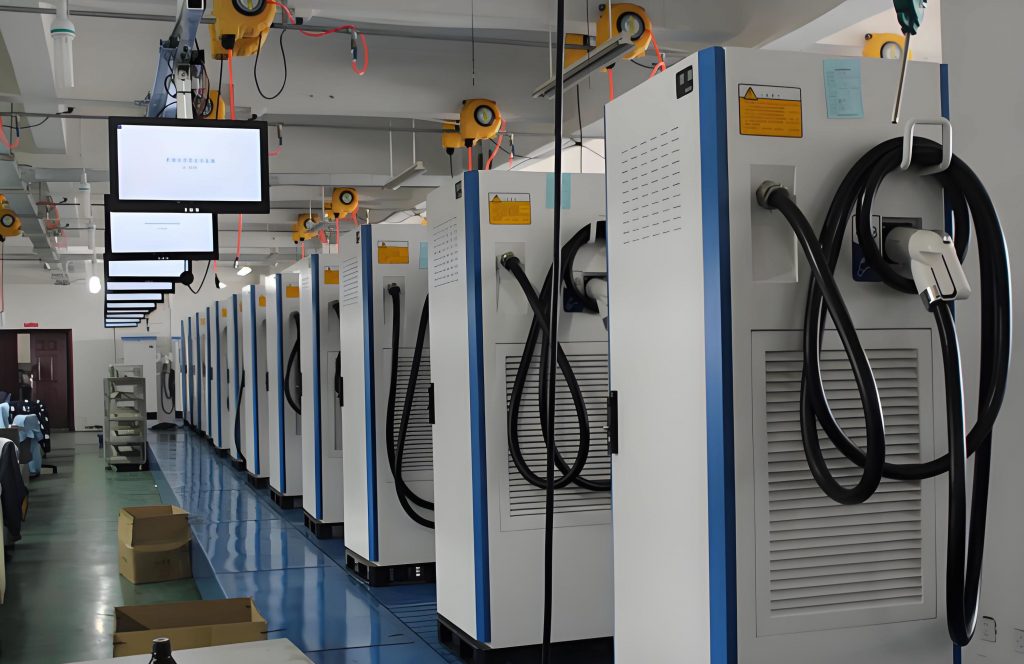
Software capabilities are equally vital for the evolution of EV charging stations. Intelligent power allocation strategies, powered by AI, allow for dynamic optimization of charging power based on vehicle type. This not only maximizes revenue from charging fees but also ensures balanced usage of charging modules, prolonging the equipment’s life. The efficiency gain from such software can be quantified as: $$ \text{Efficiency Gain} = \frac{P_{\text{optimized}} – P_{\text{standard}}}{P_{\text{standard}}} \times 100\% $$ where $P_{\text{optimized}}$ is the power output with AI-driven allocation and $P_{\text{standard}}$ is the output under traditional methods. Reports indicate gains of up to 1.5%, translating to annual savings of around $20,000 per station for high-power EV charging stations. This underscores the importance of integrating smart technologies into the core operations of EV charging stations.
The competitive landscape of the EV charging station industry is characterized by high concentration, particularly in the public and dedicated segments. Leading operators have secured significant market shares through early entry and scalable networks. The table below illustrates the market concentration ratios for different types of EV charging stations, based on recent data. This oligopolistic structure influences pricing, innovation, and service quality, as dominant players set the pace for the entire sector.
| Segment | CR5 (%) | Key Characteristics |
|---|---|---|
| Public Charging Stations | 62.1 | Moderate competition with several major players |
| Dedicated Charging Stations | 88.0 | High concentration, nearing monopoly in some areas |
| DC Charging Stations | 73.9 | Dominance by firms with technological edge |
| AC Charging Stations | 63.3 | More fragmented but still concentrated |
From my perspective, this concentration poses both opportunities and challenges for profitability. On one hand, large operators can achieve economies of scale, reducing per-unit costs for EV charging stations. On the other hand, intense competition among incumbents and the threat of new entrants keep margins thin. The bargaining power of consumers is moderate, as demand for EV charging stations remains high, but price sensitivity is increasing. Moreover, the threat of substitutes is low, given the essential role of EV charging stations in the energy transition. However, new entrants, encouraged by favorable policies, could disrupt the status quo, potentially accelerating the path to profitability through innovation.
When it comes to profitability, the financial models for EV charging stations reveal a complex picture. Operators often face long payback periods due to high initial investments and operational costs. For instance, consider a typical scenario for a small commercial EV charging station: it might include 8 units of 120 kW chargers. The initial investment covers equipment costs, which can be around $0.5 per watt, and comprehensive construction costs of $1.3 per watt. Assuming a lifespan of 10 years and a utilization rate of 12%, the annual rental income per charger is approximately $32,000. The payback period can be calculated using the formula: $$ \text{Payback Period} = \frac{\text{Initial Investment}}{\text{Annual Net Cash Flow}} $$ where the initial investment for the station is the sum of equipment and construction costs, and annual net cash flow accounts for income minus operating expenses. In this case, the payback period is about 4.9 years, aligning with industry averages of 3 to 5 years. This prolonged cycle highlights the liquidity challenges for EV charging station operators.
The advent of ultra-fast charging, or supercharging, adds another layer of complexity. Supercharging EV charging stations require higher power capacities, such as 480 kW per gun, leading to escalated costs. For example, liquid-cooled supercharging stations demand greater electrical capacity and redundant capacitors, increasing hardware investments. If the actual charging demand falls short—say, below 300 kW for extended periods—the return on investment stretches further. The cost dynamics can be modeled as: $$ \text{ROI} = \frac{\text{Net Profit}}{\text{Total Investment}} \times 100\% $$ where net profit depends on utilization rates and fee structures. In supercharging EV charging stations, ROI is highly sensitive to demand fluctuations, making it a risky venture without guaranteed high usage.
To mitigate these challenges, the industry is exploring diversified revenue streams. Beyond charging fees, EV charging stations can participate in energy markets, such as demand response programs or virtual power plants, generating additional income. For example, by engaging in peak shaving, an EV charging station can earn subsidies while supporting grid stability. The potential revenue from such activities can be estimated as: $$ \text{Additional Revenue} = \sum \left( \text{Energy Traded} \times \text{Price Premium} \right) + \text{Subsidies} $$ This approach not only enhances profitability but also integrates EV charging stations into the broader energy ecosystem, creating synergies that could shorten the path to the profitability turning point.
Looking ahead, the formation of supercharging alliances represents a strategic shift toward resource sharing and cost reduction. By collaborating, companies can pool resources for R&D and infrastructure, lowering the barrier for deploying high-power EV charging stations. This trend is exemplified by consortia that include multiple automakers and energy firms, focusing on standardizing technologies and expanding networks. The economies of scale from such alliances can be captured by: $$ \text{Cost per Station} = \frac{\text{Total Alliance Investment}}{\text{Number of Stations}} $$ which tends to decrease as the network grows, making EV charging stations more affordable and profitable in the long run.
In conclusion, the profitability turning point for EV charging stations is approaching, driven by technological advancements, market consolidation, and innovative business models. From my analysis, I believe that within the next 3 to 5 years, as utilization rates improve and costs decline, the industry could see a significant shift toward sustainable profits. The continued emphasis on R&D, coupled with policy support and evolving consumer behavior, will be crucial. As we monitor these developments, it is clear that EV charging stations are not just infrastructure but pivotal elements in the global energy transition, poised to redefine mobility and economic viability.