
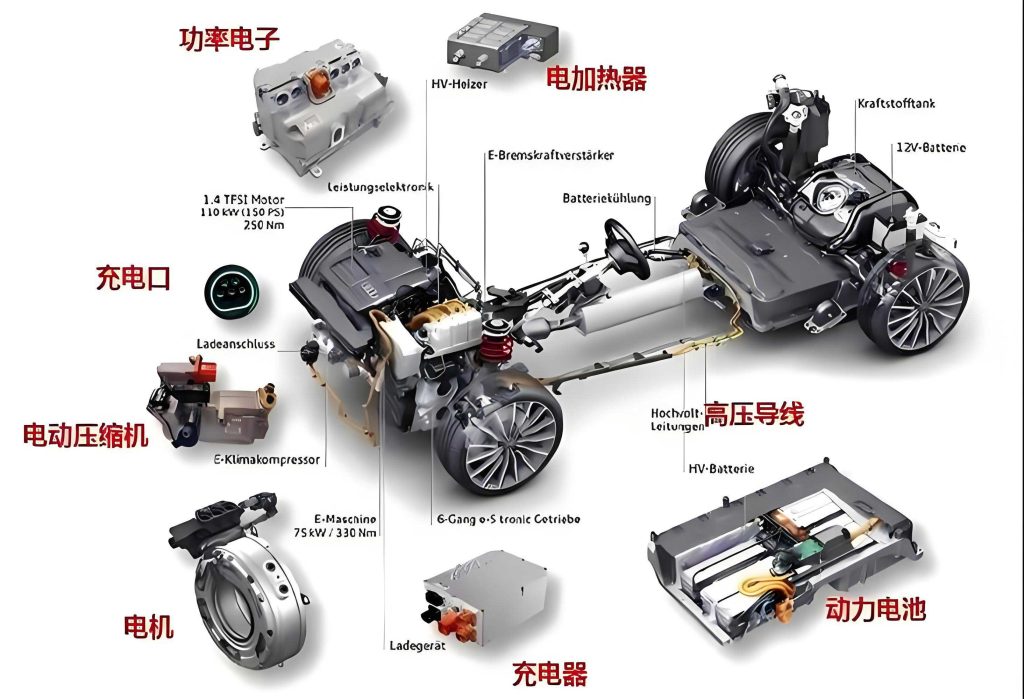
Inductive Power Transfer (IPT) technology has garnered significant attention and in-depth research due to its inherent advantages in safety, reliability, and convenience. As a crucial application domain, the battery electric vehicle Bidirectional Inductive Power Transfer (EV-BIPT) system enables interactive energy exchange with the grid. It offers benefits such as operational flexibility, load peak shaving and valley filling, and grid balancing, making it a vital research direction globally. This paper provides a comprehensive review and analysis of the current research status and key issues in EV-BIPT systems from five perspectives: circuit structures, modeling methodologies, power control strategies, system optimization techniques, and phase synchronization methods. Finally, future research directions for battery electric vehicle bidirectional inductive power transfer technology are explored and forecasted.
Fundamental Structure and Operating Principles
The primary circuit of a typical EV-BIPT system includes converters on both the primary (grid-side) and secondary (battery electric vehicle-side), resonant compensation networks, and a loosely coupled transformer. Energy flow is bidirectional; thus, either side can act as the transmitter or receiver. For clarity, the circuit near the grid is termed the primary side, and the circuit near the battery electric vehicle is the secondary side.
1. Converter Topologies
Full-bridge converters are commonly employed on both sides in EV-BIPT systems due to their simple structure and ease of design. However, compared to structures like matrix converters, this configuration often requires multiple power electronic converters on the primary side, along with large DC-link capacitors and low-frequency input inductors, which can reduce power density. Consequently, research has focused on improved converter structures suitable for EV-BIPT.
Key converter topologies include the Dual-Active-Bridge (DAB), Push-Pull Half-Bridge, and Boost-Active-Bridge structures. The Matrix Converter offers a compact “AC-AC” conversion, eliminating the DC-link stage but requiring complex commutation algorithms. The Back-to-Back Full-Bridge structure omits input inductors and filter capacitors, reducing volume and cost, but limits maximum output voltage due to the lack of low-frequency energy storage. Bidirectional AC-DC converters integrating Power Factor Correction (PFC) and inverter functions reduce switch count but require sophisticated control. Half-Bridge and Current-Fed structures are also explored for specific scenarios, often trading off power level, control complexity, and application suitability. The selection depends on a multi-objective optimization considering power requirements, efficiency, control complexity, and cost.
A comparison of major converter topologies for battery electric vehicle BIPT systems is presented in Table 1.
| Ref. | Converter Topology | Frequency (kHz) | Power (kW) | Switch Count | Advantages | Disadvantages | Application Scenario |
|---|---|---|---|---|---|---|---|
| [14] | Dual-Active-Bridge | 20.3 | 6.6 | 12 | Simple, stable, widely used | Multiple power stages, lower power density | High-reliability, general applications |
| [15] | Push-Pull Half-Bridge | 40-60 | 1.2 | 10 | Low cost, voltage doubling (push-pull) | Complex control, lower stability | Medium-low power, cost-sensitive |
| [16] | Boost-Active-Bridge | 85 | 0.5-3.5 | 12 | Low switching loss, reduced current stress | More components, complex control | Wide battery voltage range |
| [17] | Matrix Converter | 20 | 2.8 | 8 | Compact, single-stage AC-AC, high efficiency | Complex commutation, no natural freewheeling path | Space-constrained installation |
| [18] | Back-to-Back Full-Bridge | 20 | 1.1 | 12 | No input inductor/filter capacitor, smaller volume | Limited max output voltage | Volume-critical, medium power |
| [19] | Bidirectional AC-DC | 85 | 0.5 | 8 | Fewer switches, high AC-side power quality & efficiency | Complex control strategy | AC grid-connected applications |
| [20] | Half-Bridge | 150 | 1 | 8 | Simple structure, high efficiency | Lower power rating, limited application | Low-power portable devices |
| [21] | Current-Fed | 85 | 1.2 | 12 | Reduced power stages, good dynamic response | Complex switch control | Applications requiring fast response |
Table 1: Comparison of Main Converter Topologies for Battery Electric Vehicle BIPT Systems.
2. Resonant Compensation Networks
Due to the low coupling coefficient between primary and secondary coils, resonant compensation networks are essential. Their functions include: compensating for weak coupling to improve efficiency and power factor; providing constant voltage/current or decoupled characteristics; filtering high-order harmonics; and enabling soft-switching conditions.
Symmetrical topologies are generally preferred for bidirectional operation. Common networks for EV-BIPT include Series-Series (S-S), Inductor-Capacitor-Inductor (LCL-LCL), and Inductor-Capacitor-Capacitor (LCC-LCC). Other structures like CLC-LC, CLCS-LCL, and hybrid LCL-CL (parallel/series) have also been investigated for specific advantages like complementary characteristics and parameter variation tolerance, though they may require more complex coil structures.
For a battery electric vehicle BIPT system with a wide battery voltage range, asymmetric topologies like LCC-S can be advantageous. This topology provides load-independent constant voltage output in both power flow directions. When the input and output voltages are in phase, power magnitude and direction can be controlled by adjusting their amplitudes. Typically, a bidirectional DC-DC converter (e.g., FSBB or Buck-Boost) is cascaded to handle the wide voltage range efficiently. The voltage gain for an LCC-S system can be expressed as:
$$ G_v = \frac{V_{out}}{V_{in}} = \frac{M}{\sqrt{L_p L_s}} \cdot \frac{1}{\omega \sqrt{C_p C_s}} $$
where $M$ is mutual inductance, $L_p$, $L_s$ are coil inductances, $C_p$, $C_s$ are compensation capacitances, and $\omega$ is angular frequency.
3. Loosely Coupled Transformer (Magnetic Coupler)
The magnetic coupler is the key component for energy coupling. Its design significantly impacts transmission performance, considering transmission distance, misalignment tolerance, efficiency, electromagnetic compatibility (EMC), and power density. Research focuses on coil and magnetic core design to improve transmission characteristics, anti-misalignment capability, and adaptability to different application scenarios.
Coil structures are categorized into non-polarized (circular, rectangular) and polarized (DD, DDQ, Bipolar, Tripolar). While most couplers in EV-BIPT are similar to unidirectional systems, their specific optimization for bidirectional energy flow, considering potential differences in characteristics between forward and reverse modes, remains an area for future research.
Modeling Methodologies for EV-BIPT Systems
EV-BIPT systems are high-order, nonlinear, and sensitive to parameter variations. Accurate mathematical modeling is crucial for analysis, controller design, and performance prediction.
1. Fundamental Harmonic Approximation (FHA)
Due to the filtering nature of resonant networks, FHA is widely used to analyze steady-state characteristics. However, for topologies significantly affected by harmonics (e.g., LCC-LCC), higher-order harmonic components may need superposition to improve model accuracy.
2. Generalized State-Space Averaging (GSSA)
GSSA extends state-space averaging using Fourier series, converting switched circuits into linear time-invariant models for transient analysis. It is suitable for describing oscillatory state variables and switching transients. For an LCC-LCC compensated system, the state-space model can be represented as:
$$ \dot{x} = A x + B u $$
$$ y = C x + D u $$
where $x$ contains state variables like coil currents and capacitor voltages. The model’s accuracy depends on the number of harmonics retained but is sensitive to frequency deviations.
3. Circuit Averaging Methods
This method averages the input and output variables of the nonlinear switching network over a period. Techniques include the Three-Terminal Switch Model, Time-Averaged Equivalent Circuit, and Energy Conservation Law. It provides an intuitive equivalent circuit but becomes computationally intensive with increasing component count.
4. Extended Describing Function (EDF) Method
EDF uses Fourier analysis and harmonic balance theory to model significant AC components. It is more accurate than GSSA when the “small-ripple” assumption is invalid and allows flexibility in harmonic order selection. A large-signal model for an S-S compensated system using EDF involves describing functions for the converter output voltage $v_{ab}(t)$:
$$ v_{ab}(t) \approx V_{ab1} \sin(\omega t + \phi_v) + \text{higher harmonics} $$
Similarly, the resonant current $i_p(t)$ is represented. The model order and complexity increase with the number of considered harmonics.
5. Discrete-Time Domain Modeling
This high-accuracy method derives piecewise linear difference equations from the system’s state equations in different switching intervals. Stroboscopic mapping is often used for EV-BIPT systems with 50% duty cycle drives. For an LCC-S system, the discrete model for the secondary-side rectifier input current $i_{s,rec}(k)$ at the k-th switching period can be expressed as:
$$ i_{s,rec}(k+1) = f(i_{s,rec}(k), v_{Cp}(k), \phi(k), …) $$
where $\phi$ is the phase-shift angle. While precise, solving multiple state equations for complex topologies is challenging.
A comparison of these modeling methods for battery electric vehicle BIPT systems is summarized in Table 2.
| Modeling Method | Advantages | Disadvantages | Typical Application |
|---|---|---|---|
| Generalized State-Space Averaging | Captures dynamics, suitable for controller & stability design | Sensitive to frequency change, limited nonlinear accuracy | Steady-state control design |
| Circuit Averaging | Intuitive modeling, good for simple topologies | Difficult for complex systems, computation scales with order | Small-signal modeling |
| Extended Describing Function | Captures high-frequency harmonics, intuitive frequency-domain representation | Computational complexity increases with harmonic order | Harmonic analysis & optimization |
| Discrete-Time Domain | High precision, reliable | Model complexity, poor real-time performance, demanding simulation conditions | Controller simulation, digital control optimization |
Table 2: Comparison of Main Modeling Methods for Battery Electric Vehicle BIPT Systems.
Power Control Strategies
Control is essential to manage power flow direction and magnitude in EV-BIPT systems. Direction control is typically achieved by adjusting the phase difference between primary and secondary converter AC voltages (for S-S, LCC-LCC) or the DC-link voltage ratio (for LCC-S). Power level control strategies include:
1. Additional Power Conversion Stage
A bidirectional DC-DC converter is added on either or both sides. Power is controlled by adjusting the DC-DC converter’s duty cycle. This method offers easy implementation and wide regulation range but reduces system power density and efficiency, and may require wireless communication for cross-side control.
2. Energy Injection Control
The converter operates in alternating “energy injection” and “free resonance” modes. The output is regulated by varying the duty cycle of the injection mode. This method requires no extra circuitry but needs communication and results in discontinuous regulation and higher harmonic content.
3>Frequency Control
System output power is changed by varying the operating frequency, which alters the network impedance. While offering high power density and precise control, efficiency drops off the resonant peak, and magnetic component design becomes challenging over wide frequency ranges.
4>Phase-Shift Control
Derived from Dual-Active Bridge (DAB) converters, this is the most prevalent strategy for full-bridge based EV-BIPT. All switches operate at 50% duty cycle, and power is controlled by introducing phase shifts between gate signals.
a) Single-Phase-Shift (SPS): Only the phase shift $\delta$ between primary and secondary bridge voltages is controlled. Simple but leads to high current stress and hard switching at high voltage conversion ratios or light loads.
b) Dual-Phase-Shift (DPS): Controls the internal phase shift $\alpha$ (primary) and $\beta$ (secondary), often with $\alpha = \beta$, along with $\delta$. Improves current stress and enables load matching but may cause partial hard switching.
c) Triple-Phase-Shift (TPS): Independently controls $\alpha$, $\beta$, and $\delta$. Offers high flexibility, enabling wide-range Zero-Voltage Switching (ZVS) and load matching, but often at the cost of reduced power factor and increased control complexity.
d) Other Advanced Methods: Include Three-Stage Asymmetric Phase Shift (TAPS), Asymmetrical Voltage-Cancellation (AVC), seamless power loop control, and composite soft-switching optimization strategies to broaden ZVS range, minimize reactive current, or improve efficiency.
The transmitted power $P$ in an S-S compensated system under SPS control can be approximated as:
$$ P = \frac{V_{p} V_{s}}{\omega M} \cdot \delta (1 – \frac{|\delta|}{\pi}), \quad \text{for } |\delta| \le \pi/2 $$
where $V_p$ and $V_s$ are the fundamental voltage amplitudes of the primary and secondary converters, and $\omega$ is the angular frequency.
A comparison of these power control strategies is shown in Table 3.
| Control Strategy | High Efficiency | Compact Size | Simple Control | Wide Range | Communication-Free |
|---|---|---|---|---|---|
| Additional Conversion Stage | ✗ | ✗ | ✓ | ✓ | ✗ |
| Energy Injection Control | ✓ | ✓ | ✗ | ✗ | ✗ |
| Frequency Control | ✗ | ✓ | ✗ | ✗ | ✓ |
| Phase-Shift Control | ✓ | ✓ | ✗ | ✗ | ✓ |
Table 3: Comparison of Different Power Control Strategies.
5. Control Algorithms
PID and its variants (e.g., Smith Predictor PI) are commonly used for closed-loop control in EV-BIPT systems. To address nonlinearity, parameter sensitivity, and robustness, advanced algorithms like model predictive control (MPC), $H_\infty$ robust control, and Bang-Bang control have been explored. For instance, an $H_\infty$ controller designed for a system with parameter uncertainty minimizes the effect of disturbances $w$ on the output error $e$:
$$ \min_{K} \| T_{ew}(K) \|_\infty $$
where $T_{ew}$ is the closed-loop transfer function from $w$ to $e$.
System Optimization Methods
EV-BIPT system efficiency is sensitive to load variations, coupling misalignment (changing mutual inductance $M$), and component tolerances. Active control strategies are employed for optimization:
1. Multi-Variable Optimal Control: Simultaneously controls phase-shift angles ($\alpha$, $\beta$, $\delta$) and sometimes frequency ($f$) to achieve multiple objectives like ZVS for all switches, minimum reactive power (or unity power factor), and optimal efficiency tracking across wide load and misalignment ranges. The optimization problem can be formulated as:
$$ \min_{\alpha, \beta, \delta, f} P_{loss}(\alpha,\beta,\delta,f) \quad \text{subject to} \quad P_{out}=P_{ref}, \quad ZVS \text{ conditions} $$
where $P_{loss}$ represents total system losses.
2. Challenges: While multi-parameter control achieves superior performance, it significantly increases control complexity. Future research aims to find simpler yet effective optimization algorithms with low computational burden for real-time implementation in battery electric vehicle applications.
Phase Synchronization Methods
Isolated primary and secondary controllers can drift apart due to crystal oscillator variations, causing uncontrolled power fluctuations. Reliable phase synchronization is critical. Wireless communication (Bluetooth, ZigBee) introduces latency and potential EMI. Alternative methods include:
1. Additional Circuit Structures
a) Resonance Judgment & Phase Synchronization (RJ&PS) Circuit: Added to the secondary side to detect resonant current phase/amplitude for self-start and synchronization.
b) Auxiliary Pick-up Coil: A third coil senses a combined magnetic field. After canceling the secondary coil’s influence, the processed signal reveals the primary current phase. This method is sensitive to cross-coupling and complicates mechanical design.
2. Calculation-Based Methods
a) Active/Reactive Power Detection: Measures phase difference from calculated power on the secondary side, requiring precise sensing but no communication.
b) Perturb & Observe (P&O): Tracks output current extremum to infer the optimal phase difference (e.g., $\delta = \pm \pi/2$ for max power). Simple and communication-free but may cause power oscillation during tracking.
c) Zero-Crossing Detection: Converts resonant current to a sync pulse via a comparator. The DSP captures this pulse to align phases. Simple but suffers control delay.
d) I/Q (In-phase/Quadrature) Phase Detection: Insensitive to current harmonics, provides fast transient response and low phase-lock error without complex signal processing.
e) Duty Cycle ($D$) Based Synchronization: The secondary side uses variable $D$ control, and synchronization is achieved by tracking the system’s optimal efficiency point, allowing different switching frequencies on both sides.
Table 4 compares the main phase synchronization approaches for battery electric vehicle BIPT systems.
| Synchronization Method | Simple Control | No Main Circuit Interference | High Stability | Fast Synchronization |
|---|---|---|---|---|
| Wireless Communication | ✓ | ✓ | ✗ | ✗ |
| Additional Circuit | ✗ | ✗ | ✓ | ✓ |
| Calculation-Based | ✗ | ✓ | ✓ | ✓ |
Table 4: Comparison of Main Phase Synchronization Methods for Battery Electric Vehicle BIPT Systems.
Summary and Future Outlook
1. Summary
EV-BIPT technology has advanced significantly across its core components:
Circuit Structures: Diverse topologies balance power density and efficiency, yet high-power designs often involve complexity, numerous components, and elevated cost.
Modeling: Established methods offer accuracy but face challenges with high order, computational burden, and real-time performance.
Control Strategies: Phase-shift control dominates, evolving from SPS to TPS and hybrid methods, effectively managing power and ZVS, though often with a trade-off against power factor or control simplicity.
System Optimization: Multi-variable optimal control enables holistic performance improvement but struggles with computational complexity and sensitivity to local optima.
Phase Synchronization: Calculation-based methods are promising for robustness and speed, yet demand high-performance sensing and processing.
2. Future Research Directions
To meet demands for high power, robustness, and efficiency in battery electric vehicle applications, future research should focus on:
1) Advanced Circuit Topologies & Components: Explore integrated, modular, multi-level, or multi-phase topologies combined with wide-bandgap semiconductors (e.g., GaN) to reduce size/component count and improve performance. Dedicated research on magnetic couplers for bidirectional operation, analyzing potential asymmetries and seeking novel structures for better misalignment tolerance and interoperability.
2) Efficient & Real-Time Modeling: Develop low-order, high-precision hybrid models or data-driven modeling techniques that maintain accuracy under parameter variations (coupling, load) while being suitable for real-time control implementation.
3) Intelligent & Multi-Objective Control: Investigate control strategies beyond 50%-duty-cycle phase-shift, such as PWM or model predictive control (MPC). Develop intelligent, multi-objective nonlinear optimization algorithms that concurrently optimize efficiency, power factor, ZVS range, and component stress with manageable complexity.
4) System-Level Optimization & Management: Research multi-algorithm cooperative optimization for lower computational cost. Formulate optimization strategies for multi-battery electric vehicle scenarios and coordinated bidirectional energy dispatch within microgrids or grid-support services.
5) Robust & Integrated Synchronization: Combine high-precision sampling with intelligent algorithms (e.g., adaptive filters, Kalman filters) to enhance synchronization accuracy and adaptability in noisy, harmonic-rich environments. Pursue integrated design of sensing and control to reduce hardware footprint and cost.
Conclusion
Enabling efficient bidirectional energy flow between the grid and battery electric vehicles via BIPT technology is a pivotal pathway for energy integration and smart transportation development. This paper has analyzed EV-BIPT technology from five key aspects: circuit structures, modeling methodologies, power control strategies, system optimization methods, and phase synchronization techniques. By summarizing the current state-of-the-art and identifying critical research gaps, it provides a foundation and direction for the future industrialization and advancement of battery electric vehicle bidirectional inductive power transfer systems.