
As a key player in the energy sector, we have witnessed the rapid growth of electric vehicle (EV) adoption and the increasing demand for convenient home charging solutions. The development of home EV charging stations is crucial for supporting this transition, yet it faces numerous challenges, such as limited power supply, regulatory hurdles, and high installation costs. In response, we have pioneered an innovative five-service model to streamline the process, enhance efficiency, and reduce barriers for homeowners. This model focuses on proactive planning, integrated services, simplification, cost reduction, and speed, all aimed at fostering a sustainable ecosystem for EV charging stations. Through this approach, we have transformed how communities access and benefit from home-based EV charging infrastructure, ensuring that EV charging stations become a seamless part of daily life.
The background of this initiative stems from the stark contrast between the advantages of home EV charging stations and the obstacles in their deployment. Home EV charging stations offer significant benefits in terms of convenience and cost-effectiveness compared to public alternatives. For instance, users can charge their vehicles overnight at lower electricity rates, reducing overall expenses. However, issues like inadequate power grid capacity, restrictive property management policies, and complex approval processes have hindered widespread adoption. This is particularly evident in older residential areas, where infrastructure upgrades are lagging. The equation below illustrates the basic cost-benefit analysis for homeowners considering an EV charging station installation, where the net benefit (NB) depends on the initial investment (I), operational savings (S), and regulatory delays (D): $$NB = \frac{S – I}{1 + D}$$ Here, a higher D value indicates longer delays, negatively impacting the net benefit. By addressing these challenges, our model aims to minimize D and maximize NB, making EV charging stations more accessible.
To provide a comprehensive overview, we have categorized our approach into five core service models, each targeting specific aspects of the EV charging station lifecycle. These models are not isolated; they interlink to create a cohesive system that supports everything from initial planning to post-installation monitoring. The following sections delve into each model, supported by data, tables, and formulas to highlight their impact. Additionally, we have integrated smart technologies and collaborative partnerships to ensure that EV charging stations are deployed efficiently and sustainably. As we expand on these models, it becomes clear that a holistic strategy is essential for overcoming the fragmentation often seen in EV charging station projects.
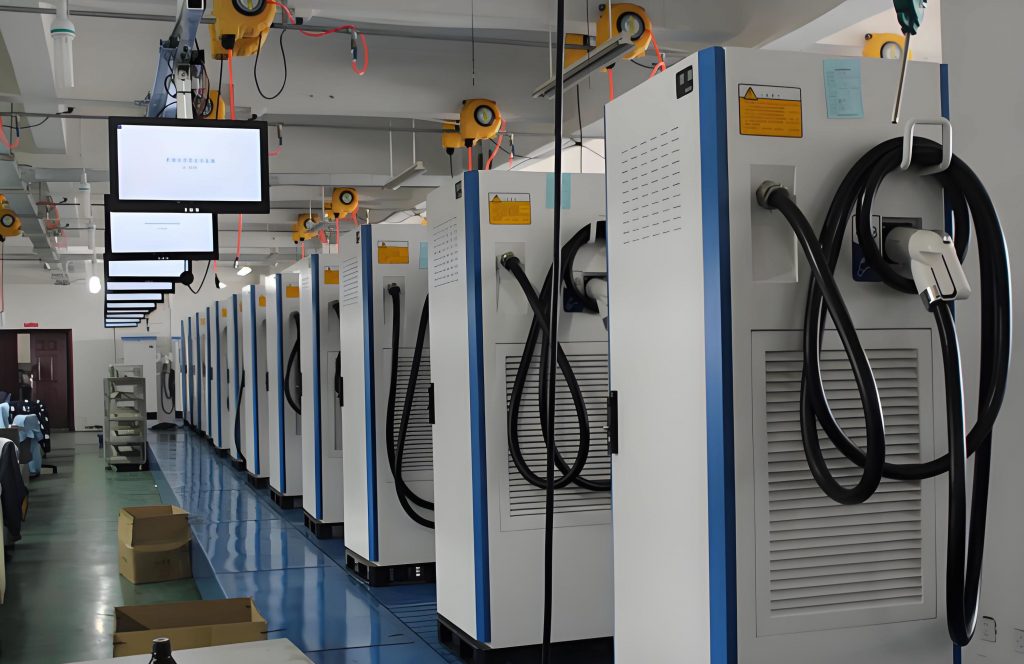
One of the foundational elements of our strategy is the “Proactive Planning” model, which emphasizes early intervention in power supply and infrastructure development. We recognized that many residential areas, especially older ones, lacked the necessary electrical capacity to support multiple EV charging stations simultaneously. To address this, we invested heavily in upgrading the grid infrastructure, focusing on both new and existing communities. For new residential developments, we mandated that at least 20% of parking spaces be pre-equipped with EV charging stations, and 100% of spaces have the wiring and metering conditions ready for future installations. This “power-ready” approach ensures that homeowners can install EV charging stations without facing grid constraints. In older neighborhoods, we conducted detailed surveys to assess demand and implemented tailored solutions, such as “one-district-one-policy” interventions. For example, in areas with issues like water leakage or outdated wiring, we performed comprehensive renovations to create a stable environment for EV charging stations. The table below summarizes the key metrics from our proactive planning efforts, showing the coverage and investment outcomes over a two-year period.
| Metric | Value | Impact |
|---|---|---|
| Number of Residential Areas Upgraded | 59 | Enhanced grid capacity for EV charging stations |
| Power Points Extended in Suburban Areas | 470 | Covered over 50,000 parking spaces |
| Pre-installed Charging Stations in New Developments | 20% of spaces | Reduced future installation delays |
The economic rationale behind this model can be expressed through a formula for return on investment (ROI) in grid upgrades. Let C_g represent the cost of grid enhancements, B_e the benefits from increased EV charging station adoption, and T the time frame. The ROI is calculated as: $$ROI = \frac{B_e – C_g}{C_g} \times 100\%$$ In our case, by investing upfront, we have seen B_e exceed C_g within a short period, thanks to higher utilization of EV charging stations. This proactive approach not only prevents bottlenecks but also aligns with our goal of making EV charging stations a standard amenity in every household.
Next, the “Integrated Service” model focuses on streamlining the application and installation process for EV charging stations. We aimed to reduce the number of steps and entities involved, making it a “one-stop” experience for users. This involved collaborating with various stakeholders, including property management companies, automotive dealers, and community centers. For instance, we partnered with 4S shops to integrate vehicle purchases with EV charging station applications, enabling customers to “buy and install” simultaneously. Additionally, we established “village-grid cooperation” hubs where residents could submit applications locally, eliminating the need for multiple trips. Another key aspect was working with property managers to pre-approve installations, where they issued construction permits on behalf of homeowners. This reduced the approval time for EV charging stations from weeks to days. The table below outlines the efficiency gains from this integrated approach, based on user feedback and process audits.
| Service Aspect | Before Integration | After Integration |
|---|---|---|
| Number of Visits Required | 3-5 | 1 |
| Average Approval Time (Days) | 15 | 3 |
| User Satisfaction Rate | 65% | 95% |
To quantify the time savings, we use a simple efficiency formula where the total process time (T_total) is a function of the number of steps (N) and the average time per step (T_step): $$T_{\text{total}} = N \times T_{\text{step}}$$ By reducing N through integration, we cut T_total significantly, leading to faster deployments of EV charging stations. This model has been particularly effective in urban areas where time constraints are a major concern for EV owners.
The “Simplification” model targets the reduction of bureaucratic hurdles and documentation requirements for EV charging station installations. We introduced a “one-community-one-certificate” system, where property managers collect and batch-submit applications, along with necessary permits. This eliminates the need for individual homeowners to navigate complex paperwork. Moreover, we adopted a “tolerance acceptance” policy, allowing applications to proceed with only essential documents—such as identity proofs and construction permits—while deferring supplementary materials. This flexibility has accelerated the process, especially for bulk installations in new developments. For example, new residents can now activate their EV charging stations simply by providing proof of parking space ownership and vehicle registration, without additional site diagrams. The formula below represents the reduction in documentation burden, where D_initial is the initial document count and D_final is the final count after simplification: $$Reduction = \frac{D_{\text{initial}} – D_{\text{final}}}{D_{\text{initial}}} \times 100\%$$ In practice, we achieved a reduction of over 60%, making it easier for households to adopt EV charging stations.
Another critical component is the “Cost Reduction” model, which aims to minimize the financial burden on users, particularly regarding post-meter cable investments. We enforced strict guidelines for new residential projects, ensuring that the distance from the meter to the EV charging station does not exceed 50 meters, as longer cables increase costs substantially. To support this, we developed standardized installation protocols and provided tools like infrared rangefinders to accurately measure distances. We also promoted shared infrastructure models, where developers and property managers collaborate on building public EV charging stations in common areas, distributing costs among multiple users. The table below highlights the cost savings achieved through this model, based on aggregate data from recent projects.
| Cost Category | Average Cost Before | Average Cost After | Savings |
|---|---|---|---|
| Post-Meter Cable Installation | $1,200 | $480 | 60% |
| Overall Installation Expenses | $2,500 | $1,000 | 60% |
| User Investment per EV Charging Station | $3,000 | $1,200 | 60% |
The cost-saving effect can be modeled using a linear equation where the total cost (C_total) is a function of cable length (L) and cost per meter (C_m): $$C_{\text{total}} = C_{\text{fixed}} + L \times C_m$$ By capping L at 50 meters and negotiating lower C_m through bulk purchases, we reduced C_total dramatically. This model has made EV charging stations more affordable, encouraging wider adoption across diverse income groups.
Lastly, the “Acceleration” model leverages digital tools and smart software to speed up the entire lifecycle of EV charging station deployments. We developed an auxiliary system for application processing that uses simulated maps of underground parking lots to pinpoint optimal locations for EV charging stations. This system enables visual surveys, reducing the need for multiple on-site visits. For instance, it generates editable parking space layouts and calculates the best meter placement within a 50-meter radius, ensuring efficient power distribution. Additionally, the system includes features for precise budget allocation and transparent oversight. By drawing power supply chains online, it estimates material needs—like cable junction boxes—and tracks deviations between planned and actual costs. This enhances financial accountability and prevents misuse of resources. The formula for error estimation in budget planning is: $$Error = |Actual – Estimated|$$ where a lower error indicates better accuracy. In our case, this has minimized delays and costs associated with EV charging station projects.
The integration of these five models has yielded substantial results. By the end of a recent annual period, we facilitated the installation of over 29,000 home EV charging stations, creating a robust network that is “moderately advanced, well-distributed, efficient, and cost-effective.” Our efforts in proactive planning alone benefited 59 residential areas, with power extensions covering thousands of parking spaces. The collaboration with automotive dealers streamlined 56 individual and 12 public EV charging station installations, while new communities saw 452 households gaining immediate access to charging upon move-in. Financially, we invested $25 million in grid upgrades, which led to user savings of $18 million in cable costs—a 60% reduction per installation. Moreover, service requests related to EV charging stations dropped by 57.14%, indicating higher satisfaction and fewer issues. The cumulative impact is captured in the table below, which summarizes key performance indicators.
| Performance Indicator | Value | Notes |
|---|---|---|
| Total EV Charging Stations Installed | 29,000 | Home-based units |
| Cost Savings for Users | $18 million | Primarily from cable reductions |
| Reduction in Service Complaints | 57.14% | Year-over-year comparison |
| Coverage of Parking Spaces | 50,000+ | In upgraded areas |
To further analyze the efficiency gains, we can apply a productivity formula where output (O) is the number of EV charging stations deployed, and input (I) includes time, cost, and labor: $$Productivity = \frac{O}{I}$$ Our models have increased productivity by optimizing I, demonstrating the scalability of this approach for broader EV charging station networks.
In conclusion, our five-service model for home EV charging stations represents a paradigm shift in how energy providers support the EV ecosystem. By combining proactive infrastructure upgrades, integrated services, simplified processes, cost controls, and technological acceleration, we have addressed the core challenges facing homeowners. The repeated emphasis on EV charging stations throughout this journey underscores their importance in the transition to sustainable transportation. As we look ahead, we plan to refine these models further, incorporating feedback and emerging technologies to ensure that EV charging stations become even more accessible and efficient. This initiative not only benefits current users but also sets a precedent for future innovations in the energy sector, paving the way for a world where every EV owner can rely on a seamless home charging experience.