
With the rapid proliferation of electric vehicles (EVs) in the 21st century, the demand for robust charging infrastructure has intensified. EV charging stations are primarily categorized into alternating current (AC) and direct current (DC) types. AC charging stations, suitable for residential and parking lot settings, deliver power slowly via an onboard charger that converts AC to DC. In contrast, DC charging stations provide direct DC power to the vehicle’s battery, enabling faster charging—a critical feature for highway service areas and urban fast-charging hubs. The high-power nature of DC fast charging, however, generates significant resistive losses and heat, necessitating advanced cooling solutions. Liquid cooling, with its superior heat transfer efficiency due to the high specific heat capacity of fluids, has emerged as the dominant technology for ultra-fast DC EV charging stations. This article explores the performance requirements, comparative analysis, and future trends of coolants used in these systems, focusing on synthetic options that meet the rigorous demands of modern EV charging stations.
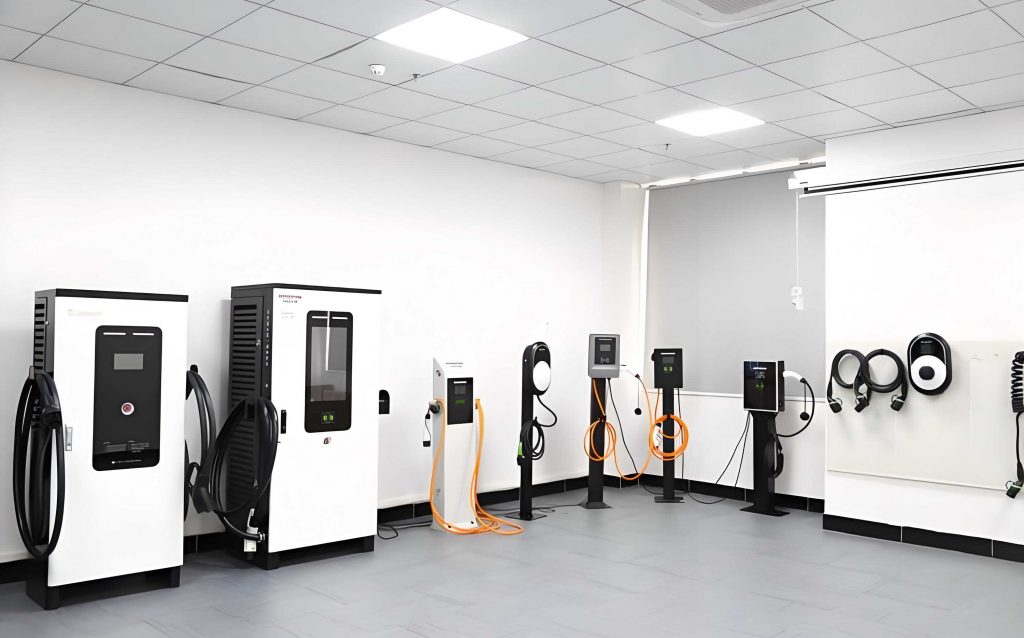
The liquid cooling system in an EV charging station operates on the principles of heat conduction and convective heat transfer. During high-power charging, components like power modules and transformers produce substantial heat. The coolant, circulating through pipes in direct contact with these parts, absorbs heat due to its high specific heat capacity, thereby preventing overheating. For instance, a silicone-based synthetic coolant can efficiently absorb thermal energy from power modules. The heated coolant is then pumped to a heat exchanger, where it dissipates heat to the ambient air via forced convection, often aided by fans. After cooling, the fluid returns to the system, maintaining optimal operating temperatures. This cycle is crucial for the reliability and efficiency of EV charging stations, as it ensures that critical components remain within safe thermal limits, thereby supporting the high-power demands of modern charging infrastructure.
The performance requirements for coolants in EV charging stations are defined by international and national standards, such as IEC TS 62196-3-1 and GB/T 20234.1—2023. These standards emphasize insulation, thermodynamic properties, material compatibility, safety, and environmental sustainability. For example, coolants must exhibit high dielectric strength to prevent electrical breakdown, low electrical conductivity to minimize leakage currents, and excellent thermal conductivity to facilitate efficient heat transfer. Additionally, they should be non-flammable, environmentally benign, and compatible with materials like metals, plastics, and seals. The following equation illustrates the heat transfer rate in a liquid cooling system: $$q = h A (T_s – T_\infty)$$ where \(q\) is the heat flux, \(h\) is the heat transfer coefficient, \(A\) is the surface area, \(T_s\) is the surface temperature, and \(T_\infty\) is the coolant temperature. This underscores the importance of high thermal performance in coolants for EV charging stations.
To evaluate coolants for EV charging stations, key parameters include kinematic viscosity, density, flash point, pour point, thermal conductivity, specific heat capacity, breakdown voltage, and environmental impact. The table below provides a comparative analysis of four common coolant types: mineral oil, synthetic ester, silicone oil, and fluorinated fluid. This comparison highlights the advantages of synthetic coolants, which are increasingly preferred for their balanced performance in EV charging station applications.
| Property | Mineral Oil | Synthetic Ester | Silicone Oil | Fluorinated Fluid |
|---|---|---|---|---|
| Kinematic Viscosity at 40°C (mm²/s) | 9.600 | 29.00 | — | — |
| Density at 20°C (g/cm³) | 0.877 | 0.967 | 0.936 | 1.800 |
| Flash Point (°C) | 153 | 260 | 190 | — |
| Pour Point (°C) | < -24 | -50 | < -60 | -50 |
| Thermal Conductivity at 50°C (W/(m·K)) | 0.12–0.15 | 0.14–0.18 | 0.13–0.14 | 0.05–0.08 |
| Specific Heat Capacity (J/(kg·K)) | 1800–2000 | 1900–2100 | 1500–1700 | 900–1100 |
| Breakdown Voltage (kV) | 66 | 75 | 50 | 35 |
| Volume Resistivity at 90°C (Ω·m) | 10¹⁴ | 10¹⁰–10¹³ | 10¹²–10¹³ | 10¹⁰–10¹⁴ |
| Biodegradability | Low | High (>70%) | Low (but harmless) | Low |
| Global Warming Potential (GWP) | Not specified | Low | Not specified | High |
The data in Table 1 reveals significant differences in coolant performance. Mineral oil, while cost-effective, has a low flash point and poor biodegradability, posing safety and environmental risks. Synthetic esters offer high biodegradability, excellent thermal properties, and good material compatibility, making them suitable for EV charging stations. Silicone oils exhibit superior fire resistance and low-temperature performance, albeit with moderate thermal conductivity. Fluorinated fluids, though inert and non-flammable, have high GWP and are costly, limiting their widespread use. The electrical conductivity \(\sigma\) of a coolant can be derived from its volume resistivity \(\rho\) using the formula: $$\sigma = \frac{1}{\rho}$$ where low conductivity is critical for insulation in EV charging stations. This parameter is essential for preventing short circuits and ensuring operational safety.
Further analysis of coolant advantages and disadvantages is summarized in Table 2, focusing on factors like environmental impact, safety, thermal performance, cost, and application maturity. This evaluation aids in selecting the optimal coolant for EV charging stations, particularly as power levels increase.
| Criteria | Mineral Oil | Synthetic Ester | Silicone Oil | Fluorinated Fluid |
|---|---|---|---|---|
| Environmental Impact | Non-biodegradable, contains impurities | Biodegradable, low GWP | Non-biodegradable but harmless | Contains PFAS, restricted |
| Safety | Low flash point, flammable | High flash point, flame-retardant | High flash point, self-extinguishing | Non-flammable |
| Thermal Conductivity | Moderate | High | Moderate | Low |
| Cost | Low (but high maintenance) | Moderate | High | Very high |
| Application Maturity | Traditional but poor compatibility | Growing adoption | Established | Limited due to regulations |
Synthetic esters and silicone oils stand out as leading choices for EV charging stations due to their environmental benefits, safety profiles, and thermal efficiency. Synthetic esters, with biodegradability rates exceeding 70% and no fluorine content, align with green initiatives. Their high flash points (above 200°C) and thermal conductivities (0.14–0.18 W/(m·K)) enable effective heat dissipation in high-power EV charging stations. Silicone oils offer inherent non-flammability, with auto-ignition temperatures over 250°C, and maintain performance across a wide temperature range, making them ideal for extreme climates. The heat absorption capacity of a coolant can be expressed as: $$Q = m c_p \Delta T$$ where \(Q\) is the heat absorbed, \(m\) is the mass, \(c_p\) is the specific heat capacity, and \(\Delta T\) is the temperature change. This equation highlights why coolants with high \(c_p\) values are preferred for EV charging stations, as they can manage thermal loads more effectively.
Looking ahead, the development of synthetic coolants for EV charging stations will focus on cost reduction, environmental sustainability, and technical standardization. Innovations in material science and chemical synthesis are expected to lower production costs, enhancing the affordability of high-performance coolants. For instance, optimizing ester-based formulations could reduce raw material expenses while maintaining efficacy. Environmental considerations will drive the adoption of biodegradable and low-toxicity coolants, potentially incorporating renewable resources. Standardization efforts, such as harmonizing test methods and performance criteria, will promote interoperability and reliability across different EV charging station models. The future growth of EV charging stations hinges on these advancements, ensuring that cooling systems can support ever-increasing power densities and operational demands.
In conclusion, the evolution of coolants for EV charging stations is pivotal to the advancement of fast-charging technology. Synthetic esters and silicone oils, with their superior insulation, thermal management, and eco-friendly properties, are poised to replace conventional options. As the industry moves toward higher power outputs and stricter environmental regulations, continued research and development in coolant technology will be essential. By addressing cost, sustainability, and standardization challenges, synthetic coolants will play a critical role in the global expansion of EV charging stations, enabling efficient and safe charging infrastructure for the future of electric mobility.