
The primary reason users purchase new energy vehicles is “good performance.” However, industry data indicates a concerning trend: user satisfaction with new energy vehicles has declined for consecutive years. This decline signals a shift in the market. As the initial novelty wears off and ownership duration increases, consumers, particularly the younger generation who are becoming the main buyers, are becoming more discerning and rational in their expectations. Their demands for driving experience are significantly higher. To meet these evolving market demands, a forward-looking approach to quality management is essential, requiring that user experience be thoroughly considered during the design and development phases.
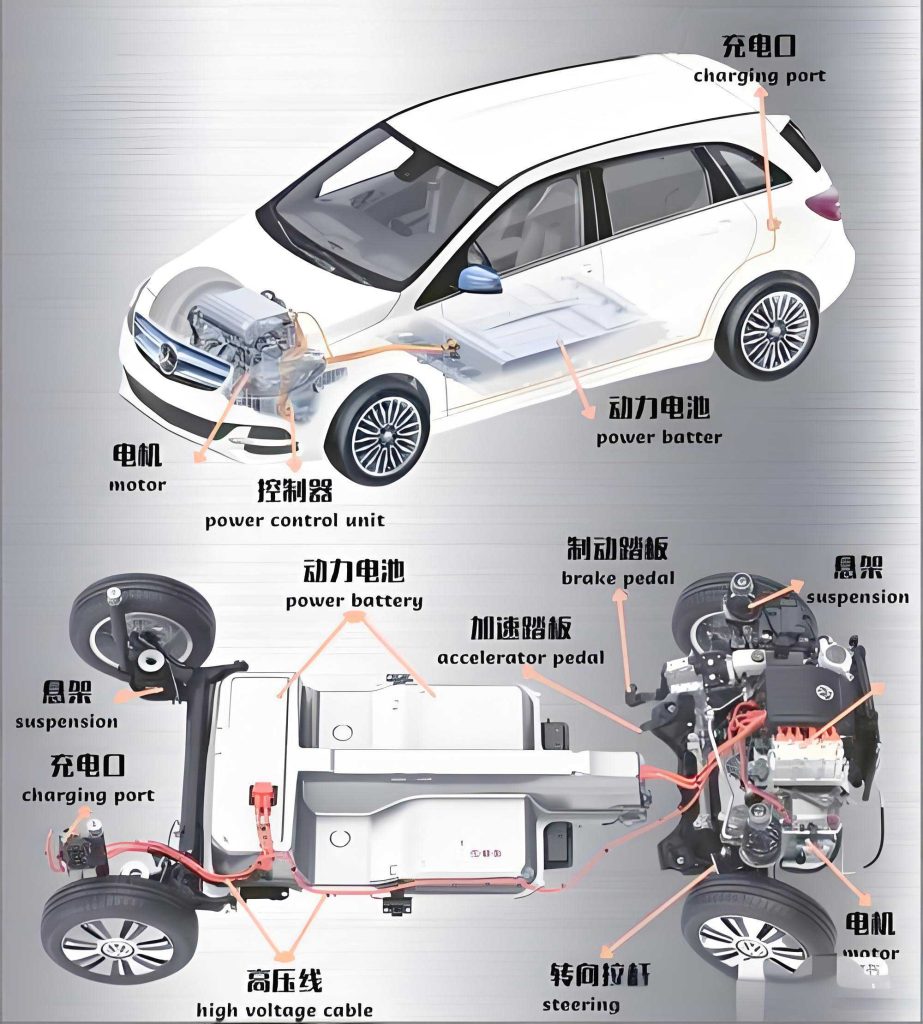
In the era of the battery electric car, while the industry has a solid foundation, new challenges have emerged. Common complaints include susceptibility to motion sickness, noticeable attenuation of power at high speeds, non-linear acceleration, significant differences in power delivery between high and low battery states, and uneven mode or gear shifting processes. These issues, often perceived as a lack of refinement or predictability, are fundamentally complaints about the “non-linearity of power response” across multiple operational domains.
This paper, based on extensive research and development experience, addresses this core challenge. We posit that the perceived quality of dynamic performance in a battery electric car is intrinsically linked to the linearity of its response. Non-linearity manifests as a disconnect between driver input and vehicle response, leading to unpredictability and discomfort. We interpret this multi-domain non-linearity specifically as: non-linearity in the time domain (response delay and build-up), non-linearity in the speed domain (power decay with speed), non-linearity in the pedal domain (inconsistent gain with pedal input), non-linearity in the State of Charge (SOC) domain (power variation with battery level), and non-linearity during state switching or gear shifting processes (jerks or interruptions).
To tackle this, we have developed a comprehensive, full-scenario dynamic performance linearization design technology. This methodology is built upon an objective evaluation system for drivability and a robust database correlating subjective evaluations with objective metrics. The goal is to solve the multi-domain dynamic linearity problem systematically. This paper will detail the theoretical framework, the design methodology, and present a practical application case involving a multi-mode hybrid electric vehicle, demonstrating the achievement of project targets alongside reduced development costs and improved efficiency.
Parsing Dynamic Linearity
Dynamic performance, or drivability, refers to the correspondence between a vehicle’s longitudinal motion and the driver’s control inputs, and how well this correspondence matches the driver’s expectations. The driver’s primary input is the acceleration pedal, and the vehicle’s immediate feedback is a change in acceleration ($\Delta a$). The core of a superior driving experience in any battery electric car lies in the predictability and smoothness of this $\Delta a$ across all conditions. We deconstruct this into several key domains.
Linearity in the Time Domain
Time domain linearity addresses the immediacy and smoothness of the acceleration build-up once the driver requests it. It is crucial for resolving complaints about “sluggish starts” or “jerky acceleration that causes motion sickness.” We characterize it using specific objective metrics relative to the moment of pedal actuation.
- $t_{0.1g}$: The time elapsed from the start of pedal application until the vehicle’s longitudinal acceleration reaches 0.1g ($\approx 0.98 m/s^2$). This metric captures the initial response delay.
- $t_{lag}$: The hysteresis time, defined as the interval between the pedal actuation passing a 2mm threshold and the vehicle acceleration reaching 0.1g. This further refines the perception of delay.
- $G_{0.1g-80\%a_{max}}$: The average gradient of the acceleration curve between 0.1g and 80% of the peak acceleration ($a_{max}$) achieved in that maneuver. This governs the “ramp-up” feel and is critical for comfort.
For optimal linearity and comfort in a battery electric car, $t_{0.1g}$ and $t_{lag}$ should be minimized (typically targeting values well below 0.5s), and $G_{0.1g-80\%a_{max}}$ must be controlled within a comfortable range (e.g., 0.5 to 1.0 $g/s$). An excessively high gradient, even with minimal delay, can cause a harsh, nauseating jolt.
Linearity in the Speed Domain
Speed domain linearity ensures that the vehicle’s capability to accelerate (per unit of pedal input) changes in a predictable and desirable manner as speed increases. It directly addresses the “high-speed power attenuation” complaint. The key objective metric here is the Acceleration Gain ($ACC_{Gain}$).
$ACC_{Gain}$ is defined for a steady-state speed and a specific pedal increment $\Delta L$ as the resulting steady-state acceleration. Formally, for an initial speed $V_0$ and initial pedal position $L_0$, after a pedal increment $\Delta L$:
$$ a_{steady} = ACC_{Gain}(V_0, L_0, \Delta L) $$
In practice, we often evaluate from a zero-pedal, zero-acceleration cruising state ($L_0=0, a_0=0$). Research and our database show that a driver’s required or expected acceleration for a given pedal input naturally decreases as speed increases. Therefore, ideal linearity does not mean a constant $ACC_{Gain}$ across speeds. Instead, it means $ACC_{Gain}$ should follow a smooth, decaying curve versus vehicle speed. A sudden, sharp drop in $ACC_{Gain}$ at higher speeds is perceived as non-linear and unsatisfactory. The design challenge for a battery electric car is to map the powertrain’s capabilities to this desired curve.
| Speed (km/h) | Typical $ACC_{Gain}$ for ΔL=10mm (m/s²) | Perception |
|---|---|---|
| 0 (Launch) | 2.5 – 4.0 | Defines launch feel |
| 30 | 1.8 – 2.5 | Strong city acceleration |
| 60 | 1.2 – 1.8 | Confident highway merge |
| 90 | 0.7 – 1.2 | High-speed overtaking capability |
| 120 | 0.4 – 0.8 | High-speed refinement |
Linearity in the Pedal Domain
Pedal domain linearity concerns the consistency of response across different levels of driver demand. The driver expects that a larger pedal press yields a proportionally stronger response, and this relationship should be intuitive and easy to master. Non-linearity here leads to the “unpredictable” or “touchy” feeling.
We evaluate this by examining the relationship between a series of pedal increments and the resulting vehicle response metrics. For launch performance, we analyze Peak Launch Acceleration ($PLA$) for pedal increments of $s$, $s+b$, $s+2b$, etc. A linear relationship suggests the driver can finely modulate launch intensity. For in-gear acceleration, we analyze the $ACC_{Gain}$ for the same series of pedal increments $\Delta L$ at various steady speeds. In an ideal, perfectly linear battery electric car, the $ACC_{Gain}$ for successive, equal pedal increments would form a linear progression. A more common and often desirable design is a slight progressive curve, but sharp deviations or reversals are unacceptable.
$$ ACC_{Gain}(\Delta L_i) \approx k \cdot \Delta L_i + C \quad \text{(for ideal linearity)} $$
A designed progressive curve might follow:
$$ ACC_{Gain}(\Delta L_i) = k \cdot (\Delta L_i)^q \quad \text{where } q \approx 1.1-1.3 $$
Linearity in the SOC Domain
SOC domain linearity manages driver expectations as the battery’s state of charge changes. A significant drop in available power at low SOC is a major complaint. The goal is not necessarily to maintain full-power performance at all SOC levels, which would require oversizing the battery, but to manage the degradation in a predictable and acceptable manner.
This involves designing the target $ACC_{Gain}$ curves (speed and pedal domain) for different SOC levels. For example, at 100% SOC, the $ACC_{Gain}$ curve might be designed for sporty performance. At 20% SOC, the curve might be scaled down uniformly by 15-20%. A sudden, non-linear cliff in performance at a specific SOC threshold is poor design. The technical challenge is to accurately model the battery’s maximum discharge power $P_{batt,max}(SOC, T)$ and ensure the powertrain torque/power requests from the linearity design do not exceed this limit at any SOC. For a battery electric car, this is a primary constraint:
$$ P_{wheel,req}(V, \Delta L) \leq \eta \cdot P_{batt,max}(SOC, T) + P_{other} $$
Where $P_{wheel,req}$ is the power needed at the wheels to achieve the designed $ACC_{Gain}$, $\eta$ is the drivetrain efficiency, and $P_{other}$ accounts for any other power sources (like an engine in a hybrid).
Linearity in State Switching / Gear Shifting Processes
For hybrids or multi-gear electric drive units, transitions between modes or gears can introduce significant non-linearity in the form of torque interruptions, jerks, or delays. The objective is to make these transitions as seamless as possible.
Key objective metrics include:
- Speed Loss ($\Delta V_{loss}$): The drop in vehicle speed during the shift process, calculated by integrating the negative acceleration area.
$$ \Delta V_{loss} = \int_{t_{start}}^{t_{end}} a_{neg}(t) \, dt $$
where $a_{neg}(t)$ is the negative acceleration during the shift. - Minimum Acceleration ($a_{min}$): The lowest (most negative) acceleration point during the shift.
- Duration of Torque Interruption ($t_{interrupt}$): The time for which acceleration remains below a minimal threshold (e.g., 0.05g).
Targets are derived from accepted automatic transmissions. For example, a speed loss of less than 1-2 km/h and an interruption duration below 0.3s is generally considered good and often seamless in a well-tuned battery electric car or hybrid.
Current State of Dynamic Performance Development
Traditionally, vehicle dynamic performance has been assessed using wide-open-throttle (WOT) metrics like 0-100 km/h acceleration time. While important for defining peak capability, these metrics are irrelevant for over 99% of daily driving. The industry has long relied on expert subjective evaluation to assess part-pedal drivability. This process is resource-intensive, requiring prototype vehicles and highly trained evaluators, and its outcomes are inherently variable and difficult to translate directly into engineering design parameters.
While tools exist to structure subjective evaluations and correlate them with objective signals, a significant gap remains: the lack of a standardized, physics-based objective evaluation system that can predict subjective feel and guide the design of the drivability experience from the earliest stages. The primary hurdles have been:
- Identifying the Correct Physical Metrics: Determining which of the many vehicle signals (speed, acceleration, jerk, pedal position, motor torque, etc.) best correlate with immediate driver perception.
- Managing Scenario Uncertainty: Real-world driving involves random traffic conditions, making standardized testing difficult.
- Accounting for Driver Variability: Different drivers have different expectations and sensitivities.
Our work starts by resolving the first hurdle: establishing that the immediate change in longitudinal acceleration ($\Delta a$) is the primary perceptual quantity for drivability. We then address the second and third hurdles by designing a suite of standardized, repeatable test maneuvers that cover the full operational space (speed and pedal domains) from defined initial states, effectively removing randomness and providing a consistent basis for evaluation and design for any battery electric car.
The Proposed Linearization Design Methodology
The core of our methodology is a shift from reactive, subjective tuning to proactive, objective-led design. It consists of three pillars: a defined objective evaluation system, a correlation database, and a set of linearization design strategies.
1. Objective Evaluation System & Standardized Maneuvers
We define the vehicle’s initial state by its speed ($V_0$), acceleration ($a_0$), and accelerator pedal position ($L_0$). The driver’s intent is defined by a change in pedal position ($\Delta L$). To cover the full operational envelope, we standardize a set of maneuvers through a process of unitization, typification, and serialization.
- Initial State: We typify $a_0 = 0$ (vehicle at rest or in steady-state cruise). We serialize $V_0$ across a range (e.g., 0, 30, 60, 90, 120 km/h). $L_0$ is typically set to 0 for launch evaluation or serialized for re-acceleration evaluation.
- Driver Intent ($\Delta L$): We serialize $\Delta L$ using a series of fixed pedal travel increments (e.g., +5mm, +10mm, +20mm, +50mm) to represent different levels of acceleration demand.
This generates a matrix of test maneuvers: Launch ($V_0=0, L_0=0, \Delta L>0$), Constant-speed Re-acceleration ($V_0>0, L_0=0, \Delta L>0$), and Tip-in/Tip-out ($V_0>0, L_0>0, \Delta L \neq 0$). For each maneuver, we record the objective metrics defined earlier ($t_{0.1g}$, $t_{lag}$, $G$, $a_{max}$, $ACC_{Gain}$, $\Delta V_{loss}$, etc.).
2. Subjective-Objective Correlation Database
A extensive database is built by performing the standardized objective tests on a wide range of vehicles (benchmark cars, predecessors, competitors) and having them evaluated by a trained jury using a consistent subjective scoring scale (typically 1-10). Statistical analysis is then performed to establish strong correlations between subjective ratings (e.g., “Launch Responsiveness,” “High-speed Confidence,” “Pedal Smoothness”) and combinations of the objective metrics.
For example, the subjective score for “Launch Responsiveness” ($S_{launch}$) might be found to correlate strongly with a weighted combination of $t_{0.1g}$ and $G_{0.1g-80\%a_{max}}$:
$$ S_{launch} = \alpha – \beta_1 \cdot t_{0.1g} – \beta_2 \cdot |G_{target} – G_{0.1g-80\%a_{max}}| $$
Where $\alpha$, $\beta_1$, $\beta_2$ are correlation coefficients derived from regression, and $G_{target}$ is an ideal gradient. This database transforms subjective targets into actionable, quantitative engineering specifications for a new battery electric car program.
| Subjective Attribute | Key Correlating Objective Metrics | Typical Target for a Premium battery electric car |
|---|---|---|
| Launch Responsiveness | $t_{0.1g}$, $t_{lag}$, $G_{0.1g-80\%a_{max}}$ | $t_{0.1g} < 0.3s$, $G \approx 0.8 g/s$ |
| Pedal Linearity & Predictability | Linearity of $PLA$ vs. $\Delta L$; Spread of multi-$ACC_{Gain}$ curves | Progressive $PLA$; Parallel, evenly spaced $ACC_{Gain}$ curves |
| High-speed Confidence | $ACC_{Gain}$ at 90/120 km/h, Slope of $ACC_{Gain}$ decay | $ACC_{Gain}(90km/h) > 0.9 m/s^2$, Smooth decay |
| Shift/Transition Smoothness | $\Delta V_{loss}$, $a_{min}$, $t_{interrupt}$ | $\Delta V_{loss} < 2 km/h$, $a_{min} > -0.15g$, $t_{interrupt} < 0.3s$ |
| SOC Consistency | % Change in $ACC_{Gain}$ from 100% to 20% SOC | Performance drop < 25% at 20% SOC |
3. Multi-Domain Linearization Design Strategy
With targets defined, the design process becomes an exercise in mapping and optimization. The core strategy involves creating a “Desired Response Map” for the vehicle.
- Define Target Response Maps: Based on the vehicle’s market positioning and the correlation database, we define the desired $ACC_{Gain}(V, \Delta L)$ map for key SOC levels (e.g., 100%, 50%, 20%). This map embodies the speed and pedal domain linearity goals.
- Calculate Powertrain Requirements: The target $ACC_{Gain}$ map is converted into required wheel torque ($T_{wheel,req}$) and power ($P_{wheel,req}$) across the speed range.
$$ T_{wheel,req}(V, \Delta L) = (m \cdot ACC_{Gain}(V, \Delta L) + F_{roll} + F_{aero}(V)) \cdot r_{wheel} $$
$$ P_{wheel,req}(V, \Delta L) = T_{wheel,req}(V, \Delta L) \cdot \frac{V}{3.6 \cdot r_{wheel}} $$
where $m$ is vehicle mass, $F_{roll}$ is rolling resistance, $F_{aero}$ is aerodynamic drag, and $r_{wheel}$ is the wheel radius. - Check Against System Limits & Iterate: The required wheel power/torque is checked against the actual limits of the powertrain components: motor peak/continuous torque curves $T_{motor}(V)$, inverter/battery power limits $P_{batt,max}(SOC,T)$, and gear ratios. If the desired response cannot be achieved (e.g., $P_{wheel,req} > \eta \cdot P_{batt,max}$ at high speed, low SOC), the target $ACC_{Gain}$ map must be adjusted (flattened) in the affected region. This is an iterative process between drivability design and powertrain sizing.
- Design Time-Domain Response: Once the steady-state map is feasible, the dynamic response ($t_{0.1g}$, $G$) is designed. This involves calibrating the torque response filters, motor control latency, and in hybrids, the engine start strategy. The goal is to meet the time-domain targets without overshooting the steady-state $ACC_{Gain}$ target.
- Design State Transitions: For hybrids and multi-gear systems, shift maps and torque handover strategies are designed to minimize $\Delta V_{loss}$ and $t_{interrupt}$. This often involves using a secondary motor for torque fill during shifts. The required torque fill capability directly informs motor sizing.
$$ T_{fill,req} \geq m \cdot |a_{min,target}| \cdot r_{wheel} / \eta_{finaldrive} $$
This multi-domain, iterative approach ensures that the final calibration of the battery electric car is not a compromise discovered late in testing, but a target met through coordinated design from the outset.
Application Case Study
This methodology was applied to the development of a multi-mode hybrid electric vehicle featuring a complex dedicated hybrid transmission (DHT) with multiple fixed gears and power-split modes (EV, series, parallel, ECVT). The complexity introduced significant challenges in achieving seamless launches, consistent acceleration, and smooth mode/gear transitions.
Problem & Initial Analysis
Early simulation and prototype testing revealed issues rooted in multi-domain non-linearity:
- Time/Speed/Pedal Domain (Launch): Starting in pure EV mode provided smooth but weak acceleration (low $a_{max}$), failing basic performance expectations. Starting in hybrid mode with engine start introduced a long delay ($t_{lag} > 0.9s$) before meaningful acceleration, perceived as “sluggish.”
- State Switching Domain (Gear Shift): The upshift strategy around 68 km/h caused a severe torque interruption. Objective measurement showed $a_{min} \approx 0.08g$ lasting over 2.6 seconds, resulting in a massive $\Delta V_{loss} > 20$ km/h, which was completely unacceptable.
Linearization Design Application & Optimization
Using our linearization design framework, we systematically addressed these issues.
1. Launch Linearization: We evaluated multiple initial mode strategies against benchmark data. The chosen strategy was to launch from an ECVT mode with the engine already running. This avoided the engine-start delay during the critical first second of launch. The electric motor was used for immediate torque response, achieving $t_{0.1g} < 0.35s$, while the engine contributed to the steady-state acceleration, achieving $a_{max} \approx 0.34g$. The acceleration gradient $G$ was carefully controlled to 0.76 $g/s$ to ensure comfort. This balanced solution scored a subjective 6.8, meeting the project target.
2. Gear Shift Linearization: The severe shift shock was the primary issue. Our analysis using $\Delta V_{loss}$ and $a_{min}$ metrics pinpointed two root causes: insufficient torque-fill capacity from the P3 traction motor, and an inappropriate shift scheduling strategy.
We implemented a multi-pronged optimization:
- Hardware Sizing Adjustment: Based on the required torque fill to maintain a minimum $a_{min,target} > 0.15g$ during the shift, the specification of the P3 motor was increased from 70 kW to 100 kW.
- Shift Map Redesign (Pedal-Linked): A one-size-fits-all shift point was replaced with a pedal-sensitive strategy.
Accelerator Pedal Opening New Shift Speed (from 68 km/h) Target Gear & Strategy Objective Result < 40% No shift (inhibited) Avoids unnecessary shifts $\Delta V_{loss} = 0$ 40% – 50% 58 km/h Earlier shift, smoother torque fill (0.16g) $\Delta V_{loss} \approx 1.0$ km/h 50% – 60% 45 km/h Further lowered shift point for smoother transition $\Delta V_{loss} \approx 1.2$ km/h > 60% 45 km/h Shift to a closer gear ratio (reducing steps), aggressive torque fill (0.20g) $t_{interrupt} < 0.8s$, $\Delta V_{loss} \approx 1.4$ km/h
The optimized shift strategy, enabled by the more powerful motor, reduced the speed loss from over 20 km/h to less than 2 km/h, bringing the subjective rating from unacceptable to approximately 7 (acceptable/good), matching conventional automatic transmissions.
Outcome
The application of the full-scenario linearization design technology allowed for the resolution of critical drivability issues early in the design and calibration phase. It provided clear, quantitative arguments for a component specification change (P3 motor upgrade) and guided the development of a sophisticated, pedal-aware shift strategy. This proactive approach prevented costly late-stage hardware changes or software compromises, directly contributing to reduced development costs, improved efficiency, and the achievement of the project’s dynamic performance goals.
Conclusion
The pursuit of superior driving experience in modern electric vehicles necessitates a move beyond traditional metrics and reactive tuning. The market’s complaints are fundamentally about non-linearities in the vehicle’s response across time, speed, pedal, SOC, and state transition domains. This paper has presented a comprehensive, full-scenario dynamic performance linearization design technology to address this challenge systematically.
The methodology is built on three pillars: a standardized objective evaluation system that deconstructs drivability into measurable physical metrics; a robust database that correlates these objective metrics with subjective human ratings; and a set of multi-domain linearization design strategies that use this correlation to translate driving experience targets into precise, actionable engineering specifications and calibration guides.
This approach transforms drivability development from a black art into a predictable engineering discipline. By front-loading the design with clear, physics-based targets and iterating with system constraints in simulation, it enables the development of a battery electric car with predictable, linear, and refined dynamic behavior. As demonstrated in the application case, this not only ensures a superior product that meets rising customer expectations but also significantly enhances development efficiency and reduces costs by minimizing late-stage changes and resource-intensive trial-and-error loops. This forward-looking, linearization-centric design philosophy is essential for the continued advancement and maturation of electric vehicle technology.