
As an automotive technician specializing in electrified vehicles, I frequently encounter complex issues involving the charging systems of hybrid electric vehicles. The ability to diagnose and repair these systems is critical, given the growing reliance on hybrid electric vehicles for sustainable transportation. In this article, I will share a detailed account of diagnosing a slow charging failure in a hybrid electric vehicle, specifically focusing on the AC charging system. This case study will be expanded with comprehensive explanations, tables, and mathematical formulations to provide a deep understanding of the principles and procedures involved. Throughout this discussion, the term ‘hybrid electric vehicle’ will be emphasized to highlight its relevance in modern automotive technology.
The hybrid electric vehicle in question was a model with a cumulative mileage of approximately 78,000 kilometers, equipped with a 1.5T engine. The customer reported that when inserting the AC charging gun, the instrument panel showed no indication, and slow charging was impossible. This fault is typical in hybrid electric vehicles, where the integration of internal combustion and electric powertrains adds complexity to the charging infrastructure. My initial step was to verify the fault by inserting the AC charging gun myself, confirming that the dashboard displayed no charging prompts. Connecting a diagnostic scanner revealed no fault codes, which is common in intermittent or connection-related issues in hybrid electric vehicles.
To systematically approach this problem, I first reviewed the fundamental working principles of the AC charging system in a hybrid electric vehicle. The AC charging process involves multiple stages to ensure safety and compatibility between the charging equipment and the vehicle. These stages can be summarized as follows: (1) Charging Connection (CC) confirmation, where the vehicle detects the physical connection of the charging gun; (2) Control Pilot (CP) guidance confirmation, where communication signals are exchanged to validate the connection and set parameters; (3) Charging initiation, where power is transferred after all checks pass; and (4) Charging termination, where the system safely stops the charge. In a hybrid electric vehicle, these stages are managed by the vehicle control unit and onboard charger, interfacing with the charging infrastructure.
The electrical behavior during these stages can be described mathematically. For instance, the CC circuit typically uses a resistor network to indicate connection status. The voltage at the detection point, denoted as $V_{CC}$, is derived from a voltage divider. If $R_{gun}$ is the resistor in the charging gun, $R_{vehicle}$ is the vehicle-side resistor, and $V_{supply}$ is the supply voltage (often 12V), then $V_{CC}$ can be expressed as:
$$V_{CC} = V_{supply} \times \frac{R_{vehicle}}{R_{gun} + R_{vehicle}}$$
Similarly, the CP signal involves a PWM waveform for communication. The duty cycle $D$ of the PWM signal determines the maximum allowable charging current $I_{max}$, often following a linear relationship such as $I_{max} = k \times D$, where $k$ is a constant. In hybrid electric vehicles, these signals must be precisely monitored to prevent faults.
To organize the diagnostic process, I created a table summarizing the key measurements and their implications for the hybrid electric vehicle’s charging system:
| Measurement Point | Normal Value | Observed Value | Implication |
|---|---|---|---|
| Charging Gun CC-PE Resistance (unpressed) | ~1.5 kΩ | 1.5 kΩ | Gun CC circuit intact |
| Charging Gun CC-PE Resistance (pressed) | ~3.3 kΩ | 3.3 kΩ | Gun microswitch functional |
| Charging Gun L-N AC Voltage | 0 V (when unpowered) | 0 V | No unintended AC supply |
| Charging Port CC-PE Voltage | ~12 V | 0 V | Potential CC line fault |
| Charging Port CP-PE Voltage | ~12 V | 0 V | CP line may be normal if not activated |
| CC Line Continuity (K88/1 to K55/5) | ~0 Ω | ∞ Ω | Open circuit fault confirmed |
Upon initial inspection, the AC charging gun and port showed no visible damage, which is common in hybrid electric vehicles where faults often reside in internal wiring. I proceeded to measure the charging gun’s parameters. Using a multimeter, I checked resistances between various terminals, as listed in the table above. All measurements aligned with expected values, indicating the charging gun was functional. This is crucial because a faulty gun could mimic vehicle-side issues in a hybrid electric vehicle. Next, I measured voltages at the charging port with the gun connected. The absence of voltage on the CC line ($V_{CC} = 0$ V) was abnormal, as it should have been around 12 V if the circuit was complete. This pointed towards a fault in the vehicle’s CC circuit.
To delve deeper, I analyzed the circuit diagram of the hybrid electric vehicle’s AC charging system. The CC line from the charging port connects to the onboard charger via a connector. By disconnecting the battery and relevant connectors, I performed continuity tests. The resistance between the charging port CC terminal and the onboard charger’s corresponding pin was infinite, confirming an open circuit. This break in the CC line prevented the vehicle control unit from detecting the charging gun’s connection, thus inhibiting the charging process. In hybrid electric vehicles, such wiring faults can stem from vibration, corrosion, or manufacturing defects, emphasizing the need for thorough inspection.
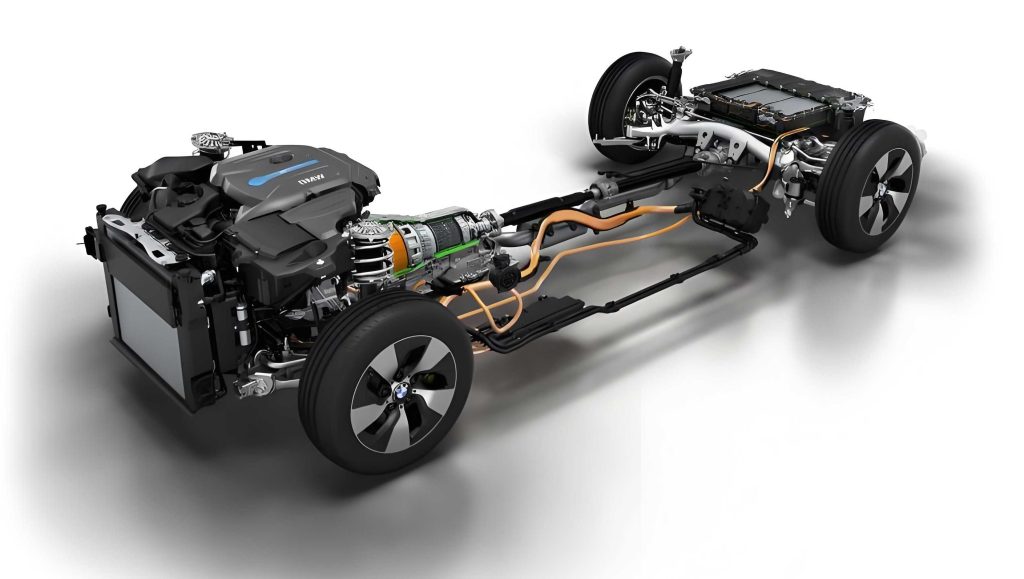
The role of the onboard charger in a hybrid electric vehicle is pivotal. It converts AC power from the grid to DC power for the high-voltage battery. The charging process is governed by communication over the CP line, which uses PWM signals. The duty cycle $D$ of the PWM signal can be calculated as $D = \frac{T_{on}}{T_{total}} \times 100\%$, where $T_{on}$ is the high-time and $T_{total}$ is the signal period. In many hybrid electric vehicles, the maximum charging current $I_{max}$ is related to $D$ by the formula $I_{max} = \frac{D}{100} \times I_{rated}$, where $I_{rated}$ is a reference current (e.g., 32 A). This ensures that the hybrid electric vehicle draws power within safe limits.
Beyond this specific fault, I explored other potential failure modes in hybrid electric vehicle charging systems. Common issues include faulty CP communication, ground faults, or software glitches. To summarize these, I created another table:
| Potential Fault | Symptoms | Diagnostic Approach | Relevance to Hybrid Electric Vehicle |
|---|---|---|---|
| CC Line Open | No charging indication, gun not detected | Continuity test, voltage measurement | Critical for connection recognition in hybrid electric vehicle |
| CP Line Short | Charging interrupted, error codes | Resistance and signal analysis | Affects communication in hybrid electric vehicle |
| Onboard Charger Failure | No power conversion, possible overheating | Functional testing, thermal inspection | Core component of hybrid electric vehicle charging |
| Software Calibration Issue | Inconsistent charging behavior | Diagnostic scanner updates | Common in modern hybrid electric vehicle systems |
In this case, after locating the open circuit in the CC line near connector K55, I repaired the wiring by splicing and insulating the conductors according to automotive standards. Post-repair, I tested the charging system: inserting the AC charging gun now resulted in proper dashboard indicators, and slow charging commenced successfully. This repair highlights the importance of meticulous wiring checks in hybrid electric vehicles, where electrical integrity is paramount for safety and performance.
To further elaborate on the charging system’s efficiency in a hybrid electric vehicle, we can consider the power transfer equation. The AC input power $P_{AC}$ is related to the DC output power $P_{DC}$ by the charger efficiency $\eta$, expressed as $P_{DC} = \eta \times P_{AC}$. For a typical hybrid electric vehicle onboard charger, $\eta$ might range from 0.85 to 0.95, meaning losses occur as heat. The efficiency can be modeled as $\eta = \frac{V_{DC} \times I_{DC}}{V_{AC} \times I_{AC} \times \cos \phi}$, where $\cos \phi$ is the power factor. Optimizing this efficiency is key for reducing energy waste in hybrid electric vehicles.
Another aspect is the safety mechanisms in hybrid electric vehicle charging. The system includes insulation monitoring, overcurrent protection, and temperature sensors. For instance, the insulation resistance $R_{ins}$ between high-voltage lines and chassis must exceed a threshold, often defined by standards such as $R_{ins} > 500 \Omega/V$. If $V_{HV}$ is the high-voltage battery voltage, the leakage current $I_{leak}$ should satisfy $I_{leak} = \frac{V_{HV}}{R_{ins}} < I_{safe}$, where $I_{safe}$ is a safe limit (e.g., 5 mA). These precautions are especially vital in hybrid electric vehicles due to their dual voltage systems.
The evolution of hybrid electric vehicle technology has led to more integrated charging solutions. For example, some hybrid electric vehicles support bidirectional charging, allowing vehicle-to-grid (V2G) capabilities. The power flow in such systems can be described by $P_{flow} = V \times I \times \sin(\theta)$ for reactive power considerations, though this is advanced. In daily diagnostics, however, focusing on basic parameters like voltages and resistances often suffices for troubleshooting common faults.
In conclusion, diagnosing AC charging failures in a hybrid electric vehicle requires a systematic approach grounded in electrical principles. From verifying connection signals to testing continuity, each step must be meticulously documented. The hybrid electric vehicle’s complexity demands a thorough understanding of both low-voltage control circuits and high-power systems. By using tools like multimeters and diagnostic scanners, along with applying formulas and tables for analysis, technicians can efficiently resolve issues. This case underscores that even minor wiring breaks can disable charging, emphasizing the need for regular maintenance in hybrid electric vehicles. As the adoption of hybrid electric vehicles grows, such diagnostic skills will become increasingly valuable in ensuring reliable and sustainable transportation.
Reflecting on this experience, I realize that continuous learning about hybrid electric vehicle systems is essential. The interplay between mechanical and electrical components in a hybrid electric vehicle presents unique challenges, but with methodical investigation, even elusive faults can be corrected. Future advancements may introduce more automated diagnostics, but the fundamental principles discussed here will remain relevant for servicing hybrid electric vehicles.