
As the adoption of electric vehicles accelerates globally, the proliferation of EV charging stations has introduced significant challenges to grid stability due to fluctuating electricity demands. In my research, I explore how big data technologies can revolutionize load forecasting and scheduling optimization for EV charging stations. By leveraging machine learning and time-series analysis, I develop methods to predict short-term and long-term loads accurately. Furthermore, I design intelligent scheduling strategies that incorporate optimization algorithms and demand response mechanisms to distribute grid load efficiently. This approach not only enhances the utilization of charging infrastructure but also mitigates peak load stresses on the power grid. Through extensive simulations, I demonstrate the effectiveness of these strategies in real-world scenarios, providing a scalable solution for sustainable EV integration.
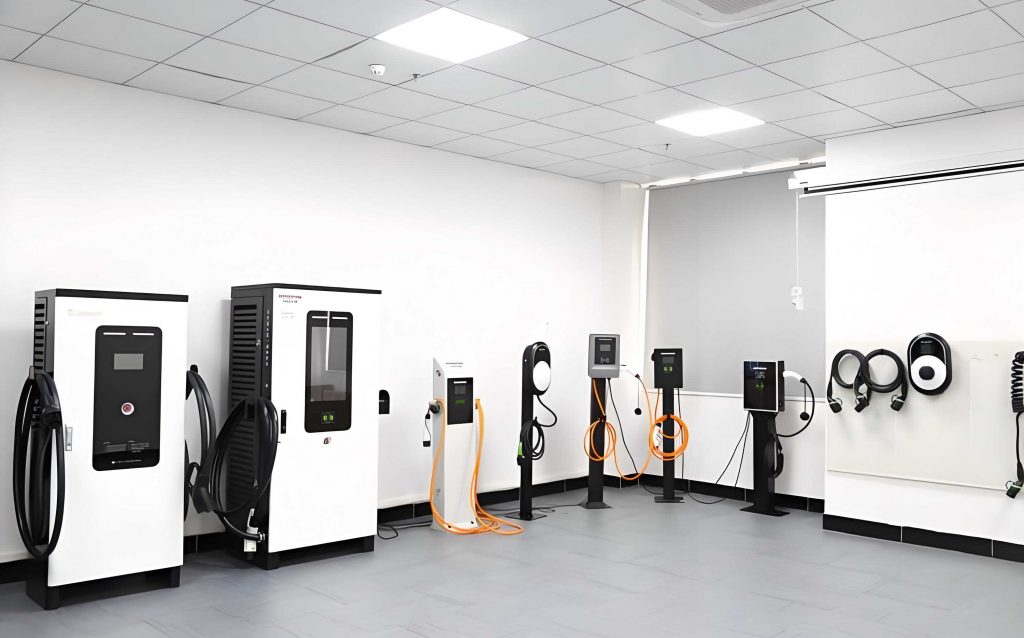
In the context of EV charging station load forecasting, big data plays a pivotal role by integrating diverse datasets, including historical charging behaviors, grid operational parameters like voltage and current, and external factors such as temperature and time. I employ machine learning models to analyze these datasets, capturing complex patterns in EV charging station demand. For instance, during weekday morning peaks from 7 AM to 9 AM, charging loads at EV charging stations surge due to commuters topping up their vehicles before travel, reaching approximately 200 kW. Throughout the daytime working hours, from 9 AM to 5 PM, the load stabilizes between 100 kW and 120 kW, with minor fluctuations from occasional charging needs. Evening commutes trigger a rapid increase, peaking around 7 PM at 350 kW as EVs return to urban areas. On weekends, the load pattern diverges, with a gradual rise starting at 10 AM and peaking between 2 PM and 4 PM at about 250 kW, followed by a steady nighttime load of 180–200 kW. Seasonal variations further influence EV charging station loads; summer heat elevates air conditioning usage, pushing peak loads to 380 kW, while winter cold affects battery performance, increasing charging durations and loads. To model these dynamics, I use time-series methods like ARIMA and LSTM networks, which account for temporal dependencies and external variables. The general form of the forecasting model can be expressed as: $$L_t = f(L_{t-1}, L_{t-2}, \dots, E_t, T_t) + \epsilon_t$$ where \(L_t\) is the load at time \(t\), \(E_t\) represents environmental factors, \(T_t\) denotes time-based features, and \(\epsilon_t\) is the error term. This enables precise predictions for EV charging station management, facilitating proactive grid adjustments.
For scheduling optimization at EV charging stations, I implement intelligent algorithms to allocate charging times and power levels dynamically. The Particle Swarm Optimization (PSO) algorithm is central to this strategy, where I initialize a swarm of particles, each encoding key parameters such as charging time and power for individual EV charging stations. Each particle’s position and velocity are randomly set within feasible ranges to ensure diversity in the search space. The fitness function is designed to minimize grid load fluctuations or charging costs, depending on the objective. For instance, to reduce load variance, the fitness function \(F\) is defined as: $$F = \frac{1}{N} \sum_{i=1}^{N} (L_i – \bar{L})^2$$ where \(L_i\) is the load at interval \(i\), \(\bar{L}\) is the average load, and \(N\) is the number of intervals. Alternatively, for cost minimization, \(F\) incorporates time-of-use electricity prices: $$F = \sum_{j=1}^{M} P_j \cdot C_j \cdot T_j$$ where \(P_j\) is the power, \(C_j\) is the cost per kWh, and \(T_j\) is the charging duration for EV charging station \(j\), with \(M\) being the total stations. During iterations, particles update their velocities and positions using the equations: $$v_{ij}(t+1) = w v_{ij}(t) + c_1 r_1 (P_{ij} – x_{ij}(t)) + c_2 r_2 (P_{gj} – x_{ij}(t))$$ and $$x_{ij}(t+1) = x_{ij}(t) + v_{ij}(t+1)$$ where \(v_{ij}(t)\) is the velocity of particle \(i\) in dimension \(j\) at time \(t\), \(w\) is the inertia weight, \(c_1\) and \(c_2\) are learning factors, \(r_1\) and \(r_2\) are random numbers between 0 and 1, \(P_{ij}\) is the particle’s best position, and \(P_{gj}\) is the global best position. This process continues until convergence, yielding optimal schedules for EV charging stations that balance load and cost.
Complementing the algorithmic approach, I integrate a demand response mechanism that incentivizes users to adjust their charging behaviors based on grid conditions. Through real-time monitoring via smart grid sensors, I collect data on voltage, current, and power at EV charging stations. Big data analytics platforms then forecast load trends using historical data, weather forecasts, and user behavior patterns. When peak periods are predicted, the system sends notifications to users via mobile apps or SMS, offering incentives such as discounted rates or rewards for shifting charging to off-peak hours. For example, users might receive a subsidy of $0.03 per kWh for delaying charging by two hours. This user feedback is incorporated into the dynamic scheduling model, refining the PSO-generated plans to align with actual demand. The synergy between algorithmic optimization and demand response ensures that EV charging station operations are both efficient and user-centric, reducing grid stress during critical times.
To validate these strategies, I conducted a simulation involving a network of 100 EV charging stations over a one-week period, replicating varying demand scenarios. The experiment compared three modes: natural charging without optimization, basic scheduling, and the proposed intelligent scheduling with demand response. Key metrics included average charging duration, grid peak load, and EV charging station utilization rate. The results, summarized in the table below, highlight the superiority of the intelligent approach. For instance, the average charging time was minimized, and peak loads were significantly reduced, demonstrating the efficacy of big data-driven optimization for EV charging stations.
| Optimization Mode | Average Charging Duration (hours) | Grid Peak Load (kW) | EV Charging Station Utilization Rate (%) |
|---|---|---|---|
| Natural Charging | 2.5 | 400 | 65 |
| Basic Scheduling | 2.0 | 320 | 75 |
| Intelligent Scheduling with Demand Response | 1.5 | 280 | 85 |
In addition to the PSO algorithm, I explored other methods like genetic algorithms for EV charging station scheduling, which similarly encode parameters into chromosomes and use selection, crossover, and mutation operations to evolve solutions. The fitness function in this case prioritizes load leveling across EV charging stations, expressed as: $$F_{GA} = \min \left( \max(L_t) – \min(L_t) \right)$$ where \(L_t\) is the load profile over time. This diversity in algorithmic approaches ensures robustness in handling different scenarios for EV charging station management.
Moreover, I analyzed the impact of external factors on EV charging station loads using regression models. For example, temperature effects on charging demand can be modeled as: $$L_{\text{summer}} = L_{\text{base}} + \alpha \cdot \Delta T$$ where \(L_{\text{base}}\) is the baseline load, \(\alpha\) is a coefficient, and \(\Delta T\) is the temperature deviation. Such models enhance the accuracy of load forecasts for EV charging stations, enabling better scheduling decisions.
In conclusion, my research underscores the transformative potential of big data in optimizing EV charging station operations. By combining advanced forecasting techniques with intelligent scheduling and demand response, I achieve significant reductions in peak loads and improvements in utilization rates. This integrated approach not only supports grid stability but also promotes the sustainable growth of electric mobility. Future work will focus on real-time implementation and scalability across larger networks of EV charging stations, further refining these strategies for global adoption.