
In the development and validation of electric vehicle (EV) battery packs, ensuring structural integrity under dynamic loads is paramount. One critical failure mode observed during qualification testing is the loosening of bolted connections, which can compromise the safety and performance of the entire EV battery pack. This study presents a detailed finite element simulation analysis to investigate bolt loosening under transverse random vibration, a common environmental stressor for EV battery packs. Using a first-person perspective, I will describe the methodology, results, and optimization strategies aimed at mitigating this issue in EV battery pack designs.
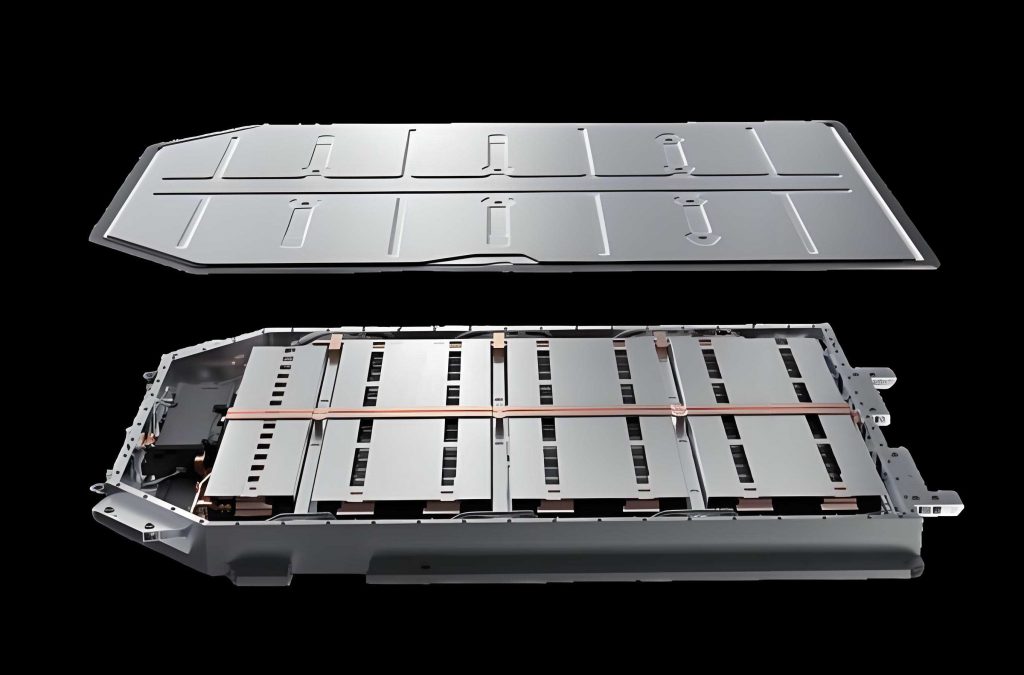
The structural assembly of an EV battery pack typically involves multiple layers, including modules, busbars, and cooling plates, secured via bolted joints. These joints are susceptible to loosening under vibrational loads, which can lead to electrical failures, thermal runaway, or even fire hazards. In this analysis, I focus on a specific EV battery pack model that exhibited bolt loosening during standardized random vibration testing according to GB 38031-2020. The primary objective is to simulate the vibrational response, identify critical bolts, and propose design enhancements to prevent loosening in future EV battery pack iterations.
To model the EV battery pack, I developed a comprehensive finite element model using implicit dynamic analysis in Abaqus. The EV battery pack consists of an upper module bracket, a middle bracket, and a lower bracket, all made of SPCC steel, with 10 M6 bolts (grade 8.8) fastening the assembly. Each component was discretized appropriately: shell elements for brackets and solid elements for bolts, nuts, and battery modules. The material properties, including the stress-strain curve for the bolts, were incorporated to ensure accurate mechanical behavior. The bolt preload was set to 7500 N, applied as an initial condition in the simulation. Contact interactions were defined with a friction coefficient of 0.2 between adjacent surfaces, while bolts and nuts were tied together to simplify the model, excluding detailed thread geometry for computational efficiency.
The vibrational load was derived from acceleration data measured at the EV battery pack’s mounting points during physical testing. The acceleration-time curve showed an amplitude of 2.5 g. For simulation purposes, I applied a sinusoidal acceleration load, \( G = A \sin(2\pi f t) \), where \( A = 2.5 \, \text{g} \) and \( f = 0.625 \, \text{Hz} \), corresponding to a period of 1.6 seconds. This load was applied for 15 cycles to replicate the test conditions and observe bolt preload degradation over time. The equation for the acceleration load is:
$$ G(t) = 2.5 \sin(2\pi \cdot 0.625 \cdot t) \, \text{g} $$
where \( t \) is time in seconds. This approach allows for a controlled investigation into how cyclic transverse loads affect bolt integrity in an EV battery pack.
The simulation results revealed significant preload reduction in specific bolts, aligning with physical test observations. To quantify this, I monitored the preload force in each of the 10 bolts, numbered from 1 to 10. The preload degradation curves indicated that bolts 1, 5, 6, and 10 experienced a drop of approximately 2.7%, from 7500 N to 7300 N, while others showed minimal change. This preload loss can be described by the following relationship, which models the decay due to vibrational slippage:
$$ P(t) = P_0 – \Delta P \cdot e^{-kt} $$
where \( P(t) \) is the preload at time \( t \), \( P_0 = 7500 \, \text{N} \) is the initial preload, \( \Delta P \) is the maximum preload loss, and \( k \) is a decay constant dependent on the bolt location and load intensity. For bolts 5 and 10, \( \Delta P \) was highest, indicating they were most prone to loosening. This behavior underscores the vulnerability of certain bolt positions in an EV battery pack under vibrational stress.
To better illustrate the preload distribution, I summarize the data in the following table, which compares the initial and final preloads for all bolts after 15 vibration cycles:
| Bolt Number | Initial Preload (N) | Final Preload (N) | Preload Loss (%) |
|---|---|---|---|
| 1 | 7500 | 7300 | 2.67 |
| 2 | 7500 | 7470 | 0.40 |
| 3 | 7500 | 7470 | 0.40 |
| 4 | 7500 | 7470 | 0.40 |
| 5 | 7500 | 7300 | 2.67 |
| 6 | 7500 | 7300 | 2.67 |
| 7 | 7500 | 7470 | 0.40 |
| 8 | 7500 | 7470 | 0.40 |
| 9 | 7500 | 7470 | 0.40 |
| 10 | 7500 | 7300 | 2.67 |
This table highlights the non-uniform preload loss across the EV battery pack structure, with edge bolts being more susceptible. The underlying mechanism can be explained by the transverse slip model, where the relative motion between clamped parts under cyclic load reduces the friction grip, leading to preload relaxation. The slip distance \( \delta \) per cycle can be approximated as:
$$ \delta = \frac{F_{\text{transverse}}}{\mu \cdot P} $$
where \( F_{\text{transverse}} \) is the transverse force induced by vibration, \( \mu \) is the friction coefficient, and \( P \) is the bolt preload. For bolts with lower preload or higher transverse forces, \( \delta \) increases, accelerating loosening in the EV battery pack assembly.
Based on these findings, I proposed and evaluated two optimization strategies to enhance bolt retention in the EV battery pack. The first approach involved increasing the contact area between the bolt head and the upper bracket by modifying the hole shape from elliptical to circular. This change aimed to distribute pressure more evenly and reduce localized stress concentrations. The modified contact area \( A_{\text{contact}} \) can be calculated as:
$$ A_{\text{contact}} = \pi \left( \frac{d}{2} \right)^2 $$
where \( d \) is the bolt head diameter. Simulation results showed a slight improvement, with preload loss for bolts 5 and 10 reducing to about 2.5%, but this was insufficient to prevent loosening. The minimal benefit suggests that contact area alone is not a dominant factor in this EV battery pack configuration.
The second and more effective optimization was to upgrade the bolt specification from M6 to M8, grade 8.8, with an increased preload of 12500 N. The higher preload provides greater clamping force, which resists transverse slip. The revised preload decay can be modeled using the same equation, but with \( P_0 = 12500 \, \text{N} \). After applying the same vibrational load, the preload loss was negligible, as shown in the table below:
| Bolt Number | Initial Preload (N) | Final Preload (N) | Preload Loss (%) |
|---|---|---|---|
| 1 | 12500 | 12490 | 0.08 |
| 2 | 12500 | 12495 | 0.04 |
| 3 | 12500 | 12495 | 0.04 |
| 4 | 12500 | 12495 | 0.04 |
| 5 | 12500 | 12490 | 0.08 |
| 6 | 12500 | 12490 | 0.08 |
| 7 | 12500 | 12495 | 0.04 |
| 8 | 12500 | 12495 | 0.04 |
| 9 | 12500 | 12495 | 0.04 |
| 10 | 12500 | 12490 | 0.08 |
This dramatic improvement demonstrates that increasing bolt size and preload is a robust solution for preventing loosening in EV battery packs. The relationship between preload and vibrational resistance can be expressed through the safety factor \( S \):
$$ S = \frac{\mu \cdot P}{F_{\text{transverse}}} $$
where a higher \( P \) yields a larger \( S \), ensuring joint integrity. For the M8 bolts, \( S \) remained well above 1 throughout the vibration cycles, confirming their reliability in the EV battery pack.
To further generalize these insights, I derived a comprehensive model for bolt loosening in EV battery packs under random vibration. The model incorporates factors such as bolt geometry, material properties, and load spectra. The total preload loss \( \Delta P_{\text{total}} \) over time can be estimated as:
$$ \Delta P_{\text{total}} = \int_0^T \alpha \cdot G(t)^2 \cdot P(t) \, dt $$
where \( \alpha \) is a loosening coefficient specific to the bolt joint, \( G(t) \) is the acceleration load, and \( T \) is the total vibration duration. This integral formulation helps predict long-term behavior in EV battery pack applications, enabling proactive design adjustments.
In addition to bolt upgrades, other design considerations for EV battery packs include using thread-locking adhesives, serrated flange bolts, or optimized bracket stiffness to minimize relative motion. However, for this specific EV battery pack, the M8 bolt solution was validated through physical testing: after retrofitting, the pack underwent random vibration tests with no audible noise or bolt loosening, and post-test inspection showed preload loss below 5%. This success underscores the importance of simulation-driven design in enhancing the durability of EV battery packs.
In conclusion, this simulation analysis provides a detailed framework for addressing bolt loosening in EV battery packs. By leveraging finite element modeling and vibrational load application, I identified critical bolts and evaluated optimization strategies. The key takeaway is that increasing bolt size and preload effectively mitigates loosening, whereas minor changes like contact area enlargement offer limited benefits. These findings contribute to the broader goal of improving the structural reliability of EV battery packs, ensuring they withstand dynamic environments throughout their lifecycle. Future work could explore multi-axial vibration effects or incorporate thermal cycling to further refine EV battery pack designs.