
In recent years, the electric vehicle (EV) industry has experienced rapid growth, driven by policy support and market demand. As a core component of EVs, the power battery serves as the primary energy source, and its failure to supply high voltage can lead to critical safety issues, including vehicle immobility and sudden power loss during operation. This article, from a first-person perspective as an EV repair specialist, delves into the diagnosis and repair of common high voltage failures in power batteries. We will explore the high voltage electrical structure, the high voltage power-up process, and analyze typical failure scenarios, emphasizing practical EV repair techniques to enhance the skills of automotive technicians. The focus is on improving understanding of power battery principles and advancing electrical car repair practices for sustainable EV development.
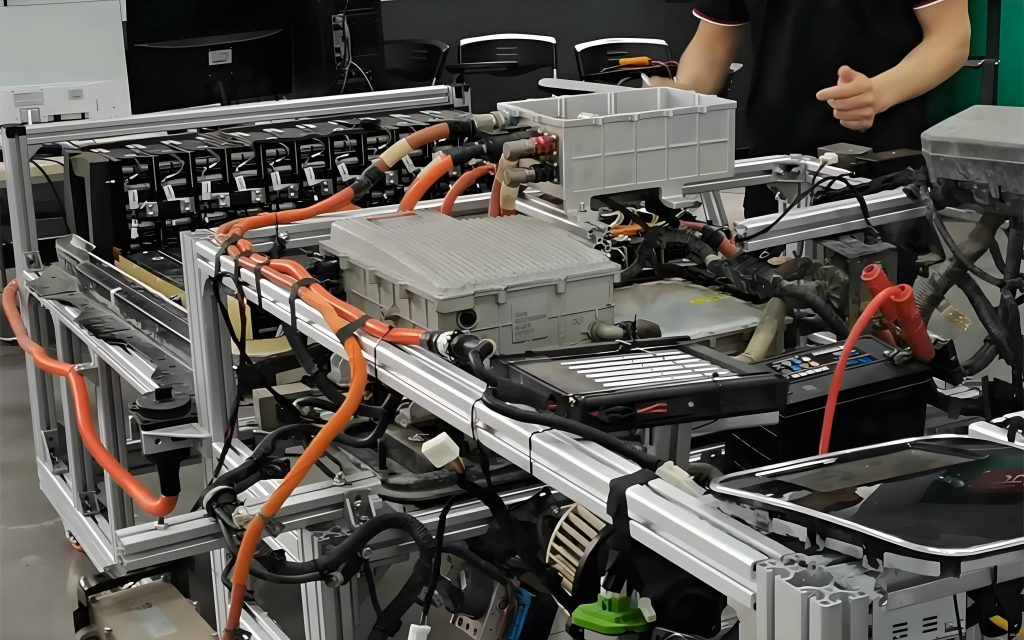
The high voltage system in an EV comprises key components such as the DC charging socket, integrated charging and distribution system, motor controller, and power battery. High voltage power-up refers to the process where the power battery, upon receiving relevant commands from the vehicle, correctly closes high voltage switches to supply high voltage energy. In a typical EV model, the high voltage power-up sequence involves several steps. First, when the vehicle key is in the ACC position, the vehicle control unit (VCU) sends an “initialization” mode signal. Simultaneously, the battery management system (BMS) is awakened via KL15, initiating low-voltage operation. The BMS performs self-checks to detect any severe faults. Second, when the key advances to the ON position and no charging gun is connected, with VCU self-checks confirming no prohibitive faults, the VCU issues a “request to close high voltage switches” command. The BMS then sequentially closes the pre-charge relay and main negative relay, followed by internal and external voltage difference detection. If the voltages match, the BMS sends a “pre-charge normal” message, closes the main positive relay, and disconnects the pre-charge relay, enabling high voltage output from the battery system.
High voltage failure can occur in two primary phases: during BMS self-check or pre-charge. Severe faults like cell under-voltage, over-voltage, excessive voltage difference, low insulation resistance, or high voltage interlock (HVIL) issues can prevent high voltage power-up. Similarly, open circuits in the high voltage loop, such as fuse blows, relay failures, or busbar fractures, lead to pre-charge failure. Effective EV repair requires systematic diagnosis and targeted interventions, which we will detail in the following sections, incorporating tables and formulas to summarize key aspects of electrical car repair.
High Voltage Interlock (HVIL) Failure
HVIL is a critical safety feature in EVs, using low-voltage signals to monitor the integrity of high voltage components and connectors. It ensures that high voltage circuits are securely connected before power-up and during operation. In EV repair, HVIL failures are common causes of high voltage power-up issues. The design of high voltage connectors includes longer high voltage terminals and shorter interlock detection terminals, ensuring safe engagement and disengagement. Diagnosis methods include visual inspection for loose connectors, short-circuit testing by bridging interlock terminals, and continuity checks with a multimeter. For instance, if a connector shows pin retraction or deformation, replacement is necessary. A table below summarizes HVIL fault diagnosis and repair steps, essential for electrical car repair.
| Fault Type | Diagnosis Method | Repair Action |
|---|---|---|
| Loose Connector | Visual inspection for improper locking | Re-seat connector and secure locks |
| Pin Retraction | Short-circuit test with wires | Replace connector or repair pins |
| Internal Wire Break | Continuity check (resistance near 0 Ω) | Replace harness or insulate with tape |
In one EV repair case, a vehicle reported HVIL faults and failed to power up. After verifying connector integrity and performing short-circuit tests, the issue was traced to a deformed interlock terminal in the internal wiring harness. Replacing the harness resolved the fault, highlighting the importance of thorough diagnosis in electrical car repair.
Insulation Failure
Insulation failure in power batteries involves reduced resistance between high voltage DC busbars (positive and negative) and the chassis ground. The BMS typically uses a balanced bridge circuit for insulation detection, where switching states allow calculation of insulation resistances. Common causes include damaged cell insulation films, worn cables, moisture ingress, or BMS hardware faults. For EV repair, diagnosis often involves measuring potential differences or using visual inspection. The insulation resistance $$R_{ins}$$ can be derived from the balanced bridge equations. For example, in a simplified model, the positive and negative insulation resistances $$R_p$$ and $$R_n$$ satisfy:
$$R_p = \frac{V_{total} \cdot (V_{ref} – V_{measured})}{V_{measured} \cdot I_{leak}}$$
and
$$R_n = \frac{V_{total} \cdot V_{measured}}{(V_{ref} – V_{measured}) \cdot I_{leak}}$$
where $$V_{total}$$ is the total battery voltage, $$V_{measured}$$ is the measured voltage, and $$I_{leak}$$ is the leakage current. In practice, EV repair technicians use multimeters to check for shorts and repair by re-insulating cells or replacing components. The table below outlines insulation fault scenarios and remedies, crucial for effective electrical car repair.
| Failure Mode | Diagnosis Approach | Repair Solution |
|---|---|---|
| Cell Insulation Film Damage | Measure potential difference to locate faulty cell | Re-wrap cell with insulation film |
| Cable Abrasion | Visual inspection for wear and shorts | Replace cable or apply insulation tape |
| Moisture Ingress | Check for water traces and dry components | Clean and dry battery pack |
| BMS Hardware Failure | ABA test by replacing BMS module | Replace BMS hardware |
For instance, in an EV repair job, insulation resistance values dropped below thresholds due to a cracked cell casing leaking electrolyte. By identifying the faulty cell through voltage measurements and replacing it, the insulation issue was resolved, demonstrating the precision required in electrical car repair.
Voltage Difference Failure
Voltage difference, or cell imbalance, is a prevalent issue in power batteries, affecting performance and lifespan. It arises from variations in self-discharge rates, internal cell faults, or connection problems. In EV repair, diagnosing voltage difference involves measuring individual cell voltages and identifying outliers. The voltage difference $$\Delta V$$ between cells can be expressed as:
$$\Delta V = |V_i – V_j|$$
where $$V_i$$ and $$V_j$$ are voltages of cells i and j. If $$\Delta V$$ exceeds a set threshold (e.g., 0.2 V), it triggers faults. Common causes include faulty cells, poor welds, or damaged sampling harnesses. Repair methods range from cell balancing to replacing entire modules. The table below summarizes diagnosis and repair strategies for voltage difference faults, a key aspect of EV repair.
| Fault Scenario | Diagnosis Technique | Repair Action |
|---|---|---|
| Intermittent Imbalance | Check user habits and measure cell voltages after storage | Perform full-pack balancing |
| Internal Cell Defect | Measure internal resistance and voltage deviations | Replace faulty cell or module |
| Harness Connection Issue | Inspect for loose contacts or poor soldering | Re-solder or replace harness |
In one electrical car repair case, a vehicle showed persistent voltage difference errors. By swapping module connectors and tracking voltage data, the fault was isolated to a specific cell with high internal resistance. Replacing the module and rebalancing the pack restored normal operation, underscoring the need for systematic EV repair approaches.
High Voltage Loop Hardware Failure
Hardware failures in the high voltage loop, including fuses, relays, busbars, and cables, can prevent high voltage power-up. In EV repair, these components are checked for continuity and integrity. For example, a fuse should have near-zero resistance; if blown, resistance is infinite. Relays are tested by applying low voltage (e.g., 12 V DC) to control terminals and measuring contact resistance. Busbar virtual welding is detected by comparing voltage measurements across welds. The resistance $$R$$ of a component can be modeled as:
$$R = \frac{V}{I}$$
where $$V$$ is voltage and $$I$$ is current. If $$R$$ is high, it indicates an open circuit. Repair involves replacing faulty parts and ensuring proper connections. The table below details diagnosis and repair for hardware faults, essential for reliable electrical car repair.
| Component | Diagnosis Method | Repair Procedure |
|---|---|---|
| Fuse | Resistance check (near 0 Ω normal) | Replace fuse and inspect for shorts |
| Relay | Apply 12 V DC and measure contact resistance | Replace relay if contacts fail to close |
| Busbar | Voltage comparison and physical inspection | Re-weld busbar to ensure connectivity |
| High Voltage Cable | Continuity test with multimeter | Re-tighten or replace cable if broken |
For instance, during an EV repair, a vehicle failed to power up due to a melted fuse caused by a short circuit. After replacing the fuse and fixing the short, the high voltage loop functioned correctly, highlighting the importance of comprehensive checks in electrical car repair.
Conclusion
In summary, diagnosing and repairing high voltage failures in EV power batteries requires a deep understanding of battery systems and practical skills. By addressing common issues like HVIL faults, insulation failures, voltage differences, and hardware defects, technicians can enhance their EV repair capabilities. This article has provided detailed methods, supported by tables and formulas, to guide electrical car repair processes. As the EV industry evolves, continuous learning and innovation in repair techniques will be crucial for ensuring vehicle safety and promoting sustainable mobility. Through hands-on experience and knowledge sharing, we can advance the field of EV repair and contribute to the longevity of electric vehicles.