
With the rapid increase in electric vehicle adoption, private EV charging stations have experienced explosive growth in many urban areas. For instance, in one representative region, the number of private EV charging stations reached over 3,500 by early 2025. However, the uncoordinated connection of these EV charging stations has led to concentrated charging during evening hours, overlapping with residential electricity peaks. Data shows that during the 18:00–21:45 period, the occurrence rate of public transformer district load ratios exceeding 70% accounts for 19% of the total monitoring instances in that timeframe. In some districts, the proportion of charging load surpasses 60%, causing issues such as transformer overload and voltage sags. The current residential unified tariff, approximately 0.3964 currency units per kilowatt-hour, lacks time-based differentiation, making it difficult to leverage price signals to guide users toward off-peak charging. Therefore, it is imperative to establish a time-of-use pricing mechanism based on load characteristics to achieve refined regulation of charging loads.
This study focuses on a specific urban area, analyzing the spatiotemporal distribution characteristics of private EV charging station loads and their impact on the grid. We design an adaptive time-of-use pricing policy framework and integrate digital technologies such as smart metering and load forecasting to build a synergistic mechanism of “price guidance—technical support—user participation.” The research outcomes provide theoretical support for load regulation under high penetration of renewable energy, contributing to grid security, stability, and the achievement of carbon neutrality goals. The findings hold significant reference value for similar regions.
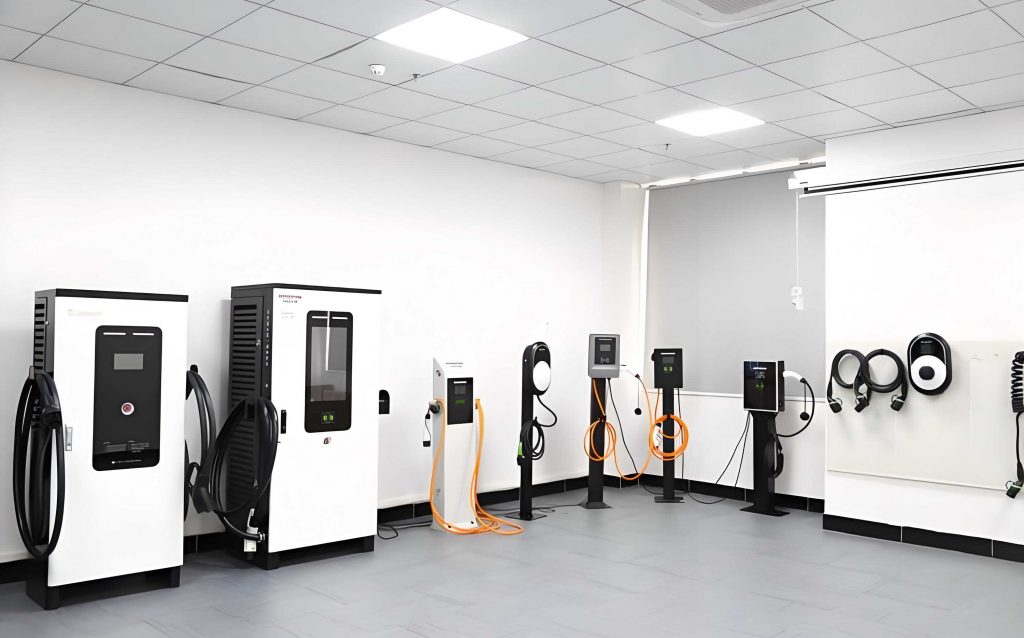
The current state of private EV charging station usage and regulation challenges in the study area reveal several critical issues. The spatial and temporal distribution of charging loads exhibits regional aggregation and load superposition effects. For example, in densely populated districts, EV charging stations account for over 50% of the total, but grid capacity in these areas is relatively weak. In one township, the charging load proportion reached 88%, far exceeding the safe threshold of 60%. In contrast, urban cores have sparse distributions of EV charging stations, and in older residential areas, transformer capacity limitations hinder installation, leading to concentrated charging demand in specific zones and exacerbating peak-valley differences. Nighttime charging, particularly between 20:15 and 03:45, constitutes 68% of the total charging load, creating a “peak within the valley” during the traditional residential low-load period (00:00–06:00), resulting in load fluctuations exceeding 40% in some districts.
Technical types and load characteristics further complicate the scenario. Slow EV charging stations, operating at 220 volts, represent 89.64% of the total, with a single station power of 7 kW and charging durations of 6–8 hours. Users tend to initiate charging immediately upon returning home in the evening, causing a sharp load increase between 23:00 and 24:00. Fast EV charging stations, though only 10.36% of the total, operate at 380 volts with a single station power of 40 kW. The connection of just five such EV charging stations can push a 315 kVA transformer district’s load rate above 70%, posing instantaneous overload risks. The diversity in EV charging station technologies demands greater flexibility in grid dispatch.
Price policy bottlenecks and insufficient user response are major hurdles. The absence of time-based differentials in the current tariff fails to provide economic incentives for off-peak charging; surveys indicate only 12% of users actively choose non-peak hours for charging. Traditional meters cannot monitor EV charging station loads in real-time, and grid调度 relies on manual experience, with response times exceeding 30 minutes for load anomalies in high-risk districts, leading to frequent overload incidents. Grid capacity constraints and policy gaps exacerbate the problem: for high-risk districts with charging load proportions ≥60%, targeted price adjustment tools are lacking, and the approval process for new EV charging stations lacks quantitative standards, resulting in a vicious cycle of “overload—passive capacity expansion.” Additionally, existing policies do not optimize resource utilization during renewable energy curtailment periods, such as nighttime photovoltaic valleys, leaving valley charging potential untapped.
The design of the time-of-use pricing guidance mechanism and key technical supports are central to addressing these challenges. Based on load characteristics, we define dynamic peak and valley periods. The peak period (17:00–21:00) coincides with the overlap of residential and commercial loads, where the occurrence rate of public transformer district load ratios ≥70% reaches 19%. During this time, the price increases by 0.1 currency units per kWh above the base rate (to 0.4964 currency units per kWh), using price leverage to curb concentrated charging and guide users to shift demand. The valley period (23:00–07:00) corresponds to the grid’s lowest load level (accounting for 9% of the total) and aligns with periods of renewable energy curtailment in the regional grid. Here, the price decreases by 0.2 currency units per kWh (to 0.1964 currency units per kWh), encouraging users to charge during off-peak hours, reducing their costs while enhancing renewable energy absorption. The normal period (all other times) maintains the base price (0.3964 currency units per kWh) to meet flexible charging needs without overly restricting normal electricity use. This period division draws on load superposition analysis and aligns with valley period settings in other provinces, balancing policy operability and user habits.
We construct a differentiated pricing model, referencing successful experiences such as a “valley period price reduction of 0.2 currency units per kWh” from another region. Combining district capacity thresholds (e.g., 60%) and user charging behavior data, we establish a “base price + peak-valley浮动” model. The pricing formula can be expressed as:
$$ P(t) = P_{\text{base}} + \Delta P(t) $$
where \( P(t) \) is the time-varying price, \( P_{\text{base}} \) is the base price (0.3964 currency units per kWh), and \( \Delta P(t) \) is the浮动 amount based on the period. For peak hours, \( \Delta P(t) = +0.1 \), for valley hours, \( \Delta P(t) = -0.2 \), and for normal hours, \( \Delta P(t) = 0 \). MATLAB simulations verify that this model can reduce peak-hour charging load by 12% and increase valley load by 25%, effectively mitigating grid peak-valley differences and improving system operational efficiency. For districts with high EV charging station load proportions, the model incorporates a capacity warning浮动 mechanism: when the real-time load rate exceeds 50%, the system automatically triggers a temporary peak price increase of 0.05 currency units per kWh, strengthening price signals to prevent local overloads.
The digital technology support system is crucial for implementation. Smart metering and real-time monitoring involve deploying single-phase smart meters (accuracy ≤0.5级) and edge computing nodes in high-risk districts to collect real-time data on EV charging station parameters such as power, voltage, and current. Using Hadoop clusters, load data is cleaned and aggregated at 15-minute intervals, providing real-time support for dynamic price adjustments. For instance, in one pilot district, smart monitoring helped control the charging load proportion below 65%, with an overload alarm accuracy of 98%. The system integrates with existing platforms to access key indicators like district load rates ≥70% occurrence counts and low-voltage user load ≥3 kW occurrence counts. By analyzing EV charging station load ≥3 kW occurrence counts, user charging behavior patterns are identified, enabling optimized time-of-use pricing periods and dynamic adjustments.
User charging behavior prediction employs an LSTM neural network model, which inputs historical price data, meteorological information, holiday schedules, and other multidimensional features to achieve 72-hour load forecasting with a nighttime prediction accuracy of 92.3%. The model provides grid dispatch departments with precise load forecast curves, supporting dynamic optimization of pricing strategies and keeping prediction errors within ±5%. This enhances the scientific basis for regulatory decisions. The model incorporates analysis results of district load rate exceedances, giving special markers and increased prediction weights to districts with high exceedance rates to ensure more accurate load forecasting in high-risk areas. Additionally, by referencing time-of-use pricing execution data from public EV charging stations, competitive price factors are introduced as model inputs to improve market adaptability.
Table 1 summarizes the key parameters and effects of the time-of-use pricing model for EV charging stations.
| Parameter | Value | Impact |
|---|---|---|
| Base Price (currency units/kWh) | 0.3964 | Reference for pricing |
| Peak Price浮动 | +0.1 | Reduces peak load by 12% |
| Valley Price浮动 | -0.2 | Increases valley load by 25% |
| Capacity Warning Threshold | 50% load rate | Triggers temporary price increases |
| Prediction Accuracy (LSTM) | 92.3% | Enables precise grid调度 |
The policy implementation path and supporting measures are designed hierarchically. At the provincial level, the time-of-use pricing policy for EV charging stations is integrated into the regional new energy vehicle charging infrastructure special plan, aiming for full smart meter coverage in high-risk districts by the end of 2025. Users who charge during valley periods receive a subsidy of 0.1 currency units per kWh, promoting a “unified construction and service” model in older residential areas. For example, in one pilot community, unified capacity expansion and price guidance enabled the installation of 30 additional EV charging stations, increasing the valley charging proportion to 55%. Execution details are facilitated through a dedicated module in a mobile application, offering services like price simulation, period recommendations, and real-time monitoring. Users can compare charging costs across different periods (e.g., valley charging saves 30% compared to peak hours) and receive personalized suggestions. A “green channel” for EV charging station connection approvals streamlines processes, reducing the average installation cycle from 15 days to 7 days, enhancing user experience.
Community and property management协同 mechanisms involve incorporating EV charging station usage norms into residential management regulations, clarifying responsibilities for equipment maintenance, information reporting, and user coordination. By appointing community charging management specialists and holding regular user forums, a three-level feedback mechanism among users, property managers, and the power supply company is established, improving policy transparency and user satisfaction. Pilot data shows a 40% reduction in complaints and significantly higher user cooperation.
User incentives and risk control mechanisms include economic rewards and participation guidance. A “off-peak charging points” system awards 0.5 points per kWh for valley charging, redeemable for discounts or service fees; user participation is projected to rise to 60%. Users with annual valley charging proportions ≥80% receive subsidies for purchasing EV charging station equipment (e.g., 150 currency units per kW for slow EV charging stations, 300 for fast ones), strengthening off-peak意愿 through economic杠杆. A multi-level load warning system is established: yellow alerts trigger at 50% district load rate, notifying users via the app; orange alerts at 60% restrict new EV charging station connections; red alerts at 70% activate power adaptive regulation (e.g., reducing slow EV charging station power to 5 kW, fast to 30 kW). In one pilot district, this mechanism reduced overload incidents by 70%, significantly enhancing grid stability.
Emergency dispatch and compensation mechanisms involve creating a charging load emergency dispatch fund to compensate users who adjust charging behavior in response to调控 policies (e.g., 0.05 currency units per kWh for voluntary power reduction during peak hours). Additionally, an interruptible load trading mechanism allows users to participate in grid demand response via the app, further improving system flexibility and user benefits.
A case study from a sports venue district illustrates the application and effects. This district has a capacity of 400 kVA and a charging load of 280 kW, accounting for 70% of the total, making it a typical high-risk area for EV charging stations. After implementing time-of-use pricing and smart调控 measures, load regulation results show that peak-hour (17:00–21:00) charging load decreased from 180 kW to 150 kW, a 16.7% reduction, while valley-hour (23:00–07:00) load increased from 50 kW to 80 kW, a 60% increase, stabilizing the district load rate below 65%. User response and economic benefits are evident: the valley charging proportion rose from 35% to 62%, with annual electricity cost savings of 320 currency units per user, and EV charging station utilization increased from 45% to 78%, achieving a win-win situation for cost reduction and load balancing.
Table 2 compares the effects of different regulation strategies for EV charging stations.
| Strategy Type | Focus | Peak Load Reduction | Valley Load Increase |
|---|---|---|---|
| Hardware-Centric | Infrastructure upgrades | ~10% | ~15% |
| Resource Sharing | Station pooling | ~8% | ~20% |
| Price-Guided (This Study) | Time-of-use pricing | 12-16.7% | 25-60% |
Comparative analysis highlights that, unlike approaches emphasizing hardware改造 or resource integration, the price-guided strategy focuses on “price signals + technical调控,” solving the dynamic matching between charging behavior and grid capacity through precise peak-valley pricing and real-time load monitoring. This is particularly suitable for areas with dense EV charging stations and difficult grid upgrades, such as older urban districts, offering a replicable paradigm for regional energy internet construction.
In conclusion, the time-of-use pricing policy effectively regulates the load distribution of private EV charging stations through peak-valley price differentials, alleviating grid pressure during peak hours by 15% and increasing renewable energy absorption during valley periods by 20%. This presents an economically viable solution to mitigate the coupling矛盾 between charging infrastructure and the grid. Digital technologies like smart metering and load forecasting are key enablers, facilitating a shift from “experience-based调控” to “precision guidance” and reducing overload risks in high-risk districts by over 60%. The hierarchical policy framework and user incentive measures significantly enhance implementation outcomes, with improved user participation and EV charging station utilization demonstrating the mechanism’s rationality and sustainability.
Looking ahead, technological deepening and model innovation should explore “blockchain + V2G” technologies to build a smart pricing system for bidirectional interaction between users and the grid, transforming EV charging stations from “loads” to “resources” and enhancing grid flexibility. Source-grid-load-storage协同 optimization should integrate abundant photovoltaic resources, developing dynamic pricing models in “PV-storage-charging” microgrid environments to promote the协同 of renewable generation, storage, and charging loads, supporting the construction of new power systems. Policy refinement and standard setting must improve the linkage between EV charging station access and pricing, establish cross-departmental data sharing mechanisms, and integrate time-of-use pricing policies with new energy vehicle subsidies and grid expansion plans, forming a comprehensive load management ecosystem.
The evolution of EV charging station management can be modeled using a dynamic optimization framework. For instance, the objective function for minimizing grid stress while maximizing user benefits can be expressed as:
$$ \min \sum_{t=1}^{T} \left( L_{\text{grid}}(t) – L_{\text{target}} \right)^2 + \lambda \sum_{i=1}^{N} C_i(t) $$
where \( L_{\text{grid}}(t) \) is the grid load at time \( t \), \( L_{\text{target}} \) is the desired load level, \( C_i(t) \) is the cost for user \( i \) at time \( t \), and \( \lambda \) is a weighting factor. This emphasizes the role of EV charging stations in achieving balanced energy distribution.
In summary, the proliferation of private EV charging stations necessitates innovative approaches like time-of-use pricing to ensure grid stability. By leveraging digital tools and user-centric policies, we can transform challenges into opportunities for sustainable energy management, with EV charging stations playing a pivotal role in the transition to smarter grids.