
With the global shift in energy structures and the push for carbon emission control, the widespread adoption of electric vehicles (EVs) has escalated demands for high-power batteries and advanced charging infrastructure. However, current technologies face significant challenges, including low energy transmission efficiency, safety risks, and poor protocol compatibility. In this article, we aim to address these issues by integrating high-power battery systems with EV charging station technologies, proposing optimized strategies for system integration. We begin by outlining the theoretical foundations of EV power systems, high-power battery key technologies, and EV charging station architectures. Subsequently, we delve into integrated design approaches covering dynamic charging interface adaptation, cooperative power control, and thermal management coupling. Furthermore, we explore system optimization through layered security frameworks, standardized protocol fusion, and intelligent operation maintenance platforms. Our research contributes to enhancing battery cycle life, improving EV charging station utilization, and supporting sustainable EV industry development.
Fundamentals of EV Power Systems
Electric vehicle power systems revolve around high-power batteries as the primary energy source, facilitating efficient conversion of electrical energy to mechanical power through power electronics and drive motors. These systems integrate battery modules, motor controllers, drive motors, and energy management units to form a comprehensive chain from energy storage to propulsion output. High-power batteries must exhibit robust dynamic response capabilities under high-voltage and high-current conditions during rapid charging and discharging, with their electrochemical properties and thermal stability directly influencing energy density and cycle longevity. The electronic control system employs multi-domain cooperative strategies to balance power demands with battery safety limits, ensuring reliability in complex scenarios like acceleration and braking. Drive motors adapt to varying loads via frequency conversion, optimizing overall energy efficiency. The evolution of power systems is transitioning from modular assembly to full-domain integration, emphasizing lightweight electrical architectures, efficiency optimization, and intelligent management enhancements.
To quantify the performance of EV power systems, we consider the power balance equation:
$$ P_{\text{total}} = P_{\text{battery}} – P_{\text{loss}} $$
where \( P_{\text{total}} \) is the net power delivered to the drive motor, \( P_{\text{battery}} \) is the output power from the high-power battery, and \( P_{\text{loss}} \) accounts for losses in converters and cables. Additionally, the energy efficiency \( \eta \) of the system can be expressed as:
$$ \eta = \frac{P_{\text{total}}}{P_{\text{battery}}} \times 100\% $$
Key components and their functions are summarized in Table 1, highlighting the interdependencies within the EV power system.
| Component | Function | Key Parameters |
|---|---|---|
| Battery Module | Energy storage and discharge | Voltage range, capacity (Ah), cycle life |
| Motor Controller | Regulates power flow to motor | Efficiency (>95%), switching frequency |
| Drive Motor | Converts electrical to mechanical energy | Torque (Nm), speed (RPM), power rating |
| Energy Management Unit | Optimizes energy distribution | State of charge (SOC), temperature monitoring |
This integrated approach ensures that EV power systems can meet the demands of high-power applications while maintaining safety and efficiency, which is crucial for the scalability of EV charging station networks.
Key Technologies of High-Power Batteries
Advancements in high-power batteries rely on material innovations and structural optimizations. Electrode materials, such as high-nickel cathodes and silicon-based anodes, are engineered for superior conductivity and ion diffusion rates, while suppressing side reactions to enhance electrochemical stability. Electrode design involves microstructural tailoring to increase surface area and reduce internal resistance, accommodating high-power loads. Electrolytes are developed for high voltage tolerance and thermal responsiveness, balancing ion transport efficiency with safety. At the module level, low-impedance connections and current equalization designs prevent imbalances, and system integration focuses on mechanical robustness and insulation, incorporating fault diagnosis units for comprehensive safety from cell to system level.
The performance of high-power batteries can be modeled using the Peukert equation, which describes the capacity reduction under high discharge rates:
$$ C = I^n \cdot t $$
where \( C \) is the battery capacity, \( I \) is the discharge current, \( n \) is the Peukert exponent (typically >1 for high-power cells), and \( t \) is the time. For thermal management, the heat generation rate \( Q \) during charging can be approximated as:
$$ Q = I^2 \cdot R + \Delta S \cdot T $$
with \( R \) representing internal resistance, \( \Delta S \) the entropy change, and \( T \) the temperature. Table 2 summarizes critical parameters and their impact on battery performance in the context of EV charging station compatibility.
| Technology Aspect | Description | Impact on EV Charging Station Integration |
|---|---|---|
| Material Innovations | Use of high-capacity electrodes and solid-state electrolytes | Enables faster charging rates and reduces thermal risks |
| Structural Design | Optimized electrode geometry and cooling channels | Improves power density and compatibility with high-power EV charging station outputs |
| Thermal Management | Integrated cooling systems and phase change materials | Mitigates overheating during rapid charging at EV charging stations |
By focusing on these technologies, we can enhance the synergy between high-power batteries and EV charging stations, facilitating more efficient energy transfer and longer system life.
EV Charging Station Systems
EV charging station systems serve as the core infrastructure for replenishing EV energy, designed with an emphasis on safety, efficiency, and compatibility. These systems comprise power conversion modules, charging interfaces, communication units, and management systems, enabling reliable energy transfer from the grid to vehicle batteries. The power module dynamically adjusts output voltage and current based on grid characteristics and vehicle requirements, addressing compatibility across different EV battery platforms. Charging interfaces ensure physical connection reliability and precise signal interaction, minimizing overheating risks in high-power scenarios. Communication protocols facilitate state synchronization and command exchange between the vehicle and EV charging station, establishing closed-loop control for operational safety. On the grid side, load management and power quality regulation techniques reduce the impact of uncontrolled charging, while orderly scheduling improves infrastructure utilization. With the rise of smart grid integration, EV charging stations are evolving to support remote maintenance, user interaction, and energy data management, fostering deeper integration with vehicle battery states.
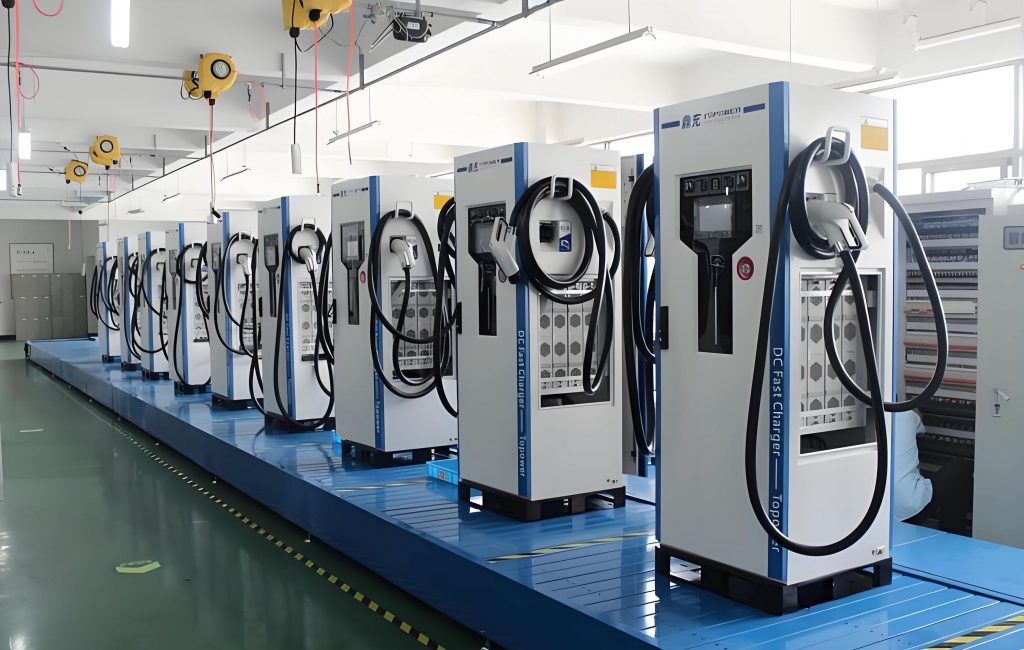
The power output of an EV charging station can be described by the equation:
$$ P_{\text{charge}} = V_{\text{out}} \cdot I_{\text{out}} $$
where \( P_{\text{charge}} \) is the charging power, \( V_{\text{out}} \) is the output voltage, and \( I_{\text{out}} \) is the output current. For efficiency optimization, the overall efficiency \( \eta_{\text{station}} \) of the EV charging station is given by:
$$ \eta_{\text{station}} = \frac{P_{\text{charge}}}{P_{\text{grid}}} \times 100\% $$
with \( P_{\text{grid}} \) being the power drawn from the grid. Key components and their roles in an EV charging station are outlined in Table 3, demonstrating how each element contributes to seamless operation.
| Component | Role | Specifications |
|---|---|---|
| Power Conversion Module | Converts AC grid power to DC for charging | Efficiency >97%, voltage range 50-1000V |
| Charging Interface | Physical and electrical connection to EV | Compatible with CCS, CHAdeMO protocols |
| Communication Unit | Enables data exchange with vehicle BMS | Supports ISO 15118, OCPP standards |
| Management System | Monitors and controls charging sessions | Real-time data analytics, remote access |
This comprehensive architecture ensures that EV charging stations can adapt to the evolving demands of high-power batteries, providing a reliable foundation for widespread EV adoption.
Dynamic Adaptation of Charging Interfaces
Dynamic adaptation of charging interfaces involves multi-degree-of-freedom floating structures and intelligent sensing systems to achieve precise physical alignment. The charging gun incorporates spherical hinge mechanisms with spring-damping units, providing six-dimensional compensation capabilities. Laser displacement sensors detect real-time positional deviations of the vehicle socket, driving servo motors to adjust the robotic arm’s posture for millimeter-level对接补偿. On the EV charging station side, wide-range voltage detection circuits establish bidirectional communication with the vehicle’s Battery Management System (BMS), enabling automatic adaptation of electrical parameters across a 50–1000 V range based on real-time state of charge and temperature data. Programmable logic controllers dynamically switch contactor topologies to facilitate this. Additionally, distributed optical fiber temperature sensor arrays integrated into the interface, combined with serpentine coolant channels and Peltier-effect semiconductor cooling, activate graded current reduction protection upon detecting abnormal local temperature rises, addressing plug-in losses and arc risks in high-power charging scenarios.
The alignment accuracy \( \delta \) can be modeled as:
$$ \delta = \sqrt{(\Delta x)^2 + (\Delta y)^2 + (\Delta z)^2} $$
where \( \Delta x, \Delta y, \Delta z \) are the deviations in spatial coordinates. The electrical adaptation is governed by the voltage-current relationship:
$$ V_{\text{adapt}} = f(SOC, T) \cdot I_{\text{max}} $$
with \( V_{\text{adapt}} \) as the adapted voltage, \( SOC \) the state of charge, \( T \) the temperature, and \( I_{\text{max}} \) the maximum safe current. Table 4 summarizes the key features and benefits of dynamic adaptation in EV charging stations.
| Feature | Description | Benefit for EV Charging Station |
|---|---|---|
| Multi-DOF Floating | Allows spatial compensation for misalignment | Reduces physical wear and improves connection reliability |
| Intelligent Sensing | Uses lasers and sensors for real-time detection | Enables automatic adjustment and enhances safety |
| Wide Voltage Range | Supports 50-1000V dynamic switching | Increases compatibility with various EV models |
By implementing these technologies, we can significantly improve the interoperability and safety of EV charging stations, ensuring efficient energy transfer even under demanding conditions.
Dynamic Power Cooperative Control System
The dynamic power cooperative control system is built on a multi-layer control architecture, where a central coordinator establishes millisecond-level communication links with the BMS and EV charging station controller via fiber-optic ring networks. Distributed edge computing nodes collect real-time data on cell voltage variations and module temperature gradients, coupled with DC bus voltage fluctuations from the EV charging station. Model predictive control algorithms are employed to rolling-optimize power distribution schemes. Power semiconductor devices, such as parallel silicon carbide MOSFET topologies, are configured with gate drive protection circuits and dynamic current sharing controllers, enabling kilowatt-level power adjustments within microseconds through adaptive pulse-width modulation duty cycles. An embedded multi-objective optimizer creates bidirectional power feedback channels between the EV charging station rectifier modules and battery packs, triggering smooth charging curve transitions upon detecting polarization voltage mutations. Ring-shaped DC bus architectures deployed between battery clusters, combined with multi-port isolated DC-DC converters, facilitate dynamic energy调度 across modules, activating energy feedback modes to transfer charge from faulty units to healthy ones under extreme conditions, ensuring optimal energy flow matching and system stability.
The power control can be described by the optimization function:
$$ \min \sum (P_{\text{demand}} – P_{\text{supply}})^2 + \lambda \cdot T_{\text{gradient}} $$
where \( P_{\text{demand}} \) is the power required by the battery, \( P_{\text{supply}} \) is the power supplied by the EV charging station, and \( \lambda \) is a weighting factor for temperature gradient \( T_{\text{gradient}} \). The dynamic response time \( \tau \) for power adjustment is given by:
$$ \tau = \frac{L}{R} $$
with \( L \) representing inductance and \( R \) resistance in the circuit. Table 5 outlines the control layers and their functions in the cooperative system for EV charging stations.
| Control Layer | Function | Impact on EV Charging Station Performance |
|---|---|---|
| Central Coordinator | Orchestrates overall power distribution | Enhances synchronization between multiple EV charging stations |
| Edge Computing Nodes | Process local data for real-time decisions | Reduces latency and improves responsiveness |
| Power Semiconductors | Enable fast switching and regulation | Increases efficiency and supports high-power outputs |
This hierarchical control approach ensures that EV charging stations can dynamically adapt to varying load conditions, maximizing energy utilization and minimizing losses.
Thermal Management Coupling System Design
Thermal management coupling system design establishes a立体化热交换网络 between batteries and EV charging stations. Battery modules incorporate miniaturized liquid cooling plates with fractal-optimized flow channels to minimize contact thermal resistance. The EV charging station side features dual-loop cooling architectures: the primary loop exchanges heat with battery coolant via counter-flow plate heat exchangers, while the secondary loop utilizes phase change material storage units coupled with centrifugal fans for heat dissipation. Heat pipe arrays integrated into battery housings and charging gun handles leverage capillary wicks for定向导热 in high heat flux zones, connecting evaporation sections to battery cooling plates and condensation sections to EV charging station heat sinks. Multi-channel temperature acquisition modules deploy distributed optical fiber sensors at critical points like battery tabs and charging terminals, generating real-time 3D temperature field maps for proactive thermal control.
The heat transfer rate \( \dot{Q} \) in the cooling system can be expressed as:
$$ \dot{Q} = h \cdot A \cdot \Delta T $$
where \( h \) is the heat transfer coefficient, \( A \) is the surface area, and \( \Delta T \) is the temperature difference. For the phase change materials, the energy storage capacity \( E_{\text{PCM}} \) is given by:
$$ E_{\text{PCM}} = m \cdot L_f $$
with \( m \) being the mass and \( L_f \) the latent heat of fusion. Table 6 summarizes the components and their roles in the thermal management system for EV charging stations.
| Component | Role | Benefit in EV Charging Station Context |
|---|---|---|
| Liquid Cooling Plates | Direct heat extraction from battery cells | Prevents overheating during high-power charging |
| Dual-Loop Architecture | Separates primary and secondary cooling cycles | Enhances reliability and allows scalable EV charging station designs |
| Heat Pipe Arrays | Facilitates efficient heat dissipation | Reduces thermal hotspots and extends equipment life |
By coupling thermal management between batteries and EV charging stations, we can maintain optimal operating temperatures, ensuring safety and efficiency across the charging lifecycle.
Security Protection System Construction
Security protection system construction adopts a layered defense architecture. Charging guns integrate arc fault detection and current ripple analysis modules to monitor abnormal discharges, while battery packs deploy multi-frequency impedance spectroscopy units to identify electrolyte decomposition. EV charging station power modules incorporate redundant discharge circuits, using IGBT clamping to limit overvoltage during transients. A three-level insulation monitoring network is established: the main circuit measures leakage currents, auxiliary circuits track insulation trends, and control circuits block interference. Contact terminals implement fuse-ejection mechanisms, triggering millisecond-level disconnection upon abnormal temperature rises. Data security layers employ dynamic key encryption, bidirectional asymmetric algorithms, and virtual private channels, combined with electrical isolation, thermal protection, and electromagnetic filtering, to ensure comprehensive safety throughout the energy transmission process at EV charging stations.
The risk mitigation can be quantified using the failure rate \( \lambda_f \) and mean time between failures (MTBF):
$$ \text{MTBF} = \frac{1}{\lambda_f} $$
For electrical safety, the leakage current \( I_{\text{leak}} \) is constrained by:
$$ I_{\text{leak}} < I_{\text{safe}} $$
where \( I_{\text{safe}} \) is the safety threshold. Table 7 outlines the defense layers and their functions in securing EV charging stations.
| Defense Layer | Function | Application in EV Charging Station |
|---|---|---|
| Physical Protection | Prevents electrical faults and physical damage | Ensures safe operation during high-power charging |
| Thermal Monitoring | Detects and responds to overheating events | Reduces fire risks and enhances reliability |
| Data Encryption | Secures communication between vehicle and station | Protects against cyber threats in smart EV charging stations |
This multi-layered approach fortifies EV charging stations against a wide range of hazards, promoting user confidence and system durability.
Standardized Charging Protocol Integration
Standardized charging protocol integration utilizes programmable protocol conversion gateways, deploying multi-core processors to run multiple protocol stacks isolated by high-speed optocouplers. Automatic recognition modules identify charging standards within 100 ms based on protocol signature codes. The protocol converters support over-the-air updates, automatically matching optimal charging curves during handshake phases. Data link layers implement dual checksums to ensure transmission reliability, while edge computing units optimize protocol switching logic, falling back to basic protocols in case of communication interruptions, thereby enabling efficient energy交互 in EV charging stations.
The protocol compatibility can be modeled as a function of the number of supported standards \( N \) and the success rate \( S \):
$$ S = 1 – e^{-k \cdot N} $$
where \( k \) is a constant. The data integrity is ensured by the checksum equation:
$$ \text{Checksum} = \sum \text{data bytes} \mod M $$
with \( M \) being the modulus. Table 8 summarizes the key aspects of protocol integration for EV charging stations.
| Aspect | Description | Role in EV Charging Station Operation |
|---|---|---|
| Programmable Gateways | Enable multi-protocol support and updates | Increases flexibility and future-proofing of EV charging stations |
| Automatic Recognition | Quickly identifies and adapts to vehicle protocols | Reduces setup time and improves user experience |
| Edge Computing | Optimizes protocol management locally | Enhances reliability and reduces dependency on central systems |
By integrating standardized protocols, we can achieve seamless interoperability across diverse EV models, making EV charging stations more accessible and efficient.
Operation and Maintenance Technical System
Operation and maintenance technical system constructs a full-lifecycle intelligent maintenance platform, leveraging multi-source heterogeneous sensors to collect real-time data on battery expansion forces and EV charging station arc parameters, complemented by mobile inspection terminals for internal device status monitoring. A digital twin engine builds 3D visual models, fusing current harmonics and thermal imaging data, with deep residual networks accurately assessing EV charging station power module aging and battery separator crystallization. Remote maintenance terminals integrate virtual debugging environments, using secure tunnel protocols for firmware updates and parameter tuning, while maintenance records are synchronized to blockchain for authentication, achieving optimal control throughout the operational lifecycle of EV charging stations.
The maintenance efficiency can be evaluated using the availability \( A \):
$$ A = \frac{\text{MTBF}}{\text{MTBF} + \text{MTTR}} $$
where MTTR is the mean time to repair. For predictive maintenance, the remaining useful life (RUL) of components can be estimated as:
$$ \text{RUL} = \frac{C_{\text{current}} – C_{\text{failure}}}{C_{\text{degradation rate}}} $$
with \( C \) representing condition parameters. Table 9 outlines the components and benefits of the O&M system for EV charging stations.
| Component | Function | Impact on EV Charging Station Sustainability |
|---|---|---|
| Intelligent Platform | Centralizes data analytics and monitoring | Enables proactive maintenance and reduces downtime |
| Digital Twin | Simulates real-world conditions for analysis | Improves decision-making and optimizes EV charging station performance |
| Blockchain Integration | Secures maintenance records and transactions | Enhances transparency and trust in EV charging station networks |
This integrated O&M approach ensures that EV charging stations remain reliable and efficient over their entire lifespan, supporting continuous improvement in EV infrastructure.
Conclusion
In this article, we have explored the integration of high-power batteries with EV charging station technologies, focusing on dynamic adaptation, power control, and thermal management in design, alongside security, protocol fusion, and maintenance in optimization. Our proposed strategies enhance battery cycle life and EV charging station utilization, contributing to the sustainable growth of the electric vehicle industry. By addressing key challenges through systematic integration, we pave the way for more resilient and efficient EV charging infrastructures, ensuring that EV charging stations can meet future demands for high-power energy transfer.