
The global shift towards sustainable transportation, driven by energy security concerns and stringent environmental policies, has led to unprecedented demand for Electric Vehicles (EVs). This surge places immense emphasis on the safety, reliability, and performance of their core component: the high-voltage traction battery. To meet the ever-increasing demands for driving range and energy density, the automotive industry has increasingly adopted Cell-to-Pack (CTP) architectures for EV battery pack systems. This design paradigm eliminates or significantly reduces intermediate module housings, directly assembling battery cells into the pack enclosure. This integration maximizes space utilization and reduces weight, directly contributing to improved vehicle efficiency. However, this architectural shift introduces new engineering challenges, particularly concerning the mechanical integrity of the cell-to-pack interface, which is primarily secured using structural or thermally conductive structural adhesives.
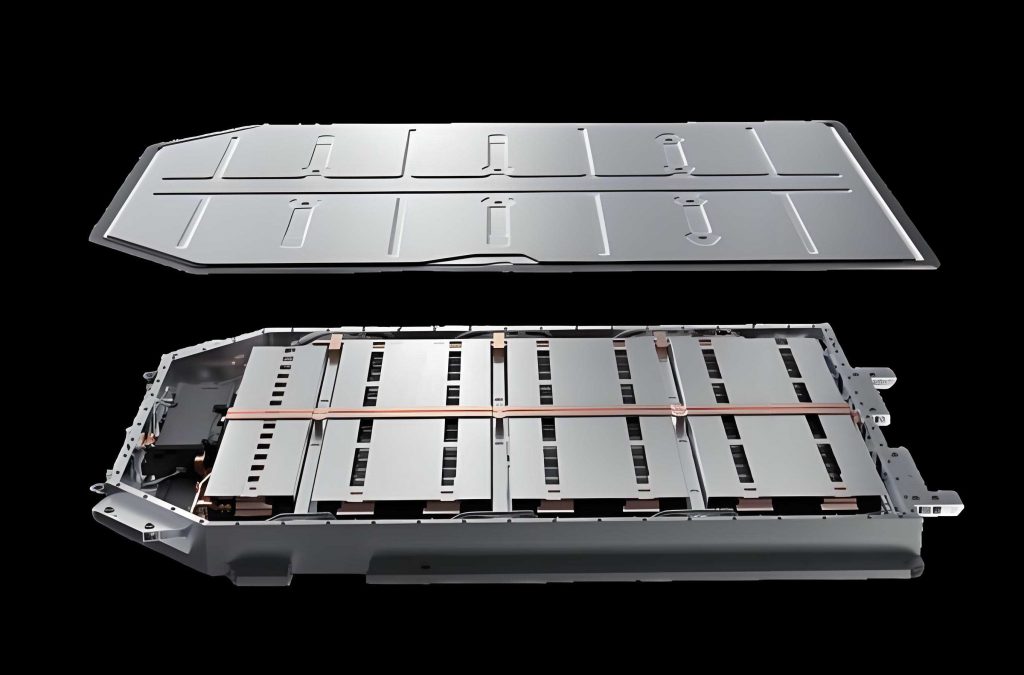
In a CTP EV battery pack, large-format prismatic or pouch cells are typically bonded directly onto a cooling plate or the pack’s internal structure. This adhesive bond must withstand a lifetime of mechanical, thermal, and environmental loads encountered during vehicle operation. Among these, vibration-induced stresses are particularly critical, as they can lead to progressive debonding or delamination of the adhesive layer, compromising thermal management, electrical isolation, and ultimately, the structural safety of the pack. Therefore, developing a reliable predictive methodology to assess adhesive performance under vibration is paramount for robust EV battery pack design. This study details a first-principles simulation approach, validated by physical testing, to calculate the potential debonding area in a CTP configuration subjected to standard vibration spectra.
Finite Element Simulation of Adhesive Stress Under Random Vibration
The foundation of our predictive methodology is a high-fidelity Finite Element Model (FEM). We constructed a detailed model of a CTP EV battery pack comprising multiple cell blocks bonded to an aluminum cold plate. The adhesive layer, a thermally conductive structural compound, was explicitly modeled with its true thickness (e.g., 1.0 mm). The material properties for the adhesive, critical for accurate stress prediction, were defined as follows: density $\rho = 2.43 \, \text{g/cm}^3$, Young’s modulus $E = 205 \, \text{MPa}$, and Poisson’s ratio $\nu = 0.38$. The cells, cold plate, and pack enclosure were modeled with their respective mechanical properties. A finely discretized mesh, with element sizes as small as 0.1 mm within the adhesive layer, was employed to accurately capture stress gradients.
The loading condition is defined by the Power Spectral Density (PSD) profiles stipulated in the national standard “Safety Requirements for Power Batteries Used for Electric Vehicles” (GB 38031-2020), which is harmonized with international regulations. This standard defines acceleration PSD levels across a frequency range (e.g., 5-200 Hz) for three orthogonal axes (X, Y, Z). A random vibration analysis was performed using the Modal Superposition method. First, a normal modes analysis was conducted to extract the system’s natural frequencies and mode shapes. The dynamic response (stress) due to the random vibration input was then calculated by superimposing the responses of these individual modes.
The primary output of interest is the stress state within the adhesive layer. For debonding initiation, the peel stress (tensile stress normal to the bonding plane) is often the dominant failure driver. The simulation computes the stress distribution across the entire adhesive interface. We define a failure criterion based on the adhesive’s allowable peel strength, $\sigma_{\text{allowable}}$. Any nodal stress value exceeding this threshold is considered a point of potential debonding. The total volume of adhesive elements where $\sigma > \sigma_{\text{allowable}}$ is calculated as the debonded volume, $V_d$. Since the adhesive layer has a uniform nominal thickness $t$, the debonded area $A_d$ is directly proportional to the debonded volume:
$$ A_d = \frac{V_d}{t} $$
To express the result as a risk metric, we calculate the Debonding Area Ratio ($R$), which is the ratio of the predicted debonded area to the total bonded area $A_{total}$:
$$ R = \frac{A_d}{A_{total}} \times 100\% = \frac{V_d}{V_{total}} \times 100\% $$
Based on cumulative project experience, we established a risk classification framework correlating the simulated $R$ value with the likelihood of vibration-induced failure in the physical EV battery pack.
| Simulated Debonding Area Ratio (R) | Risk Assessment | Interpretation for EV Battery Pack |
|---|---|---|
| $R < 3\%$ | Green (Pass) | Negligible risk of adhesive failure under vibration. |
| $3\% \leq R \leq 5\%$ | Yellow (Marginal) | Low to moderate risk; design should be reviewed or validated with test. |
| $R > 5\%$ | Red (Fail) | High risk of significant adhesive degradation; design change required. |
Experimental Validation Using the Red Ink Tracer Method
To validate the accuracy of the simulation predictions, physical vibration tests followed by a forensic analysis of the adhesive bond were conducted. The test article was a fully functional CTP EV battery pack prototype. It was subjected to the same three-axis random vibration profile defined in the standard GB 38031-2020 on an electrodynamic shaker system. Pre-test and post-test frequency response sweeps were performed to monitor any shift in the pack’s natural frequency, an indicator of global stiffness loss potentially due to large-scale debonding.
Following the vibration test, the internal condition of the adhesive interface was inspected using the Red Ink Tracer Method. This technique is highly effective for identifying microscopic disbonds or gaps in adhesive joints. The process is as follows:
- Preparation: The EV battery pack is discharged to a safe voltage. Electrical connections and busbars are carefully disconnected.
- Ink Injection: Red ink, a low-viscosity penetrating dye, is introduced into the gaps and channels between adjacent cells within the pack.
- Capillary Action: The ink is drawn by capillary forces into any existing void or separation at the interface between the cell bottom and the adhesive/cold plate.
- Curing & Disassembly: The pack is left for a sufficient period (often accelerated in an oven) for the ink to fully permeate and dry. Subsequently, the pack is meticulously disassembled, and the cell blocks are separated from the cold plate.
- Inspection & Measurement: The bonding surfaces on both the cells and the cold plate are examined. Areas where debonding occurred are distinctly stained by the red ink, while well-bonded areas remain clean. The total stained (debonded) area is measured, often using digital image analysis software, and the experimental Debonding Area Ratio $R_{exp}$ is calculated.
The quantitative comparison between the simulated ratio $R_{sim}$ and the experimental ratio $R_{exp}$ serves as the key validation metric. A high degree of correlation confirms the fidelity of the simulation model, including its boundary conditions, material properties, and failure criterion.
Case Study: Baseline Design vs. Reinforced Design
We applied this coupled simulation-test methodology to two successive iterations of a CTP EV battery pack design: a Baseline design and a structurally Reinforced design.
1. Baseline CTP Pack Design
The initial FEM of the baseline pack predicted a first-order global natural frequency of 33.3 Hz. The random vibration simulation predicted a debonding area ratio $R_{sim} = 4.7\%$, placing it in the “Yellow/Marginal” risk category and forecasting a potential reliability issue.
The physical test validated this prediction. The pre-vibration frequency sweep measured a first-mode frequency of 32.3 Hz, showing excellent correlation (97.0%) with the model and confirming model accuracy. Post-vibration, the frequency dropped significantly to 26.7 Hz, indicating a loss of stiffness consistent with adhesive failure. Disassembly and red ink analysis revealed widespread debonding. The measured debonded area resulted in $R_{exp} = 5.0\%$. The agreement between simulation and experiment was 94%, strongly validating the simulation’s predictive capability for the baseline EV battery pack.
| Metric | Simulation (Baseline) | Experiment (Baseline) | Agreement |
|---|---|---|---|
| 1st Natural Frequency | 33.3 Hz | 32.3 Hz | 97.0% |
| Debonding Area Ratio (R) | 4.7% | 5.0% | 94.0% |
2. Reinforced CTP Pack Design
In response to the baseline results, the pack structure was reinforced to increase global stiffness and reduce stress transfer to the adhesive layer. The updated FEM for the reinforced EV battery pack predicted a higher first-mode frequency of 37.7 Hz and, crucially, a dramatically reduced $R_{sim} = 2.7\%$, within the “Green/Pass” threshold.
Physical testing of the reinforced pack confirmed the improvement. The pre-vibration frequency was measured at 38.9 Hz (96.9% correlation with simulation). Most importantly, no significant frequency drop occurred after the vibration test (post-test frequency: 39.1 Hz), indicating no global damage. The red ink inspection showed only minimal, isolated debonding, with a measured $R_{exp} = 2.5\%$. The simulation-experiment agreement for the debonding area was 92.0%. This successful outcome demonstrated that the simulation methodology could not only identify failure but also reliably predict the success of a design mitigation, saving significant time and cost in the development cycle for the EV battery pack.
| Metric | Simulation (Reinforced) | Experiment (Reinforced) | Agreement |
|---|---|---|---|
| 1st Natural Frequency | 37.7 Hz | 38.9 Hz | 96.9% |
| Debonding Area Ratio (R) | 2.7% | 2.5% | 92.0% |
Discussion and Implications for EV Battery Pack Development
The consistent alignment (over 90%) between simulation predictions and experimental outcomes across both failing and passing designs provides robust evidence for the reliability of this methodology. The high correlation in modal frequencies confirms that the FEM accurately captures the dynamic stiffness of the complex EV battery pack system. The high correlation in debonding area validates the selected failure criterion (peel stress exceedance) and the overall approach to translating dynamic stress results into a quantifiable degradation metric.
This methodology offers several key advantages for the development of CTP-based EV battery pack systems:
- Predictive Design: It enables engineers to assess the vibration durability of the adhesive system early in the virtual design phase, long before physical prototypes are built. This facilitates rapid iteration and optimization of pack structure, adhesive application patterns, and material selection.
- Quantifiable Risk Assessment: The Debonding Area Ratio $R$ provides a clear, quantitative metric for judging design adequacy, moving beyond qualitative pass/fail judgments. The established thresholds (Green/Yellow/Red) offer practical guidance for decision-making.
- Cost and Time Efficiency: By identifying potential failures virtually and validating design fixes with high confidence, the number of costly physical test cycles can be significantly reduced, accelerating time-to-market for new EV battery pack designs.
- Insight into Failure Mechanics: The simulation provides a full-field view of stress concentrations within the adhesive, highlighting specific zones (e.g., pack corners, cell edges) that are most prone to failure. This insight is invaluable for targeted design improvements.
Future work could involve refining the failure criterion to account for multi-axial stress states (e.g., using a von Mises or a dedicated adhesive failure envelope), incorporating fatigue damage accumulation models for the adhesive over vibration time, and studying the interaction between thermal cycling and mechanical vibration stresses in the EV battery pack.
Conclusion
This study presents and validates an integrated simulation and experimental methodology for predicting adhesive debonding in CTP EV battery pack systems under standardized vibration loading. The core of the method involves performing a random vibration finite element analysis using modal superposition, calculating the areas where adhesive peel stress exceeds a material allowables-based threshold, and expressing the result as a Debonding Area Ratio $R$. This virtual prediction is rigorously validated using physical vibration testing followed by the red ink tracer method for precise post-mortem debonding area measurement.
The results from analyzing both a baseline and a reinforced EV battery pack design demonstrated exceptional consistency, with simulation-experiment agreement rates exceeding 90% for the critical debonding area metric. Furthermore, the practical risk threshold framework was corroborated: designs with $R < 3\%$ showed no significant failure, those with $R$ between 3-5% exhibited measurable degradation, and designs with $R > 5\%$ suffered substantial adhesive failure. This validated methodology provides a powerful, reliable, and efficient tool for ensuring the mechanical robustness and long-term reliability of next-generation CTP EV battery pack architectures, contributing directly to the safety and durability of electric vehicles.