
In the rapidly evolving landscape of electric vehicles (EVs), the EV battery pack stands as a critical component, directly influencing vehicle range, safety, and performance. The dual demands of enhanced safety and stringent lightweighting have driven intensive research into material and structural solutions. Aluminum alloys, with their favorable strength-to-weight ratio, corrosion resistance, and thermal properties, have emerged as a pivotal material for lightweighting the lower enclosure of the EV battery pack. This article, from a first-person perspective of the engineering development team, details the comprehensive design, simulation, and validation process for a new aluminum alloy lower shell for an EV battery pack, achieving significant weight reduction while meeting rigorous safety standards, particularly in side pole impact scenarios.
The national policies promoting new energy vehicles have set high benchmarks for driving range and battery system energy density. While increasing the energy density of individual cells is one path, it often elevates thermal runaway risks. Consequently, structural lightweighting of the EV battery pack has become a crucial and safer strategy to extend range. The lower enclosure, or the underbody, of the EV battery pack is the core carrier for the energy storage system. It must fulfill extremely demanding protective functions: managing thermal runaway, withstanding collisions, resisting crushing and vibration, and preventing corrosion. As EV battery pack dimensions increase to boost capacity, this lower shell also participates in the vehicle’s overall crash load path, making its structural integrity paramount. Aluminum, with a density roughly one-third that of steel, offers excellent thermal stability, corrosion resistance, and high recyclability, making it an ideal lightweight material for the EV battery pack enclosure. The inherent characteristics of extruded aluminum profiles, such as flexible cross-sectional geometry, provide high stiffness and superior energy absorption, presenting promising applications for the main frame and load-bearing components of the EV battery pack lower shell.
Among various crash scenarios, the side pole impact is particularly severe for an EV battery pack due to its concentrated load application. The introduction of the side pole impact test in the 2021 C-NCAP protocol underscores the focus on evaluating the collision safety of electric vehicle battery systems. Therefore, developing a robust lower enclosure that can protect the EV battery pack in such events is a central engineering challenge addressed in this work.
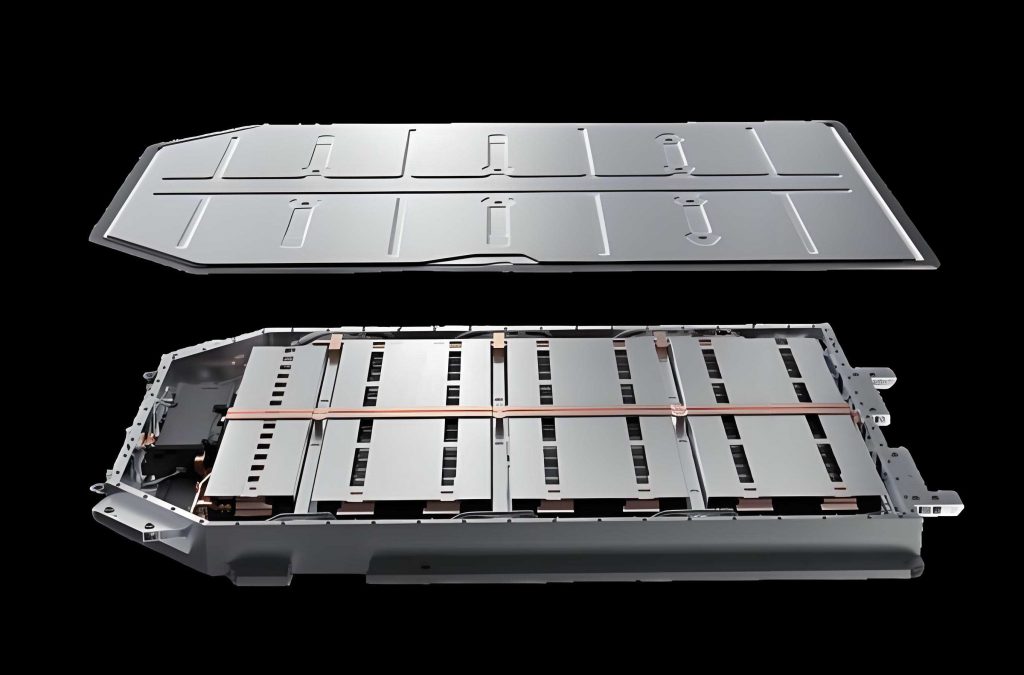
The structural design of the aluminum alloy lower enclosure for the EV battery pack was driven by a holistic approach balancing lightweighting, manufacturability, and performance. The primary architecture comprises three key elements: a perimeter frame, internal crossbeams, and a base plate. The layout of these components was meticulously aligned with the cell module arrangement and the vehicle’s designated load paths. Three internal crossbeams were positioned strategically within the EV battery pack to provide internal support and load distribution.
The perimeter frame and crossbeams were fabricated using extruded aluminum profiles. The cross-section of the side rail was carefully engineered, as illustrated conceptually, to integrate multiple functions: mounting interfaces for the EV battery pack to the vehicle, sealing surfaces, structural strength, and crucially, controlled energy absorption. The design philosophy leveraged the outer region of the profile for progressive crushing and energy dissipation during a crash, while the inner region was reinforced to maintain stability and prevent inward collapse that could threaten the battery cells. Given the complexity of the multi-cavity cross-section, the aluminum alloy 6061-T6 was selected. This material offers an optimal balance, providing high strength (yield strength of 240 MPa, tensile strength of 260 MPa) with sufficient elongation (8%) to facilitate the extrusion of intricate shapes.
The base plate of the EV battery pack enclosure serves a dual purpose: providing structural support for the cell stacks and integrating the thermal management system. It was constructed from a single, stamped aluminum sheet formed into a cold plate, which was then integrated directly onto the frame. This design eliminates separate components, contributing to weight savings. The joining methodology was critical for structural integrity and sealing. The aluminum-to-aluminum joints between the frame members were achieved using Cold Metal Transfer (CMT) welding, a low-heat input arc welding process that provides strong, ductile connections suitable for crash load-bearing structures. For attaching the base plate to the frame, Flow Drill Screwing (FDS) technology was employed. Compared to alternatives like Friction Stir Welding (FSW), FDS offers advantages such as lower heat generation, reduced equipment cost, and compatibility with sealed joints. A dedicated sealant was applied between the base plate and the frame to ensure the EV battery pack enclosure’s ingress protection rating.
A quantitative comparison against a previous-generation, similarly sized steel enclosure for an EV battery pack demonstrated the success of this aluminum design. The new aluminum alloy lower shell achieved a mass reduction of 23%, a significant leap in lightweighting for the EV battery pack system.
The performance of the newly designed aluminum alloy EV battery pack enclosure was rigorously evaluated through a combination of simulation and physical testing. The assessment focused on two key scenarios: a component-level static crush test per safety standards and a full-vehicle side pole impact simulation aligned with C-NCAP.
To ensure high-fidelity simulation results, accurate material and connection properties were essential. Specifically, the behavior of the aluminum CMT welds under both quasi-static and dynamic loading conditions was characterized through tensile testing. Specimens representing the weld joints were tested at different strain rates to capture their rate-dependent mechanical response.
The true stress ($\sigma$) vs. true strain ($\varepsilon$) curves were obtained from these tests. The static tensile curve provided the baseline behavior. For dynamic loading relevant to crashes, tests were conducted at speeds of 1 m/s, 5 m/s, and 10 m/s. The data revealed a clear strain-rate strengthening effect, which is crucial for accurately predicting crash performance. The general form of a commonly used material model, like the Johnson-Cook model, can be expressed as:
$$ \sigma = (A + B \varepsilon^n) \left(1 + C \ln \frac{\dot{\varepsilon}}{\dot{\varepsilon}_0}\right) $$
Where $A$, $B$, $C$, and $n$ are material constants, $\varepsilon$ is the equivalent plastic strain, $\dot{\varepsilon}$ is the strain rate, and $\dot{\varepsilon}_0$ is a reference strain rate. While the specific constants for the weld material are proprietary, the tested data was directly implemented into the finite element model to define the connection behavior. The following table summarizes key parameters derived from the material characterization for the aluminum alloy 6061-T6 and the typical joint performance.
| Material/Component | Yield Strength (MPa) | Tensile Strength (MPa) | Elongation at Break (%) | Notable Characteristic |
|---|---|---|---|---|
| 6061-T6 Aluminum | 240 | 260 | 8 | Base material for extrusions |
| CMT Weld Joint (Static) | ~200* | ~230* | ~6* | Ductile failure mode |
| CMT Weld Joint (Dynamic, 10 m/s) | Increased by ~15%* | Increased by ~12%* | Reduced slightly | Strain-rate sensitivity |
*Representative values based on test data; exact values are design-sensitive.
The first simulation evaluated the EV battery pack enclosure’s resistance to side intrusion according to the GB 38031-2020 standard (electric vehicle traction battery safety requirements). The test setup simulates a static crush where a semi-cylindrical indenter with a radius ( $R$ ) of 75 mm is pressed into the side of the EV battery pack enclosure at a velocity ( $v$ ) of 1 m/s. The criteria for passing are that the force must reach 100 kN before the indenter displacement exceeds 30% of the EV battery pack enclosure’s initial thickness in that direction.
The finite element model of the complete EV battery pack, including cells, modules, and the aluminum enclosure, was constructed following stringent corporate meshing standards. The simulation predicted the force-displacement response. The crush force ( $F$ ) as a function of displacement ( $d$ ) was monitored. The analysis showed that the force reached the 100 kN threshold at approximately 22 ms, at which point the inward deformation of the aluminum side frame was well below the 30% limit. Critically, the deformation was contained within the frame’s designed crumple zones, and no contact with the internal battery cells or high-voltage components occurred. This confirmed that the aluminum lower shell for the EV battery pack met the regulatory requirement for side crush resistance. The energy absorbed ( $E_{absorbed}$ ) by the enclosure in this test can be estimated by integrating the force-displacement curve:
$$ E_{absorbed} = \int_{0}^{d_{100kN}} F(d) \, dd $$
Where $d_{100kN}$ is the displacement at 100 kN force. The aluminum frame’s design efficiently converted this work into plastic deformation.
The most critical evaluation involved integrating the detailed EV battery pack model into a full vehicle finite element model to simulate the C-NCAP side pole impact. In this test, the vehicle impacts a rigid pole at a velocity of 32 km/h (approximately 8.89 m/s) at a 75-degree angle. For the EV battery pack, the ultimate safety criteria are the prevention of electrical shock, minimization of electrolyte leakage, and avoidance of fire or explosion (RESS safety). For CAE assessment, these are translated into measurable intrusion limits for the battery enclosure to ensure no contact with cells or critical components.
Based on the internal layout of the EV battery pack, specific zones on the lower enclosure were defined with corresponding intrusion tolerance targets. The primary metric was the inward deformation in the vehicle’s Y-direction (lateral direction).
| Zone on Enclosure | Description / Location | Maximum Allowable Y-Intrusion Target |
|---|---|---|
| Zone A | Critical area near central cell modules | ≤ 35 mm |
| Zone B | Wider perimeter area of the side frame | ≤ 52 mm |
| Cell Modules | Direct measurement on cell surface |
The full-vehicle crash simulation was executed. The results demonstrated that the aluminum EV battery pack enclosure performed as intended. The extruded side rails exhibited a controlled, progressive collapse sequence, with the outer section folding and absorbing kinetic energy while the inner reinforced section remained largely intact, preventing catastrophic inward breach. The simulated intrusion values were extracted from the model.
| Performance Metric | Simulation Result | Target | Status |
|---|---|---|---|
| Y-Intrusion in Zone A | 20.8 mm | ≤ 35 mm | Pass |
| Y-Intrusion in Zone B | 20.7 mm | ≤ 52 mm | Pass | Cell Deformation Risk | Negligible (No contact) | Pass |
The deformation pattern validated the “outer crush, inner stable” design philosophy. The aluminum structure effectively managed the crash energy, with the force transmitted through the EV battery pack enclosure’s frame into the vehicle’s body structure. The energy balance in such an impact can be described conceptually. The initial kinetic energy ( $KE_{initial}$ ) of the vehicle is dissipated by work done on various structures:
$$ KE_{initial} = \frac{1}{2} M v^2 = W_{vehicle} + W_{battery\_enclosure} + W_{other} $$
Where $M$ is the effective mass, $v$ is impact velocity, and $W$ represents the energy absorbed by different components. The EV battery pack enclosure’s contribution, $W_{battery\_enclosure}$, through plastic deformation, is a key factor in protecting its internal contents.
While simulation provides strong confidence, physical validation is indispensable for a safety-critical component like the EV battery pack enclosure. A prototype vehicle equipped with the new aluminum alloy EV battery pack was manufactured and subjected to an actual side pole impact test under standardized conditions.
The physical test corroborated the simulation findings. The aluminum lower shell demonstrated excellent energy absorption characteristics. Post-test inspection and measurement of the EV battery pack enclosure revealed a maximum lateral intrusion of 21.58 mm in the side frame area corresponding to Zone B. This value was significantly lower than the 52 mm target and closely matched the simulation prediction of 20.7 mm, confirming the high accuracy of the finite element model that incorporated the characterized material and joint properties.
Furthermore, the EV battery pack passed all critical safety checks post-impact: there was no electrical isolation fault, no measurable electrolyte leakage, and no signs of thermal runaway, fire, or explosion. The integrity of the EV battery pack was maintained, fulfilling the fundamental safety objectives of the crash test.
The comprehensive development process for this aluminum alloy lower enclosure for an EV battery pack demonstrates a viable and effective path for achieving simultaneous lightweighting and enhanced safety. Through a systematic approach involving innovative structural design utilizing extruded profiles, careful material and joining selection, high-fidelity simulation driven by empirically derived data, and final physical validation, the project achieved a 23% weight reduction compared to a previous steel solution while successfully meeting stringent side impact protection requirements.
The success of this design provides a valuable reference and confidence for the broader application of aluminum alloy solutions in mass-produced EV battery pack systems. The methodologies employed, particularly the integration of dynamic material properties for joints and the zone-based intrusion target setting, contribute to the advancing engineering practices for EV battery pack safety development. As the automotive industry continues its shift toward electrification, the role of lightweight, high-performance enclosures for the EV battery pack will only grow in importance, making such research and development efforts crucial for the next generation of sustainable and safe electric vehicles. Future work may explore further optimization of the cross-section geometries for even greater efficiency, the use of advanced high-strength aluminum grades, and the integration of multi-material concepts to continue pushing the boundaries of EV battery pack performance.