
As a researcher in the field of electric vehicle (EV) technology, I have dedicated significant effort to understanding and improving the reliability of electric motors in new energy vehicles. Electric motors are the heart of EVs, and their performance directly impacts vehicle efficiency, safety, and longevity. In this article, I will share my insights into common motor faults, advanced diagnostic techniques, and innovative maintenance strategies that can enhance EV repair processes. The growing adoption of electric vehicles worldwide necessitates robust electrical car repair methodologies to minimize downtime and costs. Through a combination of theoretical analysis and practical case studies, I aim to demonstrate how systematic approaches can revolutionize EV repair and maintenance.
Electric motors in EVs are subject to various stressors, including high loads, thermal cycles, and electrical surges, leading to diverse fault types. Common issues include startup failures, overheating, abnormal vibrations and noises, and electrical faults such as winding shorts or insulation breakdown. These problems not only affect driving performance but also pose safety risks. For instance, overheating can degrade motor components, while electrical faults may lead to sudden power loss. In electrical car repair, accurately diagnosing these faults is crucial. Below, I present a detailed table summarizing key fault types, their causes, and implications for EV repair.
| Fault Type | Common Causes | Impact on EV Performance |
|---|---|---|
| Startup Failure | Low battery charge, faulty startup circuit, mechanical jamming | Inability to initiate motion, reduced reliability |
| Overheating | Prolonged high-load operation, cooling system failure, internal short circuits | Decreased efficiency, potential component damage |
| Vibration and Noise | Rotor imbalance, bearing wear, loose installation | Poor ride comfort, indication of mechanical wear |
| Electrical Faults | Winding short circuits, open circuits, insulation degradation | Irregular current flow, motor malfunction |
To address these issues, modern fault diagnosis techniques have evolved, leveraging signal processing, machine learning, and model-based reasoning. In my work, I emphasize the importance of a prepared diagnostic approach for effective EV repair. Before diagnosis, technicians must understand the vehicle’s electrical system principles, including motor control strategies and sensor networks. Tools like digital multimeters, oscilloscopes, and vibration analyzers are essential. For example, in signal processing-based diagnosis, current signals are analyzed using Fourier transforms to detect anomalies. The frequency of sidebands due to faults like rotor bar breakage can be calculated using the formula: $$f_s = s f_1$$ where \(f_s\) is the sideband frequency, \(s\) is the slip ratio, and \(f_1\) is the supply frequency. This method helps identify faults early, reducing the need for extensive electrical car repair.
Machine learning techniques, particularly deep learning, have transformed EV repair by enabling predictive diagnostics. In my research, I have applied convolutional neural networks (CNNs) to classify motor faults based on multi-dimensional data such as temperature, current, and vibration. The CNN model, such as LeNet-5, automatically extracts features through convolutional and pooling layers. During training, the cross-entropy loss function is minimized: $$L_t = -\frac{1}{N} \sum_{t=1}^{N} \sum_{j=1}^{C} y_{ij} \log(p_{ij})$$ where \(N\) is the number of samples, \(C\) is the number of classes, \(y_{ij}\) is the true label, and \(p_{ij}\) is the predicted probability. Using stochastic gradient descent with a learning rate of 0.001, models can achieve over 98% accuracy in fault identification, streamlining electrical car repair processes.
Model-based reasoning relies on physical models of the motor to infer faults. For a DC motor, the voltage balance equation is: $$U = E + I_a R_a$$ where \(U\) is the armature voltage, \(E\) is the back EMF, \(I_a\) is the armature current, and \(R_a\) is the armature resistance. The torque equation is: $$T = C_T \phi I_a$$ where \(T\) is the electromagnetic torque, \(C_T\) is the torque constant, and \(\phi\) is the air gap flux. By comparing measured values with model predictions, deviations of more than 10% can indicate faults like winding shorts, guiding targeted EV repair actions.
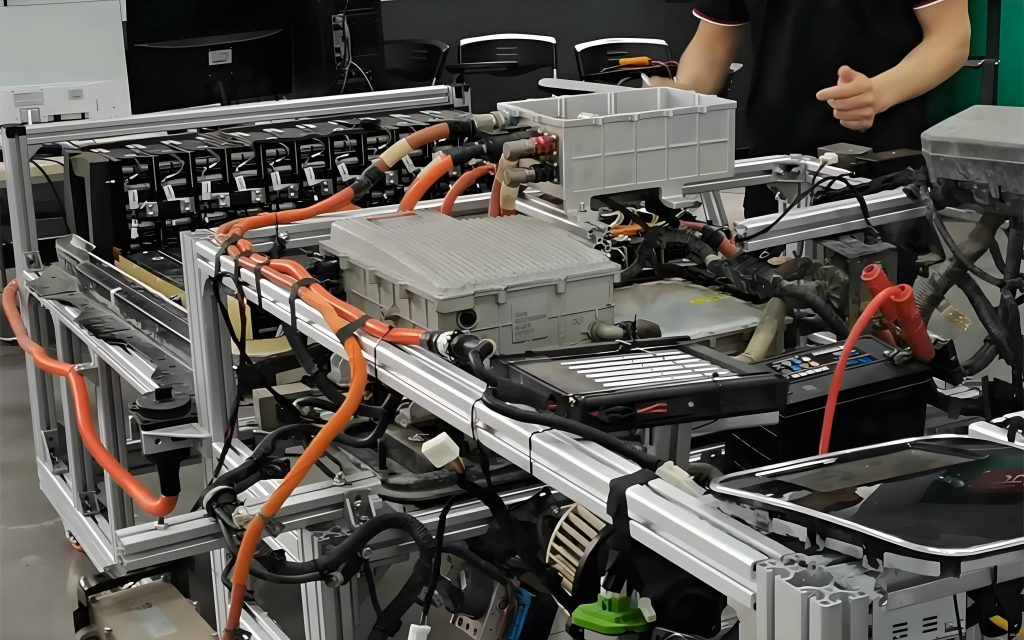
Innovative maintenance strategies are pivotal for sustainable EV repair. I advocate for a tripartite approach: preventive maintenance, corrective maintenance, and replacement strategies. Preventive maintenance focuses on monitoring key parameters to avert faults. For instance, temperature sensors track winding temperatures, with optimal ranges between 100°C and 120°C for permanent magnet synchronous motors. If temperatures exceed 125°C consecutively, cooling systems are inspected—coolant flow rates should be maintained at 5-8 L/min, and heat exchanger efficiency must exceed 85%. Vibration monitoring uses sensors to detect imbalances; normal vibration severity should be below 7.1 mm/s, and spectral analysis can pinpoint issues like bearing wear. Insulation resistance tests are conducted monthly, with values above 10 MΩ considered safe. This proactive approach reduces the frequency of electrical car repair interventions.
Corrective maintenance involves repairing diagnosed faults. For winding shorts, if the fault is external, insulation is reapplied after cleaning; for internal shorts, rewinding is necessary, adhering to original specifications like 500 turns, 0.8 mm wire diameter, and a 1-8 pitch. Post-repair, winding resistance should deviate by less than ±5% from design values. Bearing replacement requires precision fits with interference of 0.02-0.05 mm, and after installation, tests ensure vibration acceleration remains under 1.5 m/s² and temperature rise below 50°C under load. Overheating due to clogged cooling systems is addressed by flushing passages to restore flow rates, and fan replacements ensure airflows of 300-500 m³/h. These methods enhance the efficiency of EV repair.
Replacement strategies are employed when repair costs exceed 70% of a new motor’s price or when performance degradation is irreversible, such as with severe core magnetization or vibration severity over 11.2 mm/s. In EV repair, matching motor specifications—like 150 kW power, 12,000 rpm speed, and 380 V voltage—is critical. Post-replacement, controller parameters are tuned for system integration, ensuring acceleration time variations under 5% and range changes within 3%. The table below compares data from a case study, illustrating the effectiveness of these strategies in electrical car repair.
| Parameter | Pre-Repair Value | Standard Value | Post-Repair Value |
|---|---|---|---|
| Coolant Flow Rate (L/min) | 3 | 5-8 | 6 |
| Vibration Severity (mm/s) | 10 | < 7.1 | Within standard |
| Insulation Resistance (MΩ) | 8 | ≥ 10 | 12 |
| No-Load Vibration Acceleration (m/s²) | – | < 1.5 | 1.2 |
| Load Temperature Rise (°C) | – | ≤ 50 | 40 |
| Acceleration Time Variation | – | < 5% | < 5% |
| Range Variation | – | < 3% | < 3% |
In a specific case study, an EV exhibited power loss, abnormal noise, and temperature rise from 80°C to 130°C, with rpm dropping from 8,000 to 6,000. Diagnosis revealed coolant flow at only 3 L/min due to blockages, vibration severity of 10 mm/s indicating bearing wear, and insulation resistance of 8 MΩ. For EV repair, we cleaned the cooling system, restored flow to 6 L/min, replaced bearings with precise fits, and performed drying to boost insulation to 12 MΩ. Post-repair tests confirmed normal operation, with no-load vibration at 1.2 m/s² and temperature rise of 40°C. Road tests showed acceleration time and range within acceptable limits, demonstrating the success of integrated maintenance strategies in electrical car repair.
Looking ahead, the future of EV repair lies in refining diagnostic algorithms and preventive measures. As EV technology advances, incorporating real-time data analytics and IoT can further optimize maintenance. For example, adaptive models that learn from historical data can predict faults with higher accuracy, reducing unplanned downtime. Moreover, sustainable practices in electrical car repair, such as recycling components, will gain importance. In conclusion, through scientific fault analysis and innovative strategies, we can significantly enhance motor reliability and lifespan, supporting the global shift toward electric mobility. Continuous improvement in EV repair methodologies will not only benefit consumers but also contribute to environmental sustainability.
In summary, my experience underscores that a holistic approach—combining advanced diagnostics with proactive and corrective maintenance—is essential for effective electrical car repair. By leveraging formulas like $$f_s = s f_1$$ for signal analysis or $$U = E + I_a R_a$$ for model-based checks, and employing machine learning models, we can transform EV repair into a precise, efficient process. The integration of these elements ensures that electric vehicles remain reliable and cost-effective, paving the way for a greener automotive future.