
With the rapid popularization of battery electric vehicles (BEVs), range anxiety and charging inconvenience have become the most concerning issues for users. Improving the range capability and charging convenience of battery electric vehicles is a hot topic in industry research. In this paper, we propose a generalized prediction technology based on energy consumption clustering. Through theoretical derivation and real-vehicle testing, the energy consumption of battery electric vehicles is decomposed into five characteristic quantities, combined with operating condition features for prediction and optimization. This technology features fast response, high-precision prediction, and wide applicability, providing technical support for addressing range anxiety and charging issues for battery electric vehicle users.
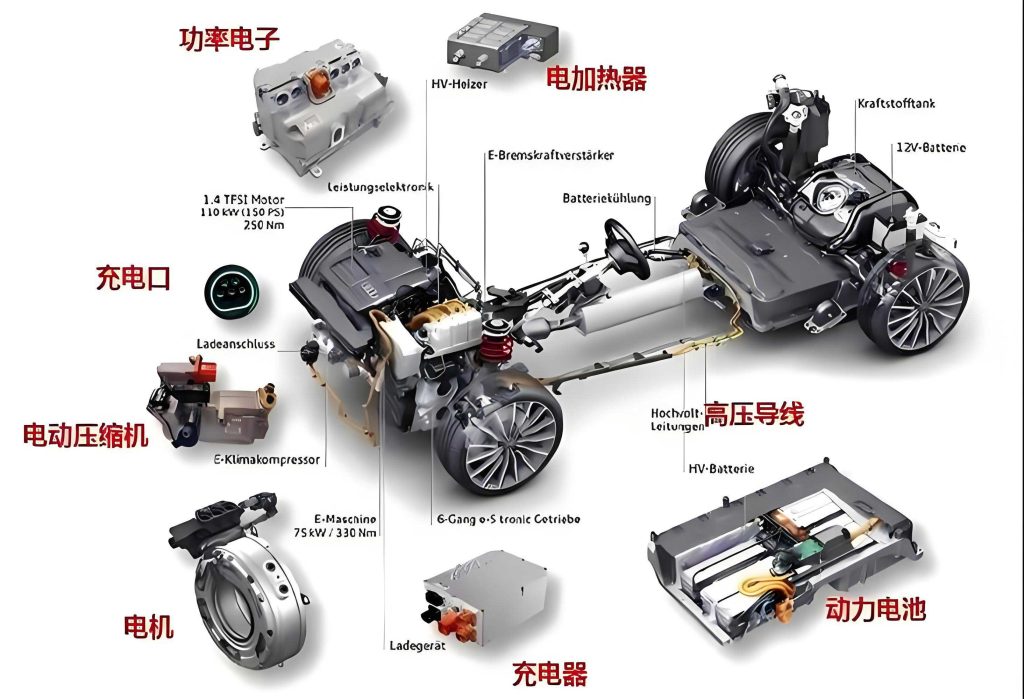
In recent years, with the enhancement of environmental awareness and adjustments in energy structure, battery electric vehicles have gradually become the main development direction of the automotive industry. However, range anxiety and charging inconvenience remain significant challenges faced by battery electric vehicle users. Range anxiety mainly stems from users’ uncertainty about the vehicle’s driving range and dependence on charging facilities, while charging inconvenience is primarily reflected in the insufficient coverage of charging networks and infrastructure. To address these issues, the industry has conducted extensive research from three aspects: performance optimization, infrastructure construction, and vehicle-road coordination technology.
The significance and purpose of this research are to develop and apply energy consumption prediction technology to solve the range anxiety and charging problems of battery electric vehicle users. Specific objectives include: 1) Creating a fast and accurate energy consumption prediction calculation model to achieve real-time prediction of energy consumption under any operating conditions. 2) Proposing an energy consumption clustering method that reduces the complex energy consumption model to several key characteristic quantities, lowering computational complexity and improving prediction efficiency. 3) Combining real operating condition features and individual vehicle characteristic features to achieve closed-loop correction and generalization learning for energy consumption prediction, enhancing prediction accuracy and applicability.
Energy consumption prediction technology is the foundation for energy-saving guidance and route planning. Traditional energy consumption prediction methods are based on instantaneous operating data (such as speed, acceleration, battery status) and use complex mathematical models or machine learning algorithms for prediction. However, these methods often rely on extensive historical data, have high computational complexity, and are difficult to apply in real-time scenarios. Currently, domestic and foreign researchers and industries have conducted numerous studies in the field of energy consumption prediction. Foreign manufacturers such as Tesla and Huawei achieve high prediction accuracy through complex models and real-time data feedback, but their methods heavily depend on big data and high computing power, making them difficult to promote in mid-to-low-end vehicles. Domestic companies have actively explored optimization and practical application of energy consumption prediction, but there is still room for improvement.
The core difficulty of energy consumption prediction lies in how to quickly and accurately predict energy consumption under future operating conditions. Traditional methods often face the following issues: 1) Model complexity: Energy consumption prediction models involve numerous parameters and high computational complexity. 2) Data dependency: They rely on large amounts of historical data, making it difficult to generalize to new vehicles or rare scenarios. 3) Response speed: The prediction model’s response speed struggles to meet real-time requirements, affecting user experience.
This research focuses on the following two directions: 1) Energy consumption clustering: Through theoretical derivation and real-vehicle testing, the complex energy consumption model is reduced to several key characteristic quantities, thereby lowering computational complexity. 2) Generalization learning: Through closed-loop correction and cloud-based self-learning methods, vehicle characteristic parameters are dynamically adjusted and optimized to improve prediction accuracy.
The innovation points of this research include: 1) Energy consumption clustering method: Through theoretical derivation and experimental characterization, energy consumption is decomposed into five characteristic quantities, significantly reducing the number of input parameters for the model, making it more concise and efficient. 2) Virtual-real combination: By obtaining vehicle attribute features through vehicle-level specialized testing and combining simulation methods to simulate operating condition features, the accuracy issues of pure simulation methods are effectively avoided. 3) Closed-loop correction and generalization system: By comparing the difference between predicted energy consumption and actual energy consumption after the trip, vehicle characteristic parameters are dynamically corrected and optimized, further improving prediction accuracy and adaptability.
The technical implementation process is divided into five steps: through theoretical derivation analysis, energy consumption is decomposed and clustered into five characteristic quantities; combined with specialized testing to obtain vehicle attribute data, energy consumption prediction for any scenario is achieved; and continuous generalization is performed through closed-loop correction.
Theoretical Derivation Analysis
The energy consumption at the wheel edge can be expressed as:
$$E_{wheel} = \frac{E_{drive} – E_{regen}}{d}$$
where \(E_{drive}\) is the driving energy, \(E_{regen}\) is the regenerative braking energy, and \(d\) is the distance. Expanding this, we have:
$$E_{wheel} = \frac{[(F_{resistance1} \cdot d + E_{acceleration}) – (E_{deceleration} – F_{resistance2} \cdot d – E_{mechanical loss})]}{d}$$
Here, \(F_{resistance1}\) and \(F_{resistance2}\) represent resistance during driving and braking, respectively. Simplifying, we get:
$$E_{wheel} = \frac{F_{roll} \cdot d}{d} + \frac{F_{air} \cdot d}{d} + \frac{E_{mechanical loss}}{d}$$
where \(F_{roll}\) is rolling resistance and internal resistance, and \(F_{air}\) is air resistance. Further, rolling resistance can be considered constant, while air resistance depends on speed. Thus:
$$E_{wheel} = C_{roll} + C_{air} \cdot \frac{\sum v^3}{\sum v} + (1 – \eta_{regen}) \cdot \frac{\sum (m \cdot a \cdot v)}{\sum v}$$
where \(C_{roll}\) is the rolling and internal resistance constant, \(C_{air}\) is the air resistance constant, \(\eta_{regen}\) is the regeneration ratio, \(m\) is vehicle mass, \(a\) is acceleration, and \(v\) is speed. The total vehicle energy consumption includes system efficiency and electrical losses:
$$E_{vehicle} = \frac{E_{wheel}}{\eta_{system}} + \frac{P_{elec} \cdot t}{d}$$
where \(\eta_{system}\) is the system efficiency, \(P_{elec}\) is electrical power consumption, and \(t\) is time. Substituting and rearranging:
$$E_{vehicle} = \frac{C_{roll}}{\eta_{system}} + \frac{C_{air}}{\eta_{system}} \cdot \frac{\sum v^3}{\sum v} + (1 – \eta_{regen}) \cdot \frac{\sum (m \cdot a \cdot v)}{\eta_{system} \cdot \sum v} + \frac{P_{elec} \cdot \sum t}{3600 \cdot d}$$
This equation forms the basis for energy consumption decomposition.
Energy Consumption Decomposition and Clustering
From the above derivation, the energy consumption of a battery electric vehicle can be clustered into five characteristic quantities multiplied by corresponding operating condition features. Specifically:
$$E_{vehicle} = Q_{roll} \cdot f_1 + Q_{air} \cdot f_2 + Q_{elec} \cdot f_3 + Q_{high} \cdot f_4 + Q_{low} \cdot f_5$$
where:
- \(Q_{roll}\) is the rolling and internal resistance characteristic quantity.
- \(Q_{air}\) is the air resistance characteristic quantity.
- \(Q_{elec}\) is the electrical characteristic quantity.
- \(Q_{high}\) is the high-speed loss characteristic quantity (for speeds ≥ 15 km/h).
- \(Q_{low}\) is the low-speed loss characteristic quantity (for speeds < 15 km/h).
- \(f_1, f_2, f_3, f_4, f_5\) are operating condition features derived from speed, acceleration, and time data.
The operating condition features are defined as:
$$f_1 = 1, \quad f_2 = \frac{\sum v^3}{\sum v}, \quad f_3 = \frac{\sum t}{d}, \quad f_4 = \frac{\sum (a \cdot v)_{high}}{\sum v}, \quad f_5 = \frac{\sum (a \cdot v)_{low}}{\sum v}$$
This decomposition significantly reduces the model’s complexity, as the vehicle attributes are constants obtained from testing, and only the operating condition features need to be computed for prediction.
| Characteristic Quantity | Description | Units |
|---|---|---|
| \(Q_{roll}\) | Rolling and internal resistance component | Wh/km |
| \(Q_{air}\) | Air resistance component | Wh/(km·(m/s)^2) |
| \(Q_{elec}\) | Electrical power component | Wh/km |
| \(Q_{high}\) | High-speed regeneration loss component | Wh/km |
| \(Q_{low}\) | Low-speed regeneration loss component | Wh/km |
Vehicle Attribute Acquisition
To obtain the five characteristic quantities, we design a benchmark operating condition (e.g., CLTC cycle) and conduct specialized tests. The steps are as follows:
- Electrical component: Measure idle energy consumption to get \(P_{elec}\), then compute \(Q_{elec}\).
- Rolling and internal resistance component: Perform constant-speed energy consumption tests at low speeds (e.g., 30 km/h and 60 km/h). With known electrical component and no regeneration loss, solve for \(Q_{roll}\).
- Air resistance component: Perform constant-speed energy consumption tests at high speeds (e.g., 80 km/h and 100 km/h). Similarly, solve for \(Q_{air}\).
- High-speed loss component: Use energy consumption data from the benchmark condition at speeds ≥ 15 km/h, along with known components and operating condition features, to compute \(Q_{high}\).
- Low-speed loss component: Similarly, use data from speeds < 15 km/h to compute \(Q_{low}\).
These tests ensure accurate vehicle-specific parameters without relying on extensive historical data.
| Characteristic Quantity | Acquisition Method | Test Conditions |
|---|---|---|
| \(Q_{elec}\) | Idle energy consumption test | Vehicle stationary, all electrical loads on |
| \(Q_{roll}\) | Constant-speed tests at low speeds | Speeds of 30 km/h and 60 km/h, flat road |
| \(Q_{air}\) | Constant-speed tests at high speeds | Speeds of 80 km/h and 100 km/h, flat road |
| \(Q_{high}\) | Benchmark cycle analysis (high-speed segments) | CLTC cycle, speeds ≥ 15 km/h |
| \(Q_{low}\) | Benchmark cycle analysis (low-speed segments) | CLTC cycle, speeds < 15 km/h |
Prediction for Arbitrary Scenarios
Once the vehicle attribute characteristic quantities are obtained, energy consumption for any operating scenario can be predicted using the formula:
$$E_{vehicle,arbitrary} = Q_{roll} \cdot \frac{f_{1,arbitrary}}{f_{1,benchmark}} + Q_{air} \cdot \frac{f_{2,arbitrary}}{f_{2,benchmark}} + Q_{elec} \cdot \frac{f_{3,arbitrary}}{f_{3,benchmark}} + Q_{high} \cdot \frac{f_{4,arbitrary}}{f_{4,benchmark}} + Q_{low} \cdot \frac{f_{5,arbitrary}}{f_{5,benchmark}}$$
where \(f_{i,arbitrary}\) are the operating condition features for the arbitrary scenario, and \(f_{i,benchmark}\) are those for the benchmark condition. This approach allows rapid prediction by simply computing the ratio of operating condition features, without needing complex simulations or extensive data.
For example, consider a battery electric vehicle with known characteristic quantities. If a new route has higher average speeds, the air resistance component will increase proportionally to the cube of speed, enabling accurate adjustment. This method is particularly useful for real-time applications in battery electric vehicles, where driving conditions change frequently.
Closed-Loop Correction and Generalization
To improve prediction accuracy over time, we implement a closed-loop correction system. After each trip, the actual energy consumption is compared with the predicted value. The difference is used to update the vehicle attribute characteristic quantities via cloud-based self-learning algorithms. The correction process can be expressed as:
$$Q_{i,updated} = Q_{i,previous} + \alpha \cdot (E_{actual} – E_{predicted}) \cdot \frac{f_{i,benchmark}}{f_{i,arbitrary}}$$
where \(\alpha\) is a learning rate. This adaptive mechanism allows the model to account for vehicle aging, environmental changes, and driver behavior variations. Moreover, data from multiple battery electric vehicles can be aggregated in the cloud to generalize the characteristic quantities for similar models, enhancing prediction coverage for new vehicles without extensive testing.
The generalization process involves clustering vehicles based on similar attributes (e.g., weight, aerodynamic drag) and sharing learned parameters across the cluster. This reduces the need for individual calibration, making the technology scalable for mass adoption in the battery electric vehicle market.
Technical Advantages and Application Prospects
The proposed technology offers several key advantages:
- Fast response: By clustering energy consumption into five characteristic quantities, computational complexity is reduced, and response speed is improved by over 96.3% compared to traditional models.
- High prediction accuracy: Through virtual-real combination methods, prediction accuracy is comparable to industry leaders like Tesla, with over 97% of scenarios having errors less than 5%.
- Wide applicability: Closed-loop correction and cloud-based generalization learning enable adaptation to diverse scenarios, covering urban, highway, and extreme conditions for battery electric vehicles.
| Aspect | Traditional Methods | Proposed Technology |
|---|---|---|
| Response Time | High (seconds to minutes) | Low (milliseconds) |
| Prediction Error | Typically 10-20% | <5% for 97% scenarios |
| Data Dependency | Requires extensive historical data | Minimal initial testing |
| Scalability | Limited to specific vehicles | Generalizable across battery electric vehicle models |
Application prospects for this technology in battery electric vehicles are vast:
- Energy-saving guidance: By providing accurate energy consumption predictions, optimal driving strategies can be suggested to users, extending range and reducing anxiety. For instance, real-time feedback on acceleration and speed can help drivers adopt efficient behaviors.
- Route planning: Combined with real-time traffic and terrain data, the technology can recommend optimal charging paths, identifying stations with minimal detours and waiting times. This addresses charging inconvenience by integrating prediction with navigation systems.
- Smart connectivity: Integrated with vehicle-road coordination technology, it enables more efficient energy management and intelligent driving experiences. For example, predictive energy consumption can be shared with infrastructure to optimize traffic flow and grid load.
- Battery management: Accurate energy prediction aids in battery state-of-charge estimation, improving longevity and safety for battery electric vehicles.
These applications not only enhance user experience but also contribute to the broader adoption of battery electric vehicles by mitigating key barriers.
Conclusion and Outlook
In conclusion, this research proposes a generalized prediction technology based on energy consumption clustering for battery electric vehicles. Through theoretical derivation and real-vehicle testing, we achieve fast and accurate energy consumption prediction. The technology decomposes energy consumption into five characteristic quantities, reducing model complexity and enabling real-time application. With advantages in response speed, prediction accuracy, and wide applicability, it provides effective technical support for addressing range anxiety and charging issues in battery electric vehicles.
Looking ahead, as vehicle-road coordination technology continues to develop, energy consumption prediction will become more intelligent and personalized. By incorporating broader operating condition data and advanced algorithms, such as deep learning for feature extraction, prediction accuracy can be further enhanced while reducing computational costs. Future work may focus on integrating weather conditions, traffic patterns, and driver profiling to refine predictions. Additionally, standardization of testing protocols for battery electric vehicles could facilitate widespread adoption of this technology. Ultimately, these advancements will support smart driving and green mobility, paving the way for a sustainable transportation ecosystem dominated by battery electric vehicles.
The potential impact on the automotive industry is significant. As battery electric vehicles become more prevalent, technologies like this will be crucial for optimizing energy use, reducing emissions, and improving user satisfaction. We envision a future where every battery electric vehicle is equipped with such predictive capabilities, making range anxiety a thing of the past and charging as convenient as refueling.
In summary, our approach demonstrates that through innovative clustering and generalization methods, the challenges of energy consumption prediction for battery electric vehicles can be effectively overcome. This not only benefits individual users but also contributes to grid stability and environmental goals. We encourage further research and collaboration to refine and deploy this technology across the global battery electric vehicle fleet.