
The rapid proliferation of electric vehicles (EVs) has accelerated the deployment of EV charging stations, which are critical components of sustainable energy systems. However, the concentrated charging behavior at these EV charging stations often leads to significant load peak-valley differences, posing challenges to the stability and efficiency of power distribution networks. This paper addresses these issues by proposing a coordinated load control method for distributed EV charging stations that incorporates measurement uncertainty. The approach involves analyzing uncertainties in charging energy efficiency measurements and integrating them into a dual-loop control strategy to optimize load management. By leveraging Buck-Boost converters and power balance principles, the method ensures stable operation and mitigates grid disturbances. Experimental validation demonstrates its effectiveness in controlling DC bus voltage and reducing load fluctuations, thereby enhancing the reliability of EV charging stations.
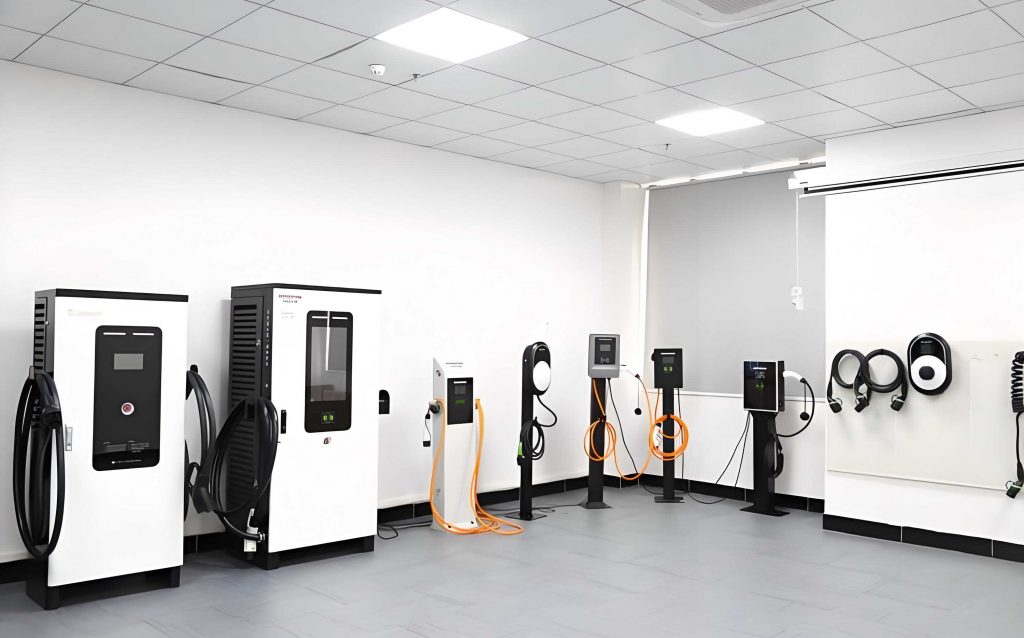
In modern power systems, EV charging stations are integral to supporting the transition to renewable energy sources. The intermittent nature of charging loads at EV charging stations can cause voltage deviations and frequency instability in distribution grids. Traditional control methods often overlook the inherent uncertainties in measuring charging parameters, such as energy efficiency, which can lead to suboptimal performance. This study focuses on quantifying measurement uncertainties and embedding them into a robust control framework for distributed EV charging stations. The methodology encompasses both inner-loop current control and outer-loop power balance control, ensuring that charging loads are coordinated to minimize peak demand and enhance grid resilience. By addressing measurement uncertainties, the proposed method provides a more accurate and reliable solution for managing EV charging station operations.
The charging energy efficiency of an EV charging station is defined as the ratio of output power to input power. Let \( P_{ac} \) represent the input power and \( P_{dc} \) the output power of a DC EV charging station. The charging energy efficiency \( \delta_P \) is given by:
$$ \delta_P = \frac{P_{dc}}{P_{ac}} \times 100\% $$
The sensitivity coefficients for input and output power are derived as follows:
$$ G_1 = \frac{\partial \delta_P}{\partial P_{ac}} = -\frac{P_{dc}}{P_{ac}^2} $$
$$ G_2 = \frac{\partial \delta_P}{\partial P_{dc}} = \frac{1}{P_{ac}} $$
Measurement uncertainty in EV charging stations arises from various sources, including repetitive measurements, instrument resolution, and environmental factors. For repetitive measurements, the standard deviation \( s(\gamma) \) is calculated using the Bessel formula for \( n \) measurements:
$$ s(\gamma) = \sqrt{\frac{\sum_{i=1}^{n} (x_i – \bar{x})^2}{n-1}} $$
The uncertainty due to repetitive measurements \( r_1 \) is then:
$$ r_1 = s(\gamma) $$
For instrument resolution, uncertainties \( r_{21} \) and \( r_{22} \) are associated with AC energy meters and testing instruments, respectively. Assuming no correlation, the combined uncertainty \( r_2 \) is:
$$ r_2 = |G_1| r_{21} + |G_2| r_{22} $$
Environmental and other factors contribute uncertainties \( r_{31} \) and \( r_{32} \), estimated based on typical influences:
$$ r_{31} = \frac{0.01\% \times P_{ac}}{\sqrt{3}} $$
$$ r_{32} = \frac{0.05\% \times P_{dc}}{\sqrt{3}} $$
The overall uncertainty from these factors \( r_3 \) is:
$$ r_3 = |G_1| r_{31} + |G_2| r_{32} $$
The combined standard uncertainty \( r \) is synthesized as:
$$ r = \sqrt{r_1^2 + r_2^2 + r_3^2} $$
Finally, the expanded uncertainty \( R \), with a coverage factor \( k = 2 \), is:
$$ R = k r $$
This comprehensive assessment of measurement uncertainty is crucial for optimizing the control strategies in EV charging stations.
The dual-loop control mode employs a Buck-Boost converter as the primary controller for load coordination in EV charging stations. The inner loop utilizes constant current control to manage the inductor current. According to Kirchhoff’s voltage law, the inductor circuit equation is:
$$ L \frac{di_s}{dt} = v_s – v_m $$
where \( i_s \) is the inductor charge-discharge current, \( L \) is the inductance, \( v_s \) is the inductor terminal voltage, and \( v_m \) is the chopper modulation voltage. The reference voltage \( v_{m\_ref} \) is determined using a PI controller:
$$ v_{m\_ref} = v_s + \text{PI}(i_{s\_ref} – i_s) $$
Incorporating measurement uncertainty, the average modulation function \( z_d \) for the Buck-Boost converter is:
$$ z_d = R \left( \frac{v_{m\_ref}}{v_{dc}} \right) $$
where \( v_{dc} \) is the DC bus voltage. The outer loop focuses on system power balance control, ensuring that the EV charging station meets specified active and reactive power references \( P_{g\_ref} \) and \( Q_{g\_ref} \). The reference power for the storage unit \( P_{sto\_ref} \) is derived as:
$$ P_{sto\_ref} = R (P_{g\_ref} + P_{dc\_load} – P_{pv}) $$
where \( P_{dc\_load} \) is the DC load on the bus and \( P_{pv} \) is the output from photovoltaic arrays. The active power \( P_g \) provided by the PWM rectifier to the grid, considering uncertainty, is expressed as:
$$ P_g = R v_{dc} i_{dc} = R \left( v_{dc} \times C \frac{dv_{dc}}{dt} \right) = \frac{1}{2} C R \frac{dv_{dc}^2}{dt} $$
This dual-loop approach ensures efficient load coordination for EV charging stations under varying conditions.
To validate the method, experiments were conducted on a large-scale EV charging station with 100 distributed charging points. The charging energy efficiency was measured under different output currents with an input voltage of 650 V. The results are summarized in the following table:
| Input Voltage (V) | Output Current (A) | AC Input Power (kW) | DC Input Power (kW) | Conversion Efficiency (%) |
|---|---|---|---|---|
| 650 | 70 | 59.54 | 57.64 | 96.81 |
| 650 | 60 | 49.52 | 46.94 | 94.79 |
| 650 | 50 | 38.64 | 36.23 | 93.76 |
| 650 | 40 | 31.52 | 29.28 | 92.89 |
| 650 | 30 | 23.84 | 21.95 | 92.07 |
| 650 | 20 | 18.56 | 16.94 | 91.27 |
| 650 | 10 | 9.25 | 8.15 | 88.11 |
The measurement uncertainties for different output currents were calculated and are presented below:
| Output Current (A) | Measurement Uncertainty (%) |
|---|---|
| 10 | 0.12 |
| 20 | 0.18 |
| 30 | 0.25 |
| 40 | 0.31 |
| 50 | 0.38 |
| 60 | 0.44 |
| 70 | 0.51 |
Under the dual-loop control strategy, the DC bus voltage was maintained within a narrow range, demonstrating effective coordination. The voltage stability is crucial for the reliable operation of EV charging stations. The supercapacitor and battery charge-discharge power profiles were also monitored, showing complementary behavior that balances low-frequency and high-frequency power demands. The total charge-discharge power curve indicates that the method successfully achieves power balance under dynamic conditions, reducing the peak load at EV charging stations.
The load distribution of the EV charging station was analyzed over a 24-hour period. The maximum daily demand and the impact of coordinated control are evident in the following data, which illustrates how charging loads are shifted from peak to off-peak hours:
| Time | Demand (kVA) | Control Scenario |
|---|---|---|
| 00:00 | 0.82 | No coordinated control |
| 03:00 | 0.84 | No coordinated control |
| 06:00 | 0.86 | With coordinated control |
| 09:00 | 0.92 | No coordinated control |
| 12:00 | 0.96 | No coordinated control |
| 15:00 | 0.94 | With coordinated control |
| 18:00 | 0.90 | With coordinated control |
| 21:00 | 0.88 | With coordinated control |
| 24:00 | 0.85 | With coordinated control |
The results confirm that the proposed method effectively reduces the peak-valley difference by redistributing charging activities to low-demand periods, such as around 06:00. This load shifting not only stabilizes the grid but also optimizes energy costs for EV charging stations. The integration of measurement uncertainty into the control logic enhances the accuracy of power management, ensuring that the EV charging station operates efficiently under real-world conditions.
In conclusion, the coordinated load control method for distributed EV charging stations, which incorporates measurement uncertainty, provides a robust solution to mitigate load fluctuations and improve grid stability. By addressing uncertainties in charging efficiency measurements and implementing a dual-loop control strategy, the method achieves precise voltage regulation and power balance. This approach supports the sustainable growth of EV charging stations and aligns with smart grid initiatives, offering significant economic and environmental benefits. Future work could explore the integration of advanced machine learning techniques to further optimize uncertainty assessment and control performance in EV charging stations.