
In recent years, the safety of energy storage systems, particularly those involving lithium-ion batteries, has been a critical concern hindering their widespread adoption. Thermal runaway in lithium-ion batteries is characterized by rapid temperature increases, ease of propagation, and complex chemical reactions, making it challenging for conventional fire protection measures to quickly extinguish and cool affected batteries. This issue is especially pertinent in EV battery packs, where thermal events can lead to catastrophic failures, including fires and explosions. The EV battery pack, as a core component of electric vehicles, requires robust safety mechanisms to mitigate such risks. Current fire suppression systems, such as water mist, gaseous agents like CO2 or heptafluoropropane, and dry powders, have limitations including poor insulation, high cost, potential for re-ignition, and secondary damage. Therefore, there is a pressing need for innovative cooling solutions that are effective, economical, and environmentally friendly for EV battery pack applications.
This study proposes a low-pressure dual-fluid atomization spray fire protection system utilizing CO2 and water, specifically designed for cooling thermally runaway lithium batteries within liquid-cooled EV battery packs. The dual-fluid spray generates fine droplets with excellent diffusion characteristics, allowing for efficient heat absorption and gas dilution in confined spaces like an EV battery pack. The primary objective is to investigate the cooling performance of this system through orthogonal experiments, analyzing the influence of key parameters—gas pressure, water flow rate, and nozzle orifice number—on the cooling time of thermally runaway batteries. By optimizing these factors, we aim to develop a reliable cooling strategy that can prevent thermal propagation in EV battery packs, enhancing overall safety. The findings are expected to contribute to the design of advanced fire protection systems for energy storage stations and EV battery packs, offering a balance between performance and practicality.
The EV battery pack environment presents unique challenges due to its compact structure and high energy density. Thermal runaway incidents often originate from overcharging, mechanical damage, or internal short circuits, leading to exothermic reactions that release heat and flammable gases. In an EV battery pack, the close proximity of cells can cause cascading failures if not controlled promptly. Traditional cooling methods may not adequately address these dynamics, necessitating tailored approaches like dual-fluid sprays. This research focuses on a liquid-cooled EV battery pack model, simulating real-world conditions to assess the spray’s effectiveness. The integration of CO2 as the atomizing gas not only aids in droplet formation but also dilutes oxygen and combustible gases, reducing explosion risks in the EV battery pack. Throughout this article, the term “EV battery pack” will be emphasized to underscore its relevance in automotive and energy storage contexts.
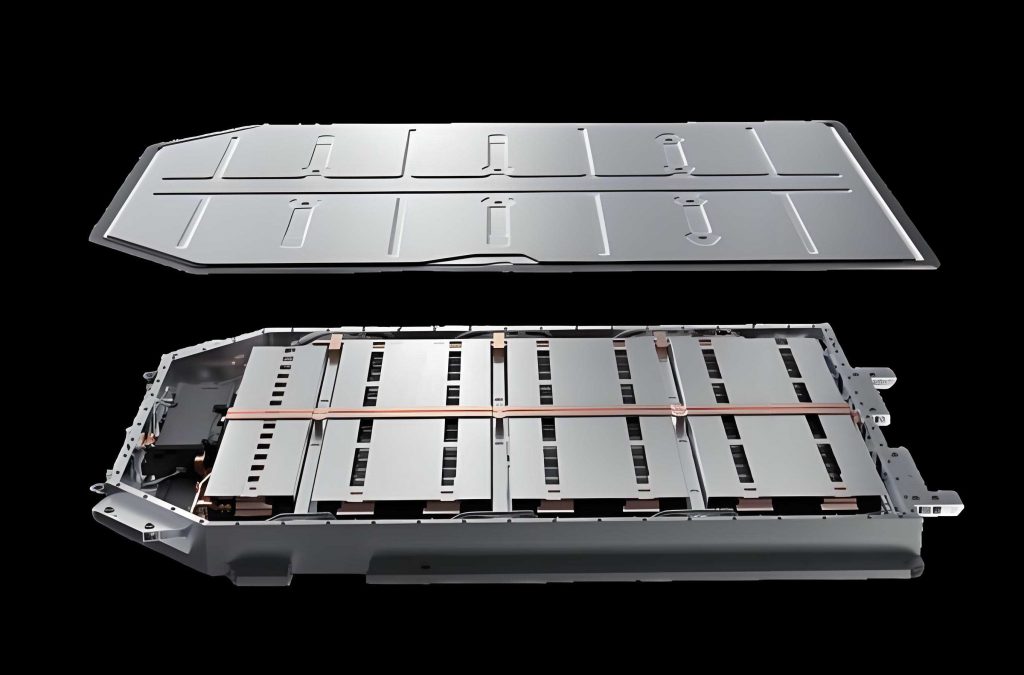
The experimental system was designed to replicate a liquid-cooled EV battery pack, constructed from stainless steel with dimensions of 940 mm in length, 580 mm in width, and 260 mm in height. This EV battery pack model included a simulated battery module using a stainless steel block to fill the interior, ensuring realistic spatial constraints. A 50 Ah lithium iron phosphate (LiFePO4) battery was placed in the region directly below the atomizing nozzle, where droplet dispersion is minimal, to test the spray’s coverage and cooling efficacy in the EV battery pack. The battery was instrumented with thermocouples to monitor surface temperature, and an infrared camera was used to observe thermal distribution within the EV battery pack. The dual-fluid spray system consisted of a CO2 supply from industrial cylinders and a water source from municipal networks, both regulated via pressure reducers and flow control valves to achieve desired parameters. The nozzle was an internal-mixing type with a扇形 air cap, installed on the upper side of the EV battery pack model to facilitate spray diffusion. A drainage valve was incorporated at the bottom to remove accumulated water, minimizing water damage risks in actual EV battery pack applications.
The orthogonal experiment methodology was employed to systematically evaluate the effects of three factors: gas pressure (P), water flow rate (Q), and nozzle orifice number (N). Each factor was set at five levels, as detailed in Table 1, forming an L25(5^3) orthogonal array. This design allows for efficient analysis of multiple parameters with a reduced number of experiments, which is crucial for optimizing the cooling performance in an EV battery pack. A total of 25 experiments were conducted, each involving a single battery subjected to thermal runaway via overcharging at a 1C rate. The cooling time (t) was defined as the duration for the battery surface temperature to decrease from 350°C to 80°C, a critical range where exothermic reactions subside. Additionally, a control experiment without spray intervention was performed to establish a baseline. The orthogonal array included an error column to assess random variations, ensuring statistical reliability. The EV battery pack’s internal environment was monitored throughout, with attention to temperature gradients and gas dispersion, to validate the spray’s role in mitigating thermal hazards.
| Level | Gas Pressure (P) / MPa | Water Flow Rate (Q) / L/min | Nozzle Orifice Number (N) |
|---|---|---|---|
| 1 | 0.1 | 0.5 | 2 |
| 2 | 0.2 | 1.0 | 3 |
| 3 | 0.3 | 1.5 | 4 |
| 4 | 0.4 | 2.0 | 5 |
| 5 | 0.5 | 2.5 | 6 |
The results from the orthogonal experiments are summarized in Table 2, which lists the cooling times for each trial. The control experiment showed a natural cooling time of 3554 seconds, highlighting the severity of thermal runaway in an EV battery pack without intervention. In contrast, all spray-assisted experiments exhibited significantly reduced cooling times, demonstrating the effectiveness of the dual-fluid system. The EV battery pack’s internal temperature, as captured by infrared imaging, dropped to ambient levels within 180 to 420 seconds after spray activation, compared to 2400 seconds in the control case. This rapid cooling is attributed to the fine droplet dispersion and CO2 dilution, which enhance heat transfer and gas suppression in the EV battery pack. The data indicate that the dual-fluid spray not only cools the target battery but also prevents heat accumulation in neighboring cells, a key advantage for EV battery pack safety. The cooling time variability across trials reflects the influence of the experimental factors, which will be analyzed in detail.
| Trial No. | Gas Pressure (P) / MPa | Water Flow Rate (Q) / L/min | Nozzle Orifice Number (N) | Error Column | Cooling Time (t) / s |
|---|---|---|---|---|---|
| 1 | 0.1 | 0.5 | 2 | 1 | 2289 |
| 2 | 0.1 | 1.0 | 4 | 4 | 2166 |
| 3 | 0.1 | 1.5 | 6 | 2 | 1449 |
| 4 | 0.1 | 2.0 | 3 | 5 | 1789 |
| 5 | 0.1 | 2.5 | 5 | 3 | 1087 |
| 6 | 0.2 | 0.5 | 6 | 4 | 1458 |
| 7 | 0.2 | 1.0 | 3 | 2 | 1857 |
| 8 | 0.2 | 1.5 | 5 | 5 | 1589 |
| 9 | 0.2 | 2.0 | 2 | 3 | 1464 |
| 10 | 0.2 | 2.5 | 4 | 1 | 1261 |
| 11 | 0.3 | 0.5 | 5 | 2 | 1342 |
| 12 | 0.3 | 1.0 | 2 | 5 | 1671 |
| 13 | 0.3 | 1.5 | 4 | 3 | 1468 |
| 14 | 0.3 | 2.0 | 6 | 1 | 1017 |
| 15 | 0.3 | 2.5 | 3 | 4 | 1178 |
| 16 | 0.4 | 0.5 | 4 | 5 | 1620 |
| 17 | 0.4 | 1.0 | 6 | 3 | 1196 |
| 18 | 0.4 | 1.5 | 3 | 1 | 1512 |
| 19 | 0.4 | 2.0 | 5 | 4 | 1034 |
| 20 | 0.4 | 2.5 | 2 | 2 | 1058 |
| 21 | 0.5 | 0.5 | 3 | 3 | 1220 |
| 22 | 0.5 | 1.0 | 5 | 1 | 1056 |
| 23 | 0.5 | 1.5 | 2 | 4 | 1240 |
| 24 | 0.5 | 2.0 | 4 | 2 | 1185 |
| 25 | 0.5 | 2.5 | 6 | 5 | 956 |
To analyze the influence of each factor on cooling time, range analysis was performed. The comprehensive average values and ranges (R) for cooling time are presented in Table 3. The range for gas pressure (P) is the largest at 624.6 seconds, indicating it has the most significant impact on cooling performance in the EV battery pack. Water flow rate (Q) follows with a range of 481.2 seconds, and nozzle orifice number (N) has the smallest range of 329.2 seconds. The error column’s range is 238 seconds, which is lower than that of N, suggesting minimal random error and reliable experimental data for the EV battery pack tests. The optimal levels for minimizing cooling time are identified as P5 (0.5 MPa), Q5 (2.5 L/min), and N6 (6 orifices), corresponding to trial 25 with a cooling time of 956 seconds. This combination ensures efficient droplet atomization and gas flow, enhancing cooling efficacy in the EV battery pack. The range analysis confirms that gas pressure is the dominant factor, underscoring its role in driving spray dynamics and heat transfer within the confined space of an EV battery pack.
| Factor | Level 1 Average / s | Level 2 Average / s | Level 3 Average / s | Level 4 Average / s | Level 5 Average / s | Range (R) / s |
|---|---|---|---|---|---|---|
| Gas Pressure (P) | 1756.0 | 1525.8 | 1335.2 | 1284.0 | 1131.4 | 624.6 |
| Water Flow Rate (Q) | 1585.8 | 1589.2 | 1451.6 | 1297.8 | 1108.0 | 481.2 |
| Nozzle Orifice Number (N) | 1544.4 | 1511.2 | 1540.0 | 1221.6 | 1215.2 | 329.2 |
| Error Column | 1427.0 | 1378.2 | 1287.0 | 1415.2 | 1525.0 | 238.0 |
Further statistical evaluation was conducted through analysis of variance (ANOVA), as shown in Table 4. The F-values for gas pressure, water flow rate, and nozzle orifice number are 7.84, 5.69, and 4.00, respectively, with corresponding p-values of 0.036, 0.060, and 0.104. Using a significance level of 0.05, gas pressure has a significant effect (p < 0.05) on cooling time in the EV battery pack, water flow rate is relatively significant (0.05 < p < 0.10), and nozzle orifice number is not significant (p > 0.10). This aligns with the range analysis, reinforcing that gas pressure is the key parameter for optimizing dual-fluid spray cooling in an EV battery pack. The ANOVA results validate the experimental design and highlight the importance of controlling gas pressure to achieve rapid thermal management in EV battery pack applications.
| Factor | Sum of Squares | Degrees of Freedom | Mean Square | F-value | p-value | Significance |
|---|---|---|---|---|---|---|
| Gas Pressure (P) | 1160763 | 4 | 290191 | 7.84 | 0.036 | Significant |
| Water Flow Rate (Q) | 842399 | 4 | 210600 | 5.69 | 0.060 | Relatively Significant |
| Nozzle Orifice Number (N) | 592922 | 4 | 148231 | 4.00 | 0.104 | Not Significant |
| Error | 148097 | 4 | 37024 | 1.00 | – | – |
The relationship between each factor and cooling time can be modeled mathematically to guide EV battery pack cooling system design. The cooling time (t) as a function of gas pressure (P), water flow rate (Q), and nozzle orifice number (N) can be expressed using a regression equation derived from the experimental data. For simplicity, a linear approximation is used, but nonlinear effects may be present due to interactions in the EV battery pack environment. The general form is:
$$ t = \beta_0 + \beta_1 P + \beta_2 Q + \beta_3 N + \epsilon $$
where $\beta_0$ is the intercept, $\beta_1$, $\beta_2$, $\beta_3$ are coefficients, and $\epsilon$ is the error term. From the data, we observe that higher gas pressure reduces cooling time, which can be described by a negative coefficient for P. Specifically, the cooling time decreases with increasing P, as shown by the average values: from 1756 s at 0.1 MPa to 1131 s at 0.5 MPa. This trend is critical for EV battery pack safety, as faster cooling mitigates thermal runaway propagation. The effect of water flow rate is more complex; initially, from 0.5 to 1.0 L/min, cooling time remains nearly constant at around 1588 s, but then decreases to 1108 s at 2.5 L/min. This nonlinearity can be captured by a quadratic term:
$$ t = \alpha_0 + \alpha_1 Q + \alpha_2 Q^2 + \ldots $$
For nozzle orifice number, the cooling time drops sharply from 1540 s at 4 orifices to 1222 s at 5 orifices, but changes little thereafter. This suggests a threshold effect, which is important for nozzle design in EV battery pack cooling systems. The overall optimization for the EV battery pack involves balancing these factors to minimize cooling time while conserving resources.
To illustrate the cooling dynamics, the instantaneous cooling rate can be calculated from temperature profiles. The cooling rate (CR) in °C/s is defined as the negative derivative of temperature (T) with respect to time (t):
$$ CR = -\frac{dT}{dt} $$
From the experiments, the average cooling rate over the 350°C to 80°C range varies across trials, but generally remains below 1°C/s for most periods. This moderate rate ensures gradual cooling without inducing thermal shock to the EV battery pack components. The dual-fluid spray enhances cooling rate by increasing heat transfer coefficients through droplet evaporation and convection. The heat transfer process in the EV battery pack can be described by the energy balance equation:
$$ m C_p \frac{dT}{dt} = h A (T_{\text{spray}} – T) – \dot{Q}_{\text{gen}} $$
where $m$ is the battery mass, $C_p$ is specific heat capacity, $h$ is the heat transfer coefficient, $A$ is surface area, $T_{\text{spray}}$ is the spray temperature, and $\dot{Q}_{\text{gen}}$ is the heat generation rate from residual reactions. The dual-fluid spray increases $h$ by promoting turbulent flow and phase change, thereby accelerating cooling in the EV battery pack. This equation underscores the importance of spray parameters in modulating heat transfer for EV battery pack safety.
The effectiveness of the dual-fluid spray in preventing thermal propagation was verified through an additional experiment with the optimal parameters (P=0.5 MPa, Q=2.5 L/min, N=6). A second battery at 100% state of charge was placed adjacent to the triggered battery in the EV battery pack model. After thermal runaway initiation and spray activation, the adjacent battery did not undergo thermal runaway, demonstrating the spray’s ability to suppress heat transfer and gas accumulation in the EV battery pack. This is crucial for real-world EV battery packs, where cell-to-cell propagation can lead to widespread failure. The cooling mechanism involves both direct droplet contact and CO2 dilution, which lowers oxygen concentration and flammable gas levels in the EV battery pack, reducing ignition risks. The EV battery pack’s integrity was maintained, with no water damage observed due to the efficient drainage system.
Comparing the dual-fluid spray with traditional fire suppression systems highlights its advantages for EV battery pack applications. Water mist systems, while effective, require high pressure and large water volumes, posing insulation and water damage concerns in an EV battery pack. Gaseous agents like CO2 or heptafluoropropane may cool inadequately and allow re-ignition, compromising EV battery pack safety. Dry powders can settle quickly, failing to sustain cooling in an EV battery pack. The dual-fluid spray operates at low pressure, reducing system complexity and cost for EV battery pack integration. It uses less water, minimizing secondary damage, and the CO2 component enhances gas suppression. The overall cooling performance, as measured by reduced cooling times and propagation inhibition, makes it a promising solution for EV battery pack fire protection.
In conclusion, this study demonstrates that a CO2-water dual-fluid spray system effectively cools thermally runaway lithium batteries in a liquid-cooled EV battery pack model. Through orthogonal experiments, gas pressure was identified as the most significant factor influencing cooling time, followed by water flow rate and nozzle orifice number. The optimal combination of parameters achieved a cooling time of 956 seconds, significantly faster than natural cooling, and prevented thermal propagation in the EV battery pack. The spray’s fine droplet dispersion and gas dilution capabilities make it suitable for confined spaces like an EV battery pack, offering a balance of efficiency, economy, and environmental friendliness. Future work should explore scalability to full-scale EV battery packs, long-term reliability, and integration with battery management systems. The findings provide a foundation for advancing fire safety in EV battery packs and energy storage installations, contributing to the sustainable deployment of lithium-ion battery technologies.
The EV battery pack remains a focal point for innovation in thermal management, and this research underscores the potential of dual-fluid sprays as a versatile cooling tool. By optimizing spray parameters, we can enhance the safety and performance of EV battery packs across various applications, from electric vehicles to grid storage. Continued experimentation and modeling will further refine this approach, ensuring robust protection against thermal runaway in evolving EV battery pack designs.