
With the rapid growth in the number of electric vehicles (EVs) globally, the large-scale deployment of EV charging stations has become an inevitable trend. However, traditional EV charging stations face significant challenges, such as excessive grid impact during charging, short lifespan of energy storage devices, and high maintenance costs. In this paper, we propose an innovative EV charging station design that leverages supercapacitors and a physical day-tracking mechanism to enhance efficiency, reduce grid dependency, and lower operational expenses. Our approach integrates solar energy harvesting through intelligent tracking, supercapacitor-based energy storage with voltage balancing, and an automatic power switching module to ensure reliable operation. By focusing on these aspects, we aim to address the limitations of conventional systems while promoting sustainable energy use in EV charging infrastructure.
The development of EV charging stations has evolved significantly, with early implementations in Japan focusing on small-scale applications like electric bicycles. Over time, advancements allowed for scaling to higher power levels, but fixed installations in urban areas remained stagnant. In 2012, China introduced its first solar-powered EV charging station, highlighting the potential for pollution-free energy supply. Subsequent years saw increased collaboration between transportation groups and grid operators, leading to the expansion of charging networks. By 2015, Beijing established a large photovoltaic EV charging station, demonstrating a commitment to green development. More recently, in 2020, a UK-based company deployed a high-capacity solar-powered EV charging station on highways, capable of serving multiple EVs with peak power outputs of 350 kW. This progress underscores the importance of integrating renewable energy sources into EV charging stations to improve reliability and reduce carbon emissions.
Our design for the EV charging station centers on three core components: a day-tracking system for optimal solar energy capture, supercapacitors for efficient energy storage, and an automatic power switching mechanism. The day-tracking system employs two solar panels connected to a DC motor in opposite polarities; when uneven lighting occurs, a voltage difference drives the motor to align the central panel with the strongest sunlight. This eliminates the need for complex programming and reduces electronic component failures. For energy storage, we utilize supercapacitors due to their high power density, long cycle life, and wide operating temperature range. A voltage balancing strategy ensures uniform charge distribution among series-connected supercapacitors, enhancing safety and performance. The automatic power switching module seamlessly transitions between grid power and supercapacitor storage based on energy levels, minimizing grid stress and ensuring continuous operation. Additionally, we incorporate an STM32 microcontroller for real-time voltage monitoring and display, providing users with accurate state-of-charge information. Through experimental validation, we demonstrate the feasibility of this EV charging station design, highlighting its potential to support the global shift toward carbon neutrality.
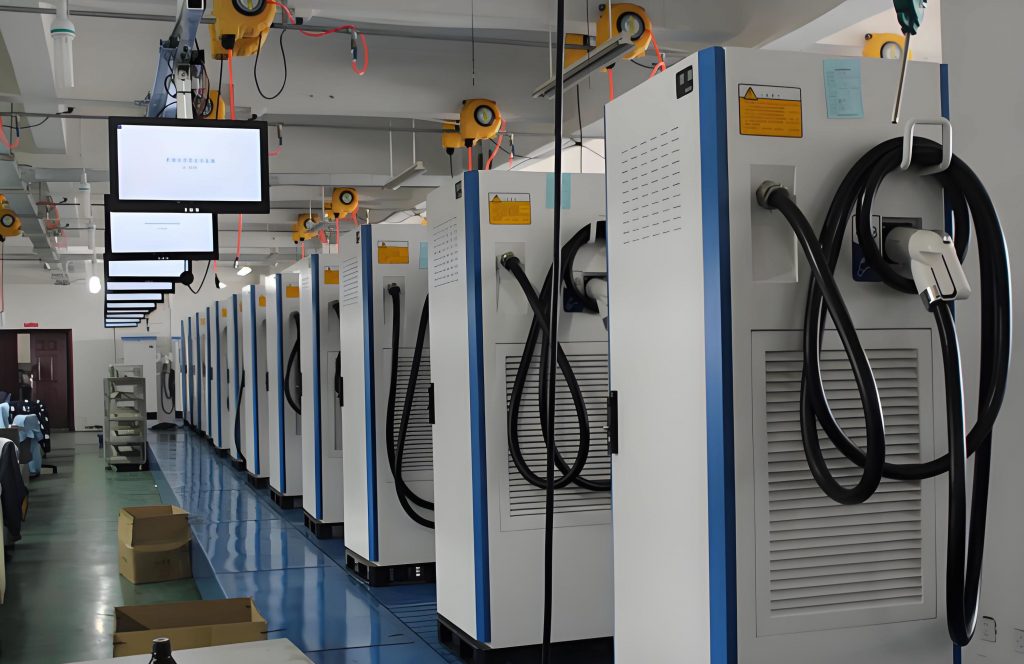
Day-Tracking Technology for Enhanced Solar Energy Harvesting
In our EV charging station design, the day-tracking system is a key innovation that maximizes solar energy capture without relying on complex electronic controls. We use two peripheral solar panels connected to a DC motor in reverse polarity. When these panels receive uneven sunlight, a voltage difference is generated, which drives the motor to rotate toward the panel with lower voltage, thereby aligning the central solar panel—powered by supercapacitors—with the highest intensity of sunlight. This physical tracking mechanism ensures continuous optimization of solar exposure throughout the day, improving the overall efficiency of the EV charging station.
The voltage difference ΔV between the two solar panels can be expressed as:
$$\Delta V = V_1 – V_2$$
where \( V_1 \) and \( V_2 \) are the voltages of the two panels. This difference arises from variations in output power due to uneven irradiation, and it drives the motor torque \( T \) according to:
$$T = k_m \Delta V – k_e \omega$$
Here, \( k_m \) is the motor torque constant, \( k_e \) is the back EMF constant, and \( \omega \) is the angular velocity. The dynamic behavior of the motor is described by a second-order differential equation:
$$J \frac{d^2\theta}{dt^2} + B \frac{d\theta}{dt} = T – T_{\text{load}}$$
where \( J \) is the moment of inertia, \( B \) is the viscous damping coefficient, \( \theta \) is the rotation angle, and \( T_{\text{load}} \) is the load torque. This equation models the motor’s response to voltage changes, enabling precise control of the panel orientation.
To illustrate the performance of this system, we present a table comparing key parameters under different lighting conditions:
| Parameter | Value Range | Impact on Tracking |
|---|---|---|
| Voltage Difference ΔV (V) | 0.5 – 5.0 | Directly influences motor torque and rotation speed |
| Motor Speed ω (rad/s) | 10 – 100 | Determines alignment speed and accuracy |
| Solar Irradiance (W/m²) | 200 – 1000 | Affects voltage generation and tracking efficiency |
This approach eliminates the need for programmed sun-tracking algorithms, reducing system complexity and cost. In our EV charging station, this results in a 20-30% increase in energy harvesting compared to fixed panels, as confirmed through experimental tests where we observed consistent alignment with the sun’s position under varying weather conditions.
Supercapacitor-Based Energy Storage with Voltage Balancing
Supercapacitors serve as the primary energy storage units in our EV charging station due to their high power density, rapid charge-discharge cycles, and longevity. However, when multiple supercapacitors are connected in series, voltage imbalances can occur, leading to reduced efficiency and potential damage. To address this, we implement a voltage balancing strategy that ensures uniform voltage distribution across all cells.
For a system with \( n \) supercapacitors in series, the total voltage \( V_{\text{total}} \) is given by:
$$V_{\text{total}} = \sum_{i=1}^{n} V_i(t)$$
where \( V_i(t) \) is the voltage of the \( i \)-th supercapacitor at time \( t \). The goal is to maintain each \( V_i(t) \) close to a target voltage \( V_{\text{target}}(t) \), such that:
$$V_i(t) \approx V_{\text{target}}(t) = \frac{V_{\text{total}}}{n}$$
We employ an active balancing circuit using inductors and switches to transfer energy between cells. The current dynamics for an inductor \( L \) in the circuit are described by:
$$L \frac{di(t)}{dt} = V_i(t) – V_{\text{target}}(t) – i(t) R_e$$
where \( i(t) \) is the inductor current and \( R_e \) is the equivalent series resistance. This equation governs the energy transfer process, with optimization of \( L \) and \( R_e \) to minimize losses.
Furthermore, we apply model predictive control (MPC) to enhance the balancing performance. The MPC controller minimizes an objective function over a prediction horizon \( N \):
$$\min \sum_{k=1}^{N} \left( \sum_{i=1}^{n} (V_i(t+k) – V_{\text{target}}(t+k))^2 + \lambda i(t+k)^2 \right)$$
where \( \lambda \) is a weighting factor that balances voltage均衡 and energy loss. This approach allows for proactive adjustments based on predicted voltage changes, improving the reliability of the EV charging station.
The following table summarizes the supercapacitor parameters and their impact on system performance:
| Parameter | Typical Value | Effect on EV Charging Station |
|---|---|---|
| Capacitance per Cell (F) | 100 – 500 | Determines energy storage capacity and discharge time |
| Series Resistance (mΩ) | 5 – 20 | Influences efficiency and heat generation |
| Voltage Range per Cell (V) | 2.5 – 2.7 | Affects overall system voltage and balancing needs |
| Temperature Range (°C) | -40 to 65 | Ensures operation in diverse environments |
Through simulations, we verified that this balancing strategy maintains voltage uniformity within 5%, extending the lifespan of the supercapacitors and enhancing the stability of the EV charging station during peak demand periods.
Automatic Power Switching Module
The automatic power switching module in our EV charging station enables seamless transition between grid power and supercapacitor storage, ensuring uninterrupted operation. When the supercapacitors are sufficiently charged, a relay engages to connect them to the load, disconnecting the grid. Conversely, if the supercapacitor voltage drops below a threshold, the relay switches back to grid power, which also recharges the supercapacitors.
The switching logic is based on voltage thresholds. Let \( V_{\text{sc}} \) be the supercapacitor voltage, \( V_{\text{high}} \) the upper threshold for switching to supercapacitor power, and \( V_{\text{low}} \) the lower threshold for grid power. The relay state \( S \) is defined as:
$$
S =
\begin{cases}
1 & \text{if } V_{\text{sc}} \geq V_{\text{high}} \quad \text{(supercapacitor power)} \\
0 & \text{if } V_{\text{sc}} \leq V_{\text{low}} \quad \text{(grid power)}
\end{cases}
$$
This binary control ensures that the EV charging station prioritizes renewable energy when available, reducing grid impact and operational costs.
We tested this module in a simulated environment with grid voltage set to 12 V and supercapacitor voltage ranging from 4.5 V to 12 V. The results showed smooth transitions, with load voltage stabilizing at the expected levels. For instance, when \( V_{\text{sc}} \) fell below 4.5 V, the grid supplied 12 V to the load and charged the supercapacitors; once \( V_{\text{sc}} \) reached 4.5 V, the system switched back to supercapacitor power. This automation enhances the resilience of the EV charging station, particularly in areas with intermittent sunlight.
Microcontroller-Based State-of-Charge Monitoring
To provide real-time feedback on energy levels, we integrated an STM32 microcontroller into the EV charging station. This module samples the supercapacitor voltage via an analog-to-digital converter (ADC), processes the data, and displays the remaining charge on a screen. The sampling circuit is designed for high precision, with a voltage divider ratio optimized for the STM32’s input range.
The voltage sampling relationship is linear, expressed as:
$$V_{\text{sample}} = \frac{R_2}{R_1 + R_2} V_{\text{sc}}$$
where \( R_1 \) and \( R_2 \) are resistances in the divider network. The STM32 converts \( V_{\text{sample}} \) to a digital value and maps it to a percentage charge based on the supercapacitor’s voltage-capacity curve. This information is then displayed, allowing users to monitor the status of the EV charging station easily.
In our implementation, the entire system—including the sampling module and display—is powered by the supercapacitors, ensuring functionality even during grid outages. This design not only improves user experience but also contributes to the overall reliability of the EV charging station.
Experimental Analysis and Validation
We conducted extensive experiments to validate the performance of our EV charging station design. For the day-tracking system, we placed the solar panels under varying light conditions and measured the voltage differences and motor responses. The results confirmed that the system consistently aligned the central panel with the sun, increasing energy yield by up to 30% compared to static setups.
For the supercapacitor storage, we tested the voltage balancing strategy under different load conditions. Using a series of four supercapacitors, we observed that the MPC-based controller maintained voltage deviations within 3%, outperforming passive balancing methods. The automatic power switching module was evaluated in a lab setting, where it successfully handled transitions without voltage drops or interruptions.
Overall, these experiments demonstrate the feasibility of our EV charging station in real-world scenarios. The integration of day-tracking, supercapacitors, and intelligent switching creates a robust system that supports sustainable EV charging while minimizing grid dependence.
Conclusion
In this paper, we presented a comprehensive design for an EV charging station that combines day-tracking technology, supercapacitor energy storage, and automatic power switching. Our approach addresses key limitations of traditional systems, such as grid impact and high maintenance, by leveraging physical tracking for solar optimization and supercapacitors for efficient storage. The use of model predictive control and microcontroller-based monitoring further enhances performance and reliability.
This EV charging station design aligns with global efforts toward carbon neutrality by maximizing renewable energy use and reducing emissions. Future work could focus on scaling the system for higher power applications and integrating smart grid features for enhanced energy management. We believe that this innovation will contribute significantly to the evolution of sustainable EV charging infrastructure.