
In recent years, the rapid adoption of electric vehicles (EVs) has driven the development of charging infrastructure, with DC charging stations gaining popularity due to their high-power and fast-charging capabilities. As a critical component in energy transactions, the metrological performance of EV charging stations must be accurately assessed to ensure fairness and reliability. I will explore various measurement and testing methodologies, focusing on both on-site and remote approaches, to address the growing demands for efficiency, accuracy, and scalability in evaluating EV charging stations. The integration of advanced technologies, such as data-driven models and physical standards, has transformed traditional methods, enabling more comprehensive assessments. Throughout this article, I will emphasize the importance of metrological compliance and the evolution toward remote solutions, which are essential for managing the widespread deployment of EV charging stations.
The metrological performance of EV charging stations primarily involves evaluating working errors and clock errors, as per established guidelines. Working errors, which quantify deviations in DC energy measurement, are central to compliance checks. These errors can be assessed through real-load or virtual-load testing methods. For instance, in real-load testing, the working error $\gamma$ is calculated using the formula: $$ \gamma = \frac{m – m_0}{m_0} \times 100\% $$ where $m$ represents the measured pulse count and $m_0$ is the calculated pulse count derived from constants and power measurements. Virtual-load methods, such as the watt-second approach, involve synchronizing power measurements with time intervals to determine errors. These foundational principles ensure that EV charging stations meet regulatory standards, but as the number of stations grows, traditional on-site methods face challenges in scalability and efficiency.
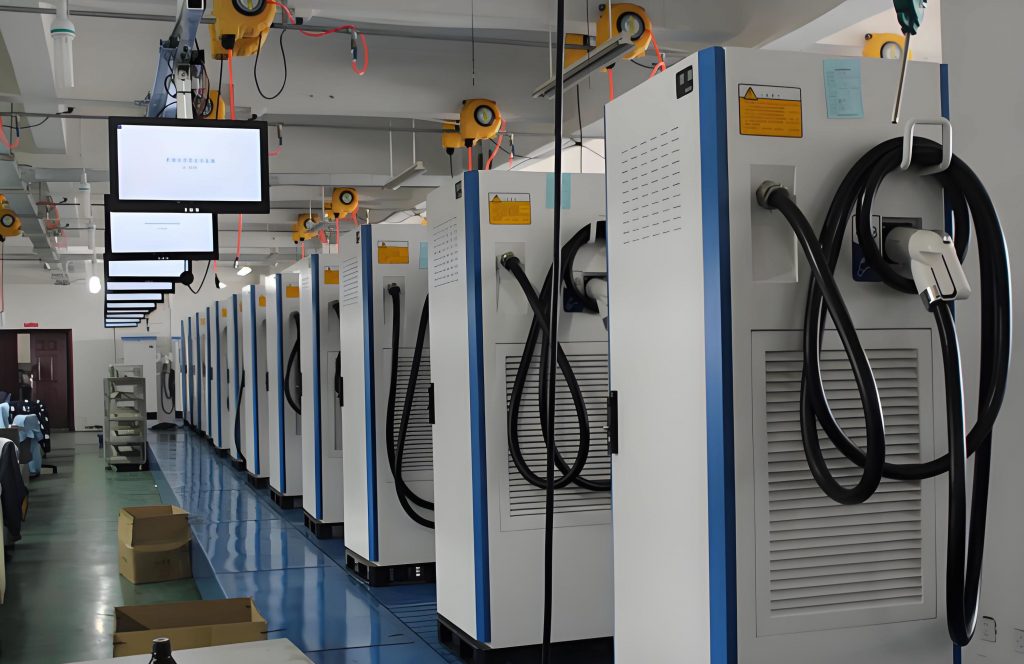
On-site metrological verification has been the conventional approach for assessing EV charging stations. This method involves using physical standard devices, such as calibration instruments, to measure parameters like voltage, current, and energy output directly at the station. The process typically includes connecting the calibration device to the charging interface and a load, forming a closed loop for testing. Over time, advancements in on-site equipment have improved accuracy; for example, the use of zero-flux current transformers and digital sensors has enhanced measurement precision under high-current conditions (exceeding 100 A). However, on-site testing is labor-intensive and time-consuming, making it less suitable for the large-scale deployment of EV charging stations. To illustrate the key aspects of on-site methods, I summarize the calculation approaches for real-load and virtual-load testing in the following table.
| Method | Calculation |
|---|---|
| Real-Load Testing | Using Equation (1): $\gamma = \frac{m – m_0}{m_0} \times 100\%$, where $m_0 = \frac{C_L N}{C_0}$ for pulse-based methods, or Equation (2): $\gamma = \frac{E’ – E}{E} \times 100\% + \gamma_0$ for energy-value comparisons. |
| Virtual-Load Testing | Applying Equation (3): $\gamma = \frac{m – m_0}{m_0} \times 100$, with $m_0 = \frac{C_L P T_n}{3.6 \times 10^6}$ for watt-second methods, where $P$ is power and $T_n$ is time. |
Remote metrological testing has emerged as a promising alternative, addressing the limitations of on-site approaches by leveraging communication technologies and data analysis. This can be categorized into methods based on physical standards and those driven by data. Physical standard-based remote testing integrates improved hardware and software to transmit data over networks, allowing for real-time monitoring without physical presence. For instance, multi-channel switching modules enable simultaneous calibration of multiple EV charging stations, enhancing efficiency. However, these methods still rely on calibrated devices, which require periodic maintenance and can introduce errors if not properly managed. In contrast, data-driven approaches utilize algorithms and machine learning to assess metrological performance remotely, reducing dependency on physical tools. The evolution toward data-driven solutions is particularly relevant for EV charging stations, as it supports large-scale, real-time error assessment and operational monitoring.
Data-driven remote testing encompasses both metrological verification and operational error evaluation. For verification, techniques like Bayesian theory and deep neural networks (DNN) have been applied. For example, a DNN model can estimate cumulative energy values based on charging behavior, comparing them with station readings to derive errors. This aligns with the concept of “value transfer,” where EVs act as intermediaries in a dynamic network, facilitating error assessment across multiple EV charging stations. Operational error evaluation, on the other hand, focuses on analyzing measurement discrepancies during operation. Using advanced metering infrastructure (AMI) data, methods like recursive least squares (RLS) and machine learning models estimate errors by considering factors like line losses and conversion efficiencies. The formula for error estimation in such models often involves minimizing residuals, such as in RLS: $$ \hat{\theta}(k) = \hat{\theta}(k-1) + K(k) \left( y(k) – \phi^T(k) \hat{\theta}(k-1) \right) $$ where $\hat{\theta}$ represents estimated parameters, $K$ is the gain matrix, and $y$ and $\phi$ are measurement vectors. These approaches enable continuous monitoring of EV charging stations, identifying anomalies without interrupting service.
To compare the various remote testing methods for EV charging stations, I have compiled a summary table highlighting their key characteristics, advantages, and limitations. This comparison underscores the trade-offs between accuracy, scalability, and implementation complexity.
| Method | Key Features | Advantages | Limitations |
|---|---|---|---|
| Physical Standard-Based | Uses calibrated devices with remote data transmission | High accuracy; real-time capability | Requires hardware maintenance; cost-intensive |
| Data-Driven Verification | Employs machine learning or Bayesian models | Scalable; reduces physical dependencies | Model training dependencies; potential accuracy trade-offs |
| Operational Error Evaluation | Leverages AMI data and algorithms like RLS | Continuous monitoring; cost-effective | Sensitive to data quality; complex model tuning |
In conclusion, the future of metrological testing for EV charging stations lies in remote, data-driven methods that offer scalability and real-time capabilities. While on-site approaches provide high accuracy, they are inadequate for the expanding network of EV charging stations. Remote operational error evaluation, in particular, shows great promise by enabling continuous assessment without additional hardware. Challenges such as dynamic line loss estimation and data quality must be addressed through improved models and algorithms. As EV adoption accelerates, advancing these methodologies will ensure reliable and fair energy transactions, supporting the sustainable growth of EV charging stations worldwide. I believe that integrating intelligent algorithms and robust data infrastructures will further enhance the efficiency and reliability of these systems.