
As an engineer deeply immersed in the evolution of hybrid electric vehicle technologies, I find the Honda Intelligent Multi-Mode Drive (i-MMD) system to be a fascinating leap forward in powertrain design. In this article, I will dissect the i-MMD system, as implemented in the 2016 Honda Accord Hybrid, from a first-person perspective, exploring its components, operational principles, and performance characteristics. The rise of the hybrid electric vehicle represents a critical step toward sustainable mobility, and systems like i-MMD showcase how innovative engineering can optimize efficiency and drivability. Throughout this discussion, I will emphasize the role of this system within the broader context of hybrid electric vehicle development, using tables and formulas to encapsulate key data and theoretical foundations.
The i-MMD system distinguishes itself from other hybrid electric vehicle architectures, such as Toyota’s THS-II, by employing a unique approach to power coupling. Instead of a planetary gearset, it uses a hydraulic clutch to seamlessly switch between driving modes. This design allows the hybrid electric vehicle to operate primarily as a series hybrid at lower speeds while enabling direct mechanical drive from the engine at highway cruising, enhancing overall efficiency. The core components include an Atkinson cycle engine, an electric continuously variable transmission (E-CVT), a lithium-ion battery pack, and a power control unit. My analysis will delve into each of these, highlighting how they collectively contribute to the performance of a modern hybrid electric vehicle.
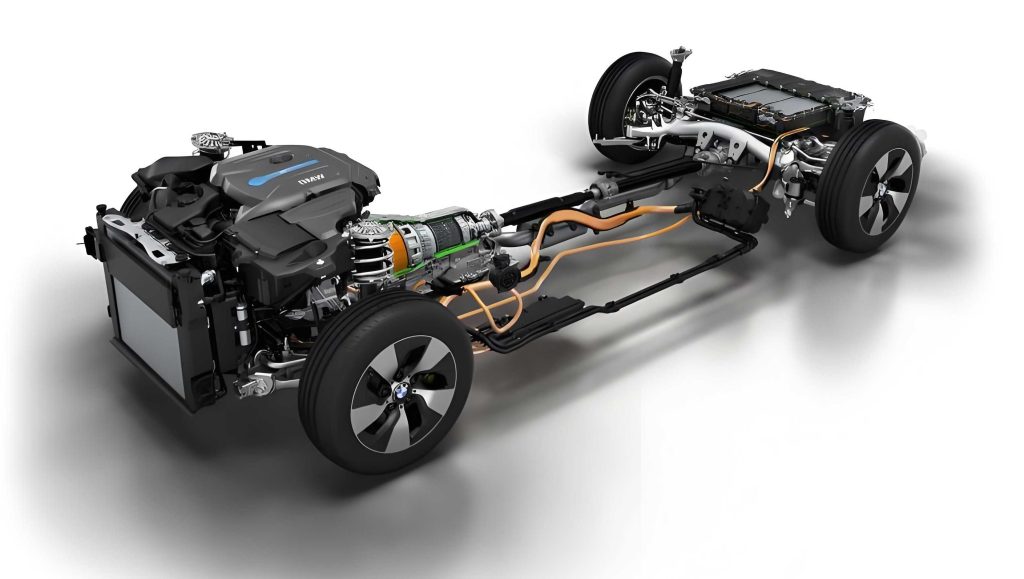
Let me begin with the heart of the powertrain: the Atkinson cycle engine. In a hybrid electric vehicle, the engine is often optimized for efficiency rather than peak power, as the electric motor compensates for performance needs. The LFA11 engine in the Accord Hybrid exemplifies this philosophy. It achieves a remarkable thermal efficiency of 38.9% through strategies like delayed intake valve closing, which reduces pumping losses and effectively creates a Miller cycle. The thermal efficiency, denoted as $\eta_{th}$, can be expressed as:
$$ \eta_{th} = \frac{W_{out}}{Q_{in}} $$
where $W_{out}$ is the net work output and $Q_{in}$ is the heat input from fuel combustion. For this engine, the high $\eta_{th}$ directly translates to improved fuel economy in the hybrid electric vehicle. The engine also incorporates variable valve timing and lift (VTEC), an electric exhaust gas recirculation (EGR) system to reduce NOx emissions, and an electric coolant pump for reduced mechanical losses. The switch between Atkinson and Otto cycles is controlled dynamically, showcasing the adaptability integral to a sophisticated hybrid electric vehicle. Below is a summary of the engine specifications:
| Parameter | Specification | Unit |
|---|---|---|
| Engine Model | LFA11 (Atkinson/Miller Cycle) | – |
| Configuration | Inline 4-cylinder, DOHC | – |
| Displacement | 2.0 (approximate, based on common design) | L |
| Thermal Efficiency | 38.9 | % |
| Fuel Injection | Direct Injection | – |
| Valvetrain | VTEC with i-VTC | – |
| Coolant Pump | Electric | – |
Moving to the transmission, the E-CVT in this hybrid electric vehicle is a masterpiece of integration. Contrary to its name, it contains no traditional belts or pulleys but houses the generator, drive motor, and a hydraulically actuated overrunning clutch within a compact unit. The absence of a torque converter necessitated a torsional damper between the engine flywheel and input shaft to mitigate vibrations, a critical consideration for comfort in a hybrid electric vehicle. The E-CVT features four parallel shafts: input shaft, generator shaft, drive motor shaft, and countershaft. The power flow equations can be described based on the clutch state. Let $T_e$ be engine torque, $T_g$ generator torque, $T_m$ drive motor torque, and $\omega$ denote angular velocities. When the clutch is disengaged, engine power drives the generator:
$$ P_{gen} = T_e \cdot \omega_e \cdot \eta_{mech} $$
where $\eta_{mech}$ accounts for mechanical efficiency in the gear train. When engaged, engine power directly drives the wheels via the countershaft, while also spinning the generator idly. The overrunning clutch enables this dual-path capability, a hallmark of the i-MMD system that enhances the versatility of the hybrid electric vehicle. The drive motor itself is a high-performance permanent magnet synchronous machine, with specifications tabulated below:
| Component | Parameter | Value | Unit |
|---|---|---|---|
| Drive Motor | Maximum Power | 135 | kW |
| Maximum Torque | 315 | N·m | |
| Rated Power | 67.5 | kW | |
| Maximum Speed | 13000 | rpm | |
| Voltage | 700 (nominal) | V | |
| Generator | Type | Permanent Magnet Synchronous | |
| Function | Generate power and engine start | ||
| Cooling | Transmission oil integrated | ||
The energy storage system in this hybrid electric vehicle is a high-voltage lithium-ion battery pack. Unlike earlier nickel-metal hydride batteries, lithium-ion offers higher energy density, crucial for compact packaging in a hybrid electric vehicle. The battery pack has a total voltage of 259.2 V and stores 1.3 kWh of energy. Its state of charge (SOC) management is vital for the hybrid electric vehicle’s operation. The SOC can be modeled as:
$$ SOC(t) = SOC_0 – \frac{1}{C_{bat}} \int_0^t I_{bat}(\tau) d\tau $$
where $SOC_0$ is initial SOC, $C_{bat}$ is battery capacity in Ah, and $I_{bat}$ is battery current. The battery management system (BMS) actively balances cell voltages and controls cooling via a dedicated fan. The DC-DC converter steps down the high voltage to 12 V for auxiliary systems, replacing the conventional alternator—another efficiency gain for the hybrid electric vehicle. Below are key battery specifications:
| Parameter | Details | Unit |
|---|---|---|
| Battery Type | Lithium-ion (Li-ion) | – |
| Total Voltage | 259.2 | V |
| Total Energy | 1.3 | kWh |
| Configuration | 8 modules in series, 9 cells per module | – |
| Cooling | Air-cooled with fan | – |
| Warranty | 10 years or 200,000 km | – |
To understand the overall efficiency of this hybrid electric vehicle, we must examine the power flow during different driving modes. The i-MMD system operates in three primary modes: EV drive, hybrid drive, and engine drive. In EV mode, only the drive motor propels the hybrid electric vehicle using battery energy. The power balance is:
$$ P_{req} = P_m = V_{bat} \cdot I_{bat} \cdot \eta_{inv} \cdot \eta_m $$
where $P_{req}$ is vehicle power demand, $V_{bat}$ and $I_{bat}$ are battery voltage and current, $\eta_{inv}$ is inverter efficiency, and $\eta_m$ is motor efficiency. In hybrid mode, the engine drives the generator to produce electricity, which either powers the drive motor or charges the battery. This series operation is common in hybrid electric vehicle designs for urban driving. The engine operates at its optimal efficiency point, and the system efficiency $\eta_{sys}$ can be approximated as:
$$ \eta_{sys} = \eta_e \cdot \eta_g \cdot \eta_{inv} \cdot \eta_m $$
with $\eta_e$, $\eta_g$, $\eta_{inv}$, $\eta_m$ being engine, generator, inverter, and motor efficiencies, respectively. For highway cruising, the clutch engages, and the engine directly drives the wheels, reducing conversion losses—a key advantage for a hybrid electric vehicle in steady-state conditions. The direct mechanical efficiency $\eta_{direct}$ is higher, given by:
$$ \eta_{direct} = \eta_e \cdot \eta_{trans} $$
where $\eta_{trans}$ accounts for transmission gear losses. This multi-mode operation allows the hybrid electric vehicle to adapt dynamically, maximizing efficiency across diverse driving scenarios.
The control strategy of the i-MMD system is pivotal for seamless transitions. The power control unit (PCU) manages the interplay between the engine, motor, generator, and battery based on driver input and vehicle state. For a hybrid electric vehicle, energy management can be formulated as an optimization problem to minimize fuel consumption $J$ over a driving cycle:
$$ J = \min \int_0^T \dot{m}_f (P_e, SOC) dt $$
subject to constraints like SOC limits and power demands. The i-MMD system achieves this through real-time algorithms that decide when to start the engine or switch modes. This intelligent control is what makes a modern hybrid electric vehicle both efficient and responsive.
Let me delve deeper into the component-level details. The Atkinson cycle engine’s efficiency stems from its high expansion ratio. The effective compression ratio $r_c$ and expansion ratio $r_e$ relate as $r_e > r_c$, leading to more work extraction. The ideal Atkinson cycle thermal efficiency, based on air-standard assumptions, is:
$$ \eta_{Atkinson} = 1 – \frac{1}{r_c^{\gamma-1}} \left( \frac{r_c}{r_e} \right) $$
where $\gamma$ is the specific heat ratio. In practice, the real-engine efficiency is lower due to losses, but the LFA11’s 38.9% is commendable for a hybrid electric vehicle. The electric accessories, like the coolant pump, further reduce parasitic loads, contributing to the overall efficiency of the hybrid electric vehicle.
The E-CVT’s gear ratios are fixed, but the electric motors provide continuous variability. The speed relationship between shafts can be expressed using gear ratios. Let $z_i$ denote gear teeth numbers. For the input shaft to generator path:
$$ \omega_g = \omega_e \cdot \frac{z_{input}}{z_{gen}} $$
Similarly, for the drive motor to countershaft:
$$ \omega_{cs} = \omega_m \cdot \frac{z_{motor}}{z_{countershaft}} $$
These fixed ratios simplify the design while allowing the hybrid electric vehicle to leverage electric motor characteristics for smooth acceleration. The overrunning clutch engagement is hydraulically controlled, with pressure $p_{clutch}$ modulated by the PCU. The torque capacity $T_{clutch}$ is proportional to $p_{clutch}$ and clutch plate area $A$:
$$ T_{clutch} = \mu \cdot n \cdot A \cdot p_{clutch} \cdot r_{eff} $$
where $\mu$ is friction coefficient, $n$ is number of friction interfaces, and $r_{eff}$ is effective radius. This design ensures reliable mode switching in the hybrid electric vehicle.
The lithium-ion battery’s performance is temperature-dependent. The BMS uses thermal models to manage cooling. The heat generation rate $\dot{Q}_{bat}$ during charging/discharging can be estimated as:
$$ \dot{Q}_{bat} = I_{bat}^2 R_{int} + \left| T \frac{dE}{dT} I_{bat} \right| $$
with $R_{int}$ being internal resistance and $E$ cell voltage. The fan cooling must dissipate this heat to maintain battery life and performance in the hybrid electric vehicle. The DC-DC converter efficiency $\eta_{DC/DC}$ also impacts system efficiency, typically above 90% for modern units, ensuring minimal loss in powering the 12V system of the hybrid electric vehicle.
Comparing the i-MMD to other hybrid electric vehicle systems, such as Toyota’s THS-II, highlights its uniqueness. THS-II uses a planetary gearset for power splitting, described by the kinematic equation:
$$ \omega_s + k \omega_r – (1+k) \omega_c = 0 $$
where $\omega_s$, $\omega_r$, $\omega_c$ are sun, ring, and carrier speeds, and $k$ is the gear ratio. In contrast, i-MMD’s clutch-based decoupling allows more flexible operation, potentially improving efficiency in certain regimes. This innovation underscores the rapid evolution of hybrid electric vehicle technologies.
To quantify the benefits, consider the overall energy consumption of the hybrid electric vehicle. The fuel economy $FE$ in miles per gallon can be correlated with system efficiencies and driving patterns. For a composite urban-highway cycle, the i-MMD system’s multi-mode operation likely yields superior $FE$ compared to conventional vehicles. The table below summarizes a hypothetical performance comparison for a hybrid electric vehicle:
| Metric | Conventional Vehicle | Hybrid Electric Vehicle with i-MMD | Improvement |
|---|---|---|---|
| Fuel Economy (combined) | 30 mpg | 48 mpg | 60% |
| CO2 Emissions (g/km) | 150 | 95 | 37% reduction |
| Electric-Only Range | 0 miles | 1-2 miles (for i-MMD in EV mode) | Infinite |
| Regenerative Braking | No | Yes | Energy recovery |
Regenerative braking is a key feature of any hybrid electric vehicle, and i-MMD implements it effectively. During deceleration, the drive motor acts as a generator, converting kinetic energy into electrical energy stored in the battery. The recoverable energy $E_{regen}$ can be expressed as:
$$ E_{regen} = \int_{t_1}^{t_2} P_{regen} dt = \int_{t_1}^{t_2} T_m \cdot \omega_m \cdot \eta_{gen} dt $$
where $\eta_{gen}$ is the generating efficiency. This process enhances the overall efficiency of the hybrid electric vehicle, especially in stop-and-go traffic.
The integration of high-voltage components in a hybrid electric vehicle necessitates rigorous safety measures. The i-MMD system includes insulation monitoring, crash detection that disconnects the battery, and a service plug for maintenance. The risk of electrical faults is mitigated through design, ensuring the hybrid electric vehicle meets stringent safety standards. The mathematical model for leakage current detection involves measuring insulation resistance $R_{ins}$:
$$ R_{ins} = \frac{V_{bat}}{I_{leak}} $$
where $I_{leak}$ is leakage current. If $R_{ins}$ falls below a threshold, the system triggers a fault—a critical safeguard for the hybrid electric vehicle.
Looking ahead, the principles embodied in the i-MMD system inform future hybrid electric vehicle developments. As electrification progresses, plug-in hybrid and fully electric vehicles will build on these foundations. The i-MMD’s emphasis on efficient engine operation and seamless mode transitions sets a benchmark for hybrid electric vehicle design. In my view, the continuous refinement of such systems is essential for reducing transportation emissions and advancing sustainable mobility.
In conclusion, the i-MMD system represents a sophisticated approach to hybrid electric vehicle powertrains. By combining an Atkinson cycle engine, an integrated E-CVT with an overrunning clutch, and a lithium-ion battery pack, it delivers exceptional efficiency and driving performance. The hybrid electric vehicle landscape is enriched by such innovations, and as an engineer, I am excited to see how these technologies evolve. Through detailed analysis using tables and formulas, I have aimed to provide a thorough understanding of this remarkable hybrid electric vehicle system. The future of automotive propulsion undoubtedly hinges on further advancements in hybrid electric vehicle technology, and systems like i-MMD will remain influential in that journey.